Imagine traditional SEO being like a giant megaphone that gets your message across the world. Local SEO, on the other hand, is more like a friendly neighbor showing a potential customer the direct route to your front door. Both approaches aim to improve your visibility in search engines like Google, but they appeal to completely different target groups and meet different needs.
This guide explains the key differences, shows when which strategy makes sense, and helps you decide where to focus.

The difference in search intent: global vs. local
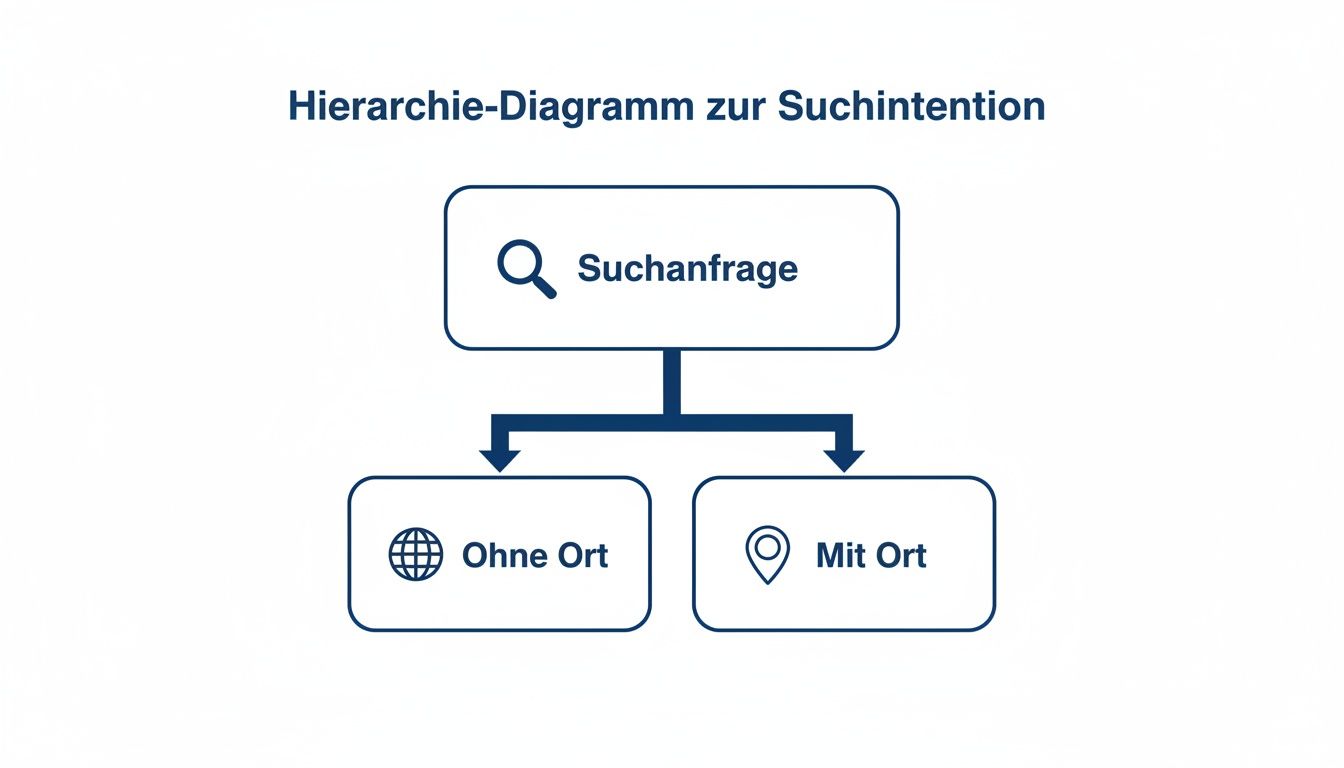
The core difference between SEO and local SEO lies in the Search intent — i.e. the intent that a user pursues with their search query. Google is now extremely good at recognizing this intent and adapting search results accordingly. Your strategy must therefore be based on the search intent of your ideal customers.
- General (non-local) search intent: A user searches for information or products, regardless of their location. The request could be “best running shoes test” or “How does content marketing work.” Here, Google provides results from major online shops, trade magazines or blogs with national relevance. Classic SEO aims to be perceived as an authority for these broad queries.
- Local search intent: A user searches for a product or service in their immediate vicinity. The request often contains a place name (“Restaurant Berlin Mitte”) or implies a local requirement (“hairdresser near me”). Google recognizes this and primarily shows local results, usually in the form of the “Local Pack” — a map with three highlighted companies. Local SEO is focused on being visible in these local search results.
So the key question is: Is your customer looking for a general solution or a provider in a specific location?
Comparing ranking factors: What counts for Google
Depending on search intent, Google evaluates websites based on various criteria. The ranking factors for a national search differ significantly from those for a local query.
Ranking factors for classic SEO
Non-local searches are about being regarded as a thematic authority in the entire German-speaking region. The most important factors include:
- Content quality and depth: Comprehensive, well-researched content that fully answers a user question.
- Backlink profile: Links from other trustworthy and topic-relevant websites signal Google authority.
- Domain authority: The “reputation” of your entire website built up over time.
- Technical SEO: A fast, mobile-friendly, and technically clean website.
Ranking factors for local SEO
Local searches shift the focus to signals that prove trust and relevance for a specific geographical location. The three pillars of local SEO dominate here:
- Relevance: How well does your company profile match the search query? An optimized Optimize Google business profile With the right categories and services, this is crucial.
- Distance: How far is your company from the searcher's location? For searches like “near me,” this is the most important factor.
- Prominence: How well-known and respected is your company locally? This is measured by the number and quality of customer reviews, local citations in industry directories, and local media reports.
The following table highlights the different priorities:
Ranking factorMeaning for classic SEOSignificance for local SEOGoogle company profileGeringVery close to the seekerIrrelevantVery highCustomer ratings (number & quality)Low to mediumVery highLocal quotes (citations)Very lowHighQuality of backlinksVery highmediumDomain authorityVery highmedium
For a local business such as a doctor's office or a handyman, a well-maintained Google company profile and positive reviews are often more important than a backlink from a national news site.
Use cases: When is which SEO strategy right?
Choosing the right strategy depends directly on your business model.
Case 1: Classic SEO for location-independent companies
If your offer isn't tied to a physical location, classic SEO is the way to go. Your goal is to reach a broad, supra-regional target group.
- Example online shop: A retailer that ships organic coffee throughout Germany optimizes for keywords such as “buy organic coffee beans online.” The customer's location is irrelevant. A well-thought-out content marketing strategy Strengthens authority around the topic of coffee.
- Example of SaaS companies: A provider of project management software wants to be found for searches such as “best project management tool.” The focus is on high-quality content, backlinks from tech blogs and technical perfection.
Case 2: Local SEO for companies with a local catchment area
For any company that serves customers in a physical location or offers services in a specific region, local SEO is essential to survival.
- Restaurant example: A pizzeria in Hamburg-Eimsbüttel must be visible for searches such as “Pizza Eimsbüttel” or “Italian restaurant near me.” The focus is on the Google company profile, positive reviews and entries in relevant Industry directories for your local ranking.
- Example craftsman: An electrician from Cologne wants to be found when someone is looking for “Elektriker Notdienst Köln”. Quick findability on Google Maps and a high number of reviews are decisive for the order. A strong Building a strong local rank That is the goal here.
Case 3: Hybrid strategies for mixed business models
Many companies serve both a local and a national market. In this case, an integrated strategy is required that combines the strengths of both approaches.
- Example bookstore with online shop: The store wants to attract local customers to readings and the café (Local SEO for “Buchhandlung mit Café München”) and at the same time sell books throughout Germany (classic SEO for “buy signed first editions”). This requires local landing pages for retail stores and optimized product categories for the online shop.

Summary: Which strategy is right for you?
The decision between SEO and local SEO depends on a central question: Where are your customers?
- Are your customers on site? Your focus must be on Local SEO lie down. Optimize your Google business profile, actively collect reviews, and ensure a strong local presence.
- Are your customers everywhere? Your focus should be on classic SEO lie down. Create outstanding content, build strong domain authority, and ensure a technically flawless website.
- Do you serve both markets? You need a integrated strategy, which uses local signals to strengthen your brand while building national reach with high-quality content.
Choosing the right strategy is crucial for your success. A professional SEO optimization by an agency can help you find the right balance and specifically maximize your visibility.
Would you like to be ahead of the pack in local competition and be at the top of Google Maps? SocialEdge is your partner for professional local SEO. We'll get you into the top 3 results in your region without an expensive advertising budget so that the right customers can find you.
Discover now how SocialEdge is moving your local business forward.