Why is local marketing so important today?
Back in the day, your company may have been a well-known name in the neighborhood. But today, “strolling” takes place digitally. Without a targeted local strategy, your business is like a restaurant in a hidden alley without a sign. People walk past it without realizing what they're missing out on.
Local marketing is your digital guide. It ensures that your company appears on the radar of potential customers exactly when they are actively looking for a solution.
Reaching for the business directory is long gone. Today, smartphones are the most important tool for consumers. Searches such as “bakery near me” or “bicycle shop Cologne” have become second nature and have changed the rules of the game for local companies.
If your company doesn't show up in these local searches, you don't exist for a large portion of customers who are ready to buy. It's about being present at the decisive moment — exactly when someone has a problem and you offer the solution.
The meaning of “near me” search
The figures speak for themselves. Searches with the addition “near me” have risen sharply in recent years. Around the world, numerous local searches per month result in a high number of store visits.
In Germany have already 97% the Internet user searched online for a local store. And about 88% mobile users who start a local search visit the corresponding store within 24 hours. You can find out more about these figures at SEO.com.
That makes it clear: Local marketing is not an optional option, but a duty. A well-thought-out strategy ensures that you are found exactly when the intent to buy is highest.
From flyers to Google search: The transformation in marketing
Classics such as flyers or newspaper ads still have their niche, but they are no longer enough as a sole strategy. They are often expensive and success is barely measurable. The digital world offers clear advantages here:
- measurability: You can see exactly how many people are accessing your profile, dialing your number or starting directions to you.
- efficiency: Many of the most effective measures, such as a well-maintained Google business profile, are free of charge.
- Target accuracy: You reach people who are already actively looking for your offers.
The key to success is understanding the basics of local search engine optimization. To dive deeper and learn how to make your website and business profile fit for local search, we recommend our guide on the topic Local SEO.
The Google company profile as a digital shop window
Don't just think of your Google Business profile (formerly Google My Business) as a business listing. Think of it as your digital shop window. It's open 24/7 and is often the first point of contact that a potential customer has with you looking for your products or services.
A carelessly maintained profile looks like a dusty display. A strategically optimized profile, on the other hand, can attract inquiries, calls, and walk-in customers without you having to invest an advertising budget.
The foundation: The consistency of NAP data
The key to successful local marketing is the consistency of your master data. In technical language, we call this the NAP data:
- Name (your exact company name)
- Aaddress (your correct address)
- Phonnummer (your primary phone number)
These three pieces of information must be the same on every platform — from your own website to your Google profile to business directories. Even small deviations such as “street” instead of “street” can confuse search engines and weaken your local visibility.
Think of Google as a librarian. It tries to store all information about your store in a single folder. If he finds different information on different pieces of paper, he becomes uncertain. The result? Your ranking may suffer as a result.
More than just a name and address: The right signals for local marketing
A completely completed profile is a strong signal to Google and your customers. It shows: “We are an active, professional and reliable company.” Selecting the right one is particularly important here. Major and minor categories. Be as specific as you can. “Italian restaurant” is more meaningful than just “restaurant” and attracts the right target group.
You can also use the attributesto highlight your distinctive features. Do you have WiFi, barrier-free access or outdoor seating? Each of these details helps potential customers make a decision and provides valuable context to Google's algorithm. If you want to set up your profile correctly from scratch, our guide provides instructions on how to set up a Create a Google business profile.
A well-maintained profile pays off: Companies with a complete Google company profile are taking part 70% more likely to attract and become visitors 50% considered for a purchase more often. There with local searches 42% If the user clicks on the results in the “Google Maps Pack”, a good ranking there is valuable.
Creating visual trust: photos and contributions in local marketing
People buy with their eyes — this is even more true online than offline. High-quality, authentic photos are therefore not a nice addition, but a necessity. They create trust, provide insight into your business and show what customers can expect from you.
The impact is huge: profiles with over 100 images get 1.065% more clicks on their website as average. If you still need professional images, you can find in Guide to AI product photography modern approaches to upgrade your digital shop window.
An often overlooked feature is the Google posts. Look at this as your advertising column directly in the search results. Here you can point out current offers, events or news. This not only keeps your customers up to date, but also signals to Google that your company is active.
Interaction as a motor: How to retain customers
Your Google profile is not a one-way street, but a direct line to your customers. Two functions are decisive here:
- Questions & answers: Potential customers can ask questions directly in your profile. Be proactive and answer them quickly and competently. In this way, you eliminate uncertainties and position yourself as an expert.
- Customer reviews: Reviews are central to your local marketing. Positive reviews build trust. Your response is decisive: 89% of consumers prefer companies that respond to all of their reviews. Anyone who ignores feedback appears disinterested and can scare off potential customers.
More channels for a strong local presence
A top-notch Google business profile is at the heart of your local strategy, but it alone isn't enough. To play a dominant role locally, you should use an ecosystem of channels that complement each other. Think of it like an orchestra: Google is the first violin, but the full symphony is only created when all instruments work together.
These additional channels send important trust signals to your potential customers and to search engines. Each channel is valuable in its own right, but they develop their true strength in a network.
The following concept map shows how the most important building blocks work together to create a strong local online presence.
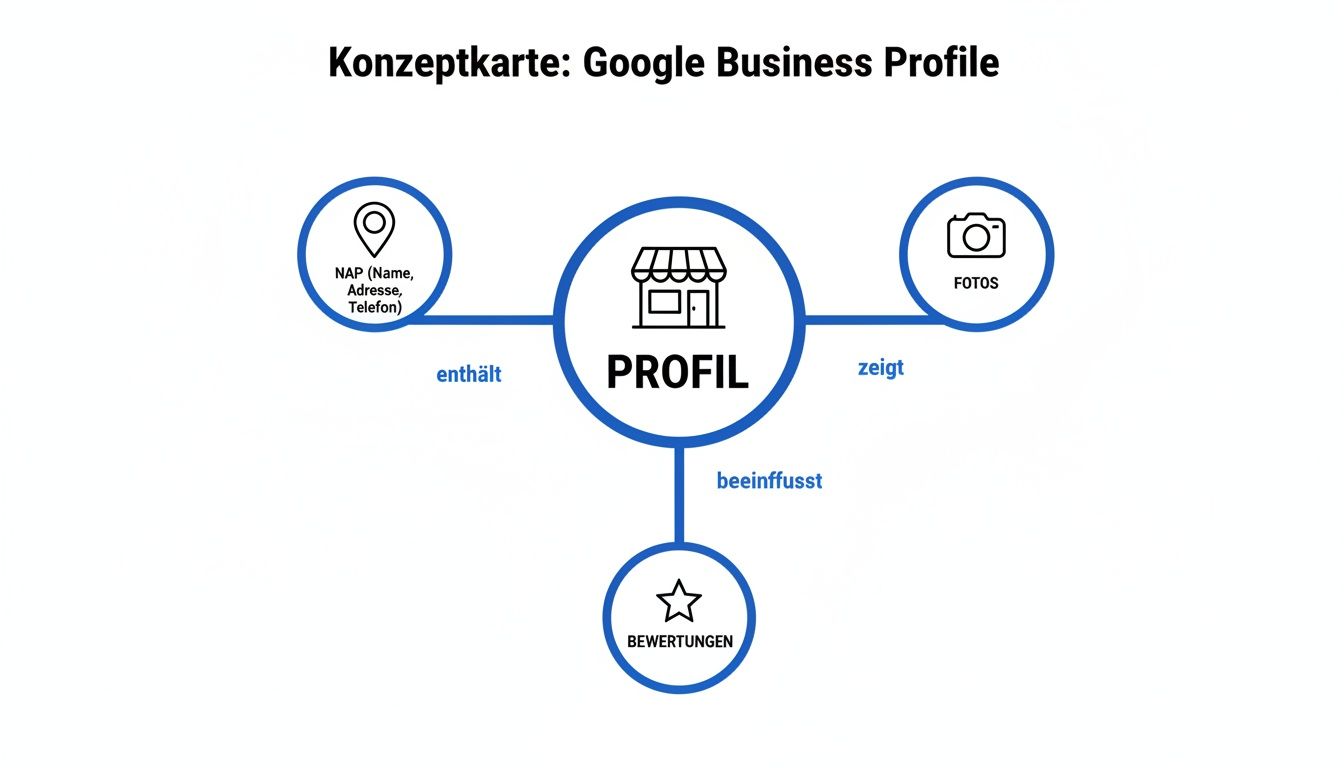
As you can see, the key elements — correct contact details (NAP), visual impressions (photos) and trust from the community (reviews) — are directly interwoven and strengthen your entire profile.
Implement local SEO for your website
Your own website is your digital home and a key factor in local marketing. While your Google profile is often the first point of contact, your website's job is to more thoroughly inform, persuade, and convert visitors into customers. A useful tool for this is local landing pages.
Imagine running a craft business in Berlin that operates in various districts such as Charlottenburg, Kreuzberg and Pankow. Instead of just a general “about us” page, you could create a separate landing page for each of these districts.
These pages should specifically address the respective neighborhood:
- Relevant keywords: Use search terms such as “Plumber Charlottenburg” or “Heizwartung Kreuzberg.”
- Local content: Report on completed projects in this district or mention well-known sights. That creates a connection.
- Customer testimonials: Show reviews from satisfied customers in this exact neighborhood.
This approach signals high local relevance to search engines. At the same time, potential customers feel addressed more directly. This is a fundamental component of everyone content marketing strategy for local providers.
Reputation management as a trust factor in local marketing
Trust is an important currency in local competition. Real customer reviews can create that trust. A study shows that 98% of consumers Read online reviews at least occasionally before choosing a local company. Actively managing your reputation is therefore crucial.
Reputation management is more than just reacting to bad reviews. It's a proactive process where you continuously encourage positive feedback and deal professionally with any type of feedback.
Actively ask satisfied customers for a review — whether in conversation, by e-mail or with a note on the invoice. However, it is crucial to respond promptly and personally to every review. A thoughtful response to criticism can often win back an unhappy customer and shows other readers that you take feedback seriously.
Use local social media marketing
Social networks such as Facebook or Instagram are suitable channels for building a local community. This is less about advertising and more about authenticity and interaction. Give a glimpse behind the scenes, introduce your team or post pictures of a district festival.
Regular posts with a local connection strengthen the bond with existing customers and make your company visible to new people in the area. Use geotags to assign your contributions to a specific location. Local hashtags, such as #friseurmünchen or #handwerkkoeln, also increase your reach.
The importance of consistent business listings for local marketing
So-called Citations are mentions of your company on other websites, usually in online business books such as the Yellow Pages, Yelp or in specialist portals in your industry. Each of these entries is another digital notice that confirms the existence and relevance of your business.
The be-all and end-all of this is the absolute consistency of your NAP data (name, address, telephone number). As already mentioned, discrepancies cause confusion for search engines. Consistent, correct entries in the most important directories strengthen your digital authority and improve your chances of a good ranking in local search.
Make success in local marketing measurable
Anyone who invests in the blue can lose money. The advantage of local digital marketing is that almost every action can be measured. In this way, you can turn assumptions into tangible data and prove the success of your measures.
Think of performance measurement as the cockpit of an airplane. The ads tell you whether you're on track and when you need to make adjustments. Without this data, you can waste valuable resources on strategies that don't work.

The right key figures for local marketing are important
To make success tangible, you need clear indicators — the so-called Key Performance Indicators (KPIs). These figures tell the story of your success and reveal where there is still a problem. It is important that you focus on the KPIs that contribute directly to your business goals.
Here's a table that summarizes the key metrics in local marketing and explains what they mean.
Key KPIs in local marketing and their significance
KPI (key figure) What it statesWhere it is measuredLocal rankingsShows your position in Google results and on Google Maps for relevant search terms. Better placement means more visibility.Google Business Profiles (Insights), specialized SEO toolsCalls using the GMB profileMeasures the number of users who click the call button in your profile. This is a clear sign of immediate interest.Google Business Profile (Insights)Route planningCount how often someone has requested directions to your location. A direct indicator of intent to visit your store.Google Business Profile (Insights)Website clicks (from local sources)Indicates how many users click on your site from your Google profile or local search results for more information.Google Business Profile (Insights), Google AnalyticsConversion rate (local traffic)Measures the percentage of website visitors from local sources who take a desired action (e.g. book an appointment, fill out a form) .Google Analytics
It is crucial to look at these figures in context. An increase in route planning is positive — but when sales stagnate, you need to analyze why these visitors aren't buying locally.
Free tools everyone should use for local marketing
You don't need expensive specialized software to get started. The most important tools for measuring success are available to you free of charge and provide valuable insights.
Google Business Profile Insights
This is your command center for local performance, integrated directly into your company profile. At a glance, you can see:
- searches: Which keywords do people use to find your company?
- User interactions: How often was the call made, the website clicked or the route planned?
- Visibility: How often was your profile shown in Google Search and Maps?
Google Analytics
If you use your website with Google Analytics connect, you can understand what visitors are doing After they ended up with you. Filter for traffic from local sources and analyze how those users are doing compared to others.
The measurability of digital marketing is also reflected in a larger economic context. Current figures show that for every euro invested in digital advertising, a turnover of 2.50 euros is generated. This underlines the potential that is also available for local companies.
A systematic approach is required to precisely monitor your local rankings and understand how you are doing compared to the competition in your neighborhood. Read our guide to learn more about effective local rank tracking.
Avoid common mistakes in local marketing
On the way to greater visibility on site, there are a few typical pitfalls. Many marketing campaigns come to nothing because small but crucial details are overlooked. That costs time and money. The good news is that these mistakes can be avoided if you know them.
See the following points as guidelines on your path to success. If you avoid the most common stumbling blocks, you'll build a stable and trustworthy local presence.
Mistake 1: Inconsistent company data in local marketing
Probably the most common mistake is inconsistent NAP data (name, address, telephone number). If your company's name, address, or phone number differ on different platforms, it causes confusion for search engines like Google.
A practical example:
Imagine a coffee shop called “Sunshine.” It is listed on Google as “Café Sonnenschein”, on Facebook as “Sonnenschein Café & Kuchen” and in an online directory only as “Sonnenschein”. In addition, “Hauptstraße 1” and sometimes “Hauptstraße 1” are stored.
This data chaos undermines Google's confidence in the accuracy of your information. The episode? Your company may be slipping in local search results because the algorithm isn't sure which information is the right one.
The solution: Create a central, binding list with your exact NAP data. Then go through all platforms and meticulously match the information.
Mistake 2: A neglected Google business profile
Many companies create their Google company profile once and then no longer maintain it. It's like opening a retail store but never cleaning windows or responding to customers. An orphaned profile sends a clear signal to customers and Google: This business is either inactive or unprofessionally managed.
Important information such as changed opening hours on public holidays is missing, there are no current photos and new reviews remain unanswered. Potential customers keep clicking on the competition. The website is also a central element. To maximize the effectiveness of your digital shop window, it is crucial to most common mistakes in web design to avoid.
Your direct to-do list:
- Post regularly: Post an update at least once a week.
- Upload fresh photos: Add new, high-quality images all the time.
- Keep data up to date: Maintain opening hours and contact details.
- Actively interact: Answer questions and respond to every review.
Mistake 3: Ignore customer feedback and reviews
Reviews are today's digital word of mouth. It is a mistake to ignore this feedback, regardless of whether it is positive or negative. Unanswered negative reviews can be a deterrent.
But ignoring positive feedback is also a missed opportunity. A short thank-you note strengthens customer loyalty and motivates others to leave a good review as well.
The solution: Make reputation management routine. Set up notifications for new reviews and take time each day to respond to feedback professionally and in a timely manner.
Mistake 4: Missing local content on the website
Your website is the foundation of your digital presence. But many companies fail to establish a clear local connection there. A website that only lists general information does not send clear signals to Google in which region it is relevant.
There's a lack of content that shows you're part of the local community. Potential customers from your neighborhood don't feel addressed, and Google is struggling to rank your page well in searches such as “Tax Advisor in Sample City.” To increase the relevance of your website, it is also important to be present in relevant online directories. More about how a modern Business directory-Entry works today, read our further article.
Your roadmap for successful local marketing
We looked at the individual components of local marketing. But how do you put it all together to form a coherent whole? That's what it's about now: your personal roadmap that turns theory into tangible results.
Don't see the following steps as a checklist that you complete once. Good local marketing is a cycle. It thrives on sticking with it and making adjustments.
Step 1: Laying the groundwork for your local marketing
Think of your local presence as a house. If the foundation isn't stable, everything you build on it will shake.
Your first tasks are:
- Optimize Google business profile: Fill out every single field. From categories to attributes to services. This profile is your most powerful free tool.
- Ensure uniform data (NAP consistency): Verify that your name, address, and telephone number (NAP) are everywhere on the network exactly identical are. This is a crucial trust factor for Google.
- Create a strong first impression: Load at least 20-30 high-quality photos high. Show off your business, team, and products.
Step 2: Become visible and gain trust
As soon as the foundation is in place, it's about turning an online entry into a customer magnet and gaining people's trust.
Focus on these regular tasks:
- Actively manage reviews: Ask happy customers for a review. Respond timely and personal to every review, whether it's good or bad.
- Let yourself be heard regularly: Post a Google post at least once a week. This could be offers, news or a look behind the scenes.
- Create local content on your website: Write about topics that have a clear connection to your city or neighborhood. This tells Google which local searches you're relevant for.
Step 3: Review and adapt the course in local marketing
Marketing without measuring success is like poking in the fog. You need to know what works to use your time and money wisely. Just by looking at the numbers, you can improve your strategy.
Local marketing is not a sprint, but a marathon. If you regularly analyze your data and adjust your strategy, you can ensure sustainable growth.
Block a fixed date in the calendar — once a month, for example — to view the key figures in Google Business Profile Insights:
- Number of calls: An indicator of buying interest.
- Number of route plans: Shows how many people were planning to come to you.
- Analysis of search queries: Find out which terms customers use to discover you.
If you notice that a particular type of Google post is getting a lot of clicks, get more of it. Do you see that you're not showing up for an important keyword? Then optimize your profile description and website texts accordingly.
If you consistently follow this roadmap, you will build up a strong position in your local market step by step.
Frequently asked questions about local marketing
Many entrepreneurs who are looking into local marketing for the first time are asking themselves the same questions. We've summarized the most important points here to give you more clarity.
How quickly can I see results through local marketing?
The first positive signals, such as more calls via your Google profile or an increasing number of website clicks, can often be seen after just a few weeks. These successes are usually the result of fundamental optimizations — above all a fully completed Google company profile.
But you have to be realistic: Local marketing It's a marathon, not a sprint. In order to secure stable top rankings in local search, which bring in a continuous flow of new customers, consistent maintenance over several months is required.
Is local marketing worthwhile even without a retail store?
Yes, definitely. This strategy isn't just for retail or hospitality. Service providers operating in a specific catchment area in particular benefit from strong local visibility.
Think of:
- craft businesses such as installers or electricians who drive to the customer.
- Mobile service providers such as physiotherapists or IT consultants.
- Companies with service area such as cleaning companies or landscapers.
Through targeted local marketing, you can find potential customers in your region the moment they need your help. It is about being present in the relevant service area.
What does professional local marketing cost?
Costs can vary significantly and depend on your approach. You can take many of the most effective measures into your own hands, but this takes time.
At the outset, the focus should be on exploiting the free potential. A carefully maintained and optimized Google company profile is the most powerful free tool available to you.
Alternatively, there are agencies and providers who do the work for you, often in the form of monthly packages. It is important to lay the foundations with the free tools first before you think about paid measures. This is how you build a sustainable and cost-effective local presence.
Summary: The key points of local marketing
Local marketing is essential for companies with a regional connection to be found online. The key to success lies in combining several measures: A fully optimised Google company profile forms the foundation, supported by consistent NAP data (name, address, telephone) on all platforms. Local SEO on your own website, active Reputation management by collecting and responding to reviews and targeted social media marketing further strengthen visibility. By regularly measuring success using key figures such as calls, route planning and local rankings, you can continuously improve your strategy and gain a decisive advantage in local competition.
SocialEdge helps local companies to be visible in the top 3 local search results without an advertising budget. We take care of the optimization so that you can concentrate on your core business. Start now and secure your competitive advantage. Find out more on socialedge.ai