Conversion rate optimization (CRO) is a systematic process for improving your online presence. The goal is to get more visitors to your website or Google profile to take the desired action. For local companies, this means generating more inquiries, calls and appointments instead of just collecting clicks. CRO is the lever for generating measurable revenue from existing traffic.
What conversion rate optimization means for your local business
CRO is more than just a technical term used in online marketing. For local entrepreneurs — whether craftsmen, restaurateurs or lawyers — it leads to tangible, measurable results. It's about actions that directly move your business forward.
Each of these actions is a Conversion, a direct profit for you:
- A potential new customer calls directly from your Google business profile.
- A prospective customer clicks on “Calculate route” to get to your store.
- A patient fills out the appointment request form on your website.
Imagine a hair salon in Bühl. Out of 100 people who find his Google profile, 10 call. That is a conversion rate of 10%. Through targeted improvements — better photos of the salon, clearer service descriptions and quick answers to reviews — 12 out of 100 visitors are suddenly calling. That are 20% more potential dates, without additional advertising spending.
The connection of online campaigns to real sales
Many local entrepreneurs underestimate how closely their digital presence is linked to business success. Any hurdle that a potential customer has to overcome online can lead to abandonment. A telephone number that is difficult to find, outdated opening hours or a lack of customer reviews can cost sales every day.
This is where optimization starts: It makes the next step as easy and trustworthy as possible for the customer. This is particularly important as most local searches today take place on smartphones. The decision for or against a provider is often made in seconds. In our article about local SEO Find out how to specifically increase your visibility on site.
What counts as a “conversion”? It depends a lot on your industry.
Typical conversions from local companies at a glance
This table shows key conversion goals for various local industries.
IndustryPrimary conversion goal (online) example of a 'micro conversion'restaurant/cafeOnline table reservationClick on the menu (PDF download)Craftsman's workshopFill out the contact form for an offer call via the website or Google profileDoctor's office/therapistOnline appointment bookingClick on the directions to the practicelaw firmRequest for an initial consultation (form) Download an information documentBarber/beauty parlourBook an appointment via an online toolVisit the “Prices” page
As you can see, the goal is always a concrete, valuable action. The “micro-conversions” are important intermediate steps that signal serious interest.
Why now is the right time for CRO
The importance of conversion optimization has increased significantly in recent years. In Germany, the average conversion rate in e-commerce is around 1.2% In 2014 at around 2.2% increased in 2023. That is an increase of over 83%. If you don't optimize, you lose ground. This applies to online shops as well as to local service providers. Organic traffic via Google Maps often achieves conversion rates of 2—5%, as users search here with a clear intent. You can find out more about the latest figures in this article about Basics of conversion rate optimization in the DACH region.
Your optimized Google company profile is no longer a “nice-to-have”, but your digital shop door. If it's stuck or looks unkempt, customers go to the competition — even if you're the best provider in town.
This guide shows you step by step how to optimize this digital shop door. We focus on the key figures (KPIs) that really matter and pragmatic adjustments for immediately noticeable results.
Measurement and analysis as a basis for conversion rate optimization
Every good optimization starts with an analysis of the figures. Before you change details on your Google profile, you need to understand what your prospects are doing — and what's keeping them from getting in touch. Here we lay the foundation for a Conversion rate optimizationthat bears fruit.
Ask the right questions. Is your business profile getting lots of views but your phone stays silent? That is a clear warning sign. Without a solid database, you are flying blind.
Relevant key figures for local conversion rate optimization
For a local business, abstract values such as “page views” are often not very meaningful. Focus on KPIs from your Google business profile statistics that directly generate revenue:
- Calls: How many people called directly via the button in the profile? This is a strong indicator of immediate buying interest.
- Route inquiries: How often have users requested directions to your store? A clear sign of a planned visit.
- Website clicks: How many visitors continue to click from your profile to your website? Here you can analyze their behavior in more detail.
These three key figures are your compass. They show where the biggest levers for improvement lie. You can obtain a detailed overview of your local rankings, which is an important basis for these key figures, through targeted Monitoring with tools for local ranking tracking.
The following illustration illustrates a customer's typical journey when looking for a local provider.
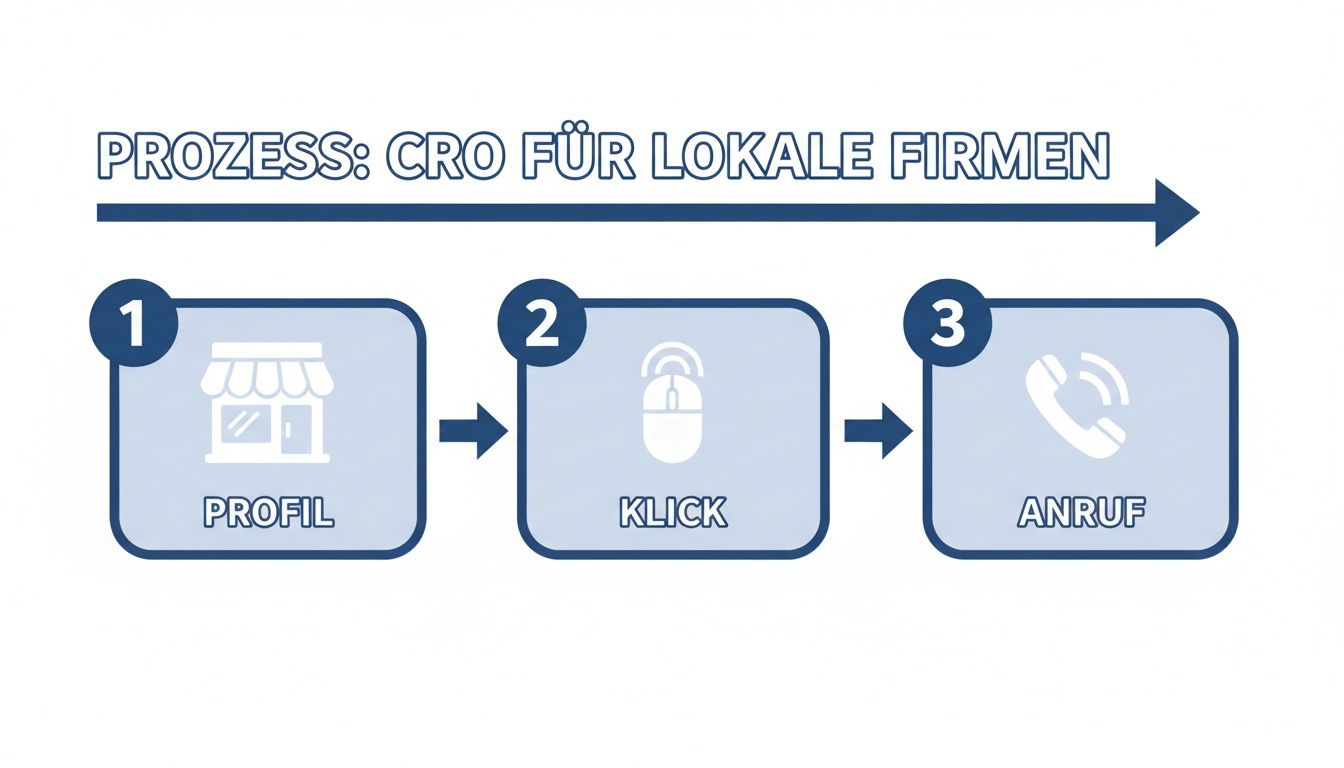
You can see right away: Between the first look at your profile and making contact, there are critical points where you can lose users.
Understanding the customer funnel and uncovering weak points
A customer's journey from Google search to phone call is like a funnel. Many potential customers come in at the top, but at every stage, a few jump off. Your job is to find and plug these “holes.”
A typical funnel for a local store looks like this:
- Visibility (at the top of the funnel): Someone searches for “plumber in Bühl” and your company appears in Google Maps results.
- Interest (middle of funnel): The user clicks on your profile, looks at photos, reads reviews, and checks your services.
- Action (at the bottom of the funnel): Convinced, he clicks on “Call” or requests the route.
Conversion rate optimization is about making the transition from one stage to the next as smooth and convincing as possible. Every click, every piece of information and every image must strengthen trust and motivate the user to take the desired action.
Where exactly are you losing prospects? Look at the ratio of your KPIs.
A practical example: A restaurant has 1,000 profile views per month, but only 5 route requests. That is a conversion rate of 0.5%. Click at the same time 150 people to the website.
There is reason to suspect that the Google profile itself is not convincing enough to trigger a direct visit. Perhaps there are no appealing pictures of the meal or the opening times are unclear. Users search the website for information that they would have expected in their profile. This is a clear signal as to where you need to start optimizing.
This analysis is an ongoing process. Review your figures regularly to identify trends and see the impact of your adjustments.
Optimize your Google business profile for more inquiries
Your Google business profile is the first point of contact for many potential customers. Think of it as your most important local landing page. This is where it is decided whether someone calls, visits your website or finds you. Many local companies are leaving potential untapped here.
Die Conversion rate optimization Your profile starts with building trust and making the path to the desired action as easy as possible.
The foundation: Correct master data for maximum trust
Complete and to 100% consistent master data are the absolute basis. Customers become suspicious when faced with conflicting information.
Your NAP data (name, address, phone number) must match exactly — not just in your Google profile, but everywhere online. A difference such as “street” instead of “street” can confuse algorithms and undermine user trust.
Precise opening times are just as important. There are few things more frustrating than standing in front of a locked door even though Google shows your store as “open.” Also maintain special opening times for public holidays or company holidays.
Categories and description: Show what you stand for
The choice of your categories determines whether Google will consider you for relevant searches. Choose a main category that exactly matches your core business.
An example: An electrician who specializes in smart home solutions should not only specify “electrician,” but also add more specific secondary categories, such as “home automation.” That attracts the right customers.
Your company description is the ideal place to naturally integrate important keywords. Don't just describe what You do but emphasize Which problem Solve them for your customers. If you're starting from scratch, our guide shows you how to create a Create a Google business profile.
Professional tip: The first sentence of your description is critical. It often appears as a preview in search results and must immediately arouse interest. Formulate your strongest value proposition here.
Visual sales arguments: Images as a factor of conversion rate optimization
Authentic, high-quality photos are among the strongest levers to boost your profile's conversion rate. They provide real insight and make your company accessible.
Avoid interchangeable stock photos. Instead, show:
- Your team in action: That creates sympathy.
- Your premises: Give customers a feel for the atmosphere
- Successful projects or satisfied customers: The best social proof.
- Professional product photos: Make your offer tangible.
Keep your images up to date. A photo with Christmas decorations in July looks unprofessional. A short video, such as a tour of your restaurant, can further increase engagement.
Google posts: Your advertising space with a clear goal
Google posts are free mini ads in search results. Use them strategically for current offers or news. A clear Call to action (CTA) is crucial for conversion.
Be specific instead of vague:
- CTA: “Request a quote”: Leads directly to the contact form.
- CTA: “Call now”: Allows you to call with one click.
- CTA: “Book online”: Direct you to your appointment or reservation tool.
- CTA: “Calculate route”: Ideal for activities that require a local visit.
A well-designed post with an appealing image and an unmistakable CTA can significantly increase interaction with your profile.
Actively manage questions and reviews
Your handling of customer feedback is a public figurehead. The “Questions & Answers” section offers a great opportunity. Proactively answer common questions yourself to alleviate uncertainties.
Responding to reviews is a direct conversion lever. Studies suggest that companies that actively respond to reviews increase their conversions by up to 30% be able to increase. Thank you for positive feedback and respond to criticism professionally.
Build trust and positively influence buying decisions
In local business, trust is the most important currency. Potential customers often make decisions in seconds. Trust Signals — decisive information — signal to a hesitant prospective customer: “I've come to the right place. ”
These trust signals are the lever for your Conversion rate optimization move forward and build a credible presence.
The power of authentic customer reviews
Reviews are the strongest sign of trust in local marketing — digital word of mouth. When someone finds your Google business profile, the first look is almost always the star rating.
Positive reviews are social proof that you're doing a good job. They reduce the perceived risk for new customers.
How to get more positive reviews honestly
The easiest way: Ask questions, preferably directly and personally. The perfect moment is when the job is done and the customer is happy.
Methods that work in practice:
- The personal request: Talk to the customer after the order has been completed. “We would be happy to receive a short review on Google if you were satisfied” is likeable.
- Make it easy: Create a direct link to your Google review form and send it via email or text message.
- QR code on site: Place a QR code on your counter, bills, or business cards.
It's not about “chasing” 5-star reviews. Create an honest channel for feedback. Authentic, detailed reviews — even with four stars — often appear more credible.
Dealing confidently with critical feedback
Negative reviews happen. Your response to this is a strong signal of trust. A professional response shows that you take feedback seriously.
The golden rule: Always be factual, thank you for the feedback and offer a solution. This refutes criticism and can strengthen the trust of future customers. For unjustified cases, it is good to know when you have a Have Google review deleted Can.
What else creates trust
Other elements underline your competence. Place them in your Google profile, e.g. in posts or the description:
- Certificates and Awards: Master workshop, seal of approval or local prices.
- Memberships in associations: Membership in a guild or professional association.
- Customer testimonials and case studies: A quote from a happy customer or “before and after” pictures.
- Local press: Reports in the local paper.
Keep barriers to contact you low. Easy to find and optimized contact options are essential.
Systematically test and prioritize measures
Conversion rate optimization is a continuous cycle: hypothesize, test, learn from data, and repeat the process. In this way, you can systematically find out what works for your customers, instead of relying on guesswork.
A/B testing: Clear decisions instead of guesswork
A/B testing is a central tool. You create two versions of an element — such as advertising copy — and show them to different parts of your target audience. Then measure which version was more popular.
For a local company, the principle can be pragmatically applied to your Google company profile.
Specific examples:
- Compare Google posts: Create two posts. In version A, the CTA is “Get a Quote Now.” In version B: “Call us for a free quote.” After a week, compare clicks or calls.
- Test the effect of profile pictures: Use a picture of your team as your main profile picture one month, and an outdoor shot of your business the next. Then compare the number of calls and route requests.
- Optimize the first impression: Re-phrase the first sentence of your description Option A emphasizes experience (“Your partner since 1995...”). Option B focuses on customer benefits (“Quick help in case of heating failure...”).
Only ever change when doing A/B testing a variable all at once. Otherwise, you don't know which change was responsible for the result.
Finding Quick Wins: The Effort and Impact Matrix
Your time is precious. Prioritize wisely with the effort and impact matrix.
Evaluate each measure based on two criteria:
- Expense: How much time, money, or knowledge do you need? (Low, Medium, High)
- effect: What impact do you expect on your conversion rate? (Low, Medium, High)
Measures in the category “Low effort, high impact” are your “quick wins.” You should start with these.
The potential is considerable. Sophisticated CRO strategies can convert by up to 223% boost. Even minor adjustments, such as reducing form fields, can reduce the conversion by 50-120% increase. You can find further insights in the Digital marketing performance data on landingi.com.
Prioritization using the example of a car repair shop
This matrix helps to identify where the use is most worthwhile.
MeasureEstimated Expenditure (Low/Medium/High) Expected Impact (Low/Medium/High) PriorityUpdate opening hours for holidaysLowHighQuick Win (Implement immediately) Reply to 5 new customer reviewsLow mediumQuick Win (Implement immediately) Upload new photos of the workshopMedium-highHigh priorityProduce a short presentation videoHighHighMedium PriorityCompletely redesign the websiteHigh high low priority (long-term project)
Small, quickly implemented things often make the biggest difference. In order to keep track of these optimizations, a specialized SEO app be helpful.
Summary and next steps
You now have a clear roadmap for Conversion rate optimization from your local company. It all starts with understanding and measuring your local metrics, such as calls and route requests. Your Google business profile is your most powerful tool. Build trust through authentic customer reviews and regularly test small changes to make it a reliable source of new customers. Stay tuned and identify the screws again and again with the biggest lever. Real optimization is a continuous cycle of measurement, testing, and adjustment.
Start with the simplest successes — the “quick wins.” If you need professional implementation support to systematically increase your conversion rate, contact us. We help you turn visibility into tangible results.
Common questions about local conversion optimization (CRO)
Here you will find answers to the most common questions about practical implementation.
How do I calculate the local conversion rate?
The formula is: (number of conversions/number of profile visitors) x 100.
Every valuable action on your Google business profile counts as a conversion: a call, a route request, or a website click.
Had your profile last month 1,000 visitors and 50 of which clicked on the call button, is your conversion rate for calls 5%.
What is a good conversion rate for a local company?
There is no universal answer as it depends on industry, location, and competition. A lawyer in a big city has different values than a hairdresser in the countryside.
As a rough clue: Conversion rates between 2% and 5% The Google company profile is a solid value.
It is more important to continuously improve your own figures.
Focus on beating your own numbers. An increase from 2% to 3% means 50% more inquiries with the same traffic. That is the real win.
Where is the best place to start optimizing?
Start with the basics, the “Quick Wins.” These are things that can be implemented quickly and often have great leverage.
First, check:
- completeness: Have you filled out every field on your profile?
- Timeliness: Are your opening hours at 100% correct?
- image quality: Do your photos look professional?
- Responses to reviews: Do you answer quickly and personally?
This foundation must be in place before more complex measures such as A/B testing make sense.
How often should I check my conversion rate?
A monthly check is ideal. This gives you enough data to identify trends without being influenced by daily fluctuations.
Use Google Business Insights and enter the most important KPIs — profile views, calls, route requests — in a spreadsheet. In this way, you can see at a glance whether your measures are working.
Would you like to utilize the full potential of your Google company profile and increase your inquiries in a predictable way? With SocialEdge We help you get to the forefront through targeted optimizations in your region — without an advertising budget. Find out now how we make your local business visible: https://www.socialedge.ai.