What conversion rate optimization means for local businesses
Many local entrepreneurs focus their energy on driving more visitors to their website or Google business profile. But what is the point of thousands of clicks if the telephone is stationary and the appointment calendar remains empty? This is exactly where conversion rate optimization comes in.
Instead of constantly increasing the advertising budget to reach new target groups, CRO focuses on getting the most out of every single visitor. It is the method of turning pure prospects into real customers. Behind this is a data-based process: They analyze why visitors take a desired action — such as a phone call — Not Execute, and eliminate these obstacles in a targeted manner.
The difference between traffic and conversions
Think of your store as a store on a busy shopping street. The Traffic Are all people who pass by your shop window. One Conversion It takes place when someone opens the door, comes in and buys something or gets advice. In this image, CRO is the design of your shop window: It ensures that your website or Google profile is so inviting and understandable that passers-by become customers.
Many assume that more traffic automatically leads to more sales. The reality is often different. An increase in the conversion rate from 1% to 2% doubles the return — with potentially significantly less effort and lower costs than doubling traffic.
For a local company, a conversion can be varied. It is not always just about direct online sales. It is often these valuable actions:
- Calls: One click on the phone number in your Google profile.
- Route planning: Someone is showing them the way to your store.
- Site clicks: A user wants to learn more and visits your site.
- Messaging: A quick query using Google's messaging feature.
- Appointment bookings: Filling out a contact form or using an online calendar.
Why CRO is critical for local businesses
In local competition, every single customer counts. Most searches for a tradesman, a restaurant or a law firm today take place on smartphones — often with the intention of taking immediate action. If a potential customer lands on your profile and doesn't immediately find what they're looking for — whether it's a clear overview of services, opening hours or a simple contact option — they're gone quickly. One click and he's with the competition.
In many industries, the average conversion rate is 2— 5%. That means: 95 from 100 visitors Leave the page again without taking any action. With targeted optimization, you can gradually improve this number and ensure that your online visibility results in more local business.
The core of CRO is data-based. They make a hypothesis (e.g., “If we make the 'Call Now” button more prominent, this will result in more calls”) and test it with small, controlled changes. In this way, your online presence becomes a reliable tool for attracting customers without having to spend more and more money on advertising. The focus is on using existing resources more effectively.
Your Google Company Profile as a Conversion Engine
For local customers, your Google Business Profile is often the first point of contact with your brand. Think of it not just as a digital business card, but as a powerful tool for Conversion rate optimization — directly in Google Search and Maps.
Many local companies make the mistake of creating their profile once and then neglecting it. But this is exactly where enormous, untapped potential lies. A fully completed and actively maintained profile creates trust and answers the most important questions even before a potential customer visits your website.
Every detail, from photos to descriptions to opening hours, influences a user's decision whether to take the next step. This could be a phone call, planning a route to the store, or clicking on your website.
Create the foundations for more conversions through your Google profile
The basis for a successful Conversion rate optimization Local marketing has correct and complete master data. Consistent are fundamental NAP data (name, address, telephone number) on all platforms. Incorrect opening hours or an outdated telephone number are frustrating for customers and have a negative effect on conversion.
Make sure that your major and minor categories accurately describe your business. A restaurant that only lists itself as a “restaurant” is missing out on the opportunity to address customers who are specifically looking for “Italian restaurant with terrace.”
Attributes also play an important role. Information such as “free WiFi”, “barrier-free entrance” or “card payment available” can be exactly the details that convince a customer to choose you and against the competition.
Impress with relevant content in your Google profile
A profile depends on being up to date. Regular Google posts where you share offers, news, or events signal to users and Google that your company is active. You can also use these posts to place relevant keywords that describe your services.
High-quality photos are also crucial. Don't just show off your shop from the outside, but also provide real insights:
- Pictures from the team: This creates personal closeness.
- Photos of your products or at work: This is how you demonstrate your competence.
- Interior photos: Give a glimpse of the atmosphere.
Each image helps the customer imagine what to expect from you and lowers the barrier to making contact. For more information, see our guide to Optimize your Google business profile.
Users often make decisions in a matter of seconds. A profile without recent photos or with a sparse description appears less trustworthy and is often ignored in favor of a more complete profile of the competition.
Use the services section to list your offers in detail. Instead of just writing “repairs,” get specific: “smartphone screen repair,” “battery replacement for all common models,” or “water damage treatment.” This makes you visible for specific search queries and attracts qualified customers.
From Profile Visitor to Customer: Promote Conversions in a Targeted Man
In the end, it's about triggering an action. Your Google profile offers direct ways to do this: The prominently placed buttons for “Call,” “Route” and “Website” are your most important calls-to-action. A well-optimized profile motivates users to click these buttons.
The average conversion rate in German e-commerce between October 2021 and October 2023 was 2.24 percent. This development is relevant for local service providers, as a strong organic presence in Google Maps can achieve similar or even better results.
Every interaction with your profile is measurable. With Google Business Profile Insights, you can see how many users have found their profile and what actions they have taken. This data is the basis for your ongoing Conversion rate optimization.
Checklist for converting your Google Business Profile
A prioritized list of the most important optimization measures for your Google business profile to increase the conversion rate.
Optimization AreaWhy it's ImportantSpecific ActionMaster data (NAP)Creates trust and prevents frustration. Foundation for local SEO. Check name, address, and phone number for consistency.Opening hoursOne of the most common reasons for a profile visit. Maintain regular and special opening hours (holidays!).Categories & AttributesIncreases visibility for specific searches. Select the most precise main category and relevant attributes.Photos & videosVisualize your offer and create a personal connection. Upload at least 10 high-quality photos (team, products, rooms).Services/productsAttracts qualified customers who are looking for exactly what you offer. Include your key services with descriptions.Google postsIndicate timeliness and provide space for offers and keywords. Post an update or offer at least once a week.Questions & answersBuild a proactive FAQ and answer common customer questions. Answer incoming questions quickly and ask them yourself.Reviews & answersThe strongest social proof. Shows that you value customer feedback. Actively ask for reviews and respond to each one.
This list serves as a starting point. Work through the points to positively influence interactions with your profile.
Build trust through reviews and social proof

Customers trust other customers. This truth is at the core of successful Conversion rate optimization for local businesses. The authentic opinion of another customer often provides the decisive impetus. That is exactly what Social Proof.
Actively managing your online reputation is therefore a central component. Potential customers who are about to make a purchase decision are specifically looking for the experiences of others. A profile with no reviews or outdated feedback seems less trustworthy. The result: The interested party turns to the competition.
Why online reviews are important for the conversion rate
Reviews work because they fulfill a human need for safety. No one wants to make the wrong decision. Real reviews take away the uncertainty from potential customers and build a basis of trust.
Studies confirm that many people trust online reviews as much as they trust a friend's personal recommendation. Especially for local service providers, where a personal experience is required, this factor weighs particularly heavily.
Trust is a decisive factor in local business. Every positive review strengthens this trust and signals to new customers that you are in good hands here.
Collecting and presenting positive feedback is therefore important. Take a look at how other companies have their Real customer reviews Present to get a feel for what works well.
How to get more reviews
Make things as easy as possible for your customers and ask questions at the right time. Don't wait passively for someone to write a review of their own accord.
Incorporate feedback requests into your processes. The ideal time is shortly after a positive experience, when satisfaction is high.
A few best practices:
- The personal question: Ask satisfied customers to share their experience online right in the conversation.
- The timely email: Just after the appointment or purchase, send a friendly email with a direct link to your Google profile.
- QR codes on site: A display at the counter or on the invoice with a QR code that leads directly to the review page can lower the hurdle.
- The note on the business card: Add a short link or QR code to your business cards.
Important: Don't offer anything in return for reviews. This is against Google's guidelines and may affect your credibility.
Dealing confidently with critical reviews
Sooner or later, almost every company receives a negative review. How you react says a lot about your company. An unanswered negative comment can be daunting, while a professional response can even boost trust.
A good response to negative feedback involves three steps:
- Thank you: Demonstrate that you take feedback seriously.
- Apologize: Take responsibility for the customer's negative experience.
- Provide a solution: Suggest that you resolve the issue in person and provide a direct contact option.
With an answer like this, you show all readers that you care about your customers. In rare cases, reviews are unfair or violate guidelines. We will explain what you can do then in our article on the topic Have Google review deleted.
Use more trust signals for your website
In addition to Google Reviews, there are other signals that underpin your credibility. Place these “trust signals” visibly on your website, ideally near your contact forms or calls to action.
Here are a few examples:
- Local seals and awards: Are you a member of a professional association or have you won a local prize? Show it.
- Customer testimonials on the website: Quotes from satisfied customers (with their permission) can be convincing.
- Mini case studies: Briefly describe a successfully resolved customer issue.
- Known from... : Have you been mentioned in the local press or a trade magazine? The logo can create recognition value.
All of these components combine to create the image of an established, reputable and trustworthy local company.
Use the mobile user experience to optimize conversions
Most local searches today start on a smartphone — whether for a restaurant, a handyman, or a doctor's appointment. This often happens on the go and out of an acute need.
A frustrating mobile site can result in a potential customer switching to the competition. When someone clicks on your page from your Google profile, they expect a seamless transition. Long loading times, tiny fonts, or unclear navigation can significantly reduce the conversion rate.
Loading time as a factor for the mobile conversion rate
Every second of waiting time is one too much. Studies show that even a delay of just One Second Can have a negative impact on the conversion rate. Mobile users are often impatients.
Use a tool like Google PageSpeed Insightsto check the speed of your mobile site. Simple measures often make the biggest difference:
- Compress images: Image files that are too large are a common cause of slow loading times.
- Remove unnecessary items: Check whether complex sliders or elaborate animations are really necessary on your mobile homepage.
- Focus on a clear design: A tidy structure not only loads faster, but also leads the user more directly to the goal.
Intuitive navigation and readability on mobile devices
There is no room for complexity on a small smartphone display. A user must immediately understand where to find the important information. A clear, simple menu, often implemented as a “hamburger menu” (three lines), has established itself as standard.
Make sure all text is easy to read without zooming in. This means a sufficiently large font and strong contrasts. Break longer texts into short paragraphs and use meaningful subheadings.
An important practical tip: All clickable elements — especially buttons and links — must be large enough so that you can easily hit them with your thumb without accidentally tapping next to them.
Historically, the conversion rate in e-commerce in the DACH region rose from 1.2 percent in January 2014 to 2.2 Percent developed in October 2023. These figures are also an important benchmark for local businesses, because clever local optimization can make similar leaps. Especially on smartphones, where decisions are made quickly, a smooth user experience minimizes purchase cancellations.
Precise calls to action to increase the conversion rate
A common mistake when Conversion rate optimization Are too general calls-to-action (CTAs). A button with the inscription “Learn more” is often not effective. It doesn't tell the user anything about what happens next.
Instead, be specific and action-oriented. What exactly should the user do?
Vague WordingBetter, Precise AlternativeLearn moreInquire now without obligation Contact us DirectBook a table online
Place these clear CTAs prominently and repeat them in strategically useful places — for example right after a service description or at the bottom of the page. This is how you guide the mobile user to the desired action.
An optimized user experience on smartphones is a decisive factor in turning mobile visitors into customers. With tools such as a SEO ranking app You can track the impact of such optimizations on your visibility
A/B testing as a method for conversion rate optimization
Successful conversion rate optimization is based on data, not assumptions. Any change to your Google profile or website that isn't tested is a risk. A/B testing is a way to systematically find out what really works for your customers.
The principle is simple: you create two variants of an element that you want to improve. Version A is the current state, version B is your new idea. This could be two different texts for a Google post, for example. You then show version A to one part of your audience and version B to the other. Then measure which variant performs better — i.e. generates more clicks, calls, or website visits.
This is how you leave the subjective world of opinions (“I think this image looks more professional”) and enter the objective world of facts (“Figure B has demonstrably to 15% more calls guided”).
Hypotheses as a basis for conversion optimization
Every good test starts with a clear hypothesis. This is a well-founded assumption as to which change will produce which outcome. A good hypothesis often follows the formula: “If I change X, Y will happen because Z.”
This structure forces you to use the Why Think about a change and make your testing more targeted.
Here are a few practical examples for a local company:
- Post title: “When we create urgency in the title of an offer post (such as 'This Week Only), more people click the 'View Offer' button because worrying about missing out on something motivates them to take action.”
- Profile pictures: “If we use a photo of our team as the main image instead of the company building, we get more calls because a more personal impression creates more trust.”
- Call to action: “When we change the CTA in our posts from 'Learn more' to 'Make an Appointment Now, 'the number of bookings increases because the call to action is more specific.”
A key benefit of testing is learning what your customers do Not want. A test that fails is not a failure, but a valuable insight that saves you from making major mistakes.
Perform simple A/B tests on your Google company profile
You don't need any special software to start testing. Your Google Business Profile is already a useful tool for simple testing.
Try this: Create two Google posts about a similar topic, but only vary one element — such as the image or headline. Publish the first post at the same time on Monday morning and the second post the following Monday. Then compare the interaction rates in Google Insights. Make sure to keep the conditions (day of the week, time) as constant as possible.
Although this method is not scientifically perfect, it quickly provides valuable trends about which types of images, texts and offers are best received by your local target group.
The potential is huge. An increase in the conversion rate of your Google Ads leads from 16.2 to 17.6 percent could mean savings of almost 800 euros with a monthly budget of 10,000 euros. These figures from the advertising sector illustrate the leverage that organic optimization also has. You can find more detailed insights in the article about The effectiveness of A/B testing on more-fire.com.
Prioritizing using the PIE method
When you start testing, you'll get lots of ideas quickly. A simple prioritization method such as the PIE framework helps to keep track of things.
You rate each idea based on three criteria on a scale of 1 to 10:
- Potential (Potential): How big do you think the positive effect will be if the test is successful?
- Importance: How valuable is traffic to the page that you are optimizing?
- Ease: How easy and quick is it to implement the test?
Add the three values together to get a total score. The ideas with the highest score should be prioritized. These are often the “quick wins” — changes with high potential and low effort at the same time. In order to identify potential more quickly, specialized SEO optimization software help.
Summary: Conversion Rate Optimization as a Process
Die Conversion rate optimization For local companies aims to turn online visibility into measurable results. It is a continuous cycle that starts with a well-maintained Google company profile, gains steam through customer trust and is led to success through a seamless mobile user experience.
Constant testing ensures that your measures are based on data and not on pure good feeling. The following graphic illustrates the simple and effective A/B testing process.
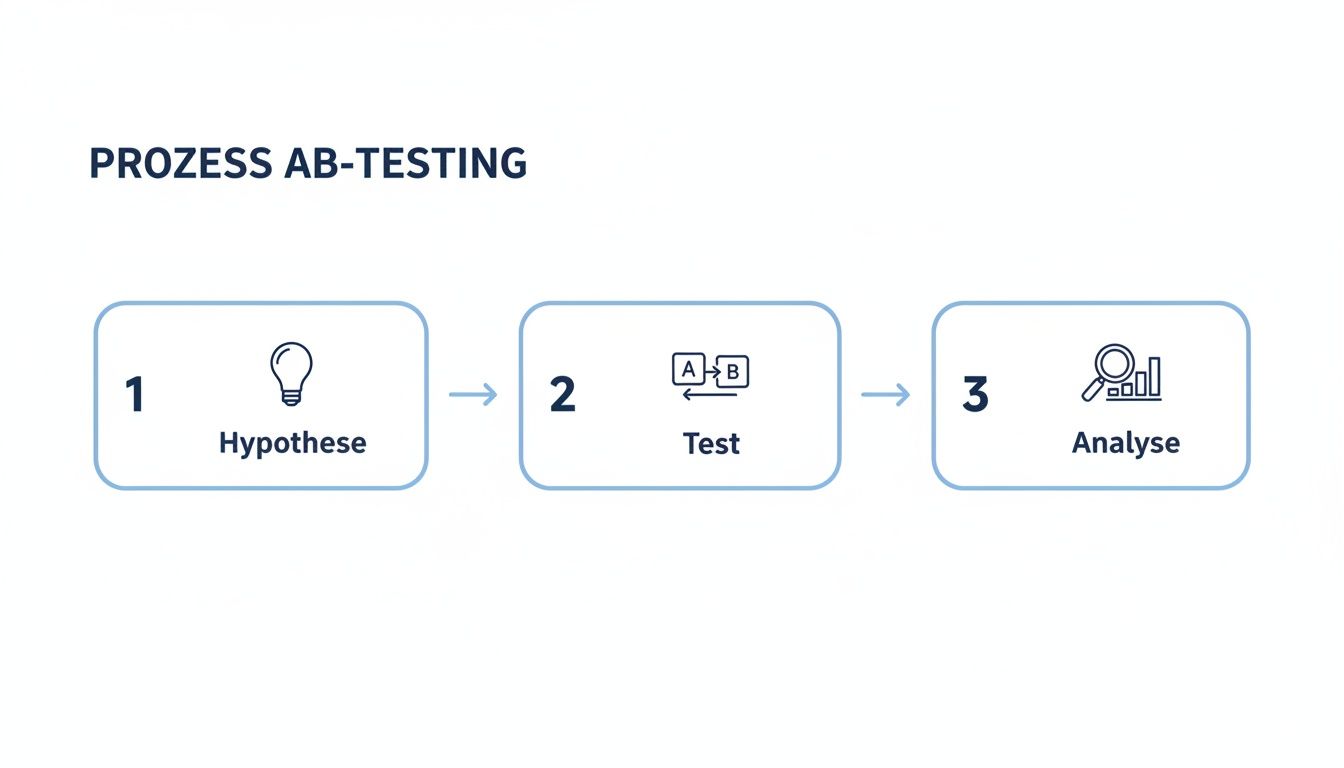
The process shows how a data-based hypothesis via a controlled test becomes an analysis that points the way to the next improvement.
Your next steps to conversion rate optimization
Start with an honest inventory:
- Do you really use all Features of your Google profile?
- How quickly do you respond to new customer reviews?
- Are there any barriers to getting in touch with you on your website?
Review the points from this guide and identify the biggest levers for your business.
Each improvement is a step toward more calls, more directions, and ultimately more revenue. Start with the most obvious optimizations.
If you want professional assistance to reach your full potential, we're here to help. Contact us for a Non-binding analysis of your options And let's find out together how we can improve your conversion rate.
FAQ: Common questions about local conversion optimization
Finally, some answers to questions that are frequently asked in practice.
What is a good conversion rate for my local business?
There is no general answer, as a “good” rate depends heavily on your industry and the definition of a conversion.
For an electrician, can 5% The website visitors who call will be a success. A hair salon with online appointment booking is likely to aim for higher rates.
Tip: Don't compare yourself to general industry benchmarks. Focus on your own Rate to improve continuously. The goal is continuous growth.
How long does it take before I see results?
The answer depends on the measures implemented.
- Quick Wins: Corrections to opening hours, uploading better photos, or adjusting an unclear button on your website can often be done within A few days or weeks Make positive changes.
- Long-term strategies: Building a strong online reputation by regularly collecting reviews is a lengthy process. The full effects often only become apparent after a few months, but the results are more sustainable.
What simple tools are there besides Google Analytics?
Google Analytics It's a powerful tool, but it can be overwhelming at first. For local companies, there are alternatives that make user behavior more clear.
Heat map tools Like Hotjar or Microsoft Clarity Visually record where visitors click on your page, how far they scroll and where they hesitate. These insights are often more intuitive than mere columns of numbers and help you quickly find hurdles in the user experience.
Summary and call-to-action
Conversion rate optimization is an ongoing process that turns your online presence into tangible business success. It's about getting the most out of your existing traffic through data-based analysis and targeted testing — from an optimized Google profile to building trust to a perfect mobile experience.
Ready to fully utilize your organization's potential? Request your free potential analysis now and let us identify the levers for your growth together.