What is local search engine optimization?
Local search engine optimization, often as “Local SEO” , is a specialized area of online marketing. Your goal is to increase a company's visibility in search results for users who are looking for products or services in the immediate geographical area. It's about reaching out to people who now have a problem and a solution onsite require.
For local companies such as craftsmen, doctors or restaurants, this is of central importance. They must be found by people whose pipe has burst, who have acute toothache or who want to go out to eat spontaneously. These are searches with an immediate need.
This type of search is fundamentally different from a general query. When someone googles “best running shoes,” the result can come from any online shop in the world. However, if the same person searches for “shoe store near me,” they signal a clear intent to buy at the current location.
The importance of local search for companies
Google recognizes this local intent and adjusts search results accordingly. Instead of a pure list of websites, the so-called “Local Pack” shown: a map with the three most relevant companies directly below the search field. This area is the most important goal in local SEO because it generates maximum attention and leads to more calls, website clicks, and walk-in customers.
The figures underline this relevance: Around 46% of all Google searches in Germany have a local connection. A well-thought-out local SEO strategy is therefore essential for any company with a physical location or a local service area. If you'd like to know more about it, Read the key local SEO statistics.
In fact, a local search ends in 78% of cases with an offline purchase, and 18% They even happen on the same day.
More than just a technical attitude
Local search engine optimization is not a one-off technical measure, but an ongoing process. It comprises various measures that send search engines and potential customers the right signals about the location and relevance of a company.
Local SEO bridges the gap between a digital search and a real customer visit. It ensures that your business is found just when someone close to you is ready to buy.
The most important fields of action are:
- Google company profile: This is the digital business card and the central element of any local SEO strategy.
- Customer reviews: Authentic, positive reviews create trust and are a strong signal for Google.
- Consistent company data: Name, address, and telephone number (NAP data) must be the same throughout the Internet.
- Local content on the website: Contributions about local projects or topics strengthen regional relevance.
Ultimately, local SEO is about establishing yourself as a trustworthy local authority. It is the most direct way to generate measurable sales in brick-and-mortar stores from an online search.
How local SEO differs from classic SEO
Classic search engine optimization is comparable to a marathon whose goal is to rank on the first page nationwide. Local SEO On the other hand, a targeted sprint is about being noticed first in your own neighborhood, in your own city or in the immediate vicinity. Both disciplines strive for more visibility on Google, but use different methods and signals.
Classic SEO is aimed at a broad, often national or international audience. The focus is on general search terms such as “buy sneakers online” or “best tax software.” Success depends heavily on general authority on the web, which is built up through backlinks from major news sites or well-known blogs.
Local SEO focuses on a geographically limited audience. It aims to reach people who are looking for a solution nearby. The keywords here are specific and location-specific, for example “plumber in Berlin-Neukölln” or “Italian restaurant near me.”
The different ranking signals in detail
The decisive difference lies in the signals that Google uses for the rating. While high-quality content and strong backlinks dominate classic SEO, other factors come to the fore in local searches.
These are the key differentiators:
- Geographical relevance: For local SEO, the physical proximity of the searcher to the company is a decisive factor. An optimally optimised craftsman from Hamburg has no chance of searching in Munich, regardless of the quality of his website.
- Google company profile (GBP): This profile is at the heart of the local SEO strategy. A completely and correctly maintained profile is often more important than many classic on-page optimizations.
- Local citations: Uniform entries of company name, address and telephone number (NAP data) in relevant online directories signal Google's trustworthiness.
- Customer reviews: The number, quality, and timeliness of reviews have a direct impact on local rankings.
A direct comparison of disciplines
To illustrate the differences, let's look at the two approaches side by side. They require different target groups, goals and methods. They often complement each other, but their priorities are clearly different.
For a local business, a link from the local city newspaper can be more valuable than ten links from supra-regional portals, as it underlines local relevance.
The following table compares the key aspects.
Classic SEO vs. local SEO at a glance
A direct comparison of the goals, most important ranking factors and target groups of classic and local SEO.
AspectClassic SEOLocal SEOTarget groupNational or international local (city, district, region)Search intentOften informational or transactional without reference to the location, often with immediate intent to act (“near me”)Most important keywordsBroad, general terms (e.g. “marketing software”) Location-based terms (e.g. “Steuerberater Bühl”)Central platformYour own websiteGoogle company profile & Google MapsMost important ranking factorsbacklinks, domain authority, content quality proximity to the searcher, GBP optimization, ratings, NAP consistencyMeasuring successOrganic traffic, national keyword ranking calls, route planning, website clicks from the local pack
In summary, classic SEO tries to be the best answer for every user, anywhere. Local SEO aims to deliver the best and most relevant answer for someone in a specific location at a specific time.
If you want to dive deeper into the basics of both disciplines, Learn more about SEO and local SEO in our comprehensive comparison. Understanding these differences is fundamental to using resources correctly and achieving measurable results for your local business.
How Google ranks local results
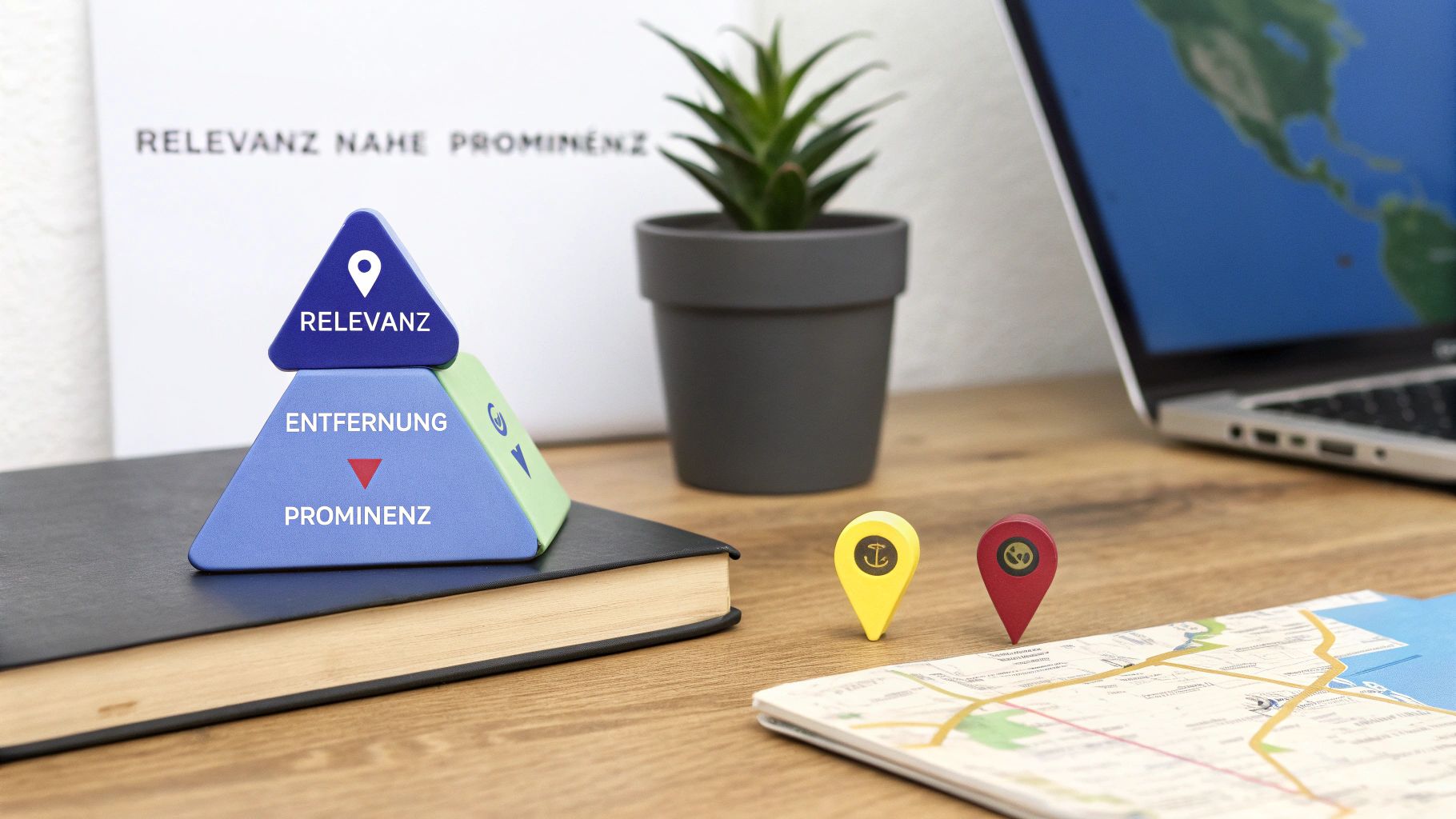
To be in the local search To be successful, it is important to understand which criteria Google uses to sort the results. The placement in the local pack or on Google Maps is not a coincidence, but the result of an algorithm that should provide the user with the most appropriate result for their request.
Google is based on three main criteria: Relevance, Distance, and Prominence. These three factors determine whether your company is visible to a potential customer.
1. Relevance: The match with the search query
Relevance describes how well your company profile matches a user's search query. Google analyses the information in your Google business profile to determine this match.
If someone searches for “Italian restaurant,” Google checks all profiles that use this category. A pizzeria that is generally only categorized as a “restaurant” has a disadvantage here.
Relevance is influenced by various elements:
- categories: Selecting the right primary and secondary categories is critical.
- Company information: Keywords in your business description and in the descriptions of your services help Google understand exactly what you're offering.
- Google posts: Regular contributions to offers, products or news signal activity and current relevance.
2. Distance: The geographical proximity
Distance is the most obvious factor. Google measures the distance between the searcher's location (if known) and your company's location. If the user does not specify a location (e.g. when searching for “Café near me”), Google uses the location data of the device used.
However, the closest store doesn't always win. A slightly more distant company with excellent reviews and high profile can overtake a closer but less prominent company. Distance is therefore an important factor, but not the only one.
3. Celebrity: Your company's reputation
Prominence is the most complex ranking factor. It describes how well-known and respected your company is — both online and offline. Google collects information from across the web to get an idea of your local authority.
You can think of prominence as a company's digital reputation. Famous museums or well-known hotels are naturally very prominent. Local companies must actively build up this authority.
Prominence is the sum of all positive signals that can be found online about your company. It convinces Google that your business not only exists, but is also trustworthy and a good choice for the user.
Important signals that strengthen your prominence:
- reviews: Not only the number but also the quality of reviews is a strong sign of trust.
- Local citations: Uniform entries in important online directories and business directories (NAP data) strengthen credibility.
- Local backlinks: Links from the local newspaper website, a city blog or a regional partner company are particularly valuable.
- Your website: Classic SEO factors such as the authority of your own website also influence your local ranking.
Conduct local searches in 80% of cases related to a purchase. The effect is particularly mobile: 76% of smartphone users visit a store within 24 hours of searching, and 28% buy directly. Companies with a well-maintained Google company profile also draw 70% more visitors on.
The combination of these three factors determines your position in the local search. By specifically influencing relevance, distance, and prominence, you can your Be able to improve your ranking on Google in a targeted manner and set yourself apart from the competition.
The most important ranking factors for local companies
Now that we understand how local search works, the question is: What specific measures can you take to rank better in the Local Pack and on Google Maps?
The foundation of every successful local search engine optimization is your Google business profile (formerly Google My Business). An incomplete or outdated profile looks unprofessional and can scare off potential customers.
The foundation: Your Google company profile
A fully maintained profile is the basis for your visibility. Google prefers complete and accurate information. Take these steps to lay a solid foundation:
- Precise categories: Choose a primary category that precisely describes your core business, such as “Italian restaurant” instead of just “restaurant.” Supplement this with appropriate secondary categories such as “pizzeria” or “delivery service” to further specify your offer.
- Relevant keywords: Integrate relevant local search terms naturally into your company description and the texts about your services. Phrases such as “tax advisor in Bühl” or “electrician for old building renovation” help Google understand which inquiries your company is relevant to.
- Correct contact details and opening times: Verify that the name, address and telephone number (NAP data) are correct and the same everywhere on the network. Maintain your opening hours carefully, even on public holidays or during company holidays. The importance of this uniformity is also reflected in our Articles about the role of business books explained.
Create trust through reviews and dialogue
Customer reviews are the digital form of word of mouth and a strong ranking factor. Not only do you convince new customers, but you also signal to Google that your company is known and trusted.
Respond to every review, whether positive or negative. Thanks for praise shows appreciation. A professional and solution-oriented response to criticism demonstrates good customer service and can win back dissatisfied customers.
The importance of reviews is growing. A recent study shows: Local companies in Germany had an average of 2025 63 Google reviews — these are 10% more than in the previous year, with an average of 4.52 stars. Active reputation management is therefore an important competitive advantage. You can find out more about this in the 2025 Google reviews study.
Active evaluation management enables you to directly shape the public image of your company. Every answer is a message to future visitors to your profile.
Visual presentation: pictures and recent contributions
High-quality photos and regular posts make your profile more attractive and give potential customers an insight into your business.
- Expressive photos: Upload professional images of your space, team, products, or work. Profiles with lots of pictures are proven to get more interactions.
- Regular Google Posts: Use the contribution function for current offers, news or events. These posts signal to Google that your business is active.
These three components — a well-maintained profile, active evaluation management and an appealing visual presentation — are the central elements of local search engine optimization.
Optimize your website and external signals for local SEO
An optimized Google company profile is key, but for maximum success, your website (on-page) and external signals (off-page) must also send a consistent local message. It is only the interplay of these areas that creates the necessary trust with Google.
On-page SEO: Make your website a local anchor point
Your website must clearly communicate where your business is based. This includes both obvious information and technical details.
They are a must NAP data (Name, Address, Phone Number). Your company name, address and telephone number should not only be present in the legal notice, but ideally also in the footer or header of every page. This makes it easier for visitors and search engines to find this important information.
If you operate multiple locations, each branch should have its own subpage. A separate page for the “hairdresser in Berlin-Mitte” and one for the “hairdresser in Berlin-Charlottenburg” sends stronger local signals than a general contact page with a list of all addresses.
The following graphic shows how the most important elements work together, from your Google profile to how it appears on your website.
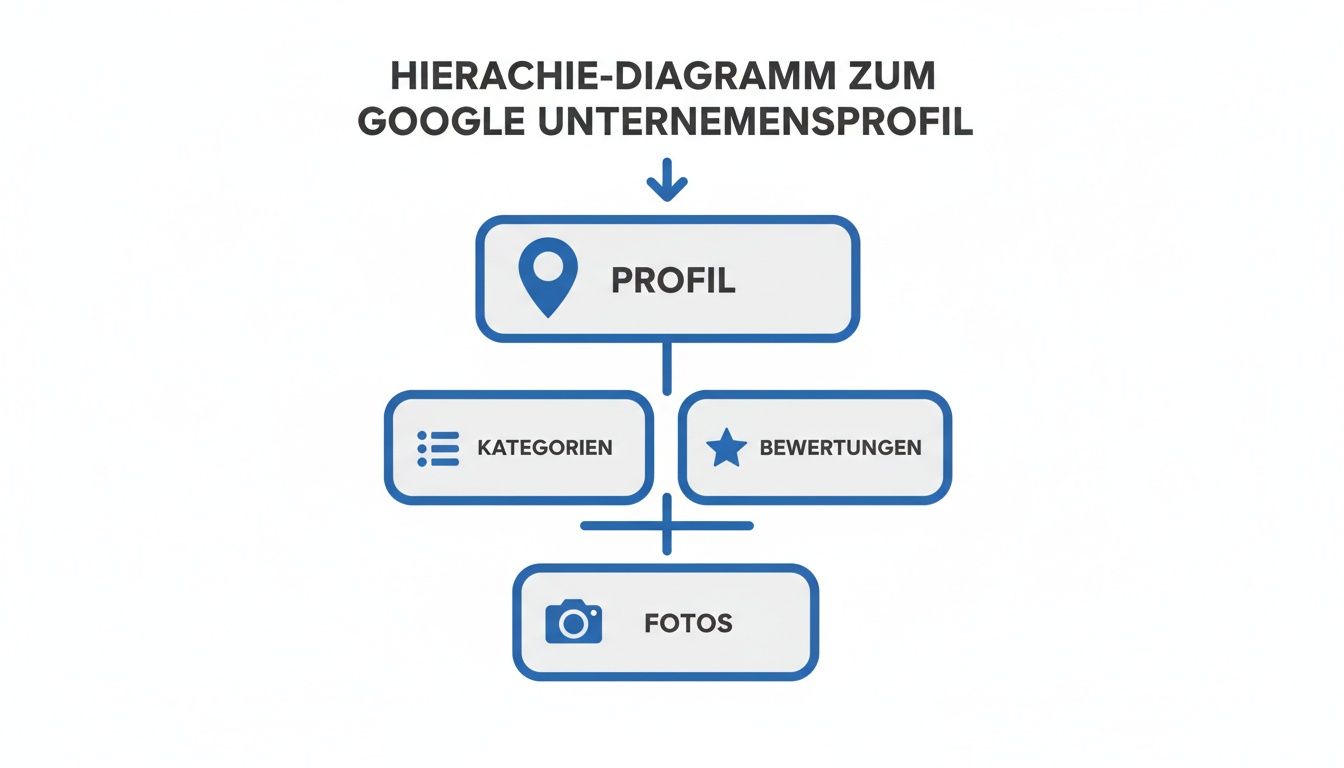
As you can see, an optimized profile — supported by the right categories, real reviews and meaningful photos — forms the basis for strong local visibility.
Local keywords and content
Integrate local keywords naturally into your website texts. A tax advisor should not only write about “tax advice,” but also use the term “tax advisor in Bühl” in page titles, headlines and running texts.
Create content that's local. These could be blog articles about local events you've attended, or case studies about projects in your region. Such content demonstrates your local roots and expertise. A well-thought-out Content marketing strategy for your business can help you find the right topics.
Technical optimization
An effective but often overlooked factor is structured data (Schema.org markup). These are snippets of code that provide search engines with precise information about your company.
With the “localBusiness” scheme, you can, among other things, submit the following data to Google in a standardized way:
- Exact name and address
- Opening hours
- phone number
- type of business (e.g. restaurant, doctor's office)
Structured data works like a standardized form for Google. They eliminate room for interpretation and ensure that all important facts about your local business are correctly understood.
Off-page SEO: Local quotes as a sign of trust
What happens outside of your own website is also very important. Play here “Citations” (local quotes) a central role. These include mentions of your company name, address and telephone number (NAP) in relevant online directories, industry directories or on the websites of local partners.
Each of these listings acts as a digital link to your business. Absolute consistency is crucial in this regard. Even the smallest discrepancies, such as “street” instead of “street”, can confuse Google and weaken trust in your data.
Check whether your company is correctly and consistently listed in the most important general and industry-specific directories. The more trustworthy and consistent quotes Google finds, the more secure the search engine is about your location data. This strengthens your local authority and improves your ranking opportunities.
Summary and next steps
Local search engine optimization is a continuous process that aims to send the right signals to Google and your customers. Your success is based on three key pillars:
- An optimized Google business profile: Maintain it as your digital shop window. It should be complete, up to date, and informative.
- Authentic customer reviews: Positive reviews create trust and signal to Google the relevance of your company locally.
- Consistent company data (NAP): Your name, address, and telephone number must be the same across the Internet. This consistency is a crucial trust factor for search engines.
Start optimizing your local presence today. Every day you leave unused is a missed opportunity to be found by customers close to you. Put the insights you've gained into practice to get real customers from local searches.
Would you like to systematically and sustainably increase your local visibility? SocialEdge helps you get to the top of local search results. We take care of the optimization so that you can concentrate on your core business. Find out more about our customized local SEO services.