What AI‑SEO means for your marketing

Think of AI‑SEO not as a complicated technical concept, but as a capable assistant for your marketing team. You set the strategic direction, and this co-pilot takes on the data-intensive detailed work. It analyses large amounts of data, finds patterns in search queries that could be overlooked manually, and suggests optimizations that would take a person significantly longer.
This is more than a passing trend; it is a fundamental change in the way search engine optimization works. Adapting to this is a necessity in order to remain digitally visible.
How AI is changing search results
The rules for SEO are changing, driven significantly by AI-driven search results such as Google AI overviews. These are AI-generated summaries that appear directly above the classic search results and often answer user questions on the results page.
This change has direct consequences for your website traffic. The introduction of Google AI overviews has already influenced the SEO landscape in the DACH region. Analytics show that the average click-through rate (CTR) for organic results is around 8.9% dropsas soon as an AI overview appears. Paid search ads (SEA) are also affected, whose CTR falls from 21.27% to 9.87%. However, websites that are mentioned as a source for such an overview can range from one to 80% higher click-through rate rejoice.
AI is not only changing like we optimize, but also What for. The goal is no longer just a place in the top 10, but also to be selected as a trustworthy source for AI answers.
Why classic SEO methods are reaching their limits
In view of this development, classic SEO methods alone are often no longer enough. Purely manual keyword research or the optimization of individual pages is often no longer sufficient. Google's AI systems today not only understand individual words, but the entire context and intent behind a search query. In order to keep up, SEO strategies must also become more intelligent.
This is exactly where AI‑SEO comes in. It helps to better understand and react to the complex relationships that determine the ranking today. The use of artificial intelligence is therefore a logical step in the evolution of search engine optimization. If you would like to deepen the basics, our contribution to SEO for AI an understandable breakdown of the most important concepts.
For companies, adapting to AI‑SEO means staying competitive and gaining a strategic advantage. It's about becoming more efficient, creating better content, and staying visible in a changing search landscape.
Opportunities and risks of AI in an SEO context

Integrating AI into your own SEO strategy offers both potential and risks. On the one hand, there are opportunities to make work more efficient and to gain deeper insights from data. On the other hand, there are also serious risks that can lead to problems without conscious handling.
A look at both sides is therefore essential. It is not about replacing human expertise, but about seeing AI as a tool that enhances our capabilities. If you know the potential and pitfalls, you can make more informed decisions.
The potential of AI for your SEO work
The biggest advantage lies in the increase in efficiency. Tasks that used to take hours or days can now be completed by AI systems in minutes. This is particularly true when analyzing large amounts of data to identify patterns and trends.
AI also helps, which Search intent to understand better. Instead of focusing only on individual keywords, modern tools can decipher the needs and questions behind a search query.
Here is an overview of the most important opportunities:
- Automate routine tasks: The creation of meta descriptions, the writing of image alt texts or the planning of internal links can be partially automated.
- Improved keyword research: AI tools can uncover semantic relationships and long-tail keywords that often go undetected during a purely manual search.
- Personalized content: Content can be tailored more precisely to the needs and previous knowledge of the target group.
- Scaling content production: It will be possible to create more content faster and thus achieve wider thematic coverage, ideally without loss of quality.
Risks in AI SEO and how to avoid them
Despite the options, care must be taken. The biggest risk is adopting AI-generated content without verification. Without human control, factual errors or stylistic deficiencies can creep in, which impair user confidence.
In addition, search engines like Google are getting better at identifying low-quality, mass-produced content. Anyone who fills the web with superficial AI texts risks penalties that can jeopardize established rankings.
AI tools are tools, not authors. The ultimate responsibility for quality, accuracy and originality always lies with people.
The figures illustrate the development: According to a recent analysis, 19% of content in Google's top 20 results AI-generated — a significant increase of just 2.3% in 2020. Use at the same time 91% of digital marketers already AI for content creation. This underlines the importance of a conscious approach. High-quality content, backlinks and search intent remain decisive ranking factors. More about These SEO statistics and their importance Find out in this analysis.
There are also legal and ethical grey areas. Who owns a text written by an AI? How do you ensure that no copyrights are infringed? These questions have not yet been fully resolved and require a responsible approach.
In order to minimize risks, a clear strategy is necessary:
- Human verification: Every text created by an AI should be checked for facts and style by a subject matter expert.
- Focus on E-E-A-T: Enrich AI designs with personal experience, real expertise, and verifiable sources to meet Google's quality guidelines (Experience, Expertise, Authoritativeness, Trustworthiness).
- Ensuring originality: Use AI to support ideas or structure, but formulate the final texts in your own, authentic voice.
Table: Weighing up opportunities and risks in AI SEO
This table compares the key advantages and potential drawbacks to make it easier to decide for or against specific AI applications.
Opportunity (advantage) risk (disadvantage)saving time by automating routine tasks.Risk of factual errors and AI “hallucinations.”Deeper data analysis to uncover hidden SEO potential.loss of quality with uncontrolled mass production of content.More efficient keyword research and a better understanding of search intent.Penalties from Google when identified as low-quality spam content.Scaling content production to cover a wider range of topics.loss of brand voice and authenticity when automation is too high.Personalizing content for specific target group segments.Legal uncertainties regarding copyright and plagiarism.
Ultimately, it's about finding a balance. AI can be a strong ally in SEO as long as it is used consciously and as a complement to human expertise.
Use cases of AI for your SEO strategy
Let's see how AI is being used in practice. AI is a tool that can simplify and improve many daily SEO tasks. Here are a few directly implementable examples from the core areas of SEO work.
When you KI-SEO When used correctly, you can create content that not only appeals to search engines, but above all to users.
AI-powered keyword research
AI tools can deepen keyword research. They understand semantic relationships between search terms and help to identify the user's intent.
Imagine yourself running a local craft business. In the past, they might have optimized for “installing heating.” Today, AI can uncover related topics and relevant questions.
- Uncover topic clusters: The AI recognizes that someone who is looking to “install heating” is also interested in “new heating costs” or “heating replacement subsidies.” With this knowledge, you can build comprehensive theme worlds.
- Find long-tail keywords: AI tools identify specific niche issues, for example “retrofitting heat pumps in terraced houses experiences.” Such keywords often have a lower search volume, but users have a high probability of conversion.
- Analyze competitors: An AI can analyze your competitors' keyword strategies and show you where gaps exist that you can fill with your own content.
This data-driven approach results in a content strategy that is tailored to your target audience and sends the right signals to search engines.
Efficient content creation with AI
Good content remains at the heart of every SEO strategy. As an assistant, AI can speed up the process from idea to finished text without sacrificing quality when used correctly.
The right attitude is important: See AI as support, not as a finished author. In the end, what is needed is a human expert who checks the facts, adjusts the tone and adds a personal touch.
An AI design is a good starting point, but not the finish line. Human refinement makes a good text an outstanding one.
Here are a few handy uses:
- Have outlines created: Tell AI your topic and target group. Within seconds, you get a logical, SEO-friendly structure for an article.
- Brainstorm headlines: Have various H1 headlines and subheadings suggested that arouse curiosity and include the main keyword in a meaningful way.
- Generate FAQ sections: Based on the most common user questions about a topic, the AI generates a “questions and answers” section. This can be useful for the “People Also Ask” boxes on Google.
If you want to dive deeper into this topic, check out our blog for practical tips on AI SEO optimization, which help you to further sharpen your processes.
AI support for on-page optimization
AI can also assist with the technical tasks of on-page optimization. Recurring but important tasks can be partially automated, leaving more time for the strategy.
AI shows its strengths particularly when it comes to meta data and internal links. Clean on-page optimization is the basis for search engines to understand and rank your content correctly.
A few specific examples:
- Meta titles & descriptions: AI tools analyze a page's content and suggest concise meta data that can improve click-through rate (CTR) in search results.
- Internal linking: Modern tools can scan your website and make suggestions for relevant internal links. This strengthens the thematic authority of your pages and better guides users through your offering.
- Image alt texts: The automatic creation of alt texts for images not only improves accessibility, but also provides valuable signals for Google image searches.
By delegating these tasks to an AI and reviewing the results, you create a clean technical basis for better rankings and save time that you can invest in the quality of your content.
Practical workflows and AI prompts for SEO
The value of KI-SEO shows up in daily use. A well-thought-out workflow is critical to increasing efficiency without sacrificing quality. It is about creating repeatable processes in which AI serves as an assistant and human expertise sets the course.
This graphic illustrates the process, divided into the three SEO phases: research, creation and optimization.
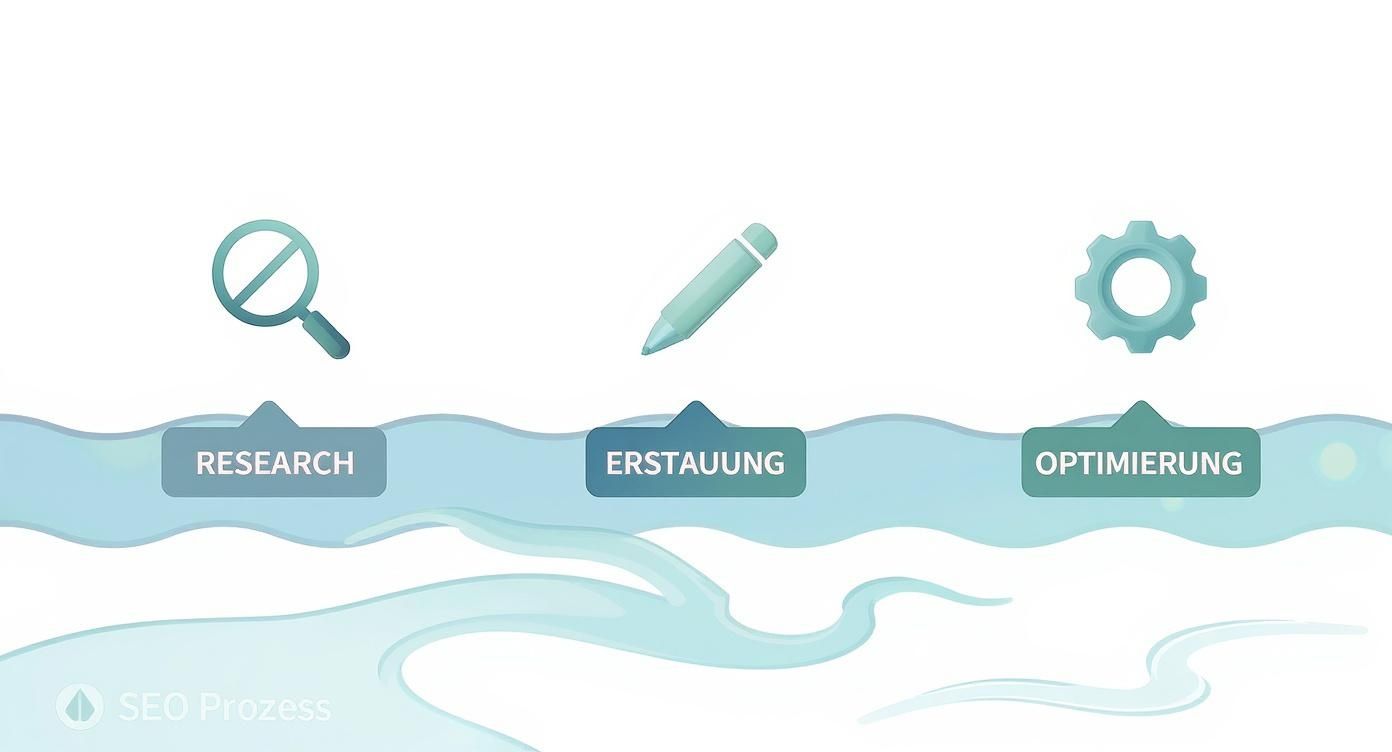
AI can help at every stage, but strategic control remains in human hands.
A workflow from idea to finished text
An effective process for creating a blog article follows a clear pattern. This process ensures that both the search engine and the readers receive real added value.
This is what such a path may look like:
- Idea generation & keyword analysis (AI-supported): You start with a rough topic. An AI tool helps to find relevant keyword groups and user questions.
- Structure & structure (AI & people): Based on this analysis, the AI can create an outline proposal. They adjust the structure and create a common thread.
- Preparation of raw text (KI): They feed the AI with clear instructions (prompts) for each bullet point. The result is a first draft.
- Human Refinement & E-E-A-T Enrichment: This is the decisive step. An expert checks the text for facts, adds personal experiences and adjusts the tone of voice.
This hybrid approach combines the speed of the machine with the depth and credibility of a human being.
The importance of good AI prompts
The quality of AI results depends directly on the quality of your instruction. Accurate, context-rich prompts deliver valuable, tailored results. To get the most out of your AI workflows, you need to learn how to formulate good instructions. If you want to go deeper here, you can find Prompt engineering for AI excellence a guide to communication with AI.
A good prompt is like asking a precise question to an expert. The more specific you ask, the more helpful the answer is.
An effective SEO prompt should always roller, which the AI should adopt, the exact task, the important context And the desired format contain the answer.
Field-proven prompt templates for SEO tasks
You don't have to start from scratch. Use proven templates and adapt them to your needs. The following prompts are designed for tools such as ChatGPT or Gemini.
Example prompt for competitor analysis:
Role: You're an SEO Analyst.
Task: Analyze the top 5 search results for the keyword “[insert your keyword here].” Identify the subtopics covered in the articles, the user questions that answer the H2/H3 headings, and the overall tone of voice (e.g. guide, review).
Context: I'm planning an article that is more comprehensive than the competition.
Format: Output the results as a table with the columns “URL,” “Subtopics covered,” and “Identified user questions.”
Example prompt for creating headlines:
Role: You are a creative copywriter with SEO experience.
Task: Write 5 different H1 headlines for a blog article about “[insert your topic here]”.
Context: The main keyword is “[insert your keyword here].” The target audience is [describe your target group here]. The headlines should arouse curiosity, communicate a clear advantage and contain the main keyword.
Format: List the 5 suggestions as a numbered list.
Such structured commands are the key to successfully putting AI SEO into practice. They turn a tool into a targeted assistant.
Choose the right AI‑SEO tools
The market for KI-SEO Tools are big, and choosing the right tool is critical. There is no one-size-fits-all solution. Instead of a long list of products, this is a decision-making tool to help you find the tool that fits your goals.
The selection depends on your priorities, budget, and team size. A small, local company has different requirements than a large e-commerce store. Focus on the core features that you really need.
AI tools for content creation and optimization
These tools are at the heart of many AI‑enabled SEO strategies. They help write and analyze competitors' content to uncover the need for optimization.
- Jasper (formerly Jarvis): A well-known copywriting tool, ideal for marketing teams that quickly need various text formats — from blog articles to product descriptions. The strength lies in the many templates.
- Frase.io: This tool combines content creation with deep analysis. Frase analyses the top search results for a keyword and creates a detailed content briefing from them. Suitable for SEOs who want to create data-based content tailored to search intent.
AI tools for keyword analysis and content strategy
AI‑supported platforms go deeper than traditional SEO tools. They recognize semantic relationships and help build entire topic clusters instead of just focusing on individual keywords.
A good AI strategy doesn't replace human creativity. It enhances our capabilities through data-driven insights.
- Surfer SEO: A popular tool among content marketers. Surfer analyses the SERPs and provides specific, data-based recommendations: text length, keyword density and thematically relevant terms. Integration with Google Docs or WordPress speeds up the workflow.
- MarketMuse: This tool is aimed at larger companies and content teams. It uses AI to analyze the entire website, identify content gaps, and make strategic suggestions for new topics. MarketMuse is designed to build thematic authority.
Specialized AI tools for technical SEO optimization
AI also has its place in technical SEO. This involves automating complex and time-consuming tasks such as analyzing log files or planning internal links.
- Alli AI: This tool specializes in automating on-page and technical SEO tasks. It can make code changes and optimizations in real time, which is particularly interesting for large websites with thousands of sub-pages.
The landscape of KI-SEO Tools are constantly evolving. A recent study in the attic room shows that 0.13% All website visits come via AI tools such as ChatGPT, while Google is still 44.19% delivers. AI traffic has grown sevenfold within a year, and these visitors remain on average 76.7% longer on the page. You can find more detailed insights in the complete analysis of AI traffic and its significance. A good SEO app can help to monitor such new traffic sources and adjust the strategy. Choosing the right tool is the first step to taking advantage of this change.
Measure success in AI SEO and ensure quality

KI-SEO only makes sense if there are measurable results and the quality of your content increases. It's not just about producing texts faster. The key question is: Does the AI-powered content reach your users and contribute to your business goals?
To do this, we need to look beyond classic key figures such as keyword rankings. The signals that show how users interact with the content are more important.
KPIs for measuring content quality
Modern SEO focuses on user experience. The following metrics help you evaluate whether your AI-generated content passes the field test.
- Time on page: If visitors stay on your site longer, it's a sign that they find the content useful.
- Bounce rate: A low bounce rate signals that the content meets user expectations.
- Conversion rate: Whether you subscribe to the newsletter, contact us or make a purchase — this shows the return on investment of your efforts.
Without these data-driven insights, you're operating in the dark. A good Software for SEO optimization is essential to keep track and refine your strategy based on data.
Quality assurance in accordance with E‑E‑A‑T as a human corrective
Google demands content that radiates experience, expertise, authority, and trust — in short: E‑E‑A‑T. An AI text cannot do that by itself. Careful inspection and refinement by a person is therefore essential.
AI provides the framework, but your expertise and experience turn it into content that people trust.
Consider the following checklist as an integral part of your workflow before an AI-powered text goes online:
- Fact check by experts: Have all data and statements been reviewed by someone with expertise?
- Enrichment with real experiences: Where can you include personal anecdotes or case studies?
- Clear authorship: Is it clear who is behind the content? A name and a face create trust.
- Verification for originality: Have you made sure that the text is unique?
- Tone of voice and brand voice: Does the text match your brand and communication?
When you consistently perform these quality checks, you ensure that your KI-SEO-Strategy gains the trust of your target group and search engines in the long term.
Summary and next steps
AI‑SEO is more than an automation tool; it's a strategic partner for greater efficiency and deeper insights. From keyword research to content creation, it provides support in many areas of the SEO process.
The key to success lies in combining machine power and human intelligence. Avoid pure mass production of content. Instead, opt for quality based on E‑E‑A‑T principles.
Recommendation to get started: Start with a manageable area, such as creating meta descriptions or outlining a blog article. Gain experience, measure results, and gradually optimize your process.
Want to make sure your business is visible in local Google searches? SocialEdge helps you improve your presence on the Google company profile and Google Maps.
Discover now how SocialEdge improves your local ranking.
Common questions about AI and SEO
The topic of artificial intelligence raises many questions. Here we answer the most common of them.
Does AI make SEO experts unemployed?
No AI is an assistant, not a substitute for human expertise. AI performs routine tasks and data analyses. The strategy, creative ideas and final quality control according to E-E-A-T criteria remain in the hands of people.
Does Google punish content written by an AI?
Google doesn't punish the use of AI per se, but low-quality content, regardless of whether it was created by a human or a machine. As long as your content is helpful, original, and relevant, its origin is secondary. However, mass-produced, superficial texts without human editing can be classified as spam.
Can I simply have my complete texts written by an AI?
This is technically possible, but not strategically recommended. AI tools are good for initial drafts, outlines, or collections of ideas. The enrichment with real experiences, the verification of facts and the final touches should be done by a person to ensure quality and trust.
An AI design is the perfect starting point, but never the finish line. Human expertise turns a good text into an outstanding one that users and search engines trust.
What is the best way to get started with AI SEO?
Start with a clearly defined, manageable task. Use AI tools, for example, to create meta descriptions or to research long-tail keywords for a blog post. Observe the results, gain experience and gradually expand the use to other areas.