What AI means in the context of SEO

AI SEO refers to the optimization of websites and their content so that they are optimally understood, evaluated and rated as valuable by AI-supported search algorithms. A key example of this is Google's Search Generative Experience (SGE). This provides users with a prepared answer to their search query directly, even before they have to click on one of the classic links.
This change is fundamental. SEO used to focus on reaching the top position in search results. Today, another question is taking center stage: Is my content rated as relevant and credible by AI that it serves as the basis for these new answer formats?
From keywords to authoritative answers
The traditional SEO strategy was heavily based on keyword lists. In AI SEO, the focus is shifting to providing complete answers. It is no longer enough to enrich a page with the right terms. Instead, the target group's questions must be answered in such depth and comprehensible that no relevant aspects remain unanswered.
This approach is already anchored in the strategic planning of many companies. A survey showed that 82% of German companies Plan or review the use of big data technologies by March 2025 — a basis for AI-supported SEO. Details can be found in the study on Planning digital technologies in German companies.
AI reinforces the need to build trust. A single, excellently researched article that completely clarifies a complex question is now more valuable than ten superficial blog posts that only scratch the surface.
Why E-E-A-T is gaining in importance
The basic SEO rules are not superfluous due to AI, but are becoming more relevant. In particular, the E-E-A-T principle (Experience, Expertise, Authoritativeness, Trustworthiness) is taking center stage. An AI must filter the most reliable information from millions of sources in order to generate a high-quality answer. E-E-A-T signals play a decisive role here.
Your job in AI SEO is to communicate these signals clearly:
- Experience: Demonstrate practical knowledge through case studies, practical examples, or personal insights.
- Expertise (Expertise): Support your expertise with precise data, facts, and detailed explanations.
- Authority (Authoritativeness): Position yourself as a recognized source in your niche, for example through technical contributions or positive mentions.
- Trustworthiness: Create transparency through clear contact information, an imprint and authentic customer reviews.
How AI is changing search results pages (SERPs)

The traditional search results page (SERP), an ordered list with ten blue links, is changing. Users are increasingly finding direct answers formulated by AI, interactive elements and summaries right at the top of the page.
technologies such as Google Search Generative Experience (SGE) Act like a research assistant. In a fraction of a second, they analyze a variety of sources — websites, forums, reviews — and synthesize the most important information into a single, coherent answer.
From ranking to source of information
This is changing the rules for digital visibility. A top ranking in the classic link list no longer guarantees that content will be noticed. In KI-SEO The focus is shifting: It is no longer just about being on top, but about becoming the source for the AI answer with your own content.
Visibility today means being mentioned and quoted prominently in AI summaries. The factors that make a good Google placement influence, remain relevant.
The new currency in AI SEO is no longer position, but presence. Anyone who manages to be cited by the AI as part of the answer gains users' trust directly on the SERP — even before they visit a website.
The increase in zero-click searches
A related phenomenon is the increase in “Zero-click searches”. Users get their answer directly on the Google page and often have no reason to click on a link anymore.
At first glance, this may sound negative for traditional website traffic, but it also opens up new opportunities. Each mention in an AI-generated response strengthens brand authority in the user's consciousness — without any click.
Profound understanding of user intent
The biggest change happens when analyzing user intent. Classic algorithms relied heavily on keywords. AI systems, on the other hand, understand the semantic context — the actual intent behind a search query.
The AI recognizes whether someone is looking for quick information, wants to compare a product or needs detailed instructions. This requires content to precisely address the needs of the target group so that the AI classifies it as a relevant source of answer.
What types of content do AI systems prefer
In classic SEO, the focus was heavily on keywords. For AI systems such as Google's SGE, this is no longer enough. The AI strives to best and most complete to provide an answer by combining information from various sources.
The key question is therefore: How does your content become one of the puzzle pieces that the AI selects? The answer lies in trustworthiness and depth of content. Superficial texts that merely repeat known information are ignored. AI is looking for content that comprehensively covers a topic, offers new perspectives and demonstrates real expertise.
The importance of structure and depth of content
AI systems are designed to recognize patterns and logical relationships. A clearly structured, data-backed article is easy for them to process and classify as reliable. It is no longer just about eine to answer the question, but also to anticipate and clarify potential follow-up questions from users.
What is important when it comes to AI-optimized content?
- completeness: Address a topic comprehensively and go into depth.
- Clear structure: Use subheadings, lists, and short paragraphs to create a logical structure.
- Unique added value: Integrate your own data, experiences, case studies, or survey results to set yourself apart from the competition.
- Demonstrated expertise: Make sure that your content reflects the E-E-A-T (Experience, Expertise, Authoritativeness, Trustworthiness) principle, backed by clear authorship and well-founded arguments.
A simple test: Would you only recommend your own item to a customer to answer a complex question? If the answer is a resounding “yes,” you're on the right track.
The role of structured data
An often underrated tool in AI SEO is structured data (Schema markup). They act as a kind of “vocabulary book” for search engines by translating the content of your website into a machine-readable language.
By marking elements such as products, reviews, opening hours or FAQs with schema markup, you provide the AI with precise, contextual information. This increases the likelihood that your content will be correctly interpreted and presented in prominent formats such as rich snippets or AI answers. You can find out more about how to future-proof your content in our article on the topic SEO for AI.
Social signals as an indicator of relevance
AI models learn not only from website content, but also from signals from social media. Interactions such as shares and comments serve as indicators of the relevance and authority of brands and topics.
Used in February 2025 65.5 million people in Germany Social media, around 78.9% of all Internet users corresponds. This large amount of user-generated data indirectly influences what AI models regard as important and trustworthy. You can find out more about this in the most important social media statistics for Germany.
Common mistakes when using AI for SEO
AI tools that promise content creation at the click of a button are tempting. However, unreflected use entails risks and can damage the SEO strategy. The key is knowing typical pitfalls and using AI as a tool instead of as a substitute for human expertise.
A common problem is mass production of superficial content. If 100% of a text comes from AI and is published without human verification, it lacks what counts for users and search engines: depth, experience and authenticity.
loss of brand voice and authenticity
Anyone who completely outsources content creation to AI risks losing their own brand voice. AI-generated texts often sound generic and interchangeable. They cannot reflect a company's personality, values, or unique perspective. The result is soulless content that doesn't connect with the reader.
Risk of misinformation and excessive optimization
Another significant risk is AI “hallucinations,” which involve making up facts, quotes, or sources. Publishing such false information undermines credibility and permanently damages the E-E-A-T profile.
An experiment by SEO expert Lily Ray showed how quickly AI systems adopt and disseminate invented information. Within just 24 hours satirical claims were presented as facts by various AIs — a clear warning sign.
In addition, many tools tend to place keywords unnaturally frequently. This outdated method is recognized as inferior by modern algorithms and can result in punishment.
AI as a tool, not as an author
The strategic approach is to think of AI as an assistant. Instead of generating entire texts, the tools should be used for specific tasks:
- Idea generation and research: Generate topic suggestions for specific keywords or customer questions.
- Create outlines: Propose a logical structure for a comprehensive article.
- Summarize texts: Quick recording of key points from long sources.
- Optimize formulations: Improve individual sentences or paragraphs.
The final content creation, fact-checking and strategic classification must remain in human hands. This is the only way to ensure that content offers added value, conveys brand voice and is trustworthy. A professional search engine optimization agency can help you find the right balance.
Practical recommendations for your AI SEO strategy
A future-proof KI-SEO-Strategy does not require a radical reorientation, but an intelligent expansion of best practices. The focus is shifting from short-term tactics to sustainable measures that build trust and authority. The aim is to make content so valuable that it becomes an indispensable source for AI systems.
Instead of falling into activism, existing processes should be specifically adapted. The foundation — excellent content and a solid technical basis — remains decisive.
Investment in E-E-A-T and thematic depth
The most important lever is consistently aligning your content with E-E-A-T-Principle: Experience (experience), expertise (expertise), Authoritativeness (authority) and Trustworthiness (trustworthiness). AI systems are looking for signals that prove that content is backed by real practical experience and expertise.
Invest time in comprehensive content that highlights a topic from all angles. Such “cornerstone content” positions you as an authority in your field and is preferred by AI as a reliable source.
This infographic shows how misusing AI can damage E-E-A-T assessment.
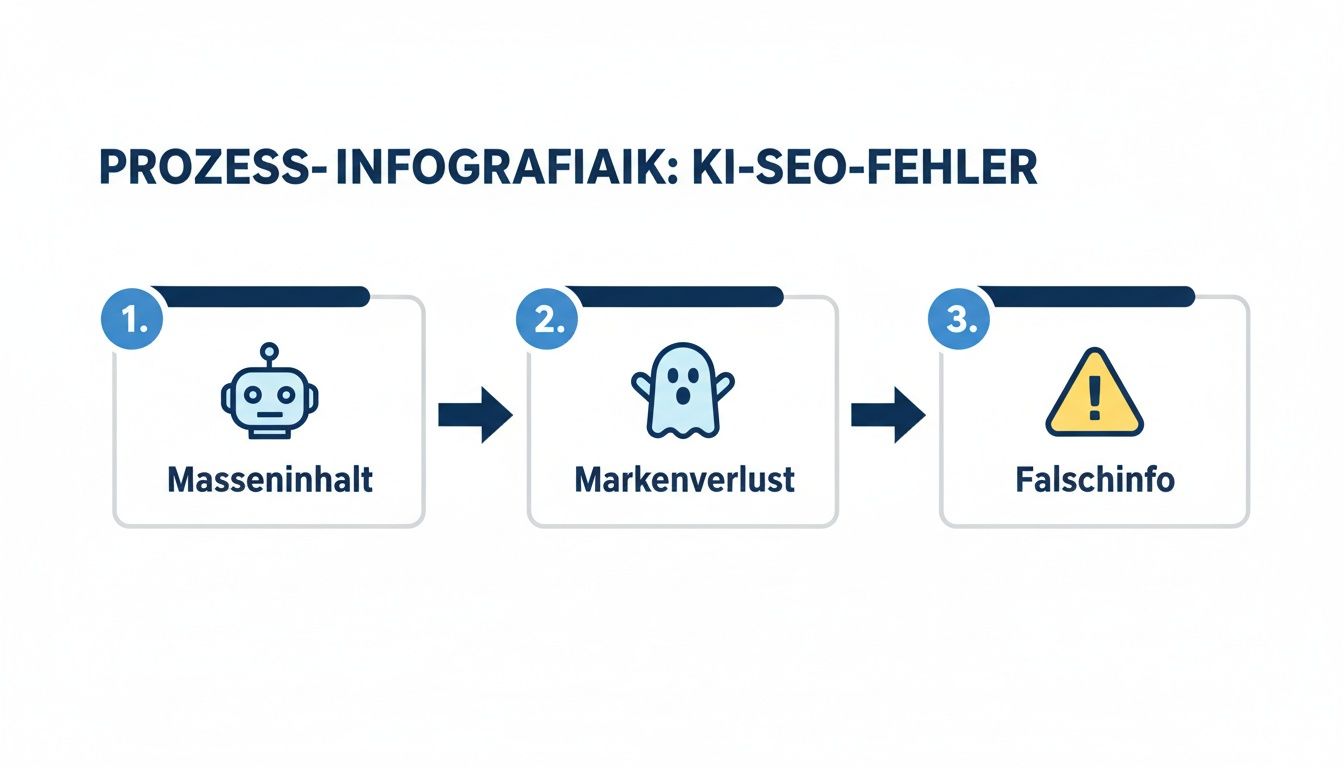
The unreflected mass production of content leads to brand confusion and misinformation, which undermines trust.
Use structured data and conversational search
Another decisive factor is the consistent use of structured data (Schema.org). These markups help machines understand your content by giving information a clear context. This increases the chance of appearing in AI-generated answers or rich snippets.
At the same time, search behavior is changing towards conversational search. People are increasingly entering entire questions instead of individual keywords.
- Identify the typical W questions (Who, What, When, Where, Why, How) in your niche.
- Structure your texts so that they answer these questions directly.
- Use FAQ areas to address common concerns in a bundled manner.
Put yourself in the shoes of your customers: What question would they ask an expert? Give exactly this answer on your website — clearly and directly.
Use AI tools strategically
Use AI tools as assistants, not as authors. Use the strengths of AI for preparatory work to save time without sacrificing quality control.
- Keyword research & cluster analysis: Identify topic clusters and niche keywords.
- Find content gaps: Analyze which questions your competition is leaving unanswered.
- Create outlines: Get suggestions for a logical structure that you fill with your expertise.
By using AI for research and structuring, you gain time for what's important: writing unique, helpful content. For more optimization tips, check out our guide to SEO app.
Summary and next steps
AI SEO is not reinventing search engine optimization, but sharpens the focus on tried and tested principles. High-quality, user-oriented content, a technically flawless website and verifiable authority (E-E-A-T) are more important today than ever. AI forces us to move away from pure keyword optimization and instead create comprehensive thematic depth. Structured data is essential to make the context of your content understandable to machines. Use AI tools strategically to support research and analysis, but maintain creative and content control. Human expertise remains your decisive advantage.
Would you like to prepare your SEO strategy for the age of AI? A powerful SEO software can help you make data-based decisions and keep track of things. For local companies, our specialized marketing software customized solutions to strengthen your visibility.