How AI is changing search: From links to answers
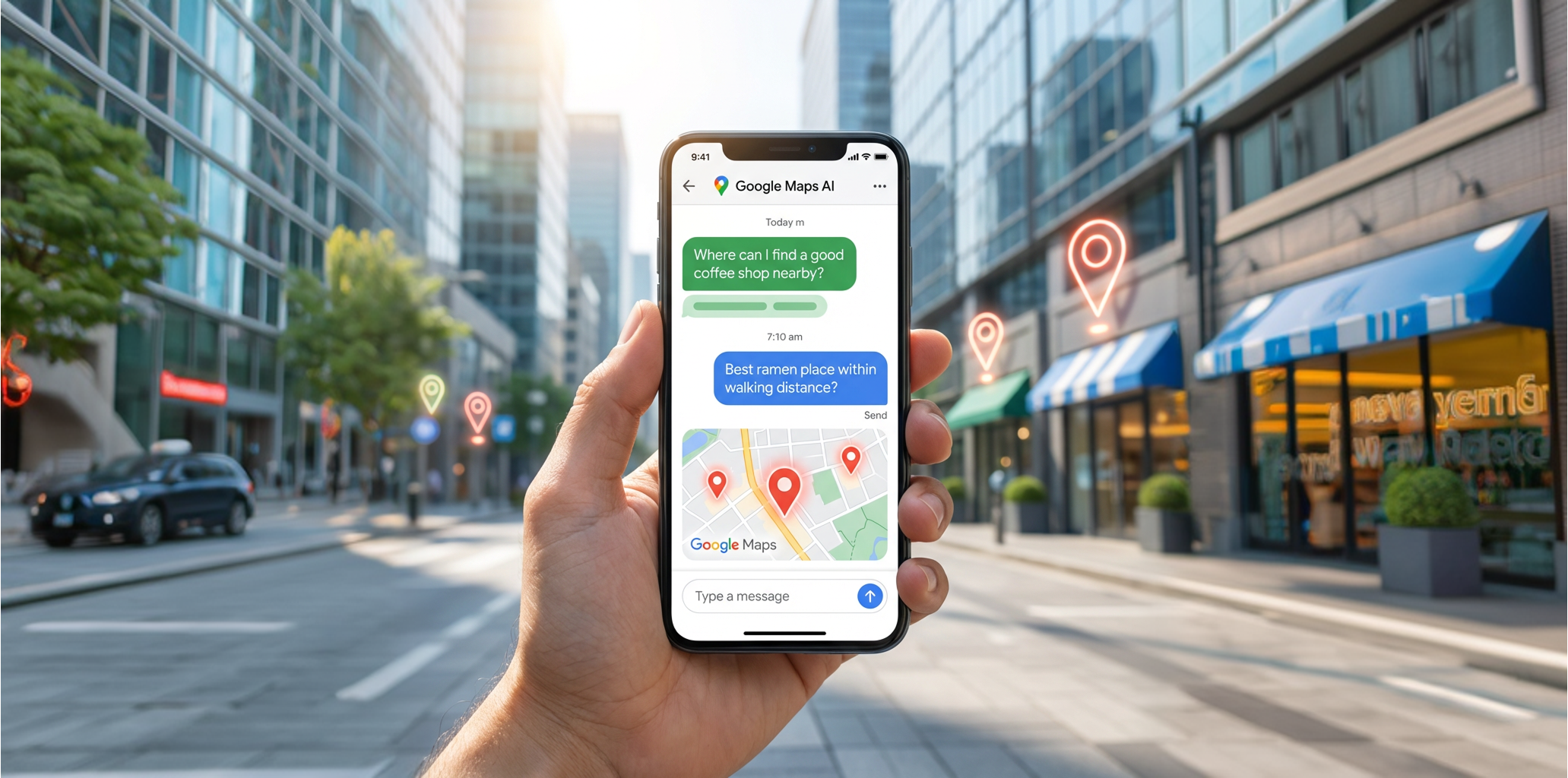
Artificial intelligence is revolutionizing local searches from the ground up. Instead of a simple list of blue links, searchers are increasingly getting a direct, summary answer. That changes everything about how potential customers find your business.
The change is most noticeable in the search queries themselves. People today formulate their wishes much more precisely, almost like in a conversation.
- Formerly: “Pizzeria Berlin”
- Today: “Where can I find a quiet pizzeria with gluten-free options that is open right now?”
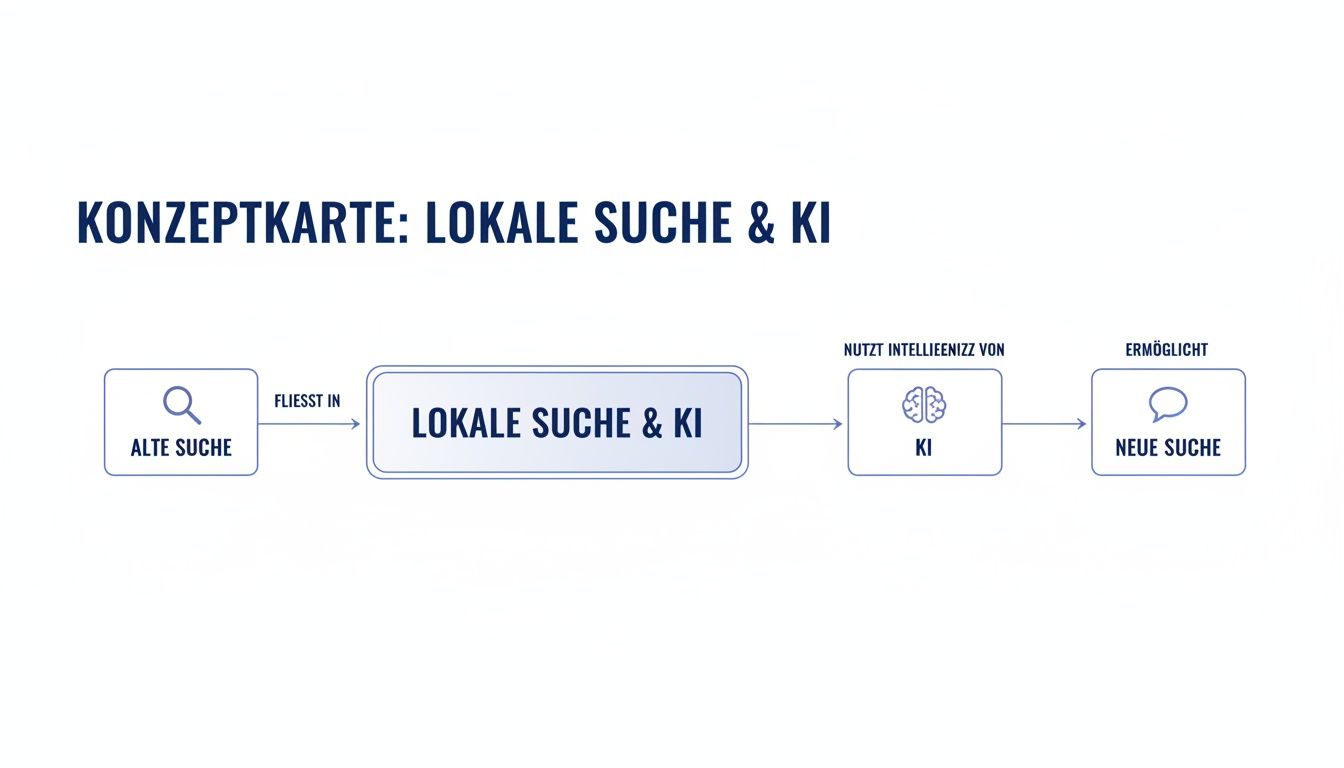
For this new type of search, AI is taking on the role of a digital research assistant. She no longer just clicks through websites, but actively collects information from various sources in order to provide a tailor-made, immediate answer. This development leads to more “Zero-click searches”: Users get their answer without even having to visit a website. Visibility directly on the Google results page is thus becoming the new currency.
Sources of information about AI and the consequences for SEO and AI
To answer a complex question, AI taps into an entire network of data: your Google company profile, customer reviews, your website, and other online directories.
Let's imagine a specific search query: “Which plumber in Bühl offers 24-hour emergency service and has good reviews? “This is how AI thinks:
- Understanding intent: It breaks down the question into its components: service (plumber), location (Bühl), feature (24-hour service) and quality signal (good reviews).
- Merge information: It specifically scans Google company profiles, reads service descriptions, checks opening hours and even analyses the undertone of recent customer reviews.
- Provide an answer: Based on this data, she formulates a direct answer, such as: “The Müller plumber service in Bühl has a 24-hour emergency service. In the reviews, customers often praise the quick help. Here is the phone number...”
An incomplete profile or missing information means that you remain invisible to relevant inquiries. Every detail of your digital presence — from the listed services to answers in the Q&A area — is now direct fodder for AI.
What remains unchanged: SEO basics in the age of AI
Even though AI changes our tools, the basic principles of SEO remain. Modern algorithms are trained to recognize and reward genuine quality. AI is therefore no substitute for a solid foundation — it is the best amplifier for it.
The core of every sustainable SEO strategy can be summarized with Google's E-E-A-T concept: Experience, Expertise, Authoritativeness, and Trustworthiness (Experience, expertise, authority, and trustworthiness).
E-E-A-T in local practice
For a local business, it's about sending clear signals that convince both people and AI.
- Experience (Experience): Show me what you can do. Authentic customer reviews, case studies on your website, or Google posts with before-and-after images prove your experience.
- Expertise (Expertise): Position yourself as an expert. Detailed descriptions of your services that include not only What, but also that Why Explain, do this.
- Authoritativeness: Build local authority. Consistent company data (name, address, telephone number) in all important online directories signals to Google that your company is established.
- Trustworthiness (trustworthiness): Gain trust. Real, positive reviews and professional, timely responses to any feedback are critical to this.
A solid foundation of trust and expertise is the best preparation for the future of AI. Artificial intelligence rewards exactly the quality signals that have always been at the heart of good SEO work.
Another key factor remains User experience (UX). A slow, confusing, or mobile-unusable page leads to poor user signals that have a negative impact on your ranking. The foundations for successful local search engine optimization are therefore more relevant than ever. Find out more in our comprehensive guide to Local SEO.
AI-friendly content: formats that machines understand
For an AI to rate your offer as highly relevant, content must be prepared in a language that machines can easily understand. It is about structure and clarity.

The foundation: structured data (schema markup)
Structured data are digital labels that clearly explain information on your website to search engines. They translate your content into accurate, machine-readable language. The AI thus knows exactly that “20" is a price in euros and not a house number. Without these “labels,” the AI is just guessing.
Key scheme types for local businesses:
- Local Business: Define your company, address, telephone number, opening hours.
- Service: Clearly describe your services.
- Review/aggregaterating: Indicates customer reviews.
- FAQ page: Signals a page with frequently asked questions and answers.
Provide clear answers with FAQ pages
A well-structured FAQ (Frequently Asked Questions) page is an extremely effective format. It answers the exact questions of your potential customers and provides concise, direct answers. This question-answer structure is perfect for AI to process and is often displayed directly in search results.
The power of well-structured articles
Classic blog articles remain relevant when they have a logical and clean structure.
- Clear hierarchy: Use headings (H2, H3, H4) correctly to organize topics logically.
- Short paragraphs: Focus on one central idea per paragraph.
- Lists and tables: Bullet points and tables help machines capture data quickly.
These formats are a crucial component of any modern content marketing strategy.
SEO and AI roadmap: Your strategic steps
Getting started with linking SEO and AI is a systematic process. This roadmap serves as a practical guide to prepare your local SEO strategy for the future.

Step 1: Check the foundation
Before you use AI tools, the basis must be right. AI models only work with the information they find about your company.
- Check your Google business profile: Is every area filled in completely and precisely? This is the primary source for Google. Learn more about how to your Optimize your Google My Business profile.
- Analyze customer reviews: Which topics and questions come up again and again? This provides starting points for new content.
- Reconcile website data: Do your name, address, and telephone number (NAP data) match your Google profile exactly? Inconsistencies undermine trust.
Step 2: Experiment with AI tools
Create initial touchpoints with AI to speed up routine tasks
- Generate ideas: Use tools such as ChatGPT or Google Geminito get ideas for Google posts or blog articles.
- Design answers: Let AI create designs for responses to customer reviews, which you then personalize.
- Identify customer questions: Ask the AI directly: “What questions do customers have before they book [your service]? “The answers are a goldmine for new FAQ pages.
Step 3: Establish processes and measure success
Develop simple routines and understand the impact of your actions.
Define clear processes, such as responding to every new review within 48 hours. A consistently implemented process is worth more than a complex strategy that no one follows.
Focus on tangible metrics such as the number of calls or route planning via your Google business profile. A first-class Placement on Google depends more and more on how well and quickly you answer the questions of potential customers.
Summary and next steps
Integrating AI into your SEO strategy is an ongoing process. The change from the classic link list to direct AI answers requires a solid database and AI-friendly content formats. At the same time, SEO basics such as E-E-A-T and a positive user experience remain decisive. Start with a clear roadmap: Review your foundation, experiment with accessible AI tools, and measure the results that really matter for your local business.
Do you want to ensure that your company is at the forefront of the AI era? The SocialEdge team helps you to optimally set up your Google company profile and thus attract more customer inquiries in the long term. Discover now how we can increase your local visibility.