Short-term measures: Quick results for your Google ranking
You can implement these levers immediately and often achieve visible improvements within a few weeks. They form the basis for sustainable success.
1. Fully optimize your Google business profile
The foundation for your local Improve Google's ranking A fully optimized Google company profile is available. Think of it as your digital storefront on Google Maps and local search. Google has been shown to prefer profiles that are detailed and up to date, as they offer users the most added value. A patchy profile is a missed opportunity to build trust and send important ranking signals.
effect: A high level of completeness signals relevance and engagement to Google. Each completed area provides the algorithm with valuable information about what you offer and which search queries you're relevant to.
Typical mistake: The profile is created once and is then no longer maintained. Missing photos, outdated opening times or an uninspired description lead to poorer rankings.
Specific actions:
- Visual content: Upload at least 30-50 high-resolution photos (exterior and interior views, team, products/services). Add a short presentation video (30-60 seconds).
- Company description: Use the 750 characters to present your company and integrate important local keywords (e.g. “certified electrician in Munich-Schwabing”).
- Use attributes: Add specific features that customers are looking for (such as “wheelchair access,” “free parking,” “card payment available”).
- Regular care: Update opening hours proactively before holidays.
A carefully maintained profile pays off directly with more calls, website clicks and store visits. Detailed instructions can be found at Google company profile optimization on socialedge.ai.
2. Select strategic categories
Choosing the right categories in your Google business profile is a powerful lever. You tell Google which customer needs you are the right solution for. An ill-considered or too general selection severely limits your ranking potential.
effect: A precise main category combined with relevant secondary categories expands the range of search queries for which you are visible. Google therefore not only understands your core business, but also your specializations.
Typical mistake: Only a single, very general category such as “service provider” is chosen instead of using specific categories such as “building cleaning” or “window cleaner.”
Specific actions:
- Specify the main category: Select the most specific category that describes your core business in detail. Instead of “Restaurant,” choose “Italian Restaurant.”
- Use secondary categories: Add up to nine more categories that represent your key services (e.g. “dental clinic” as the main category, “orthodontist” and “implantology” as secondary categories).
- Competitor analysis: Analyze the categories of top 3 competitors for your most important keywords to find valuable suggestions.
- Avoid irrelevance: Don't add categories that are only marginally related to your offer. This weakens the relevance for your core business.
3. Publish Google posts regularly
Google posts are short messages that appear directly on your company profile. They work like mini blog posts and are displayed prominently in search and on maps. Regular posts signal to Google that your company is active and engaged.
effect: Each post offers the opportunity to place relevant keywords and to demonstrate that your profile is up to date. Google rewards this activity because it provides users with real-time value.
Typical mistake: The function is not used at all or is only used sporadically. Contributions without a clear call to action are missing their potential.
Specific actions:
- Frequency and planning: Publish at least one post per week A simple editorial plan for offers, news or seasonal tips helps.
- Use call-to-action (CTA): Use the integrated buttons such as “Call now,” “Book an appointment,” or “Learn more.”
- Visual design: Use high-quality images or short videos. Images with text overlays that summarize the offer often get a higher click-through rate.
- Diversity of content: Mix different types of posts to keep the content interesting for your followers (product presentation, event announcement, employee portrait).
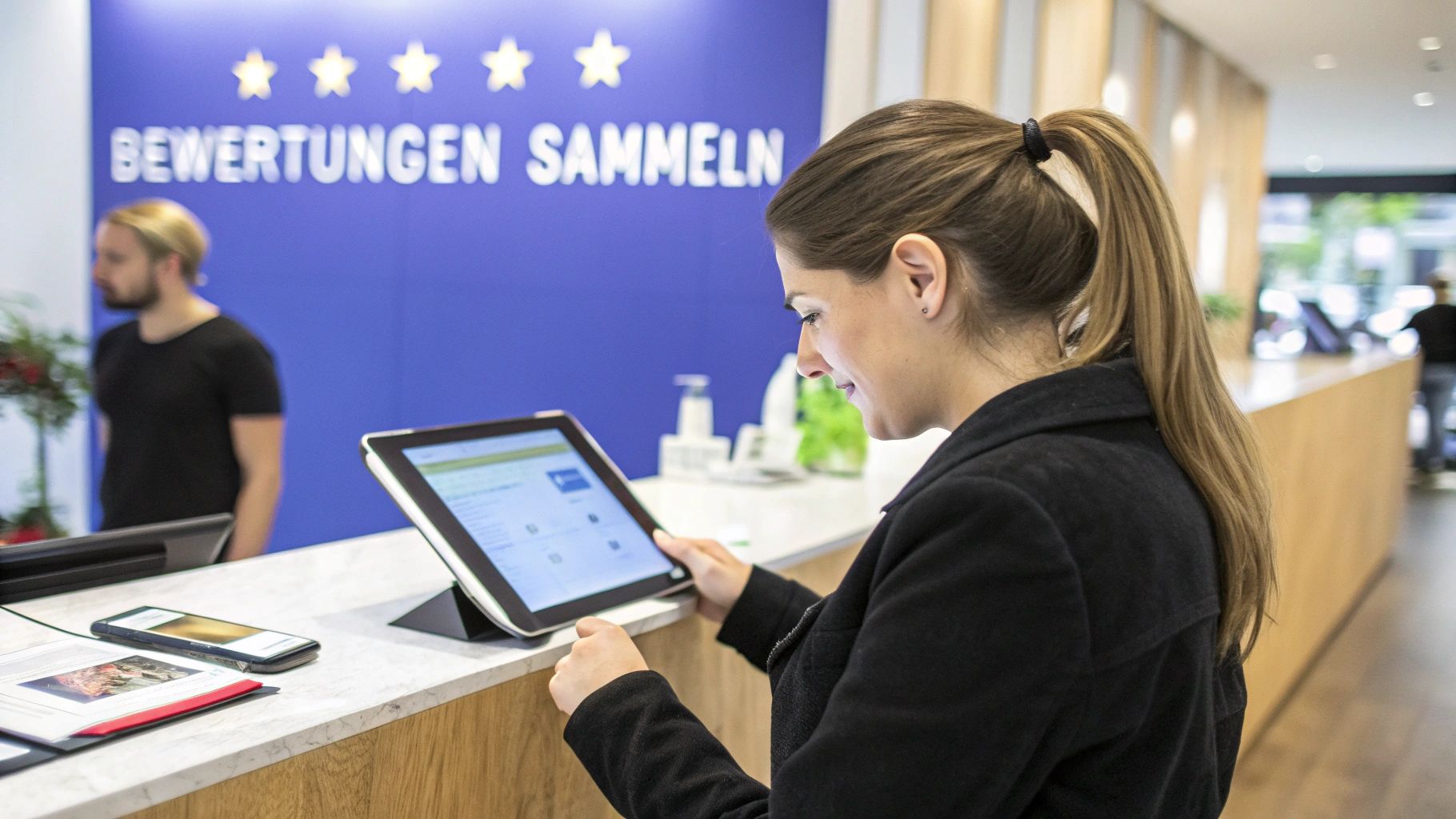
4. Actively collect and respond to reviews
Positive reviews are the digital currency of trust and a critical ranking factor. Google regards a high number of authentic, positive reviews as a strong signal of quality and relevance.
effect: A continuous flow of new reviews signals to Google that your business is active and popular with customers. This social proof not only convinces the algorithm, but also potential new customers.
Typical mistake: Passively waiting for reviews and not responding to negative feedback This gives the impression that customer reviews are not appreciated.
Specific actions:
- Ask proactively: Ask satisfied customers for a review right after a successful service.
- Remove barriers: Make it easy for customers. Use QR codes on invoices or an email link that leads directly to the review page.
- Respond to every review: Respond consistently within 24-48 hours. Thank you for positive feedback and show empathy and a solution-oriented attitude when criticized.
Active reputation management is a powerful tool. To make this process easier, learn how a SEO app that can optimize reputation management.
Long-term measures: sustainable dominance in local search
These strategies require more time and planning, but they cement your position at the top and create a lasting competitive advantage.
5. Ensure NAP consistency (Local Citations)
NAP stands for Name, address, and telephone number. The absolute consistency of this data across the Internet is a fundamental factor. Google collects information from many sources (such as business directories) to verify the trustworthiness of your company.
effect: The more high-quality and consistent online citations (local citations) Google finds, the more certain the search engine is that your company is genuine and active. This leads to better rankings.
Typical mistake: Different spellings of the address (“Hauptstr. 10” vs. “Hauptstraße 10”) or outdated telephone numbers in various directories that undermine Google's trust.
Specific actions:
- Define a central data source: Set an exact, official spelling for your name, address, and phone number and use it everywhere.
- Check existing entries: Review your data on all major platforms (Google, Bing, Apple Maps, Facebook, business directories) and correct discrepancies.
- Create new entries: Create new, consistent entries in relevant, high-quality online directories. Here, quality comes before quantity.
You can find more information about this in the article on Business directory entry on socialedge.ai.
6. Optimize local content on the website
While your Google business profile is your business card, your website is the foundation. Google analyzes your site's content to rate your relevance to specific searches and locations.
effect: Specially optimized local landing pages unequivocally signal to Google which service you stand for at which location. This link strengthens your profile's signals and is rewarded with better visibility.
Typical mistake: A single “contact” page for multiple locations, or the lack of content that provides a clear local connection (such as mentioning neighborhoods or local landmarks)
Specific actions:
- Create location pages: Create a separate subpage for each physical location. Include the location name in the H1 heading, URL, and meta description.
- Use geo-keywords: Use combinations of your service and the city or district organically in your texts.
- Include local schema data: Implement the “localBusiness” schema markup to deliver your data to search engines in a standardized format.
A well-thought-out local content strategy is a sustainable way to prove your expertise. More about this in the Content marketing strategy guide on socialedge.ai.
7. Use high-quality photo and video content
Visual content is critical to Improve Google's ranking to be able to. A profile with a rich collection of photos and videos signals authenticity and demonstrably increases user engagement.
effect: Google rates high user engagement (long time spent, many clicks on images) as an indicator of relevance and quality and rewards this with better visibility. Visual content also answers unspoken customer questions.
Typical mistake: Upload few, outdated, or unprofessional images Stock photos look impersonal and don't inspire trust.

Specific actions:
- Regular updates: Upload 2-4 new, authentic photos a week (e.g. with your smartphone) to signal that they are up to date.
- Professional start: Invest once in professional photos of your team, premises and services.
- Optimize files: Name image files with relevant keywords (e.g.
herrenhaarschnitt-friseur-berlin-mitte.jpg) and keep the file size small.
8. Build local backlinks and partnerships
Links from other relevant and trustworthy websites act as digital recommendations for Google. They signal to the algorithm that your company is a recognized authority in your region.
effect: The more high-quality, thematically appropriate local links point to your website, the stronger your ranking foundation becomes. A link from the local Chamber of Crafts weighs more than dozens of links from irrelevant directories.
Typical mistake: to buy links from low-quality or thematically inappropriate sites. This can be considered spam by Google and result in penalties.
Specific actions:
- Industry directories & associations: Sign up for the most important industry books and associations in your niche.
- Local partnerships: Collaborate with complementary, non-competing companies in your area and link each other to partner sites.
- Local sponsorship: Support a local sports club or cultural event. Sponsors often receive a mention with a link on the organizer's website.
Building a strong local link profile is a long-term strategy that solidifies your authority. This procedure is part of a comprehensive concept for local SEO. Read more about the basics at Local SEO and the key factors for success on socialedge.ai.
Summary: Your simple action plan for better Google rankings
Getting to the top of local Google results requires a structured and continuous process. It is not a question of starting dozens of measures at the same time, but of consistently using the right levers.
Your specific 3-step roadmap:
- Create a foundation (Next week):
- Get Google business profile up to 100%: Review and complete each area (NAP, opening hours, services, attributes).
- Optimize categories: Select the most specific main category and relevant secondary categories.
- Enable initial reviews: Actively ask your last five satisfied customers for an honest Google review.
- Signal activity (next month):
- Publish posts regularly: Schedule a fixed appointment per week for a Google post.
- Maintain visual content: Upload a new, authentic photo every week.
- Respond to every review: Respond to every new review within 24 hours
- Build authority (next 6 months):
- Create local content: Write a subpage or blog article that answers an important local customer question.
- Use local partnerships: Actively seek a backlink from a local partner (e.g. association, complementary company).
- Analyze competition: Check the profiles of your top 3 competitors on a monthly basis and learn from them.
By consistently following this roadmap, you transform knowledge into measurable results. Not only will you improve your Google ranking, but you'll also build stronger ties with your local customers.
Do you lack the time or know-how to consistently implement these steps? SocialEdge specializes in using exactly these levers for local companies. Focus on your core business while we take your digital visibility to a new level. Find out more at SocialEdge.