Why deleting a Google review is so complex
Every entrepreneur who receives a review that is considered unjustified for the first time wants to remove it quickly. However, the reality is different. Google acts as a neutral platform and only intervenes in the event of clear violations to protect the integrity of the rating system. If every review were deleted upon request, the trust of users would be lost.

The importance of online reviews has increased significantly in recent years, which makes the topic of “delete a Google review” all the more relevant. Studies show a significant increase in the number of reviews among companies.
Read at the same time, according to BrightLocal 98% the consumer online reviews, where 87% rely specifically on Google. These figures illustrate the significant influence of reviews on purchasing decisions.
What makes a Google review deletable?
Google has a detailed catalog of guidelines. Only if a review clearly falls into one of the prohibited categories is there a realistic chance of removal. Subjective criticism, even if negative, is seen by Google as valuable feedback for other users.
The most common reasons that can lead to deletion are:
- Conflict of interest: Reviews from (former) employees, direct competitors, or people who were obviously paid for it.
- Hate speech or harassment: Personal attacks, threats, or discriminatory statements.
- Irrelevant content: Comments that have nothing to do with customer experience, such as political opinions.
- Fake content and spam: Reviews of fake profiles, bots, or repeatedly posted identical content.
The table below gives you a quick overview.
Overview of deletable vs. non-deletable Google reviews
This table shows which types of Google reviews have a chance of being deleted and which usually persist.
Evaluation type (example) Reason for possible deletionTypically persists because... “This is the worst store in town! The owner is a fraud! “Insult, potentially false statement of fact, personal attack. Violates guidelines. -- “I didn't like the food. The sauce was too salty. “--This is a subjective opinion and is protected by freedom of speech. One-star review without text spam or fake content (if verifiable, e.g. from a bot profile) .Hard to prove that it wasn't a real customer. Often seen as a legitimate expression of opinion. “I've never been there but my friend told me that... “The evaluation is not based on personal experience. -- “The parking lot was full and the music was too loud. “--Describes a real, albeit negative, customer experience.
In the end, it is always a tightrope walk. A demonstrably false claim is different from an unpleasant opinion.
A subjective opinion such as “I didn't like the food” is protected by freedom of speech and cannot be deleted. On the other hand, a demonstrably false statement of fact such as “The restaurant uses expired food” can be legally contestable.
The proactive way: reputation management for your company
Instead of just focusing on getting negative comments removed, a proactive approach is usually more effective. Effective reputation management means minimizing the potential damage caused by individual negative reviews by creating a solid basis of positive feedback.
A strong foundation of many satisfied customer testimonials makes occasional criticism less significant. This strengthens the trust of new customers. The basis for this is a well-maintained Business profile on Google. This is how you gradually regain control of your online image.
Report a Google review for review: The official way
If you discover a review that clearly violates Google's guidelines, the first and most direct way is to report it. This is the official first step towards an unjustified Delete Google Review to leave. Google has integrated this feature directly into your business profile.
The process starts in your company profile dashboard. From there, navigate to the “Reviews” section. There is a menu with three dots next to each review. Clicking on it opens the “Report Review” option, which starts the official review process on Google.
Formulate the message correctly for higher chances of success
After you click on “Report,” a form opens in which you must specify the reason for the report. This is a crucial step. A concise, well-substantiated report can make the difference between success and failure.
Avoid blanket terms such as “unfair” or “lie.” Instead, follow the violations defined by Google. Select the appropriate category:
- Conflict of interest: The review is from a competitor or a former employee.
- Spam: The content is advertising, irrelevant, or posted repeatedly by different accounts.
- Hate speech: The review contains discriminatory, racist, or offensive remarks.
- Not related to the topic: The content is not related to your business or customer experience.
Your argument should be factual and fact-based. The report is reviewed either by an algorithm or by an employee who has no previous knowledge of your case. The more clearly you explain the breach, the easier it is for Google to make an informed decision.
What happens after I report a Google review?
Patience is required after submitting the form. Google doesn't give a fixed time frame, but the audit can take from a few days to several weeks. Don't report the same review multiple times — it doesn't speed up the process. You will usually receive an email confirming receipt of your report.
Important note: A message does not guarantee deletion. Google is examining the case exclusively on the basis of its own guidelines. If the review is considered borderline but not a clear violation, it remains online.
If your report is rejected, that is no reason to give up. You can use the “Review Management Tool” on your Google profile to track the status of your report. If the review persists despite what you think is a clear violation, you can file an appeal. This escalated case is often reviewed by another team member at Google, which can increase the chances. Complete documentation and sharper argumentation are crucial here. In order to make optimal use of such features, a deep understanding of the tool is important. Our guide to the topic Manage Google business profile offers valuable help here.
Direct dialogue with the reviewer: An often overlooked solution
Not every critical evaluation requires immediate notification. The frustration is often a misunderstanding or a problem that can be clarified in direct conversation. Before you go down the formal route via Google, direct dialogue can be the fastest and most humane solution.
Try to look at the critique from the customer's perspective. An honest, solution-oriented approach is a sign of professionalism. It is not about urging the customer to change, but about understanding their concerns and finding a solution together.
When direct contact with the reviewer is worthwhile
An anonymous 1-star review without comment offers few points of reference. In other cases, however, direct contact is very valuable.
Talk to the customer directly if:
- You can identify the customer: They know who wrote the review and remember what happened.
- A specific problem is described: The criticism is about something tangible, such as a defective product or a long waiting period.
- There is a misunderstanding: The assessment appears to be based on incorrect assumptions.
Examples of wording for the right communication
The tone of voice is crucial. A public response is your calling card for all potential customers. A personal message, on the other hand, discreetly clarifies the situation in the background.
1. The public response — your figureheadThis response is visible to everyone and is an important part of your reputation management.
Dear [reviewer's name],
Thanks for your feedback. We're sincerely sorry to hear that your experience with us did not meet your expectations. We take your criticism very seriously. Please contact us directly at [your email address or phone number] so we can find a satisfactory solution for you.
2. The personal message — when you know the customerHere you can address the situation more directly and personally.
Dear Mr/Mr. [customer's last name],
We've read your review on Google and I'm very sorry that you were dissatisfied with [state a specific issue]. The satisfaction of our customers is our ultimate goal. Would you be open to a brief conversation so that we can discuss how we can make up for it?
3. A request for more details — if the evaluation is unclearSometimes a criticism is vaguely formulated. Ask questions to understand the issue.
Dear [reviewer's name],
Thank you for your review. We would like to follow up on your feedback, but we are unable to identify the incident at this time. Would you please briefly let us know at [your email address] when you were with us or what exactly it was about? Every comment helps us improve our service.
Responding actively is always better than waiting. Studies show that 56% of customers be drawn to brands that respond to reviews. A well-thought-out answer can not only win back an unsatisfied customer, but also convince new ones. Your entire customer communication should ideally be directed to your higher-level content marketing strategy be embedded.
Take legal action against a Google review
Sometimes a simple message isn't enough. If a review contains demonstrably false, defamatory, or business-damaging allegations, the standard reporting channels reach their limits. At this point, legal action should be considered to address such Delete Google Review to leave.
In Germany, the distinction between a permitted expression of opinion and an inadmissible statement of fact is decisive.
An opinion such as “The service was slow” is subjective and backed by freedom of speech. A statement of fact such as “The workshop uses stolen spare parts”, on the other hand, must be provable. If it is not, there is an infringement of the law.
The fine line: opinion vs. false statement of fact
Understanding this difference is fundamental. An expression of opinion is a personal value judgment that cannot be objectively classified as “true” or “false.”
A statement of fact relates to specific, verifiable circumstances. If someone claims facts that are demonstrably incorrect and damage your reputation, you have legal options.
The crux of the matter here is almost always the burden of proof. They must be able to explain conclusively why a statement is a false fact and not just an exaggerated but still valid opinion.
File a complaint using the Google legal form
Google has set up a separate channel for these serious cases: the form to report legal violations. This process requires significantly more substance than a simple message.
They must argue precisely which specific law the assessment violates. Complete documentation is essential:
- Screenshots: Save the reviewer's rating and profile
- Internal documents: Collect documents that refute the claims (e.g. customer lists, invoices).
- Clear reason: Explain factually why it is a defamation or a false statement of fact.
Since Google Reviews make up a majority of online reviews, a single reputation-damaging review can have a significant impact. More about Google rating statistics can be found at taggbox.com. In serious cases, this justifies legal action.
When an IT law lawyer makes sense
If Google does not respond to your complaint via the legal form or only responds with a standard answer, it is advisable to involve a lawyer specialized in IT law. An expert can increase pressure on Google and formulate the legal argument in a targeted manner.
The cost of hiring a lawyer is an investment that can be worthwhile compared to the potential loss of revenue from a defamatory review. An initial consultation often provides clarity about the chances of success.
The first step is often clarifying the customer identity. This decision tree shows how you can proceed based on this.
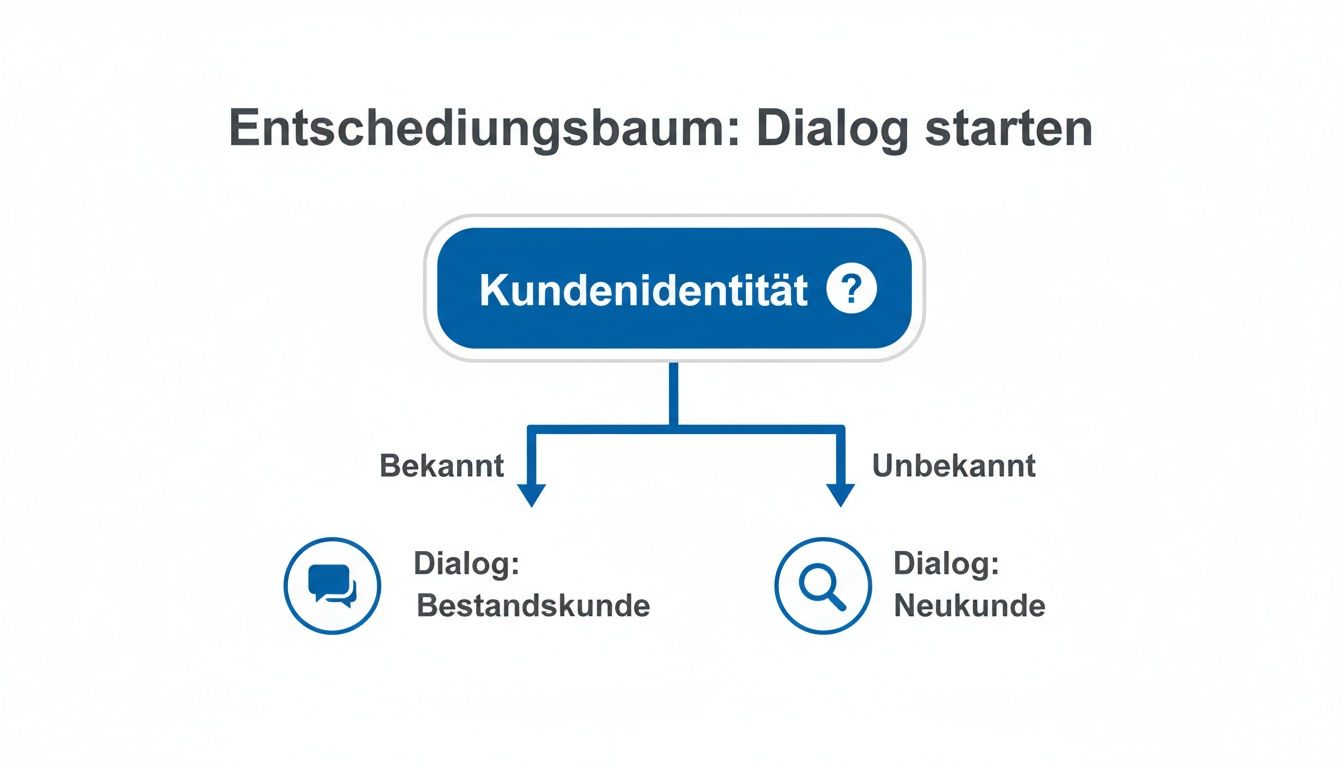
The graphic shows that the direct dialogue only works with known customers. Anonymous reviewers often only have the formal or legal way to protect your company.
Proactively build a strong online reputation
Instead of just reacting to negative feedback and hoping that a single Delete Google Review To be able to, a proactive approach is more effective. A strong foundation of many authentic, positive voices is the best shield against the damage caused by individual negative comments.

The trick is to systematically ask satisfied customers for a review. Many don't think of writing a review of their own accord, even if they were satisfied. A friendly, well-timed request can make a big difference here.
Ask satisfied customers specifically for Google reviews
Integrate feedback requests into your existing processes to generate a steady stream of positive feedback.
Here are a few best practices:
- QR code in store: A display at the counter or a note on the invoice with a QR code to your Google profile.
- Link in email signature: A discreet link in the signature of your business emails.
- After project completion: A personal or email request for a successfully completed service.
- On the “thank you” page after an online purchase: Take advantage of the positive moment right after the purchase.
These consistent efforts result in an impressive number of positive reviews over time. A effective CRM system can support this process.
Current and numerous reviews signal to potential new customers: This company is active, is appreciated and consistently delivers good quality.
The power of the quantity and timeliness of Google reviews
The influence of Google reviews on local rankings has increased significantly in recent years. Since deletion attempts are often unsuccessful, collecting good reviews becomes all the more important. Studies show that 59% of users more than 20 reviews want to read and 53% particularly on recent reviews pay attention.
Generating fresh reviews on a continuous basis is your most powerful weapon in reputation management.
When you create a solid basis of positive feedback, a single negative review becomes a barely noticeable outlier. This not only strengthens your image, but also improves your visibility in local search — a key aspect for successful Local SEO.
Summary: The right strategy for your business
One Delete Google Review Letting go is often a lengthy process with an uncertain outcome. A single tactic rarely achieves the goal; a well-thought-out, multi-pronged strategy is required.
If a review clearly violates Google guidelines, report it with specific reasons. In the case of comprehensible criticism or misunderstandings, direct dialogue with the reviewer is often the better way. However, the most effective protection against bad reviews is a proactively built, excellent online reputation. A negative voice loses weight when it is drowned out by dozens of positive comments.
Focus on providing outstanding service and actively asking satisfied customers for feedback. A professionally maintained Google company profile is a direct investment in your visibility and success.
Do you need help with your reputation management? Please feel free to contact us for a non-binding consultation. Together, we develop the best strategy for your company.
Delete Google reviews: Frequently asked questions
Here you can find answers to the most common questions about Google reviews.
How long does it take Google to respond to a report?
There is no standard answer to this question. The duration of the audit at Google can vary from a few days to several weeks. Google itself does not give a fixed time frame.
Our advice: Once you've reported the review, keep calm. Reporting the case repeatedly does not speed up the process. It can only be useful to contact you again if you have new, solid evidence.
Can I have a review removed by an ex-employee?
Yes, the odds are good here. Reviews from former employees provide a clear conflict of interest and therefore violate Google's guidelines.
When reporting, choose the reason “conflict of interest.” If you can prove your former employee status (e.g. through an employment contract), your prospects improve.
Google regards conflicts of interest as critical as they undermine the platform's credibility. Reviews are intended for real customer experiences, not as an outlet for personal or professional disputes.
What is the difference between reporting and making a legal complaint?
These are two fundamentally different approaches that are often confused.
- Report a review: This is the standard way via your company profile. You use it when a review is against Google content guidelines violates (e.g. spam, hate speech, conflict of interest) This is always the first point of contact.
- File a legal complaint: You choose this route if the rating is against applicable German law violates, i.e. fulfills facts such as defamation, slander or demonstrably false statements of fact. This process is more formal and often requires legal support and solid evidence.