What “Google local services” really means
When it comes to this term, many entrepreneurs either only think of paid ads or confuse it with their Google business profile. In fact, it's a combination of multiple interlocking components that work together to improve your visibility in the local environment.
It can be thought of as a system with three pillars, each of which performs its own task. Understanding this distinction is an important step for an effective local marketing strategy. Without this clarity, there is a risk of investing time and money in the wrong channels.
The three pillars of local visibility on Google
The basic idea behind this system is to quickly and easily present suitable local providers to searching customers. Google has created three main tools for this purpose, which are often referred to as the umbrella term Google local services The following are summarized:
- Google Business Profile (formerly Google My Business): This is your free, digital shop window and the central point of contact for all important information such as address, opening hours, photos and customer reviews. A well-maintained profile is the basis for all further measures.
- Organic search in Google Maps: When someone searches for “hairdresser near me,” Google Maps shows relevant stores on a map. Your placement in these unpaid results depends directly on the quality of your company profile and others Local SEO factors off.
- Local Services Ads: This is a special paid ad format that appears at the top, above normal search results. These ads are available for specific industries, such as tradesmen or lawyers, and require a “Google Verified” certification.
It is important to understand: Your Google company profile is the foundation. Without a strong, well-maintained profile, not only does your visibility in Google Maps search suffer, but the effect of potential ads is also limited.
The following concept map shows how these three elements work together and form a system for local services on Google.
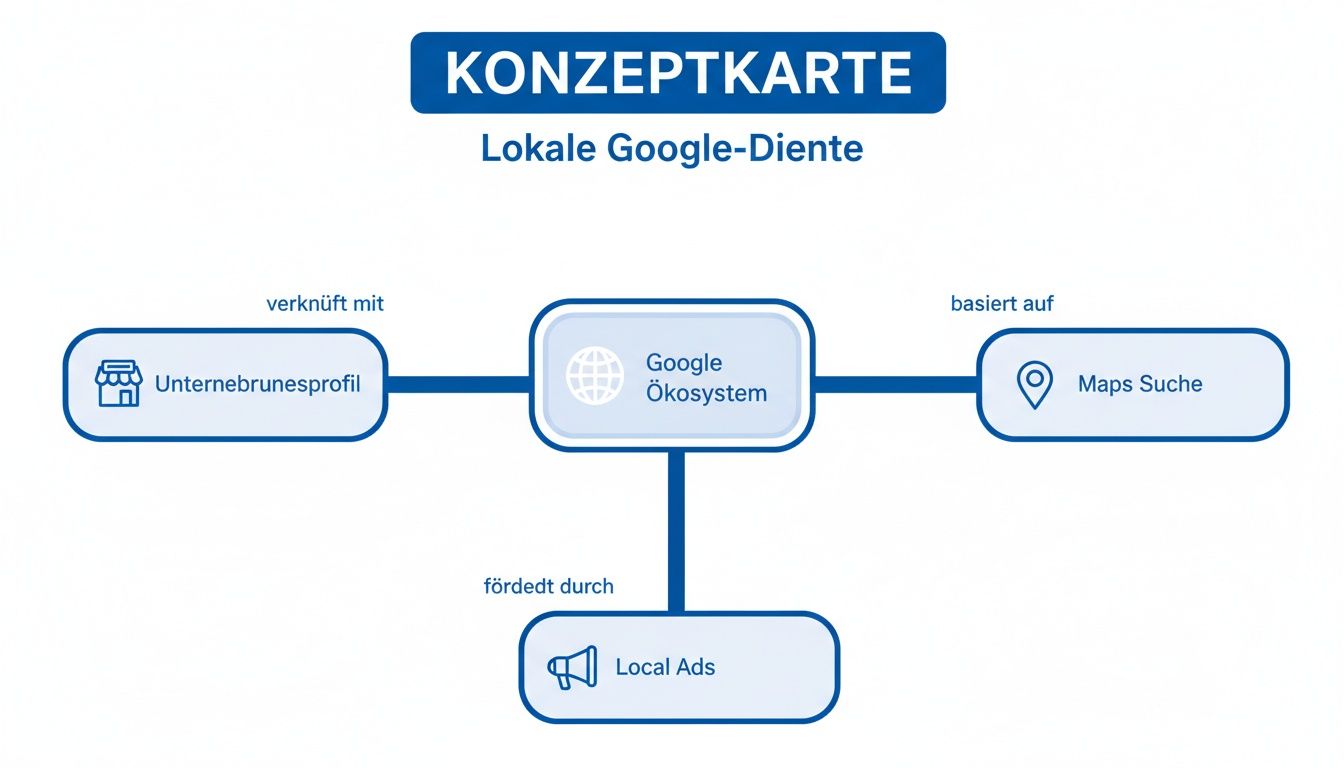
It's clear that the company profile is the central source of information that feeds both unpaid maps searches and paid ads. Understanding the role of each component is essential to finding the right strategy for your business.
A direct comparison helps to make these differences even clearer.
An overview of Google's local services system
This table compares the three core components, which are often summarized under the term 'Google local services, 'and shows their main purpose, cost model and ideal target group.
componentPrincipal purpose cost modelIdeal forGoogle company profileDigital business card, information center, basis for visibilityFreeAny company with a physical location or a local service areaOrganic maps searchUnpaid visibility in local search results and on the mapFreeCompanies that want to be found organically through good reviews and an optimized profileLocal Services AdsTop rankings for qualified leads, generation of direct inquiriesPay per leadService providers (e.g. tradesmen, lawyers) who want to generate calls and orders immediately
Each of these parts has its own justification. While the company profile forms the indispensable basis for everyone, Local Services Ads are a targeted, paid addition for specific industries that need leads quickly.
Google Business Profile vs. Local Service Ads: The Differences
If you want to be successful in local competition, you should know the two most important tools in the Google universe for local services and use them correctly: the Google company profile And the Local Services Ads (Local service ads). Even though they both increase your visibility locally, they pursue different approaches and goals.
Imagine your Google company profile Like the digital foundation of your business. It's free, accessible to everyone, and essential these days. Here, you bundle all important information as a digital figurehead: opening hours, address, telephone number, your services and — crucially — the opinions of your customers in the form of reviews. A well-maintained profile creates trust and attracts customers organically, i.e. without ongoing advertising costs.
Die Local Services Ads On the other hand, they are a highly specialized, paid channel that can provide you with verified and ready to buy customers. This ad format isn't available for every industry and requires verification by Google to earn the “Google Verified” seal. The advantage: You don't pay for clicks, but per qualified request (lead). This makes the investment predictable.
The foundation: Your Google company profile
Whether it's a hair salon, a law firm or the restaurant around the corner — every local company needs a fully optimized Google company profile. It is the basis of your visibility in Google search and Google Maps. When potential customers in your area search for what you offer, your profile is often the first point of contact.
Maintaining this profile is not a one-time task, but a continuous process. Current information and regular activity signal to Google's algorithm that your company is relevant. Detailed instructions on how to properly build and maintain your profile from scratch can be found in our comprehensive article on Optimize your Google business profile.
A strong, organic foundation based on your company profile is a necessity. It is the most sustainable way to be found in local search results in the long term and without constant advertising costs.
The spearhead: Local Services Ads
Local Services Ads are a targeted, paid advertising campaign. They appear at the top of the search results page, even before the classic Google Ads and the “Local Pack” with the three map results. This top ranking is specifically intended for service providers with whom customers often need quick and reliable help — think of plumbers, electricians or locksmiths.
The key difference lies in the verification process. In order to get the “Google Verified” badge, companies must provide evidence of licenses, insurance and even background checks. This seal of approval is a strong signal of trustworthiness for seekers.
Which tool is right for you and when?
Whether you focus solely on your company profile or invest in additional Local Services Ads depends on your industry, goals, and budget.
A sole focus on the Google company profile is ideal when:
- You want to focus on sustainable, organic growth and build a basis of trust in the long term.
- Your industry is not (yet) approved for Local Services Ads.
- Your marketing budget is rather tight and you want to use free channels.
An investment in Local Services Ads can be worthwhile if:
- You work in a qualified sector such as crafts or legal advice and would like to generate qualified inquiries.
- You are willing to pay per specific lead in order to fill your order situation quickly.
- You want to use the “Google Verified” seal as a competitive advantage to set yourself apart from the competition.
However, the two tools are not mutually exclusive. A useful strategy is often a combination of both. A well-maintained company profile underpins the impact of your paid ads. This is because many customers who click on an ad then take a look at your profile to get a complete picture based on reviews and photos.
Why your store needs an optimized Google profile
A well-maintained Google company profile is more than just a digital business card. Think of it as a sales representative working around the clock for you in the local market and acquiring new customers. And that at no additional cost. It's not just about being found online, but about actively generating business.
Figures show how important this presence is. Click for local searches 42% of users directly to a result in the Google Maps Pack — i.e. to one of the top three entries. Companies with a full profile have a 70% more likely to attract visitors and become 50% more likely to be considered for a purchase.
These statistics make it clear that an optimized profile is a business necessity. It can decide whether a potential customer calls you or your competitor.
Your profile as a digital sign of trust
Imagine a scenario: Someone has a power outage at home. The person pulls out their smartphone and searches for “emergency electrician service in [your city].” Google immediately shows the Maps Pack with several providers.
- Profile A (your competitor): An old photo, few reviews, no current opening times.
- Profile B (your company): Professional pictures of the team at work, over 100 recent, positive reviews (which you've responded to!) , clear emergency service hours and a Google post that promises quick help in the event of a power failure.
Who will the customer call? The answer is obvious. At that moment, your profile is sending the right Trust signals. It conveys competence and reliability even before the interested party has seen your website.
An optimized Google business profile is your chance to make a good first impression. It answers the customer's unspoken questions: “Can I trust this provider? Is he professional? What do other customers say about him? ”
From visibility to direct sales
A well-maintained profile leads to specific actions that have a direct impact on your turnover. Each element — from photo to review — has the purpose of moving the user to the next step.
Especially for specialized local service providers such as occupational therapy practices, an optimized Google profile is essential to reach new patients. Good local findability can make the decisive difference here, especially when it comes to the right Occupational Therapy Practice Software , which also contributes to professionalization.
The most important revenue levers for your profile
Optimizing your profile is not an end in itself, but should trigger revenue-relevant actions. The most important levers are:
- More calls: The prominently placed “Call” button makes it easy to contact us.
- More directions: Clicking on the “Route” button means that the customer is already on his way to you.
- More website clicks: Interested parties who want to know more land on your website with one click.
- More direct interactions: Features such as the question-answer area or direct messages enable an uncomplicated dialogue.
An optimized profile for Google local services It is therefore not just a marketing tool. It is the direct bridge to the customer that can turn a simple search into an order or a shop visit.
The most important ranking factors for Google Maps
Have you ever wondered why a competitor appears in the top 3 results on Google Maps while your own store is barely visible? The answer lies in how Google's algorithm rates local businesses — and that's basically based on three clear pillars.
Google itself mentions these factors relevancy, distance and notoriety. You can only secure one of the coveted places in the “Maps Pack” if all three aspects are taken into account. Anyone who understands these factors can invest their time specifically in the measures required for Google local services Really bring something.
Relevance: The match with the search query
Relevance answers the question: How well does your company fit in with what the user is currently looking for? If someone searches for “Italian restaurant with terrace,” Google will prefer the profiles that clearly communicate exactly these criteria.
To verify this, the algorithm analyses your Google company profile.
- Business categories: Choosing the right main and secondary categories is crucial. An “Italian restaurant” as the main category and “pizzeria” as a secondary category tells Google precisely what you offer.
- Services and products: Go into detail. A plumber should not only be registered as a “plumber,” but should also list services such as “pipe cleaning” or “heating maintenance.”
- Description and contributions: Keywords in your company description and in regular Google posts also signal to Google which search queries you are relevant for.
The background: Google wants to provide its users with the most appropriate result. The more detailed and consistent information you give Google, the easier it is for the algorithm to recognize that you are the right answer to a search query.
Distance: The physical proximity
Distance is the most direct ranking factor. It describes how far away your company is from the searcher. When searching for “coffee shop near me,” it's logical that Google shows the cafes at the top that are just a few steps away.
You cannot directly influence this factor. However, it is important to know that Google calculates differently here. Sometimes the distance to the user's current location counts, other times the distance to the center of the location that is being searched for (e.g. “Steuerberater Berlin Mitte”).
Recognition: Your digital reputation
Reputation, often referred to as celebrity, measures how reputable and popular your company is online. It's about how often and in what context your company is mentioned on the Internet. There is a lot you can actively do here.
Decisive signs of awareness are:
- reviews: The number, average score, and timeliness of your Google reviews are an important ranking factor. Many positive and recent reviews signal to Google: This company is popular and trustworthy.
- Local citations: Uniform mentions of your name, address, and telephone number (the NAP data) in important online business directories strengthen your local authority.
- Backlinks: Links from other relevant, local websites — for example from a local sports club or a regional news site — are like valuable recommendations for Google.
A look into the future shows that the importance of profile activities and valuations will continue to grow. Forecasts assume that by 2026 entries and activities 32% and reviews 20% that will turn out ranking signals. At the same time, interactions such as time spent in maps are becoming more important. Read more about this development in this interesting article on local ranking factors on huenemohr.de.
In addition, user signals are also playing an increasingly important role. If users frequently click on your profile, call your phone number, or calculate the route to you, Google sees this as a positive sign. For a comprehensive plan of how to influence all of these signals in your favor, check out our guide, which will help you Improve Google Maps ranking Can.
Tutorial: How to optimize your Google business profile
A good ranking in the Google Maps Pack is the result of continuous work and maintenance. The following points are your practical checklist, with which you can systematically optimize your Google company profile and become a customer magnet for local services on Google be able to do.
With these measures, you have direct influence on the three major ranking factors: relevance, distance and awareness. If you work carefully here, you'll send Google the right signals.
Categories and keywords: Speak the language of Google
It all starts with clearly defining what you're doing. This is where you lay the foundations for how relevant Google regards your company for search queries.
Start with the main category on — it must get to the heart of your core business. Be as precise as possible. Instead of just “health,” you should choose “physiotherapist” or “dentist.”
After that, add as many suitable Subcategories Add how it makes sense. A restaurant with the main category “Italian restaurant” could, for example, also complement “pizzeria”, “restaurant with terrace” and “delivery service.”
Put yourself in the shoes of your customers: What search terms would they type in to find an offer like yours? It is precisely these terms that should be included in your categories and services.
But your most important keywords don't just belong to the categories. Of course, incorporate them into your business description and use them in Google posts when you report on new offers. Here's how to give Google more context. When you're at the very beginning: Our guide shows you how to start a Create a Google business profile.
Photos and videos: Show who you are
A picture is often worth a thousand words. Professional, up-to-date photos and videos are essential to build trust and set yourself apart from the competition. A profile without pictures or with outdated recordings quickly looks unprofessional.
Regularly upload fresh images that show your business from different perspectives:
- Outdoor shots: Help customers recognize your business
- Interior photos: Give an impression of the atmosphere and your premises.
- Team photos: Show the people behind the company. That creates a personal touch.
- Pictures at work: Nothing is more convincing than competence in action. A craftsman on a construction site or a florist tying a bouquet are powerful visual signals.
A little tip: Name the image files with relevant keywords and — if possible — geotag them before you upload them. These are additional small signals for Google.
Your business data (NAP): Maintain consistency
The consistency of your core data is critical for your local authority. Die NAP data (Name, Address, Phone — i.e. name, address, telephone number) must be identical throughout the Internet.
In concrete terms, this means that the spelling in your Google profile must exactly match that on your website, on Facebook and in all other online directories. Even the smallest deviations, such as “Street” instead of “Street”, can confuse the algorithm and weaken your position in the ranking.
Contributions and Q&A: Stay in touch
An active, lively profile is rated positively by Google. Use the tools available to you to communicate regularly with your customers and prospects.
Google posts are like free mini ads right in the profile. With it, you can:
- offers Promote: Provide information about discounts or limited-time promotions.
- news share: Report new products or changed opening hours.
- events announce: Draw attention to events.
Even the Question and answer function (Q&A) is an often underrated tool. Don't just wait for customers to ask questions. Take action yourself! Ask the most common questions you encounter in everyday life and answer them precisely. In this way, you relieve potential customers of uncertainty and provide valuable information.
The power of reviews for your local marketing
Reviews are the modern form of word of mouth and therefore one of the most powerful levers for your success in your search for Google local services. This is about more than just a few stars next to your company name. Reviews are a decisive factor for potential customers and Google. For almost 9 out of 10 customers are they an important criterion when deciding for or against a service provider.
Good reviews create trust. They provide so-called “social proof” — proof that your company delivers what it promises. At the same time, they are a strong signal for Google's ranking. Google prefers companies that receive positive feedback from their customers, because that speaks for quality.
How to actively get more positive reviews
Don't wait for customers to leave a review on their own. Most satisfied customers simply don't think about it. A proactive process is key here.
Integrate the request for feedback firmly into your customer service. The best time is shortly after a successful deal, as long as the positive experience is still fresh in your mind.
The following methods have proven effective:
- The personal question: At the end of a conversation, ask satisfied customers directly and politely for brief feedback on Google.
- The follow-up email: After completing the order, send a short, personal email. Include a direct link to your Google review profile to make it as easy as possible for the customer.
- Use QR codes: Place a QR code that leads directly to the review page, on your invoices, business cards, or at your shop counter.
Dealing professionally with negative feedback
No company is perfect, and negative reviews can happen. Don't see this as an attack, but as an opportunity. A professional, quick and solution-oriented response to criticism can strengthen the trust of potential customers. It shows that you take feedback seriously.
Always answer publicly, remain factual and thank you for the feedback. Offer to resolve the issue offline to find a solution together. This signals professionalism. In certain cases, such as fake reviews, there are also options to Have Google review deleted, but this is subject to clear rules.
The timeliness of reviews and the interaction of users with your profile are decisive factors for local SEO. Well-thought-out review management is therefore a necessity in order to remain visible on Google.
Summary: How to use Google Local Services effectively
For successful local marketing, it is crucial to use the entire system of Google local services to understand and use. The absolute foundation for your visibility is and remains a fully optimized Google company profile. It is the basis for your presence in Google Search and Google Maps.
Concentrate on the most important levers: correct master data, active maintenance through regular contributions and current photos, and professional management of your customer reviews.
Start optimizing your profile today using the tips from this guide. Each step improves your local presence sustainably and helps you attract more customers in your region.
If you want to leave this process to an experienced partner to achieve sustainable results, SocialEdge an option. We help companies become permanently visible in their region without relying on an expensive advertising budget. Find out more about how we do it at https://www.socialedge.ai.