Why your Google business profile is the foundation for local SEO
A Google business profile is more than just another item on your to-do list. Think of it as your digital shop window, prominently placed in local Google searches. The question is simple: Would you rather walk into a brightly lit, inviting store or one that looks dark and neglected? This is exactly how potential customers — and Google itself — perceive your company online.

A strategic approach to the issue Google My Business and SEO is essential. When people today search for a hairdresser, a lawyer or the best café around the corner, they pull out their smartphones and start a search on Google or directly in Maps. Your customer journey almost always starts online.
The first digital impression counts
A fully completed and actively maintained profile is an important asset here. It is the first point of contact with these searchers and signals both to them and to the Google algorithm: “This company is active, reputable and matches what you're looking for. ”
This impression can be measured in concrete figures. Data shows that companies with a complete profile are more likely to visit the site by 70% rises. The probability of buying increases by 50%. In addition, these companies will 2.7 times more common rated as credible.
The bridge from search to shop visit
Your profile is therefore the direct bridge from digital search to a real visit to your shop. It has a big impact on whether you make it into the “Local Pack” — those three highlighted map results that are at the top of the results page.
An optimized profile is more than just fodder for the algorithm. It's about building trust long before a customer steps across your doorstep. It is the basis on which a successful local SEO strategy is built.
Ultimately, a strong profile transforms digital curiosity into real customers and is therefore a central component of any local marketing strategy. Dive deeper and learn how to make your local SEO Be able to improve in a targeted manner.
Understanding the three pillars of local rankings
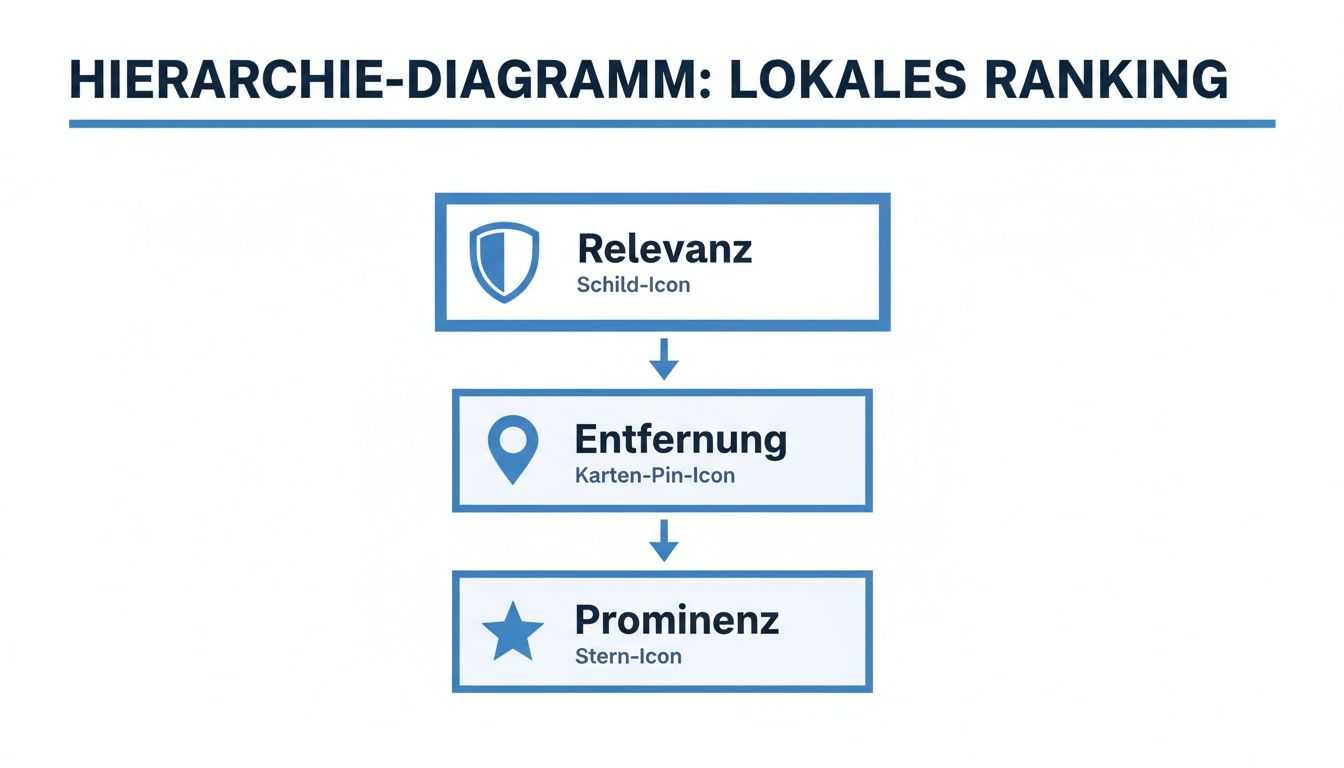
If you want to appear at the top of local searches, you need to understand how Google works. Think of Google as a well-organized concierge for local businesses. When someone searches for “café near me,” this concierge doesn't want to recommend just any café, but the best and most suitable one. To this end, he reviews every company according to three clear criteria.
These three decisive ranking factors are Relevance, Distance, and Prominence. They are the basis for your visibility on Google Maps and in the Local Pack. Anyone who internalizes this logic has taken the first step to specifically sharpen their own strategy for the Google company profile and local SEO.
Relevance: How well does your offer match the search query?
Relevance answers a simple question: “How well does my business fit in with what the user is currently looking for? “So it's about sending Google clear signals about what you're offering. The most powerful tool for this is not a description full of keywords, but choosing the right business category.
Always choose the most specific main category that describes your core business. A tax advisor should choose “tax advisor”, not just “service provider.” This one piece of information weighs more than any description text. You can then cover additional services such as “payroll accounting” in the secondary categories.
Categories are like the departments in a department store. If someone is looking for shoes, send them directly to the shoe department (your main category) and not just roughly to the right floor (too general a category).
Distance: Location as a ranking factor
The distance factor seems logical at first glance: The closer your company is to the searcher, the better. But it is not quite that simple. Google's algorithm uses the presumed Include the user's location, even if the user does not explicitly enter a location.
A search for “law firm” gives completely different results if you're in downtown Munich than if you're looking in a suburb. Google interprets the context of the request. That is exactly why an exact, verified address in your company profile is essential. Without it, Google can't attribute your store to a physical location.
This screenshot from Google Maps shows how central the geographical position is for displaying the results.
Each red pin on the map marks a company whose location has been precisely recorded in order to be found by users in the immediate vicinity.
Celebrity: Your digital reputation as an SEO lever
Prominence describes how well-known and respected your company is — both online and offline. Google is trying to digitally represent the real reputation of a business. This factor is a mix of different signals that prove your trustworthiness.
The most important building blocks of prominence are:
- reviews: The number, average star rating, and how recent your Google reviews are is a massive sign of quality. A steady flow of new, positive reviews shows Google that your business is well received by customers.
- NAP consistency: Your core data — NAme, Aaddress, Phone Number — must be the same throughout the web. Uniform entries in important business directories confirm to Google that your information is reliable.
- Site authority: The strength of the website linked to your profile also counts. A website that is well optimized for SEO with relevant content and strong backlinks has a positive effect on your company profile.
A café with hundreds of positive reviews and consistent data is rated as more prominent than a new café with just a handful of reviews — even if relevance and distance from the searcher are the same. Your digital reputation is therefore an important lever for top rankings.
Step-by-step guide to optimize your business profile
You know now that relevancy, distance and prominence The three major levers for your local ranking are. But how do we put it all into practice?
A strong Google company profile is the result of targeted optimization. See every single field on your profile as a chance to show Google and your customers who you are and what you can do. Consider the following items as your personal checklist.
The following graphic shows how these three pillars work together and form the basis for your visibility.
We are now going to do exactly these three adjustments.
Strategically choose the right categories
This is probably the most important single click you can make for your relevance. By choosing your categories, you tell Google which problem you are the solution to.
yours main category must be as precise as possible. An “Italian restaurant” is better than just a “restaurant.” A “specialist lawyer for employment law” is more accurate than just a “lawyer.” This information decisively determines whether you even appear in relevant search queries.
You can also up to nine Subcategories add. Use this leeway to display your entire offering. For example, our Italian restaurant could complement “pizzeria”, “delivery service” and “event room.” This also makes you visible to customers who search for related terms.
Write a description that is convincing
They have 750 charactersto convince potential customers and Google of yourself. Avoid pure keyword stuffing. Instead, write an inviting text that sums up your unique selling point and incorporates your most important services naturally.
Ask yourself: What makes us special? Why should a customer come to us and not to the competitor three roads away? The answer belongs in your description.
A good description is like an elevator pitch: short, clear and convincing. It not only explains what you do, but also who you are and the value you deliver.
Create trust with images
Authentic photos build trust long before someone calls you. You make your business tangible and give it a face.
- Outdoor shots: Show off your store from the front in daylight. This is how customers find you right away.
- Interior photos: Give an insight into your rooms. Create an atmosphere and show off your work environment.
- Team photos: Introduce the people behind the company. Friendly faces build a connection.
- Product & service photos: Show me what you can do. A craftsman presents completed projects, a restaurant presents his dishes.
Upload fresh images regularly. This keeps your profile alive and signals to Google that you are actively cultivating your business.
Advanced tactics for your SEO
An optimized profile is not a static business card, but a lively communication channel. Use interactive features to show engagement and stand out from the crowd.
- Activate message function: Make it easy for customers to contact you directly from your profile. Ideally, answer within a few hours. Quick response improves customer experience.
- Proactively fill the question and answer area: Be your own customer. Simply ask the questions you are asked most frequently yourself and provide the right answer right away. This is how you build a useful knowledge base.
- Use Google posts for up-to-date information: With posts, you can promote offers, news, or events. Regular posts signal activity to Google and users. A contribution is seven days Highly visible for a long time and can include a direct call-to-action. These updates are an important factor in the interplay between Google My Business and SEO.
When you take these steps, your profile goes from a simple business listing to an effective marketing tool. Each optimized area helps to increase your visibility and attract more suitable customers. Optimizing your profile goes hand in hand with the user experience on your website. Find out how to turn visitors into customers in our article on Conversion rate optimization.
The critical role of reviews for local SEO
Customer reviews are the digital gold for every local business. They're the modern form of word of mouth — and a powerful sign of trust, both for Google and for your future customers.

When Google decides which company ranks at the top of local search results, “prominence” is one of the three most important factors. Reviews are the most direct way to build up that prominence. Each review is proof to the search engine: this company exists, is active, and has a reputation in the real world.
Why reviews influence buying decisions
The influence of reviews on buying behavior is huge. They serve as social affirmation that reduces uncertainty among potential customers even before they visit your website.
A study from 2023 found that the average Google business profile 66 reviews collects per location. Trust is even more important: 88% of customers Trust online reviews just as much as you trust a friend's personal recommendation. This shows that a good online reputation is just as valuable today as a good reputation on the street.
Reviews are more than just feedback. They are an important ranking factor. Good review management is therefore one of the most effective SEO measures you can take.
In addition to pure profile information, interaction with your customers is crucial. Have a look at The importance of online reviewsto understand how you can improve your local ranking in a targeted manner
Proactively generate more positive reviews
Don't wait for reviews to roll in. With a strategic approach, you can ensure a steady flow of feedback.
- The perfect time: Ask satisfied customers for a review right after a positive experience — after completing a project, right after a purchase, or after a successful service appointment.
- Make it easy: Create a direct link to your Google review page and share it via email, SMS, or as a QR code.
- The personal touch counts: A short, personal message thanking you for your trust works better than a standardized mass email and increases the response rate.
Respond confidently to any feedback
How you handle reviews is at least as important as collecting them yourself. Each of your answers is a public demonstration of your customer service.
Reaction to positive reviews:Say thank you! Address the customer by name and pick up a specific point from the review. This shows that you actually read the review.
Response to critical reviews:Sensitivity is required here. Respond promptly but not in a hurry.
- Thank you for the feedback: Show that you also value critical voices.
- Sincerely apologize: Take responsibility for the negative experience.
- Provide a solution: Suggest taking the conversation offline to resolve the issue and leave a contact option.
Dealing confidently with criticism can often win back an dissatisfied customer. In rare cases of unjustified reviews, our guide will show you the necessary steps to take a Delete unfair Google review to leave.
Make the SEO success of your Google company profile measurable
Anyone who optimizes without measuring the results does not know whether the measures are effective. To understand the real value of your work on your Google Business Profile, you need to make success tangible. Google provides the appropriate tools for this directly in the statistics area of your profile.
The key is not just looking at superficial figures such as impressions. The key question is: What do people have thereafter done? This shows whether the time you have invested is paying off.
Interpret the most important key figures for your local SEO correctly
The statistics, also known as “performance data” by Google, tell you a lot about the behavior of searchers. Focus on the actions that lead directly to new customers.
- Website clicks: This number shows how many users jumped from your profile to your website. A signal that your profile is curious.
- Calls: This is a clear indicator of buying interest. Every call made through your profile is a warm lead that is due to your local visibility.
- Directions: This is an important key figure for every business with walk-in customers. Anyone who requests directions is intending to drop by you.
A look at these three key figures gives a good feeling of the success of your local SEO measures. When these values rise, you're doing something right — you're not only increasing visibility, but also attracting customer interest.
Analyze search queries and uncover potential
An often overlooked area in statistics is search queries. Google lists the terms people used to find your profile here. This list is a gold mine for your continued optimization.
Are you discovering terms here that you have not yet actively considered yourself? This is a sign that there is demand that you can meet in a more targeted manner. Use these insights to write new Google posts, refine your services, or add another sub-category.
With this data-driven approach, your strategy becomes a system that improves itself. You regularly check which actions and search terms produce the best results and can invest your time where the impact is greatest. There are specialized tools for a deeper analysis of your local rankings. Learn more about the options in our guide to the topic local rank tracking.
Conclusion: How to strengthen your local SEO with Google My Business
A strategically optimized Google company profile is your strongest lever for sustainable growth in local competition — the linchpin of everyone Google My Business and SEO Strategy. You now have a roadmap to increase your digital visibility.
Focus on these four key areas:
- Integrity and accuracy: A completely completed profile with exact company data (NAP), suitable categories and high-quality photos is the basis.
- Active reputation management: Respond quickly and professionally to every review to demonstrate good customer service.
- Consistent data on the web: Make sure that your company name, address, and telephone number are the same on all major online platforms.
- Regular activity: Use Google posts, answer questions, and upload new images to signal to Google and users that your business is active.
If you want to see what such local SEO tactics look like in practice, for example in the real estate industry, you will find real estate blog insights from industry colleagues.
Think of your Google business profile as a living tool, not as a static listing. Only through continuous maintenance will you reap the fruits of your work and establish yourself at the top of local search results.
Do you need help taking your local presence to the next level? Contact us for a non-binding local SEO consulting, in which we uncover your potential. Let us work together to ensure that there is no way around you locally.
Google Business Profile and SEO FAQs
Now that we have delved deep into the world of Google's business profile, we will finally answer the questions that come up again and again in practice. Here you can get quick and clear answers.
How often should I update my Google Business Profile?
Regularity is crucial. Google prefers active profiles because they signal that the information is reliable.
As a rule of thumb, it has been proven to be at least one Google post per month to publish. You should upload new photos when there's something new to see — a completed project, seasonal decor, or a new team member. Ideally, respond to customer reviews within 24 to 48 hours. This shows appreciation and that you take the dialogue with your customers seriously.
An immediate update of your master data is a must. If opening hours, address or telephone number change, this information must be corrected immediately. Nothing is more frustrating for customers than outdated information.
What is the difference between main category and minor categories?
The choice of categories is an important step. Die main category It's the sign above your door. It tells Google what your core business is. It is important to be as precise as possible here. Choose “tax advisor” instead of the general term “service provider.” This information has the biggest impact on which searches you'll be considered for.
Die Subcategories are like additional signposts. They show what other services you offer. Our tax advisor could enter “payroll” or “management consulting” here. With up to nine secondary categories, you can make your profile relevant to a wider range of search queries.
Should I include keywords in my business name?
The answer is a clear No. Integrating keywords or place names into the company name (e.g. “Dachdecker Müller Hamburg”) is a violation of Google guidelines. It is considered spam and may result in a poorer ranking or even blocking your profile.
The name in your profile must exactly match the name you use in real life. It is the name that appears on your company sign and in official documents. Authenticity pays off.
Instead, put keywords where they belong:
- In your company description, of course
- In the texts of your contributions
- When naming your services and products
- In the answers to customer questions
Long-term success in local SEO is built on trust and clean methods.
SocialEdge helps you strategically optimize your Google company profile and get it to the top of local search in the long term. If you're ready to maximize your visibility without expensive ads and get more local customers, then Discover now how SocialEdge can transform your business.