Why regional search engine optimization is crucial
Imagine the main shopping street in your city. A well-designed shop window catches the eye and arouses the interest of passers-by. Regional SEO works like a digital shop window, except that it is placed where customers are today: on Google and on Google Maps.
Search behavior has fundamentally changed. Traditional industry books are barely relevant anymore. Instead, “hairdresser near me” or “painter in Bühl” is entered directly into the smartphone. This development makes local search an important channel for every company with a fixed location or a defined service area.
Customers search differently today
Anyone who has a need today is often looking for a quick solution nearby. If you're looking for a restaurant on the go, you don't want to cross the entire city. In the event of a pipe burst, a plumber is required who can be on site quickly.
This is where she sets regional search engine optimization on. The goal is not global visibility, but to achieve a leading position in your own catchment area.
Regional SEO is about relevance for a local audience. The goal is not everybody to achieve, but the correct People, at the right time, in the right place.
Statistics confirm this trend. About 46 percent All searches on Google today have a local connection. Searches with the addition “near me” reach over 1.5 billion queries per month worldwide. For local service providers, this means that anyone who is not visible online leaves potential orders to the competition. Insightful https://www.socialedge.ai/local-seo-statistiken show how dominant this trend is now.
From online click to sales
The journey from local search to action is often short. 76 percent of the people who carry out a local search on their smartphone visit the store they have found the same day. 28 percent These searches lead directly to a purchase.
This direct connection makes regional SEO an effective marketing tool. It's not just about visibility, it's about measurable results:
- More calls from potential new customers.
- More route planning and therefore more walk-in customers.
- More direct inquiries via the website.
A strong digital presence is of great importance today, especially for local service providers such as tradesmen. A practical article shows how targeted Online marketing for tradesmen increases visibility on site and leads to more orders. A well-thought-out strategy can directly lead to measurably more sales generated by customers from the neighborhood.
Important local ranking factors for your SEO strategy
In order to be easily found locally on Google with a company, it is important to understand how the search engine works. With every local query, Google tries to deliver the most appropriate result. To this end, the algorithm is based on three key pillars: relevancy, distance and prominence.
These three factors form the basis for a good ranking in local search results.
Relevance: How well do you fit the search query?
First, Google checks whether a company matches the search query. When someone types in “Italian Restaurant Bühl,” the result should be a pizzeria and not a kebab shop. That is the relevance.
Your job is to give Google clear signals. This starts with primary category in your Google business profile. An electrician should be registered as an “electrician”, not generally as a “handyman.”
Details are also important. Does the electrician also offer 24-hour emergency service or wallbox installations? These belong as secondary categories. The more precisely you describe your offer, the easier it is for Google to show you in the right search queries.
Distance: How close is your store to the searcher?
The second factor is distance. Physical proximity to the customer is crucial for local searches. Thanks to GPS data from a smartphone or the IP address on the PC, Google usually knows where the user is right now.
If someone searches for “café near me” on the go, Google will logically suggest stores in the immediate area. You can't influence the distance itself, but you must ensure that your Address data accurate and consistent everywhere are.
The distance is fundamental for the “Local Pack” — the map view with the top three results. Google prefers companies in a specific area that the algorithm deems suitable for a search.
That also means staying realistic: A craftsman from Munich is hardly likely to search in Hamburg. Your SEO measures should always focus on your actual catchment area.
Celebrity: How well-known and trustworthy is your company?
Recently, celebrity comes into play. This is about your company's reputation and authority — both online and offline. Google wants to know how established and respected your business is.
To do this, the search engine collects various signals:
- Customer reviews: The number, average rating, and timeliness of your Google reviews are an important signal. Many fresh, positive reviews from Google show that customers are satisfied here.
- Local backlinks: If the local city portal, the Chamber of Crafts or the regional newspaper reports about you and links to your website, that is very valuable. Such links strengthen your local authority.
- Consistent company data (NAP): Your company name (name), address, and phone number (phone) must be the same on your website, in your Google profile, and in all major online directories. Any discrepancy can lead to uncertainty on Google.
To summarize the most important factors at a glance, I have summarized them in a table.
Overview of key local ranking factors
This table prioritizes the most important factors for regional SEO and shows their approximate weighting in the Google algorithm to help companies focus their efforts.
.tbl-scroll {contain:inline-size; overflow-x:auto; -webkit-overflow-scrolling:touch} .tbl-scroll table {min-width:600px; width: 100%; border-collapse:collapse; margin-bottom:20px} .tbl-scroll th {border:1px solid #ddd; padding:8px; text-align:left; background-color: #f2f2f2; white-space:nowrap} .tbl-scroll td {border:1px solid #ddd; padding:8px; text-align:left} ranking factordescriptionpriorityGoogle business profileCorrect categories, complete information, regular posts, Q&Avery highonline reviewsNumber, quality, timeliness and your responses to itVery highOn-page signalsLocal keywords in the title, NAP on the website, local ContentHighbacklinksLinks from relevant, local and industry-specific websitesBehavioral signalsClick-through rate, calls via Google Maps, mobile clicksNAP consistencyUniform company data in important directoriespersonalizationSearch history and location of the user cannot be directly influenced
This table serves as a guide for your SEO work. Focus on the very high priority items first to get the most results.
The following graphic shows how these optimizations support customers on their journey.
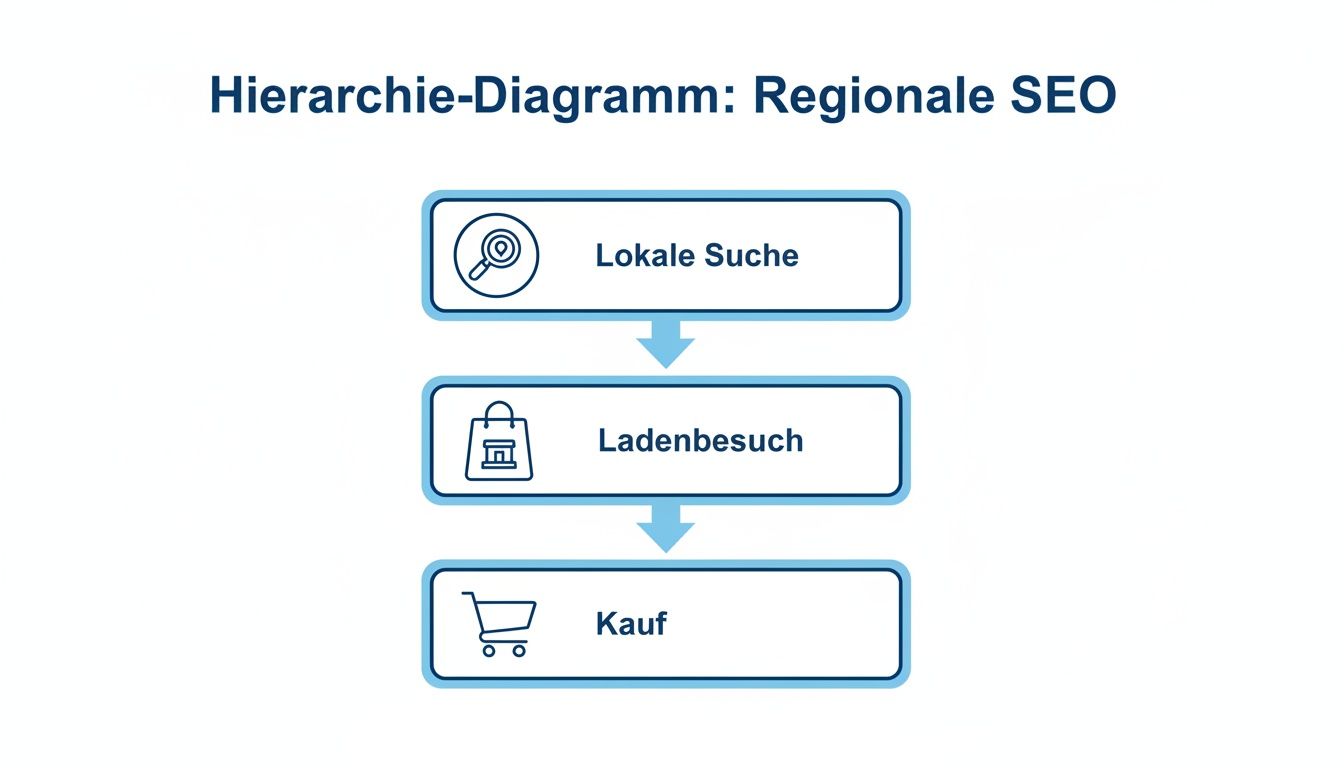
It's clear that a well-thought-out local SEO strategy picks up potential customers in their search, motivates them to visit and, in the best case, leads directly to the purchase.
Ultimately, it is the interplay of all three pillars that determines your success. Neglect one area, make things easier for your competition. If you want to understand how local search works even better, you will find valuable information in our further article, which contains the Basics of Local SEO illuminated. By specifically strengthening relevance, distance and prominence, you build solid and sustainable visibility in your region.
Google company profile as the core of regional SEO
When it comes to regional search engine optimization, your Google company profile is the central element. Think of it not just as a digital business listing, but as your interactive business card right in Google search results and on maps. This is where the journey starts for most of your potential customers.
A seamlessly maintained profile is a strong sign of trust in Google and your customers. It is the most direct way to provide all important information at a glance and to set yourself apart from the competition.
The foundation: The right categories
The choice of categories is one of the most critical settings for your local visibility. yours primary category must get to the heart of your core business. A roofer therefore chooses “roofer” and not “craftsman” in general. It is precisely this category that decisively determines which search queries you can appear in.
In addition, you can have up to nine secondary categories use to specify your offer. Does the roofer also offer plumbing work or install skylights? That is exactly what belongs here. Be as specific as possible — the more precisely you describe your offer to Google, the better.
Impress with meaningful content
An empty profile looks unprofessional and leaves potential unused. Take the time to fill out each area carefully and communicate your strengths clearly.
- Company description: They have 750 characters space. Describe what you do, including local keywords such as “painter in Bühl” or “emergency electrical service for Offenburg.”
- Photos and videos: Visual impressions are important. Show off your team in action, the results of completed projects, or a glimpse of your shop. New images regularly signal Google activity and make them more tangible for customers.
- Products and services: Create your most important offers directly in your profile, ideally with a description and price. In this way, potential customers can immediately see what you offer, which can shorten the purchase decision.
If you carefully maintain these areas, your profile will go from a passive listing to an active marketing platform. An in-depth guide to how to your Optimize Google business profile, can be found here.
Remember: Your Google Business Profile is an ongoing process. Regular updates are the key to staying permanently visible in local searches.
Activity creates trust and better rankings
A solid base is good, but continuous activity is critical. Google rewards profiles that are actively used to interact with customers and share up-to-date information.
What you do on your Google profile can directly influence your ranking. Studies show that the profile alone is for around 32 percent which is responsible for local ranking factors. By way of comparison, the classic optimization of your website (on-page signals) is only about 15 percent. Companies that regularly post posts and upload new photos can increase their visibility in the Local Pack by up to 25 percent boost.
Use these features wisely:
- Create Google posts: Inform yourself about current offers, promotions, events or news. Each contribution is visible for seven days and sends a message that it is up to date.
- Use the question-answer function: Proactively answer frequently asked questions yourself. This allows you to keep control of the information and set up an FAQ section directly in Google search.
- Activate messages: Give customers the option to contact you directly via chat. Quick answers can improve the customer experience.
By using these tools regularly, you show Google and your customers that your company is active and engaged.
Build trust for regional searches with customer reviews
Reviews are the digital form of word of mouth. They are more than just stars next to your company name. Each review tells a story about your company and shapes how new customers perceive you.
For Google, fresh, authentic customer reviews are a clear signal of relevance and recognition. A steady supply of new feedback shows that your business is active. That is why proactive reputation management is an important part of sustainable local visibility.
Why reviews are a strong ranking factor
Customer feedback has become increasingly important to Google in recent years and is making a difference 20% the overall weighting of local ranking factors. It is not so much the sheer mass that counts as the topicality of reviews.
The figures speak for themselves: 46% Consumers trust online reviews just as much as they trust personal recommendations. That trust is the crux of the matter. Positive reviews serve as social proof (Social Proof) and can lower the barrier for new customers. They confirm: “Others have been here before and had a good experience.” This can make it easier to decide whether to contact us or make a purchase.
How to motivate customers to provide honest feedback
The biggest hurdle is often getting satisfied customers to share their opinion. The process should be made as easy as possible without being intrusive or violating Google's guidelines.
Here are a few tried and tested methods:
- The right time: Ask for an evaluation when satisfaction is highest, for example right after a successful project completion.
- The personal approach: A friendly, direct question in conversation or a short, personalized message is often more effective than an impersonal mass email.
- The direct route: Create a direct review link via your Google company profile and share it via email, SMS or as a QR code.
- The right motivation: Discounts or gifts for reviews are against the guidelines. Instead, emphasize how very honest feedback helps you improve your service.
Respond professionally to every review
Your response to a review is almost as important as the review itself. By doing so, you are publicly showing that you take feedback seriously. A well-thought-out response strengthens your brand image.
Each review is an opportunity for dialogue. A quick and personal response signals appreciation and can win back dissatisfied customers and turn satisfied customers into loyal fans.
This is how you proceed strategically:
- In case of positive reviews: Thank you in person and be specific. Pick up a point from the review, for example: “Thank you for complimenting us on time! Our team is happy about that. ”
- For negative reviews: Respond quickly and professionally. Apologize for the negative experience, offer a solution and suggest moving the conversation to a private channel (telephone, email).
Dealing confidently with criticism shows professionalism. If you want to dive deeper into the art of finding the right answers, check out our post on the topic Reply to Google reviews valuable tips and templates.
Your own website: Your digital figurehead for the region
The Google company profile is an important start, but regional search engine optimization involves more. Your own website is the foundation. It is your digital headquarters that shows Google where you are based and what you offer.
The Google profile is the first point of contact. Your website enables a detailed discussion afterwards, which creates trust. For the two to work together, your site must be focused on local searches.
Optimize your own pages for every location
Do you have multiple branches or do you serve different cities? Then a general “about us” page is not enough. Anyone looking for “Steuerberater Bühl” expects a page that deals specifically with this location.
Create a separate landing page for each location. These pages should reflect the local character.
- Show local projects: Mention specific customers or orders from the region.
- Introduce the local team: A photo and the direct contact details of the contacts make your company accessible.
- Include a map: An embedded Google Maps map is a clear signal and helps customers find their way around.
- Use local keywords: The city name belongs in the headings, text and file names of the pictures.
With this procedure, you clearly signal your local relevance to Google.
On-page optimization with local relevance
The tried and tested SEO principles also apply here. The key is to provide them with a local reference. It's about integrating your location reference into the code and content of your website.
The page title (title tag) and the meta description are important levers. That's often the first thing a potential customer sees of you in Google results.
Example of an optimized page title:Malerbetrieb Schmidt in Bühl | Façades & Interiors
Example of a compelling meta description:Your painter in Bühl and the surrounding area. We offer professional painting services for private & commercial use. Inquire now without obligation.
Such adjustments can increase the click-through rate in search results.
Schema markup: Speak plain language with Google
Schema markup, also known as structured data, is a more technical topic. Think of it like digital labels that you attach to the information on your website. These labels help Google clearly understand content such as your address, opening hours, or phone number.
For local providers, the type is LocalBusiness very useful. This allows you to provide targeted information:
- Name, address, telephone number (NAP): The basic contact details.
- Opening hours: Special times for public holidays can also be set.
- Geographic coordinates: The longitude and latitude for the exact location.
- reviews: You can enter your average star rating here.
By using schema markup, Google can process your information better and present it more attractively in search results, for example through rich snippets. If you have your local SEO optimization Take it seriously, schema markup is an important component.
Focus on success: measure and plan regional SEO
Doing regional SEO without analyzing key figures is of little use. To evaluate the success of your measures, you need to keep an eye on the right indicators — Key Performance Indicators (KPIs).
The most important tool for this is your Google business profile. The performance reports there show how users are interacting with your company.
The important KPIs in the Google company profile
Optimization is an ongoing process. By regularly analyzing your profile's performance data, you can identify patterns, understand your customers better, and adjust your strategy.
Focus on the following metrics:
- searches: How often has your company been shown on Google? The report also shows which terms were used for this purpose.
- Profile views: How many people viewed your profile after they found it in search or on Google Maps?
- Calls: A valuable key figure that shows how many users have called directly from the profile.
- Directions: This metric shows how many potential customers have planned a route to you — a clear signal of intent to visit.
- Website clicks: Measures how many prospects have switched from your Google profile to your website.
These are direct indicators of the benefits of your work. Every call and directions is a potential new customer.
From number to action
Analyzing these KPIs helps you make well-founded decisions. For example, if you see a spike in calls after a Google post about a special promotion, you know that this type of content works.
Look at your performance data as a compass. They not only show you where you stand, but also which direction you need to go to expand your local presence.
A regular look at this dashboard is essential. Plan fixed appointments, for example once a month, to review developments and derive the next improvements. How to ensure that your regional search engine optimization will be a lively and successful process.
Summary and next steps
Regional search engine optimization is a decisive factor for the success of local companies. By specifically optimizing your Google company profile, actively collecting customer reviews and adapting your website to local searches, you can significantly increase your visibility in the immediate area. The key is continuity: Maintain your online presence regularly, interact with your customers and analyze your results to constantly improve your strategy.
If you want to sustainably strengthen your local online presence and stand out from the competition, now is the right time to act. Discover now how SocialEdge sustainably increases your local visibility.