What does SEO optimization software do?
Search engine optimization without reliable data is comparable to navigating through unknown bodies of water without a compass. One SEO optimization software serves as your digital navigation system. It bundles important tools such as rank tracking, competitive analyses and keyword research so that you can navigate through the complex world of Google in a targeted manner.
The real benefit of these tools is not just collecting data. The aim is to develop a tangible strategy from this flood of information. Instead of manually checking hundreds of search terms for hours, the software does it in minutes and provides accurate insights that you can use right away.
How to turn data into well-founded decisions
Good SEO software converts a confusing amount of raw data into clear, understandable recommendations for action. It not only shows you where They are up to date, but also why That is so and what You can do something specific to improve yourself. That is the difference between passive observation and active design.
With these tools, you can be proactive instead of just reacting to algorithm changes from Google. They help you answer essential questions:
- Which keywords bring potential customers to the website?
- Where do I stand in direct comparison to my most important competitors?
- Which technical errors on my part hinder my success?
More time for strategy through automation
One major advantage is the automation of recurring tasks. Manually checking rankings, analyzing backlinks, or compiling reports takes a lot of time — time that would be better invested in your company's strategic planning.
SEO software is not a panacea, but a strategic tool. She does the analytical work so that you can focus on what drives your business forward: developing a well-thought-out strategy.
Because these processes run in the background, you gain valuable freedom. Suddenly, you have time again to create content, maintain customer relationships, or improve your services. This is particularly valuable for local companies with often scarce resources, because every euro invested and every hour counts here. The right software ensures that your effort has the maximum impact.
Key features of SEO software for local businesses
Anyone who runs a local business has different goals than a nationwide online shop. It is not about being visible throughout Germany, but exactly where your own customers live and work. General SEO software is often overloaded with features that you don't need as a local provider.
It is therefore crucial to focus on the essentials. Instead of getting lost in data, pay attention to a handful of core features that really make a difference. These tools are the basis for standing out from the competition in local search.
Think of the software as a cockpit: A central location that shows you everything you need — rankings, competitors, and the right keywords — at a glance.
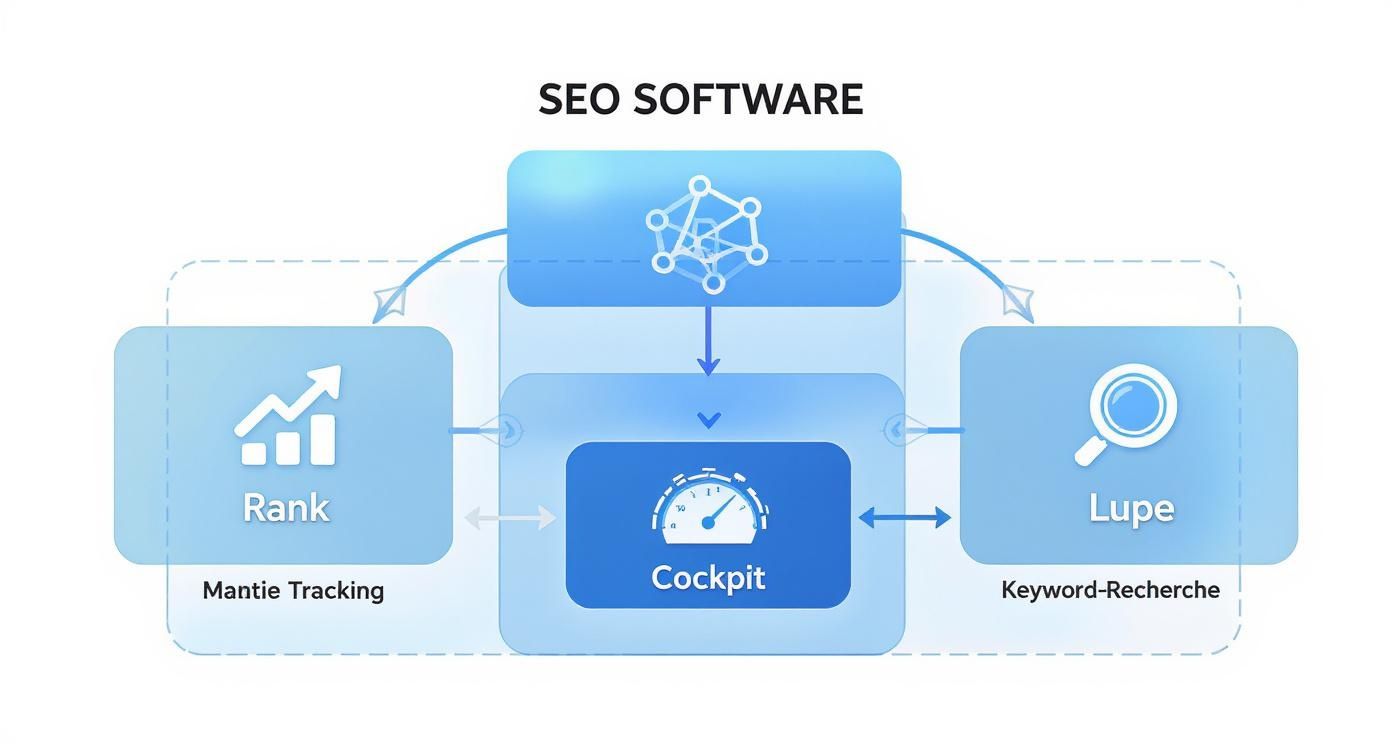
This graphic shows how a central dashboard (the cockpit) bundles all information. In this way, you always have an overview of your performance.
1. Local rank tracking for positioning
General rank tracking is of little significance for local companies. What good is it for a restaurant in Hamburg to know that it is number one in Munich for “best pizza”? The decisive factor is how things are doing in Hamburg-Eimsbüttel or Altona.
Right here comes local rank tracking into the game. It measures your Google positions specifically for specific postal codes, cities, or even individual districts. So you can see in practice where your customers can find you — and where there is still potential.
You can think of it as a heat map that shows where your visibility is strongest. This level of detail makes it possible to tailor your own strategy precisely to the areas in which the target group is actually searching. Learn more about how to your Improve Google Maps ranking, can be found in our further article.
2. Connection to the Google company profile
Your Google company profile is your digital figurehead. For many customers, it is the first point of contact with your business. However, maintaining this profile manually can be a hassle.
Good SEO software can make this job easier by connecting directly to your profile. Suddenly, you can control everything from one central location:
- Schedule and post posts: Tell customers about offers and news without having to log in to Google every day.
- Answer customer questions directly: Respond quickly to questions asked on your profile.
- Manage photos & videos: Make a professional impression with up-to-date images.
- Analyze performance data: See at a glance how many calls, website clicks, or directions your profile is generating.
This centralization saves time and ensures that your profile stays up to date — an important factor for your local ranking.
3. Consistent company data through NAP management
There is one important rule for local search engine optimization: consistency. NAP stands for Name, address, phone number (name, address, telephone number). These three core data must be identical in all relevant online directories.
Even small deviations such as “street” instead of “street” can confuse Google. Such inconsistencies can be a sign of lack of trustworthiness for search engines and can have a negative impact on your ranking.
Special software automates the check. It scans relevant business directories, finds errors and enables you to correct them centrally. This is how you send a clear signal to Google: My company is reputable and my data is reliable.
4. Actively manage reviews and reputation
Online reviews are the digital form of word of mouth. Over 90% of customers Read reviews before you visit a local store. Anyone who is not active here is leaving their reputation to chance.
Good software can help you do this in several ways:
- Collect new reviews: It can automatically ask satisfied customers for a review.
- Keep an eye on everything: You'll be notified when a new review is received.
- React efficiently: With templates and a central overview, you can respond quickly and professionally — to praise and criticism.
Active reputation management creates trust among new customers and signals to Google that your company is active.
5. Comprehensible reports to measure success
In the end, it's the result that counts: Is it worth the effort? Good software provides clear, understandable reports that make success tangible.
The figures speak for themselves: The global SEO market is based on 146.96 billion US dollars estimated, and are already investing in Germany 43% of small businesses specifically on their websites. It's worth it, because almost 94% All clicks end up on organic search results. SEO measures result in a conversion rate of around 2.4%, while with paid ads, it's only 1.3% are.
A powerful reporting module shows you exactly the key figures that are important for your local business: How many calls came from Google? How many people have requested directions? How has traffic from local search developed? In this way, you can see the return on investment (ROI) and further improve your strategy based on data.
How to find the right SEO software for your company
The market for SEO tools is large and confusing. Instead of presenting an endless list of providers, we provide you with a checklist. This allows you to find a solution that is right for you and your company.
The most important first step is an honest inventory. Ask yourself: Where are we with our visibility right now? What are our biggest hurdles and what do we want to achieve in the next six to twelve months? The answers to these questions are the basis for every good decision.
Define and prioritize requirements
Before you look at software offerings, you should clarify your requirements. Every company is different. What is essential for a large marketing agency may be superfluous for a local craft company.
Start with a list. Review the following points and consider what is a priority for your business:
- Core Features: Which of the features discussed are a must for you? Are you primarily concerned with local rank tracking? Or is she Google business profile integration And that Customer reviews management more important?
- Budget: How much can and do you want to invest monthly or annually? Price alone is not a good guide. The actual benefits for your business are more important.
- Team size: Who will work with the software? Are you alone or do you want a small team to access it? This has an impact on how important ease of use and features are for collaboration.
This preparatory work helps you not to be blinded by features that are useless to you. Having a clear idea of your needs is the best way to invest wisely.
What is important when choosing
With your list of requirements, you can now search specifically. Focus on these five criteria to make a solid choice.
- scalability
Can the tool grow with your business? Good software is flexible. It should allow you to add more locations later or go deeper into the analysis without having to switch providers. - Usability
The most powerful software is useless if it is complicated to use. Is the dashboard tidy and understandable? An intuitive interface saves you time and nerves in the long run. - Integration options
Check that the tool easily connects to the systems you're already using. Connections to Google Analytics And the Google Search Console. It becomes valuable when you can also connect your CRM system to track the entire journey from Google search to the customer. - Support quality
If something doesn't work, quick and competent help counts. How easy is support available? Is there a German-speaking contact person? How quickly do you respond to inquiries? Good customer service can save you hours of frustration. - value for money
Don't just look at the monthly price. What exactly is included in the package? Are there any hidden costs? Always compare the specific range of functions with the price to see the true value of a solution.
Choosing the right SEO software is a strategic decision. The goal isn't to find the cheapest tool, but the one that has the biggest positive impact on your bottom line.
When deciding between a comprehensive suite and a specialized tool, the table below can help you weigh the pros and cons.
Comparing SEO software types for local businesses
This table compares all-in-one platforms with specialized tools to help companies choose the right software solution based on their specific needs.
FeaturesAll-in-one platformsSpecialized tools (e.g. only for rank tracking)range of functionsComprehensive (rank tracking, audits, NAP, reviews, etc.) Focused on a single core function.complexityOften higher, requires more training time. Usually very easy and intuitive to use.prizeUsually more expensive but potentially cheaper than multiple individual licenses. Cheaper to get started, costs add up with multiple tools.Ideal forCompanies that want to bundle all SEO activities in one place. Companies that want to close a targeted gap in their workflow.instanceSemrush, Ahrefs (although more for general SEO) BrightLocal (focus on local SEO), SE Ranking (focus on rank tracking)
As you can see, there is no “best” solution. It always depends on your individual needs, budget, and internal resources.
The practical test is decisive
Theory is one thing, daily work is another. Almost every reputable provider provides free trial versions or demos. Take advantage of this opportunity.
Create a test account and complete your typical tasks. Connect your Google business profile, set up your most important keywords for tracking, and create a simple report. This is the only way to know whether the software is working for you in everyday life. A professional provider can often help you with a first SEO audits help to evaluate the current status of your website and identify potential. To understand the importance of such an audit, you can read our guide which explains what a good SEO audit agency does makes out.
At the end of this process, you didn't just buy any software. You've made a well-founded, strategic decision based on your specific goals and requirements.
Implement and use your SEO software successfully
It's one thing to have a good tool. But using it in such a way that it delivers results is the real task. The right Software for SEO Optimization can support your local business—but only if it's cleverly set up and used strategically. In this section, we'll walk you through the key implementation steps and show you how you can measure the success of your work.
The process starts with a clean setup. Think of it like the foundation of a house: If that doesn't fit, it'll be difficult later.
The cornerstone: setting up the software correctly
A well-thought-out configuration saves you time later and ensures that the data you receive is reliable. Without a clean database, you make decisions blindly.
Start by linking all your important accounts. This is the basis for seeing the full picture of your online presence.
- Connect Google Business Profiles (GBP): That's at the heart of your local SEO. A direct connection allows the software to retrieve performance data such as calls or route planning and enables the central administration of contributions and reviews.
- Connect Google Search Console: This free tool from Google provides insights straight from the source. You can see which search terms your site is getting impressions and clicks for and uncover technical issues.
- Integrate Google Analytics: Connect your software to analytics to understand what visitors are doing on your website. This allows you to see how users who come via local search behave and whether they become customers.
As soon as the accounts are connected, it's time to track keywords. Be as specific as possible here! Track your most important search terms not only for your city, but also for individual districts or postal code areas where your customers live.
From data to results: define the right KPIs
Rankings alone are not a business goal. It's a common mistake to just focus on your position in search results. Key performance indicators (KPIs for short) that are directly related to your business success are more important.
Instead of just looking at the position for “Friseur Berlin,” you should focus on key figures that reflect true success.
A top ranking is a means to an end, not the end goal. The success is reflected in the increase in customer inquiries, store visits, and revenue generated by your online visibility.
Here are a few business-relevant KPIs to keep an eye on with your software:
- Number of calls over GBP: How many potential customers called you directly from the Google listing?
- Number of route plans: How many users have requested directions to your store? A clear signal of buying interest.
- Website clicks from local search: Keep track of how many visitors come to your site from your Google profile.
- Conversion rate on the website: How many of these visitors fill out a contact form, book an appointment, or buy something?
By focusing on these tangible metrics, you can clearly quantify the return on investment (ROI) of your SEO efforts.
Securing and optimising success in the long term
Implementation is not a one-off project. Set up automated reports that clearly show you the most important KPIs on a weekly or monthly basis. This saves time and ensures that you always have an overview.
Review these reports regularly and take the next steps from them. Do you see a break-in in calls? Maybe it's time to update your Google Business Profile. Our guide shows you how to make your Optimize Google My Business Can.
It is just as important to keep an eye on the market. In the year 2025 Google dominates the German search engine market with a share of around 86% across all devices, while Bing is on around 6% is coming. The difference is exciting depending on the device: On the desktop, Bing has approx. 15% a significantly higher proportion. At the same time, mobile search in Germany is growing to over 65%, which further cements Google's supremacy. Against this background, it is crucial to adapt your own SEO strategy to the respective user habits and the device being used.
By combining a clean setup, measuring the right KPIs, and continuous analysis, you transform your Software for SEO Optimization from an analysis tool to an active engine for your business growth.
A glimpse into the future of SEO software
The world of search engine optimization is constantly evolving. That is why a modern Software for SEO optimization adjust permanently. Three major developments are clearly emerging.
Artificial intelligence as a strategic partner
Artificial intelligence (AI) There is more to SEO tools than just a technical detail. AI-supported functions can now do much more than just evaluate data. They help you understand the intent behind a search query and create content that fulfills that intent.
Instead of just listing keywords, a good AI analyses semantic relationships. It suggests topic clusters with which expertise can be shown. It can even help you create initial drafts of text or revise existing pages.
You can think of AI in SEO software as an experienced strategist. It recognizes patterns and opportunities in large amounts of data that remain invisible to the human eye and provides specific recommendations for action.
With these intelligent analyses, local companies can create content that not only ranks but also appeals to customers. AI thus becomes a tool for an efficient content strategy. If you would like to dive deeper into the topic, read our further article to learn more about AI SEO optimization options.
Optimization for voice search
The way we search is changing. More and more people are using voice assistants such as Siri, Alexa or Google Assistant. These queries are usually longer and formulated as complete questions — unlike the keywords we type into Google search.
Modern SEO software must take this change into account. It helps to design content in such a way that it can serve as a direct answer to spoken questions. This means focusing on “long-tail keywords” and preparing information in a clear question-answer style.
Structured data and zero-click searches
In a world where users often find their answer directly on the Google results page without visiting a website, win structured data in importance. These snippets of code help Google quickly understand the content of a page and make it prominent in formats such as Featured Snippets to display.
Good software recognizes where such markups are worthwhile and provides instructions for implementation. The figures speak for themselves: forecasts assume that by 2025 around 20% All searches will be carried out by voice input. In doing so, expect 48% personalized results for the user. About 34% The voice search answers come from websites that use structured data. This underlines the importance of this issue. More You can find exciting SEO statistics at wpbeginner.com.
Summary and next steps
A good SEO optimization software is more than just a tool for monitoring keyword positions. It is a compass in local competition, which helps you make well-founded decisions and become visible locally.
It is crucial not to choose just any solution, but the one that suits your business. The best software is always the one that best solves your specific challenges.
Start with an inventory: Where do you currently stand with your local SEO? Where are there gaps and where is there untapped potential? Use our checklist to systematically compare different software providers and make a wise decision for your company.
Ready to improve your local visibility and get more customer inquiries? Learn how specialized software can help you stay ahead of the competition.
SEO software frequently asked questions
Finally, we'll answer a few typical questions about SEO tools for local businesses.
As a small business, do I really need SEO software?
Yes, such a tool can be a decisive factor, especially for small, local businesses. They are in competition with the shop around the corner. Good software helps you do just that: to become visible in your immediate catchment area where your customers are looking for you.
Many tasks that would be time-consuming manually — such as checking the ranking in your district or responding to new reviews — are automated. This gives you an advantage with manageable effort.
How much time do I have to plan for training?
It depends on the tool in question. However, most modern programs are designed in such a way that the most important functions can be quickly understood. The basic setup, such as linking to your Google business profile, is usually a matter of minutes.
A practical tip: Don't try to master every function from the start. Focus on the two or three core featuresthat benefit you the most — such as managing your reviews and ranking tracking for your most important keywords. Realistically speaking, you come with about half a day Familiarization is already a long way off.
How can I specifically measure the success of the software?
A common mistake is just paying attention to rankings. A good ranking is a means to an end, but key figures that have a direct impact on your business are more important. Good software provides you with exactly this data in a clear manner.
Pay particular attention to these success indicators:
- More calls: See if more customers are calling directly from the Google listing.
- More route planning: Measure how many people are showing you the route to your store.
- More clicks to the website: See if traffic is increasing from local search results to your website.
- Better conversion rate: See whether visitors to Google also become customers who make appointments or fill out contact forms.
If you keep an eye on these tangible results, you can clearly see the return on investment (ROI) of your SEO measures and continuously improve your strategy.
Are you ready to get off to a good start locally and get more customer inquiries? SocialEdge is the specialized software that gets you into the top 3 local search results. Find out more and stay ahead of the competition at https://www.socialedge.ai.