Why SEO is a strategic investment for software providers
For software and SaaS companies, SEO is not an optional marketing extra, but a central growth engine. During Google Ads can buy visibility in the short term, SEO is building a channel that delivers sustainable qualified leads. Every optimized article and landing page acts like a digital salesperson who works around the clock without being paid per click.

The key advantage of SEO in software-Company is reaching out to people with a high intent to buy. In contrast to traditional advertising, which is often perceived as annoying, you pick up potential customers exactly when they have identified a problem and are actively looking for the right solution.
The strategic importance of organic visibility
Organic search is often the first point of contact in a buying process, which is often long and complex when it comes to software products. The decision for business software is rarely made spontaneously. Research is carried out, alternatives are compared and trustworthy sources are sought.
A well-thought-out SEO strategy accompanies potential customers along this entire “customer journey.” It positions your company as a competent point of contact — long before a sales meeting takes place.
By creating useful content that solves specific problems for your target audience, you not only create visibility, but also build authority and trust. The result: Your customer acquisition costs (CAC) fall, because well-positioned content can generate new leads over the years.
SEO as a buffer against rising advertising costs
Competition in the SaaS sector is intense, which is continuously increasing the prices for paid ads. A strong organic presence makes you more robust against such market fluctuations. While competitors are using up their budget for every click, your website generates a steady stream of traffic that doesn't depend on a daily budget.
Investing in SEO pays off on several levels:
- Sustainable lead stream: An article that ranks well today can still generate valuable inquiries three years from now.
- Lower customer acquisition costs (CAC): In the long term, customers acquired organically are less expensive than through paid campaigns.
- Building brand authority: Anyone who appears high up on Google is seen as an expert.
- Increased brand recognition: Your brand will be visible to exactly the people who are interested in your topic.
Ultimately, for a software company, SEO is an investment in a valuable asset: its own, independent marketing and sales channel. It is the systematic way to generate predictable and scalable growth directly from the search.
Typical SEO page types for software companies
An effective SEO strategy for software companies is based on a well-thought-out architecture of various types of pages that pick up potential customers at every stage of their decision-making process. Each type of page fulfills a specific function to serve the respective search intent and guide users step by step through the sales funnel.
The foundation of this architecture is based on three pillars that are inextricably linked in SEO for software: a clean technical basis, relevant on-page content and strong off-page authority.
The following graphic shows how these pillars work together in a logical flow — they are the prerequisite for any successful content strategy.
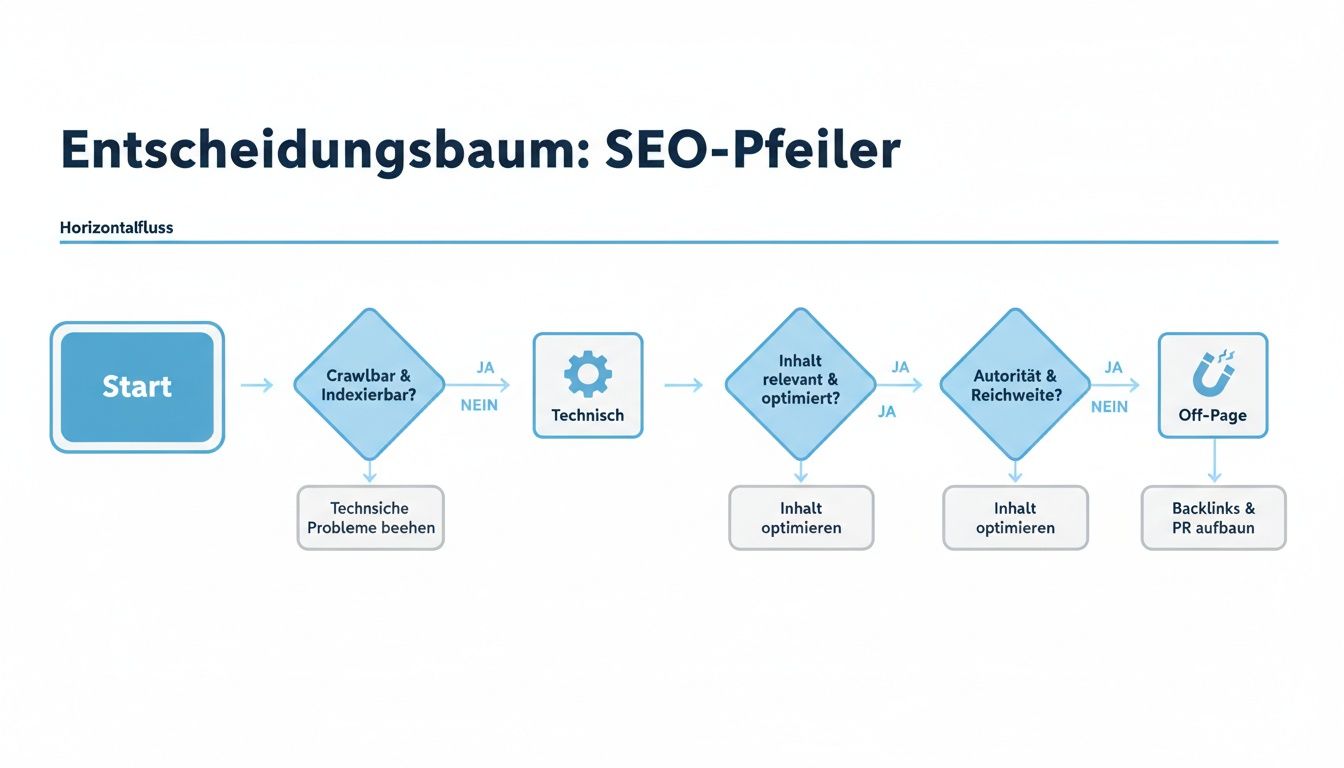
What the flow chart makes clear: Without a solid technical foundation, even the best on-page and off-page measures cannot be effective. This is a crucial point for visibility for all types of pages.
Solution pages: creating awareness of the problem
Solution pages are the first point of contact for many users. They target keywords that describe a general problem — often before the searcher knows that there is a software solution for it.
For example, someone is looking for “organize tasks for a team” or “bundle customer feedback,” but not yet specifically for a project management tool. Solution pages address this problem, explain the consequences of doing nothing and position your software as the right solution.
The strategic goal is creating awareness of the problem and to establish your company as a competent partner.
Feature pages: Demonstrate concrete benefits
While solution pages clarify the “why,” feature pages focus on the “how.” They cover individual functions of your software and answer specific questions from users who already have a more detailed idea of the solution.
The keywords for this are more specific, for example “automated invoicing” or “project management gantt chart.” On these pages, it is important not only to explain a function, but above all the concrete benefits represent for the user. Use cases, screenshots and short videos help make the functionality tangible.
Comparison and alternative sites: influencing buying decisions
These two types of pages are in SEO in software particularly valuable because they appeal to users who are about to make a purchase decision. Their buying intent is extremely high; they're at the end of the funnel.
- comparison sites (e.g. “Software A vs. Software B”) pick up users who compare specific providers and weigh up their advantages and disadvantages.
- Alternative pages (e.g. “Alternative to Software C”) intercept dissatisfied users from a competitor or those who are looking for a more appropriate option.
The key to success here lies in a fair and value-added presentation. It's not about devaluing competitors, but about offering an honest comparison that shows for which use case your solution is the better choice.
These pages often have a high conversion rate as they provide a direct answer to a highly specific, commercial search query. Careful planning of this content is a core part of every functioning Content marketing strategy for software companies.
Comparing strategic page types for SaaS companies
Page typeStrategic goalsTypical keyword alignFunnel phaseSolution pagesCreate problem awareness & generate demand-oriented or needs-oriented (e.g. “improve team communication”) Top of FunnelFeature pagesShow detailed product benefits & demonstrate expertiseFunction-specific (e.g. “CRM with email integration”) Middle of Funnelcomparison sitesActively influence purchase decisions & highlight USPs “Product A vs. Competitor B” Bottom of FunnelAlternative pagesPick up undecided or dissatisfied users “Alternative to Competitor C” Bottom of Funnel
By specifically creating and optimizing these four types of pages, software companies ensure that they have the right answer for every search intent and at every stage of the customer journey.
Understanding keyword intent and funnel stages in software SEO
Successful SEO doesn't just depend on For which Keywords you rank, but primarily from why Someone is looking for it. Die Search Intent is the linchpin for creating content that not only generates traffic but also leads. There is an intent behind every Google search, and it's your job to understand it and provide the right answer.
In the software sector, these intentions can be assigned to the classic phases of the marketing funnel. A prospective customer at the beginning of their research has different questions than someone who is about to make a purchase decision.
Top of the Funnel (ToFu): The information-driven search
At the top of the funnel, potential customers have a problem but often don't yet know that there is a software solution for it. Your search is wide-ranging and information-oriented. They are looking for answers, instructions and explanations.
At this point, it's about creating awareness of the problem and positioning yourself as an expert. The content must be educational and helpful without focusing on your product.
- Typical searches: “How to increase team productivity,” “manage customer feedback,” “visualize project progress.”
- Suitable content formats: Detailed blog articles, guidelines, white papers, checklists, or webinars.
- The goal: Build trust and establish your brand as a reliable source of useful information.
Middle of the Funnel (MoFU): Commercial Research
There is awareness of the problem in the middle of the funnel. The user now knows that there are software solutions and starts researching and comparing options.
The search queries are becoming more specific and often contain comparative or evaluative terms. Now is the right time to position your product as one of the top solutions.
At this crucial point in the customer journey, the preliminary decision is made as to whether your company is shortlisted. Your content must now clearly show why your software is the better solution to the user's specific problem.
- Typical searches: “best project management tool for small teams”, “Zapier alternative”, “Hubspot vs Salesforce comparison.”
- Suitable content formats: Direct comparison pages (X vs. Y), “alternatives to” pages, detailed case studies, and specific application examples.
- The goal: Demonstrate the superiority of your solution for specific applications and convince the user of the benefits.
Bottom of the Funnel (BoFu): The transactional search
At the bottom of the funnel, the user has already opted for a few providers. His search is now aimed at buying. He's looking for pricing, demos, or implementation details. The intent to buy is highest here.
Your content must now clear up any remaining doubts and make the deal as easy as possible. Clarity, transparency and a simple process are crucial here.
- Typical searches: “[your product] prices”, “book [your product] demo”, “socialedge trial version”.
- Suitable content formats: Clearly designed pricing pages, landing pages for demos, simple contact forms and FAQ pages for onboarding.
- The goal: Enable conversion (demo request, test registration or purchase) directly and smoothly.
If you consistently align your content strategy with these search intentions and funnel phases, you ensure that you have the right answer for every stage of the customer journey. This not only applies to globally active SaaS companies, but is also an important factor for local SEO from software providers.
Measuring success in software SEO: KPIs that really count
High rankings and traffic are indicators, but not business goals for a software company. The true value of SEO in software is reflected in the contribution to business success. To prove the ROI of SEO measures, you need to focus from pure SEO metrics to business KPIs.
It's about creating the connection between a click on Google and a paying customer. This is the only way to prove that SEO is not a cost factor but a profitable growth channel.
From rankings to leads: Sales figures
Measuring success must go beyond visitor numbers. The key question is: How many potential customers does the organic channel generate for our pipeline? To do this, clear conversion goals must be defined in analysis tools.
The relevant key figures at this level are:
- Organic leads: The number of demo requests, trial version registrations, or contact forms that are generated directly via organic search.
- Conversion rate (organic): The percentage of visitors from organic search who perform a desired action.
- Cost per lead (CPL): The monthly SEO costs divided by the number of organic leads generated. This allows a direct comparison with paid channels.
These key figures translate SEO activities into the language of sales and make the value understandable for the entire company.
The decisive change in measuring success lies in viewing SEO not as an isolated marketing discipline, but as an integral part of the sales funnel. Any optimized content must make a clear contribution to lead generation.
Evaluate the quality of leads: MQLs and SQLs
Not every lead has the same value. A student who downloads a white paper is different from a decision maker who books a demo. The qualitative evaluation of leads is therefore the next decisive step.
For this purpose, leads from the organic channel should be classified:
- Marketing Qualified Leads (MQLs): Contacts who are considered potentially suitable based on their behavior (e.g. visit to the pricing page) or data (e.g. company size).
- Sales Qualified Leads (SQLs): MQLs that have been reviewed by sales and accepted as a promising sales opportunity.
- Lead-to-customer rate: The percentage of organically generated leads that actually become paying customers. This quota is the ultimate proof of the quality of SEO work.
By linking SEO data with a CRM system, it is possible to understand which keywords and content attract the most valuable customers.
Demonstrate long-term ROI: Customer lifetime value
The financial success of SEO in software often appears over a longer period of time. A customer who is acquired today through a helpful blog article can generate revenue for years to come. The Customer Lifetime Value (CLV) is therefore a central metric for recording full ROI.
Analyze the average CLV of customers acquired through the organic channel compared to other channels. It often turns out that organically acquired customers are more loyal because they found you out of a genuine need for information. With this analysis, you have a strong case for further investments in your SEO strategy. For detailed instructions on how to improve your ranking, read our article on Optimizing app SEO rankings.
How AI scales content production for software SEO

Artificial intelligence has arrived in marketing and is changing content creation for software companies. AI tools are not a substitute for human expertise, but a lever to speed up content processes and produce high-quality content on a larger scale.
For software companies working with SEO in software If you want to grow, this scalability is a decisive advantage. Instead of working on a single technical article for weeks, teams can increase their content production with AI support.
More efficient workflows with AI
The use of AI starts even before you write. AI tools help to analyze large amounts of keyword data and sort them into thematic clusters. These clusters form the basis of a well-thought-out content strategy.
The AI can then create detailed outlines based on the content of the current top rankings. It analyses SERPs (Search Engine Result Pages), identifies frequently asked questions and suggests a logical structure. This step alone saves hours of manual research. Based on this, the AI can create raw texts that serve as the basis for human fine-tuning.
Why human expertise remains essential
Despite the capabilities of AI, humans remain at the heart of content production. AI provides the framework, but it is only human expertise that gives the content the necessary quality and authenticity.
Artificial intelligence is a tool that makes us more efficient. However, it does not replace critical thinking or industry experience. The best content is created when an AI-generated design is refined with human insights and a unique perspective.
An experienced editor takes on decisive tasks:
- Fact check: AI can provide incorrect or outdated information. Careful testing is essential.
- My own perspective: Real experiences, case studies, and clear opinion set content apart from the competition.
- Brand voice: The editor ensures that the tone and style match the software company's brand.
The impact of AI on search results is obvious. Companies that rely on this technology produce on average 42% more content per month as their competitors. If you want to learn more about how to combine AI and SEO, you can find valuable practical tips in our guide on AI in SEO. The combination of AI efficiency and human creativity results in better rankings and sustainable organic traffic.
Summary and next steps
SEO for software companies is a strategic process that is based on a deep understanding of the target group and their search intent. The key to success lies in the systematic creation of relevant content for every phase of the customer journey, based on a solid technical basis and a clear measurement of business-relevant KPIs. By integrating AI into content production, this process can be efficiently scaled to generate sustainable organic leads and drive company growth.
Your next steps could be:
- Technical testing: Check your site's speed and mobile-friendliness with tools like Google's PageSpeed Insights.
- Keyword analysis: Identify the core problems of your target group and assign them to the appropriate search terms.
- Content audit: Analyze whether your current pages cover search intentions in the various funnel phases.
- Set KPIs: Define clear goals for organic leads, MQLs, and conversion rate to make success measurable.
Would you like to sustainably increase your organic visibility on Google and generate qualified inquiries? SocialEdge is your specialized partner. We get companies like yours to the top of search results. Discover now how SocialEdge is driving your organic growth.