SEO for AI: What optimization for intelligent search engines requires
Imagine that a user enters a complex question and, instead of the usual list of blue links, receives a finished, precise answer that an AI compiles in real time. This is the engine behind the “SEO for AI” theme. This is not a completely new concept, but the logical development of search engine optimization — adapted to the capabilities of artificial intelligence.
Basically, the approach can be divided into two areas:
- Optimize for AI search experiences: This is about structuring your website so that AI algorithms not only find your content but recognize it as a real authority for their generated answers. The aim is to be cited in the new, prominent AI answer fields.
- Use AI for your own SEO work: This means using AI tools to make your own SEO processes more efficient — from keyword research to content creation to technical analysis.
The change: away from keywords, towards concepts and thematic depth
In the past, it was often enough to place the right keywords in the right places. Today, it is necessary to demonstrate profound expertise on a topic. AI systems don't think in individual words, but in semantic contexts and entire concepts. They want to understand the intent behind a search and provide the best, most comprehensive answer to it.
SEO for AI means processing your own expert knowledge in such a way that machines can understand it and classify it as trustworthy. It is the bridge between human knowledge and machine processing.
This paradigm shift requires a more strategic approach to content. Instead of isolated blog articles about a keyword, thematic clusters are set up that shed light on a topic from all important perspectives. This is signaling to AI: Comprehensive expertise exists here.
The following graphic shows the two pillars on which “SEO for AI” is based: optimising your own site for AI systems and using AI tools to increase efficiency.
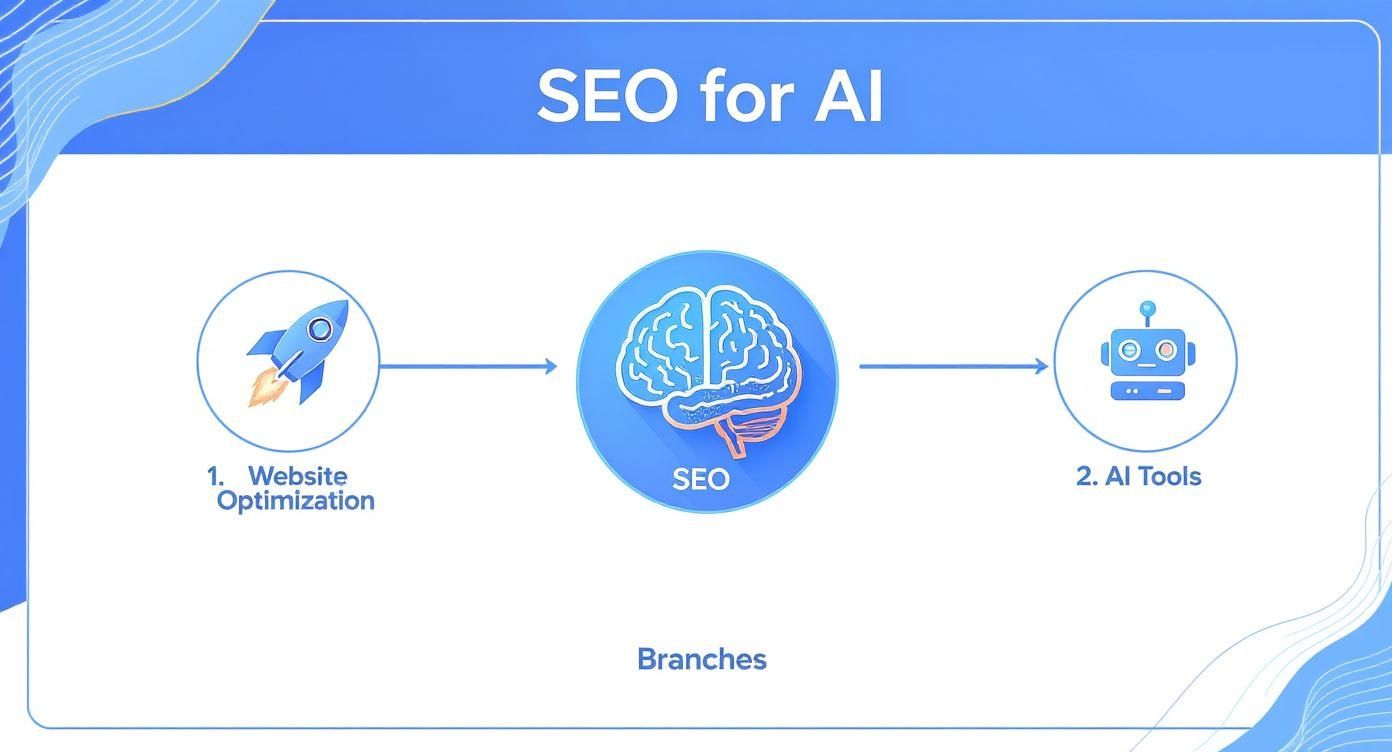
Both areas are inextricably linked to build a sustainable SEO strategy.
Why the topic of SEO is now relevant for AI
The introduction of generative search experiences such as Google's Search Generative Experience (SGE) is no longer a distant vision, but is already being tested in many countries. Anyone who doesn't act now risks losing visibility in an AI-driven search landscape.
It's not just about ranking on page one anymore. It's about becoming a direct source of AI answers. This guide serves as a roadmap for understanding the new rules of the game and proactively aligning your strategy for the future of search.
Understanding and using the new AI search landscape

The classic list of blue links, as we've known it from Google for decades, is slowly fading into the background. Generative AI is fundamentally changing search results pages (SERPs). Instead of just redirecting users to other websites, search engines are increasingly providing finished, summarized answers right at the top of the page.
This change is being driven by new formats such as Google's Search Generative Experience (SGE) or conversational tools such as Perplexity. These systems better understand the intent behind a search query and compile a coherent, immediately usable answer from information from various sources.
The result is a change in search behavior. Instead of clicking through ten different links, users are presented with the quintessence directly. This can result in a drop in clicks on traditional organic search results. For website owners, this means that the organic traffic they've relied on for years could decrease.
Why becoming a source of AI is crucial
In this new environment, it is no longer enough just to rank on the first page. The new goal must be: to be quoted directly in the AI-generated answers. Your website must establish itself as the trusted primary source from which AI gets its information for answers.
When you become a source, you ensure your visibility, even when direct clicks go back to your page. Your brand name and expertise will then appear prominently in the most important area of search results — right in the AI answer box. This strengthens your authority and brand recognition.
Generative artificial intelligence (AI) marks a turning point for search engine optimization (SEO) in Germany. According to forecasts, generative AI could have a market share of 54.2% conquer in the area of web search and permanently change the way we find information.
Thematic authority as the key to success in SEO for AI
To become the preferred source for AI systems, you must Topical Authority build up (thematic authority). That means positioning yourself as a leading authority in your niche. You need to cover a topic comprehensively, deeply, and comprehensibly so that search engines rate your content as a reliable source.
Think of it like building a digital knowledge center. Instead of just publishing individual, detached blog articles, you create a closely connected ecosystem of content that highlights every conceivable facet of your core topic.
How to signal thematic authority:
- Depth before width: Focus on working seamlessly on one main topic before you focus on the next.
- Clear structure: Work with a logical page architecture. A central main page (pillar page) covers the topic in general, while many supporting detailed articles (cluster content) address specific aspects and everything is linked together.
- Clear signals: Use structured data (schema markup) so that the AI can capture the relationships between your content faster and more error-free.
Building up this authority is a long-term process. A professional SEO optimization by an agency can help you set the right priorities and prepare your content specifically for the new AI search. By clearly structuring and presenting your expertise, you lay the foundation for remaining visible in the AI-driven search landscape.
Create content that works for AI and people
Good content has always been the basis for successful SEO, but in the age of AI, this principle is becoming more important. It is no longer enough to have an AI generate a text. The decisive factor is to create content that is of genuine quality — content that both convinces people and is recognized by algorithms as a first-class source of information.
This brings a well-known concept back into focus: E‑E‑A‑T. The acronym stands for Experience, Expertise, Authoritativeness, and Trustworthiness. It is Google's evaluation scheme for quality and an important guideline for AI systems.
E‑E‑A‑T as a compass for high-quality AI-optimized content
Think of E‑E‑A‑T as a checklist that AI uses to assess the trustworthiness of your content. Your job is to send clear signals for each of these points.
This is what it looks like in practice:
- Experience (Experience): Show that there is real, hands-on experience behind your content. Report on specific customer projects, share anecdotes from everyday working life, or document practical tests. An AI only summarizes what already exists — it cannot make its own experiences.
- Expertise (expertise): Back up your statements with facts, data and in-depth knowledge. Link to recognized studies, quote industry experts, or present your own analyses. Superficial content is rated as less valuable by an AI.
- Authoritativeness: Build a reputation as an authority in a targeted manner. This includes meaningful author profiles with qualifications, mentions on other well-known websites in your industry and consistent publication of high-quality content on your core topic.
- Trustworthiness (trustworthiness): Create trust through transparency. A complete legal notice, easy-to-find contact details, clear sources and a secure website (HTTPS) are basic requirements.
These signals are the key to your own Google placement to improve and also remain visible in the new, AI-supported search results. A clear structure and verifiable competence help the algorithms to classify your content as relevant and trustworthy.
The right balance: AI efficiency and human depth
Don't think of AI tools as content vending machines, but as powerful assistants. Used correctly, they can increase efficiency. However, they should not replace human expertise. The combination of both is the key to success at SEO for AI.
The share of AI-generated content in top Google results has already risen significantly in the DACH region. An analysis by SE Ranking shows that around 19% The content in the top 20 results is AI-supported — an increase of 2.3% in 2020. Already using at the same time 91% the digital marketer in Germany AI for content creation. This underlines how important it is to stand out from the crowd with strong E-E-A-T signals. You can find out more about these SEO statistics directly with the experts from SE Ranking.
The trend is clear: The amount of content is increasing. Only those who deliver genuine, tangible quality will prevail in the long term.
Prompt engineering and human quality control
The quality of an AI's output depends on the quality of the input. Here comes that Prompt engineering into the game. Instead of just giving an AI a keyword, precise instructions must be formulated.
Example of a bad prompt:Write a blog article about SEO for AI.
Example of a good prompt:Write a 500-word section for a blog article about “Optimizing content for AI and people.” The target group is local service providers. Explain the E-E-A-T (Experience, Expertise, Authoritativeness, Trustworthiness) principle in a practical way. Give specific examples of how a craft business can incorporate these signals on its website. The sound should be informative and easy to understand. Use short sentences.
A precise prompt provides a better basis for work. However, the best AI design is always just the first step. The subsequent human review and refinement makes the difference.
Checklist for final human inspection:
- Fact check: Are all figures, data and facts correct? AI models can “hallucinate,” i.e. invent facts. Verification is essential.
- Uniqueness & experience: Have you added personal experience, a unique perspective, or a case study that only you can provide?
- Tone & style: Does the text match the voice of your brand? Does it sound authentic and human or generic?
- Real added value: Does the content have practical uses that go beyond what you'll find on other websites on the same topic?
In the end, it's about using AI as a tool to communicate human expertise more efficiently. The machine provides the framework, but the credibility and unique perspective come from people. This combination makes content powerful enough for the new era of search.
Technical SEO: The foundation for AI-driven search engines

The best content is ineffective if the technical foundation of your website isn't stable. In the age of AI search, technical SEO has become even more important. The new algorithms not only evaluate what They say but also How easy they can process this information. A clean, fast and logically structured website is a strong sign of trust for any search engine.
The basics must be right: Fast loading times, flawless display on mobile devices and secure HTTPS encryption are standard today. AI systems prefer websites that offer a positive user experience; a slow or faulty page is rated negatively.
The biggest technical lever for SEO in the age of AI However, it lies in the structured data.
Structured data as a translator for AI
Imagine being able to provide an AI with the most important facts about your company in an edited form instead of having it analyze the entire text. Do just that structured data, also known as Schema markup. You translate your content into a standardized language that machines understand immediately and without room for interpretation.
Instead of just seeing a block of text, thanks to Schema, an AI immediately recognizes: “This is a local company, these are the opening hours, this is the address and these services are offered.” This clear communication is valuable. The AI can use this data directly for its generated answers or for advanced search results (rich snippets).
With structured data, you can provide an AI with the blueprint of your content. They reduce ambiguity and increase the likelihood that your information appears correctly and prominently in search results.
Important scheme types for local companies
For local service providers, there are several types of schemes that should be used to unequivocally identify expertise and offerings.
LocalBusiness: The most important component. It defines your company, your address (NAP data), opening hours and the type of work you do.Service: Describe your specific services. You can have a separate one for each serviceService- Create an entry and add details such as prices or target groups.RevieworAggregateRating: Award customer reviews. If done correctly, they can display star ratings directly in search results — a strong sign of trust.FAQPage: Do you have a section with frequently asked questions? This markup helps the AI understand the question-answer pairs and play them out directly in search results.
Implementation requires technical expertise, but many modern content management systems offer plugins that make work easier. It's worth the effort because it makes your website more valuable for AI systems.
Why architecture and user experience remain critical
In addition to structured data, traditional technical aspects remain decisive. A clear, logical page architecture not only helps visitors find their way around, but also search engine crawlers. A flat hierarchy, useful internal links and clear navigation signal a well-thought-out knowledge base.
The first step is a comprehensive technical analysis to uncover weaknesses. If you're unsure where to start, a professional can SEO audit by an agency provide clarity and provide a prioritized to-do list.
Any technical hurdle that you remove makes it easier for AI to rate your content as high-quality and trustworthy. An investment in clean technology is a direct investment in your future visibility.
Use AI tools strategically and measure success

One SEO-for-KI-Strategy is only as good as the tools used to implement it and the key figures that prove success. But how do you measure this success when the rules of the game change? Classic indicators such as click rate (CTR) lose importance when users receive their answers directly in the AI search.
The focus is shifting from pure click to Visibility in AI responses. The decisive factor is how often your brand appears as a source in the summaries generated. This new goal requires adjusted tracking and a look at KPIs such as brand mentions and positioning as an authority.
The right KPIs for SEO in the age of AI
The performance measurement is becoming more detailed. Instead of just paying attention to traffic and rankings, you should integrate these metrics into your analysis:
- Visibility in AI answers: Track how often your domain is cited in SGE snapshots or in responses from tools like Perplexity.
- Brand search volume: Is the number of direct searches for your brand name increasing? This is an indication that users perceive you as an expert through AI answers.
- Engagement metrics: Key figures such as length of stay remain important. They signal that your content is engaging users — a positive signal for AI systems.
A recent analysis of search flows in the German market shows the rise of AI-based search assistants. Although Google remains dominant, alternative tools such as ChatGPT and Perplexity are seeing strong growth. This shows that more and more German users rely on AI systems for their search queries, which further underlines the need for an adapted SEO strategy. Find out more about this development in German search behavior on hosting.de.
Field-proven AI tools for everyday SEO
The intelligent use of tools is crucial to work efficiently and achieve better results. Instead of trying out lots of tools, it's better to focus on a few, powerful helpers that solve specific problems in your workflow.
To help you get started, we've put together an overview of useful AI tools, categorized according to their primary area of application in the SEO process.
Recommended AI tools for various SEO tasks
Category Tool ExamplesMain BenefitsContent creation & optimizationSurferSEO, Frase.io analyses top-ranking content and provides specific recommendations for keywords, structure, and depth to create comprehensive articles.Semantic keyword researchAnswerThePublic, AlsoAsked, finds questions and topics that interest users. This helps build up thematic authority beyond just keyword stuffing.Technical analysis & schemeScreaming Frog, schema.org validators uncovers technical vulnerabilities on your website and helps you correctly implement structured data.
The right SEO optimization software can make the difference between stagnation and growth. It automates recurring tasks and ensures that your decisions are based on data.
When you integrate such tools into your workflow, you save time and gain insights that would have been hidden if you had manually analyzed them. In this way, you can make well-founded decisions that optimally position your website for AI-driven search.
Conclusion: How to start your SEO strategy for tomorrow
Switching to AI-powered SEO may seem complex at first. However, the foundation remains the same: a technically clean website, high-quality content, and a deep understanding of your customers' needs. The main difference is to process your knowledge in such a way that even a machine understands it and can use it for its answers.
AI tools do not replace human expertise, but help make it more visible and prepare it for new search formats. Think of this as the next chapter of your SEO work, not a complete restart.
In summary, the following key points for a sustainable SEO strategy can be identified:
- Focus on thematic authority: Build up deep knowledge in your niche instead of covering many topics on the surface.
- E-E-A-T as a guiding principle: Create content that builds on real experience and expertise and builds trust.
- Prioritize technical SEO: Use structured data to make your content understandable to machines and ensure a flawless user experience.
- Use AI tools strategically: Use AI as an assistant to optimize processes, but always maintain human quality control.
If you're unsure where to start or need a professional assessment, we're here for you. Contact us for a non-binding initial consultationto review together what your strategy for the search of the future could look like.
SEO for AI FAQs
Here you can find answers to the most important questions about AI-based search engine optimization.
Is content created with AI a problem for SEO?
No, not necessarily. For Google, it counts Quality and benefits for the reader, not the origin story of the content. However, if AI texts only serve to manipulate search results with keywords, this is a violation of the guidelines. If, on the other hand, AI is used as an assistance system to structure one's own expertise, develop ideas and refine texts, this can enrich work.
Does Google recognize whether a text is from an AI?
Google is focused on identifying helpful content rather than identifying the origin of a text. Whether a human or a machine created the content is secondary to the ranking, as long as the content useful, reliable and focused on the seeker is. The decisive factor is whether the content meets the E‑E‑A‑T criteria and offers real added value.
What is the biggest risk of using AI for SEO?
The biggest risk is publishing generic, faulty, or impersonal content. AI models can invent (“hallucinate”) facts, which can damage your website's credibility. The most important rule is therefore: Never blindly trust the output of an AI. Eine careful human examination, a thorough fact-check and enrichment with personal experience are essential.