Why local SEO is an effective acquisition strategy
Imagine that your calendar is filled with projects from customers who are actively looking for your expertise. Instead of sending out emails for hours that often go unanswered, set up a system that directs qualified prospects to you. That is the core of a well-thought-out SEO strategy for freelancers.
Many assume that SEO is expensive, complicated and only relevant for large companies. That is not true. As a local service provider in particular, you have an advantage: You are not competing with the whole of Germany, but primarily with providers in your city or region. This makes the playing field manageable.
Rethink your acquisition
A web designer from Cologne can optimize his website and Google profile for keywords such as “WordPress agency Cologne.” In doing so, he is specifically addressing companies in his area that often prefer a personal local contact. The probability that such a request will result in an order is significantly higher.
The following graphic shows the difference: away from reactive cold calling, towards a proactive system that generates inquiries for you.
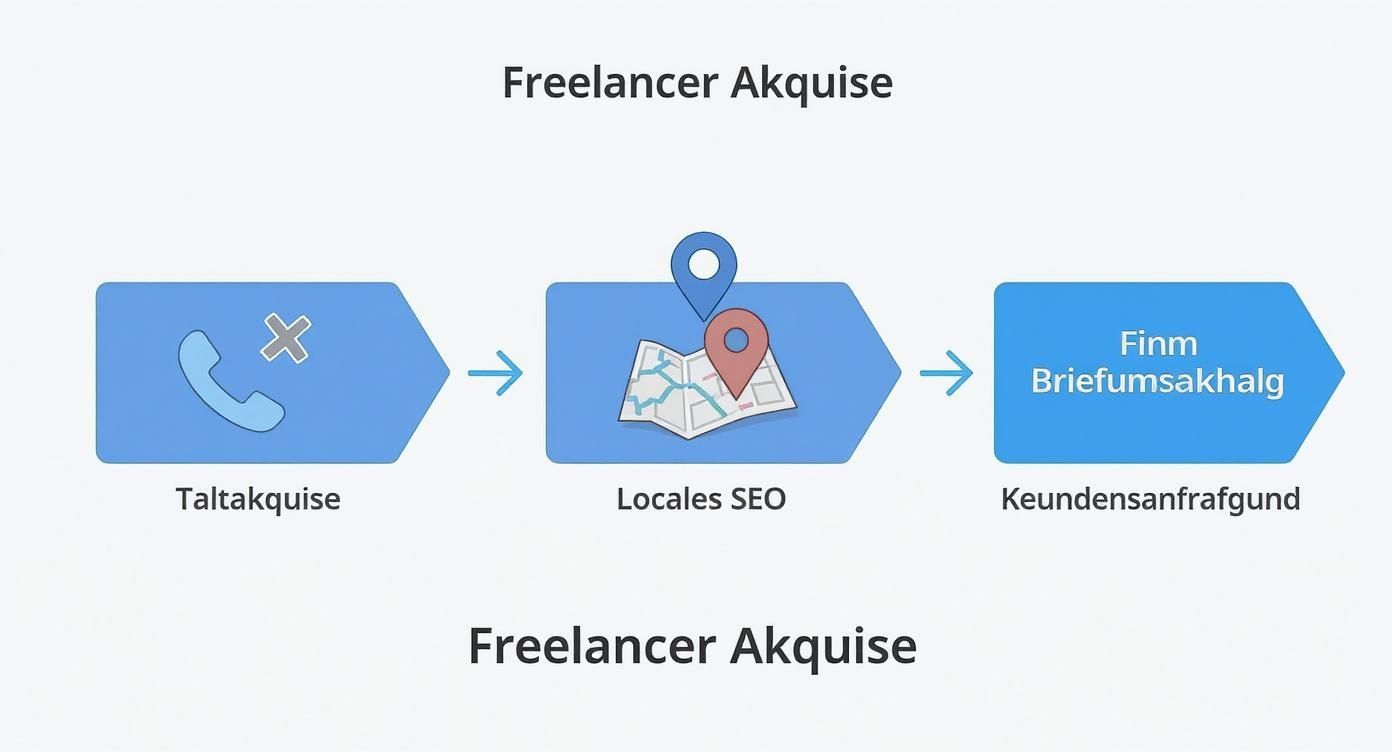
Local SEO can thus complement or replace the cold calling process and deliver a steady stream of qualified leads.
A big market with potential
This path is also a well-founded decision from an economic point of view. The German market for SEO and content services is a 10 billion euros-Market that is constantly growing. In 2022 alone, companies in this country have around 8.2 billion euros invested in content marketing. This shows that companies want organic, sustainable visibility and are willing to pay for it. For you as a freelancer, this means a large pool of potential customers.
The key point is: It is not about being visible to everyone, but to the correct people. Local SEO filters the target group and attracts customers who are about to make a purchase decision and need an expert like you.
When you strategically build your online presence, you create a predictable and sustainable source of order. This not only gives you financial security, but also the freedom to concentrate on the activities you do best and love to do.
Want to dive deeper into the basics? Our contribution to the topic local online marketing gives you a comprehensive overview.
Attract the right customers: Your keyword strategy as a freelancer
Good SEO for freelancers Don't start with technology, but with the question: Who is your ideal customer? Before you customize your website, you need to understand how that person searches for your service. It's about finding the words and phrases that someone who's willing to pay for your expertise types in the Google search bar.
This step is critical. An inappropriate keyword strategy may get you visitors, but not paying customers. As a web designer from Berlin, if you only optimize for the keyword “web design”, you are in competition with countless agencies and blogs from all over the country. Many who are looking for it just want to find out more, but do not want to commission a project.
The importance of local and transactional searches
The key to success is that Search intent to understand your potential customers. Someone who is about to be commissioned searches more specifically. The inquiries often contain two important signals: one local connection And a clear Intent to buy.
A few examples illustrate the difference:
- In general: “Learn WordPress” (information search)
- Specific & ready to buy: “WordPress developer Hamburg” (service provider search)
- In general: “How much does proofreading cost” (information search)
- Specific & ready to buy: “Proofreading for non-fiction books Munich prices” (search for service providers)
The second variant signals a specific interest in a service. You should focus on such keywords — so-called long-tail keywords. They often have less search volume, but the conversion probability is significantly higher.
Your job is to compile a list of search terms that signal a clear interest in buying. You don't need thousands of curious visitors, but a handful of qualified inquiries that match you and your offer.
How to find suitable keywords — even without expensive tools
You don't need an expensive subscription to get started. The Google Keyword Planner is often enough. You can use it free of charge via a Google Ads account, even without placing ads. Here you can enter ideas and receive suggestions, an approximate monthly search volume and an assessment of the competition.
Start with a simple brainstorming session:
- Service + location: Think of all variants of your service and combine them with your city and surrounding towns. So not only “photographer Berlin”, but also “business photographer Berlin Charlottenburg” or “wedding photographer Potsdam.”
- Problem + solution: Put yourself in the shoes of your customers. What problem do they have? Are you perhaps looking for “website loads slowly” instead of using the technical term “performance optimization”?
- Question keywords: Many searches start with “How,” “What,” or “Which.” Keywords such as “How do I find a good copywriter” are good for informative blog articles that build trust and expertise.
Gather these ideas in a spreadsheet. Write down the keyword, monthly search volume, and estimate the relevance for your business. Focus on terms with a realistic search volume — often that's enough 10 to 50 searches per month — and a feasible competition. To check the competition, enter the keyword on Google and analyze the top 10 results. Are they big agencies or other freelancers like you?
In the end, you'll have a solid base. This keyword list is your roadmap for your website content — from the texts on your service pages to future blog articles. If you want to professionalize your research later on, there is a selection of SEO apps specifically designed for such tasks.
How to make your website a point of contact for customers
Think of your website not just as a digital business card, but as a sales representative who works for you 24/7. For this to actively generate inquiries, technology and content must be coordinated. Here sets On-page SEO to: It's about optimizing your website so that Google recognizes your expertise and potential customers contact you.
Every detail — from headline to image title — is a way to show Google what your page is about and which searches you're relevant to.
First impressions in search results: page titles and meta descriptions
The page title (title tag) and the meta description are your figureheads in Google results. They're often the first thing a potential customer sees of you. This is where it is decided whether someone clicks on your link or switches to the competition.
Place your main keyword in the title, ideally at the front. Formulate the title as a clear value proposition and the description as a brief summary that arouses curiosity and highlights the benefits for the customer.
An example shows the difference:
- Less optimal: Home | Müller Webdesign
- Better: Professional web design Cologne | Müller web design for SMEs
The second track immediately communicates what is being offered, where it is being offered and for whom. That is clear communication.
Service sites that convince and rank
Your performance pages are at the heart of your website. Here you have to convince both the search engine and the visitor. A clean, logical structure is the key.
Start with a meaningful H1 headline that includes the page's main keyword. Then structure the text with interim summaries (H2, H3) to shed light on various aspects such as your work process, the benefits for the customer or your pricing. This improves readability and gives Google a clear content hierarchy.
Good service sites answer potential clients' questions before they're asked. Don't just describe what They do. Explain why It helps the customer and what working with you looks like.
A tip for a professional appearance: As soon as customers come across your optimized site, a professional email address creates trust. Here you can find out how to create a Set up email with your own domain.
The technical foundation for your success
The best service site is of little use if the technical basis is not right. Two factors are particularly important: charging speed and mobile usability.
A website that is longer than three seconds needed to shop, loses a significant portion of their potential visitors. At the same time, most people use their smartphones to surf. Your site must therefore look and function just as well on a small display as on a large monitor.
A quick checklist for the basics:
- Mobile-first approach: Is your page easy to use and read on any device?
- Page speed: Are your images compressed? Do you use caching mechanisms to reduce load time?
- Internal links: Do you link blog articles to suitable service pages and vice versa? This helps Google understand the connections on your website and distributes the “link power” to important sub-pages.
These technical improvements are not a one-off project, but a continuous process. They form the basis on which your content efforts are built. The combination of strong content and clean technology is an important lever in SEO for freelancers.
If you want to dive deeper into how to create impactful content, we recommend our guide to Development of a content marketing strategy.
The following table gives you an overview of the most important on-page elements and their optimization potential. Use it as a checklist to review your own website.
On-page SEO checklist for your freelancer website
Element optimization target example for a web designer in ColognePage title (title tag)Integrate main keyword + location + name/brand. Unique for every page `Professional web design CologneMeta descriptionArouse curiosity, create click incentives. Main keyword and call-to-action includedAre you looking for a web designer in Cologne? I build modern, fast websites for local businesses. Arrange a free initial consultation now!H1 headingThe most important heading of the page. Must include the primary keywordModern web design for your company in CologneSubheadings (H2, H3)Structure text, increase readability. Cover secondary keywords and related topics.My process: From idea to finished website, How much does a website cost?, Why local SEO is so important in CologneContentAnswer questions from the target group, show expertise. Include at least 300 words, keywords, of course. Detailed description of the web design process, presentation of reference projects, explanation of the benefits of WordPress for SMEs.Image SEO (alt tags)Each image needs a descriptive alt tag. Helps with accessibility and image search.Screenshot of the website for a Cologne craft business, created by web designer Peter Schmidtinternal linksLink relevant sub-pages to improve user navigation and link juice. Link from a blog article about “Tips for good website texts” to the “Web Design” service page.
This checklist is a good starting point. Review the points for your most important pages to identify potential to improve your visibility.
Optimize local search with your Google business profile
For freelancers who want to attract local customers, the Google company profile (formerly Google My Business) is a powerful and free tool. It acts as your digital storefront right in Google search results and Google Maps. A well-maintained profile can be decisive for whether a potential customer contacts you.
Although many freelancers create a profile, they do not use the full potential. It's about more than just a name and address. Each feature offers the option to send Google signals about your relevance and expertise. This is a cornerstone for successful SEO for freelancers.
Laying the right foundation: Consistent company data
The first step is the most important: Make sure that all basic information is accurate and consistent across all platforms. This creates trust with Google and with your future customers.
Select the correct main category, because this has a strong influence on which search queries you are found for. Be as precise as possible — a “web designer” is not a “marketing agency.” With suitable secondary categories, you can further specify your offer.
The company description is also often neglected. Use this space strategically. Instead of just writing “I offer web design,” incorporate your key keywords and location naturally.
Each field in this profile is an opportunity to tell Google more about your business and underline your local importance.
Actively demonstrate your expertise
Creating a profile and then neglecting it is not effective. To be visible in the local search, you must be active regularly. Google prefers profiles that are up to date and offer users added value.
Here are three areas that you should maintain continuously:
- Google posts: Use this feature as a mini blog. Announce completed projects, share a quick expert tip, or link to your latest blog post. Every post is an opportunity to place relevant keywords.
- Photos and videos: Visual impressions are important. Upload high-quality photos of your work, workplace, or yourself regularly. This creates trust and makes your profile more approachable.
- Questions & answers: Proactively answer typical customer questions before they're asked. You can even set and answer the most important questions yourself to stay in control of the information and help searchers directly.
Reviews: Your social capital in Google search
Customer reviews are a strong ranking factor on Google Maps. They serve as social proof of the quality of your work. Profiles with many, positive and recent reviews are often preferred.
A profile without recent reviews may lose relevance on Google. Your goal should be to build a steady flow of new, positive feedback.
Make it as easy as possible for happy customers to leave you a review. Integrate the evaluation link into your email signature or actively send it after project completion. And respond to every review — both positive and critical. A professional response to a negative review can build trust.
If you'd like to go even deeper here, check out our guide for detailed steps on how to get your Optimize your Google business profile.
Demonstrate your expertise through content and backlinks
Your technical basis is in place and your Google profile is optimized. Now it's time to provide Google with solid proof of your expertise. Here are two effective levers in SEO for freelancers In play: targeted content and authentic backlinks. The goal is not to become a content engine, but to strategically build trust.
A well-thought-out strategy for content and links signals to Google that others in your industry regard you as an important point of contact. This can set you apart from the competition and lead to consistently good rankings.
A content strategy that fits into your everyday life
As a freelancer, you often don't have the time to publish several blog articles a week. That is also not necessary. Instead of mass, you should focus on class. Focus on a few but helpful content that answers the most pressing questions from your target customers.
Such content not only attracts potential customers but is also more likely to receive links from other websites. Here are a few formats that have been tried and tested for freelancers:
- Detailed case studies: Describe a real customer project. What was the starting point? How did you address the issue? And what measurable results did you achieve? Documented successes create trust.
- Practical instructions: Create a guide that solves a typical problem for your target audience. For example, a web designer could write instructions on how to find the right hosting provider for a local company.
- Local resource pages: Make a list of useful resources for your city or region. A photographer could present the “10 best locations for business shoots in Munich.” Such local content is often linked.
Create content that is so valuable that others share it on their own and use it as a reference. Each of these contributions is a building block for your expert status and can work for you for years.
Link building made understandable: relationships instead of tricks
Backlinks — links from other websites to yours — are like recommendations for Google. You don't have to use questionable tactics for this. For freelancers, it's primarily about building real relationships and becoming visible in their own niche.
Instead of buying or trading links, focus on organic methods:
- Guest contributions: Write a high-quality technical article for an industry blog that your customers also read. You deliver added value and in return receive a valuable link and the attention of a new audience.
- Local directories: Subscribe to the most important local and industry-specific directories. Make sure that your NAP data (name, address, phone) is exactly the same everywhere.
- Network collaborations: Get in touch with other freelancers or local companies whose offerings complement yours. This can result in natural links, for example through mutual recommendations.
This authentic path is sustainable and sends the right signals to Google. Successful SEO can also have a direct impact on your income. Studies on the income development of SEO freelancers show that hourly rates depend heavily on professional experience. While beginners with 50 to 80 euros Experienced freelancers with over three years of practice can start per hour 80 to 120 euros charge per hour. You can find out more about salary structures in the sector in this Read a study on SEO salaries in Germany.
Measure SEO success and adjust the strategy
SEO is not a one-time project, but an ongoing process that requires observation and adjustment. Focus on the key figures that are really relevant to your freelancer business.
To measure the success of your measures, two free tools from Google are essential: the Google Search Console and Google Analytics. If you haven't already done so, you should set them both up. The Search Console shows you which keywords your site is ranking for and where there are technical problems. Google Analytics tells you how visitors come to your site and what they do there.
It depends on these key figures
Don't get lost in the details. To assess whether your SEO measures are effective, three key metrics are sufficient to start with:
- Development of keyword rankings: Are the positions of your most important keywords improving in search results? A look at the Search Console will tell you about this.
- Organic traffic: Is the number of visitors coming to your website via unpaid Google search increasing? This is a direct indicator of increasing visibility.
- Number of contact requests: This is the most important key figure. How many qualified inquiries do you receive per month via your contact form or email?
The true yardstick for success SEO for freelancers It is not traffic alone, but the quality and number of customer inquiries that result from it.
A routine for the monthly check-up
Block yourself an hour once a month for a quick SEO check. Review the development of the three key figures mentioned above. Ask yourself: Which pages or blog articles worked well in the last month? Where is there still untapped potential?
This data-based view helps you to improve your strategy in a targeted manner. If a blog post attracts a lot of visitors but doesn't generate inquiries, you could include a clearer call-to-action. If you're stuck on page two for an important keyword, you could create new content about that topic or build a relevant backlink.
The reward for this effort is not only better visibility, but can also be reflected in income. The average salary for SEO freelancers in Germany is around 66,749 euros per year. This shows that investing in these skills can pay off in the long term. You can find more insights into the salary structures of SEO freelancers here.
This cycle of implementation, measurement and adaptation ensures that your website gradually develops into a reliable source of customer inquiries.
Frequently asked questions about SEO for freelancers
As a freelancer, there are many questions about SEO. Here you can find answers to the most common ones.
How much does SEO cost me as a freelancer?
The costs depend on your approach. When you do everything yourself, your biggest investment is your time. Plan at least at the start 5-10 hours per week for research, optimization and content creation.
If you seek external help, the monthly costs for basic support from an expert are usually between 500€ and 1,500€. The price depends on the scope of the measures and the competitive situation.
When can I expect the first results?
SEO requires patience. In the local sector, where competition is often lower, with consistent work, there is often already three to six months First successes are visible.
This could include better rankings for your services or more calls from your Google business profile. Highly competitive keywords in big cities usually require a longer period of time.
Can I implement SEO completely alone as a freelancer?
Yes, it is possible. Anyone can learn the basics. With good instructions and the right tools, you can optimize your website, Google profile and initial content yourself.
An expert can be useful if you don't have the time, you're reaching technical limits, or you're not making the desired progress despite your efforts.
Summary and next steps
SEO for freelancers is an effective way to become visible online and receive qualified customer inquiries. The key lies in local orientation, a well-thought-out keyword strategy, a technically clean website and an actively maintained Google company profile. Complemented by high-quality content and authentic backlinks, you will build up a sustainable source of acquisition. Start with the basics, measure your success, and adjust your strategy regularly to be successful over the long term.
Would you like to be more visible in your region without sacrificing your own time? SocialEdge can help you with your Google Maps marketing. Discover how we can help you now.