What does organic growth mean for companies?
Organic growth is the opposite of inorganic growth, where success is accelerated through paid advertising or company takeovers. Instead, the business is gradually developing from within.
Think of it like a tree: It grows slowly but develops deep, strong roots. This makes it resilient, even in difficult market conditions.
In essence, this means making optimal use of existing resources. New customers are acquired and existing customers are retained because the products, service and online presence are convincing. The approach is to be so helpful and relevant that customers find the company on their own and are happy to recommend it to others.
Why an organic strategy is valuable for companies
Anyone who focuses on organic growth benefits that go beyond saving advertising costs:
- Sustainability: Organically built visibility is long-lasting. A good reputation and top positions on Google don't disappear just because an advertising budget is cut.
- Credibility: People trust organic search results and real recommendations more than ads. This creates trust in the brand and promotes customer loyalty.
- Crisis security: Companies that grow organically are often more stable. Analyses of the fastest-growing SMEs in Germany show that these companies have an average of 16 percent grow per year and achieve high profits in the process — even in uncertain economic times. More about these You can find information about SMEs at cavisio.de.
Organic growth is not a coincidence, but the result of a well-thought-out strategy. It's about creating attraction through quality and visibility so that customers come by themselves instead of convincing them with advertising.
This approach creates a solid foundation for long-term customer relationships and makes your company less sensitive to market fluctuations. It is an investment in the future that pays off in the form of loyal customers and healthy growth. In order to get off to a good start, it is crucial to understand the basics of Online marketing for small businesses to understand.
The foundations for sustainable organic growth
Organic growth is a key component of building a company on solid foundations. Basically, it's about building a presence that speaks for itself. Instead of buying attention in the short term, people invest in values that last and attract customers in the long term.
This process is not a sprint, but requires strategic vision. In some cases, an initial investment can be useful. A investment credit can create the necessary leeway here, for example, to initiate important projects. The goal is clear: to be the first address that customers can find on their own when needed.
The most important pillars for growing your business
Think of your organic growth as a sturdy building. It stands on several pillars, and each one is crucial for stability.
- Your Google business profile: Today, this is an important digital figurehead. For local customers, a well-maintained profile is often the first point of contact.
- Local SEO: Here, all digital tracks — from your own website to business directories — are aligned in such a way that Google recognizes you as a relevant local answer to a search query.
- A well-thought-out content strategy: Provide answers to your customers' questions. Good content positions you as an expert and creates trust long before a purchase is made.
- Active reputation management: Real customer reviews are valuable. Anyone who actively responds to feedback builds credibility and convinces future customers.
- Consistent company data (NAP): NAme, Aaddress, Phone — these three details must be identical throughout the network. For search engines, consistency is a clear sign of trustworthiness.
It is not enough just to be visible. It's just as important to appear trustworthy. An optimized Google profile without reviews is just as ineffective as an excellent website that no one can find.
The difference between organic and paid growth is often underestimated. The following table compares the two approaches and shows why the organic strategy usually pays off for local service providers in the long term.
Comparison: Organic vs. inorganic company growth
A comparison of the core characteristics, advantages and disadvantages of organic and inorganic (paid) growth for local companies.
.tbl-scroll {contain:inline-size; overflow-x:auto; -webkit-overflow-scrolling:touch} .tbl-scroll table {min-width:600px; width: 100%; border-collapse:collapse; margin-bottom:20px} .tbl-scroll th {border:1px solid #ddd; padding:8px; text-align:left; background-color: #f2f2f2; white-space:nowrap} .tbl-scroll td {border:1px solid #ddd; padding:8px; text-align:left} featuresOrganic growth (e.g. SEO, content) Inorganic growth (e.g. Google Ads)Time spentLong-term structure, sustainable impactImmediate results that are linked to the budgetexpensesIndirect costs (time, expertise), no direct advertising budgetDirect click costs, requires an ongoing budgetcredibilityVery high, based on trust and relevanceLower, is clearly perceived as paid advertisinglifetimeVisibility persists even without constant investmentVisibility ends when the campaign is stopped
These pillars form the basis for the next steps in this guide. They are the tools to gradually stand out from the competition.
If you want to dive deeper into the topic and learn how to develop real appeal with valuable content, then our guide to Development of a content marketing strategy It's a useful next step.
Local SEO as a roadmap for organic growth
If you want to be successful with your local company, you shouldn't rely on chance. Local visibility is the result of a consistently implemented strategy. This is the key to organic growth to promote right on your own doorstep. This roadmap shows how to move forward in local searches.
The process can be divided into three areas, which are interlinked: visibility, reputation, and content. Think of it as a foundation on which to build your local presence.
The following infographic sums up this three-step approach.
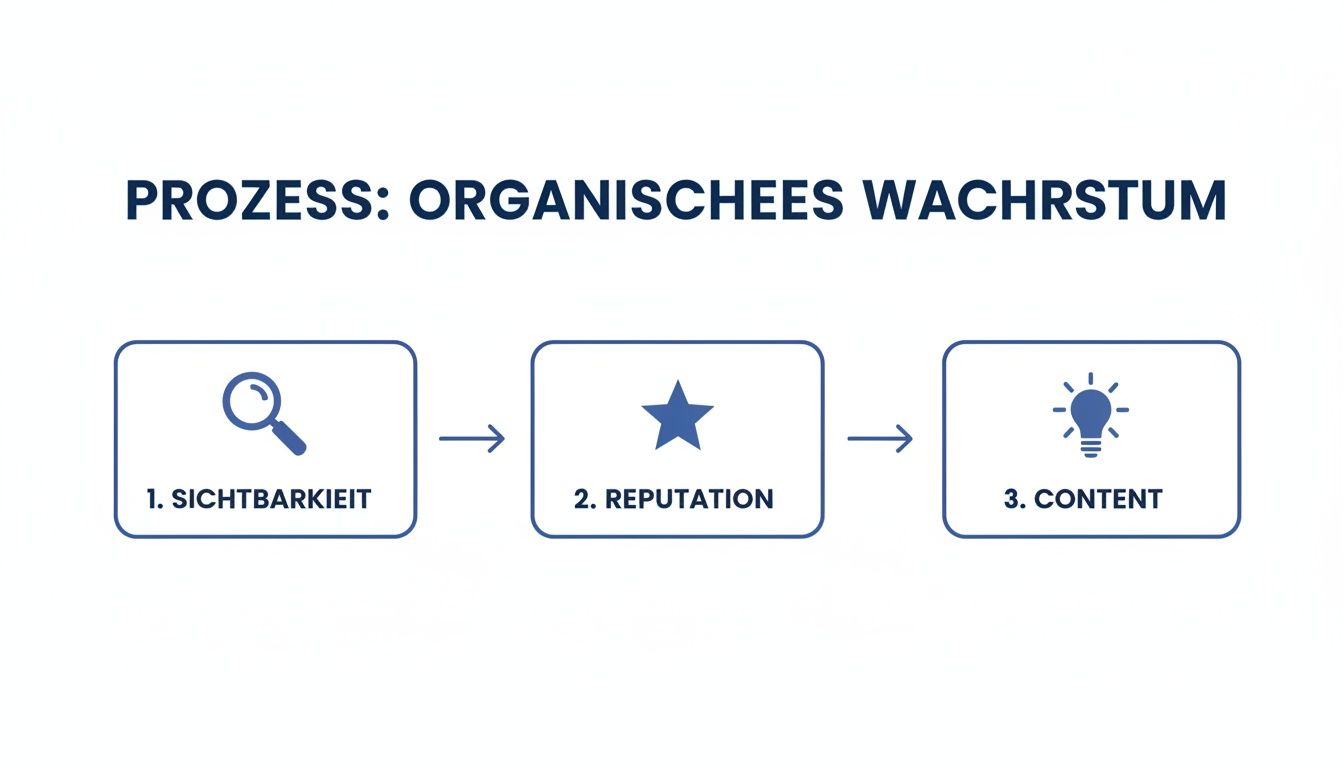
The graph makes it clear that sustainable success only happens when customers not only find you, but also trust you and find your content helpful.
Starting point for growth: The Google company profile
Your Google business profile is at the heart of your local visibility. For many potential customers, it is the first point of contact — which is why it must be convincing. Let's start with the basics that often make the difference:
- Select the right categories: Be precise. Choose “Italian Restaurant” as the main category instead of just “Restaurant.” Add appropriate secondary categories to round off the picture.
- Include keywords sensibly: Integrate relevant search terms into your company description and the answers to customer questions, of course.
- Post posts regularly: Use the contribution function for news, offers or events. This signals to Google and users that your company is active.
- Proactively answer questions: Maintain the question and answer area yourself and answer the most common questions in advance. This allows you to keep control of the information.
A well-maintained Google company profile is more than a digital business card. It's an active tool that builds trust and brings customers straight to you — often before they've even visited your website.
When the profile is standing, the foundation is laid. Now it's time to optimize your website for local searches as well.
On-page optimization and the importance of consistent data
Your website must clearly signal to Google where you can be found and what you offer. Do you have multiple locations? Then create a separate subpage for each. Otherwise, optimize your homepage with clear local keywords such as “tax advisor in Hamburg.”
The absolute consistency of your core data is at least as important, including NAP (Name, Address, Phone) called. Your name, address, and telephone number must be identical to the letter in all major online directories. Even the smallest deviations such as “street” instead of “street” can confuse search engines and have a negative impact on your ranking.
A look at the economic situation also shows how crucial a stable, organic basis is. While the 100 top-selling listed companies in Germany saw a 15 percent drop in profits recorded, achieved the German start-up scene with 3,568 start-ups a new record. This shows the potential of agile, organically growing business models. You can find more insights on this in the Analysis of the top 100 companies on ey.com.
With these measures, you create a solid technical and content basis. They send clear signals to search engines and build trust through consistent information. If you want to go even deeper into the details, you can read our article about local SEO valuable further tips.
Fostering customer trust with content and reputation
Visibility is a good start. But what that organic growth for a company What really drives us is trust. The moment a potential customer considers whether to contact you, trust becomes the decisive factor. Two elements are essential for this: high-quality content and a positive reputation.

Think of it as two sides of the same coin. With first-class content, you show off your expertise, while a good reputation underpins this expertise with solid evidence.
Show off your expertise with valuable content
Content marketing isn't about advertising slogans, it's about answering your customers' real questions. Become a problem solver and a reliable point of contact in your industry. Someone looking for “best insulation for old buildings” wants a well-founded answer, not a sales brochure.
Let's say you're a heating engineer. Instead of just listing your services, you could create content that really helps:
- A blog article: “The 5 most common heating maintenance mistakes and how to avoid them”
- A handy guide: A simple checklist that anyone can use to winterize their heating system.
- A brief case study: A before-and-after example of heating modernization for a local customer.
Such content not only attracts the right prospects — it also builds trust long before you create an offer. They clearly signal that I understand my business and take my clients' concerns seriously.
How a good reputation strengthens your company
Your online reputation is what others say about you — online, these are primarily customer reviews. A profile with many positive reviews can be the decisive impetus for an undecided customer.
Proactive reputation management is more than collecting stars. It is an open dialogue with your customers that shows that their opinion is important to you. The currency you use to build trust here is transparency and appreciation.
A strategic approach to reviews can be divided into simple steps:
- Actively ask for feedback: Happy customers don't always think about writing a review. A friendly request for a completed assignment can make a big difference here.
- Respond to every review: Thank you for your praise and respond to criticism in a professional and solution-oriented manner. This shows all readers that you take service seriously.
- Stay authentic: Real, honest reviews are valuable. Support this image by providing authentic insights into your company, for example with photos of the team.
Dealing with feedback professionally in particular is crucial. If you are unsure how to react, our guide provides tips on how to confidently Reply to Google reviews. In this way, you can use critical comments yourself as an opportunity to prove your customer orientation and strengthen trust in your company.
Make organic company growth measurable and manage
A good strategy has been proven in practice. But how can you tell that your own efforts are paying off if you can't simply balance advertising spending with sales? When it comes to organic growth, it is important to interpret the right signals. It's about understanding the key figures that really say something about success.
The principle applies here: What you don't measure, you can't improve. Without clear indicators — so-called key performance indicators (KPIs) — you act in uncertainty and do not know which measures are taking effect.
The KPIs that are relevant for local companies
Focus on a handful of metrics to feel the pulse of your organic growth. You can find most of this important data directly in the statistics of your Google business profile.
Focus on these four key metrics:
- Local search visibility: How often does your company appear in local search results, particularly in the “Local Pack” on Google Maps? An increase is a clear sign that your optimizations are working.
- Clicks to the website: How many users click on your website from your Google profile? This is a good indicator of how well your profile converts interest into further action.
- Calls from the company profile: A phone call is often the most direct route to a new order. If the number of calls to your profile increases, this is a strong signal of concrete interest in buying.
- Directions: When someone starts planning your route to you, it is a very strong signal that they want to visit your shop in person.
Think of these KPIs as your company's cockpit. Each value is an important indicator that tells you whether you're on track to turn visibility into real customers.
With this data, you can evaluate and specifically adjust your strategy. For example, do you notice that your visibility is growing but there are no clicks and calls? Then maybe your profile texts, photos or reviews aren't convincing enough.
A systematic Local rank tracking It also helps you to understand such relationships more precisely and to ensure that your effort is reflected in more customers and sales.
Summary: Your path to sustainable success
Organic growth is not a short-term project, but a long-term strategy. The reward is a robust, crisis-resistant company that stands on a foundation of loyal customers and is not dependent on expensive advertising budgets.
The key factors for this are a well-maintained Google company profile, consistent company data, helpful content for your customers and a positive reputation. Start building that foundation today. The best place to start is often to take stock of your current online presence.
While you optimize your operational business, a well-thought-out investment strategy can also contribute to long-term protection. This is how the topic plays out for many entrepreneurs Buying real estate as an investment an increasingly important role.
Frequently asked questions about organic growth of companies
Finally, I will answer a few questions that are frequently asked in practice in order to better assess the costs and benefits of organic growth.
How quickly can the first results of organic growth be seen?
Organic growth takes time. Anyone who promises immediate top placements is usually dubious. While paid ads are visible overnight (as long as you pay), organic growth builds a solid foundation.
The first positive signals, such as an improved position in local Google search or more interactions with your profile, are often visible after just a few weeks. For consolidated top rankings and a noticeable increase in customer inquiries, you should realistically with six to twelve months calculate. The patience pays off, because a top position achieved is more sustainable than any purchased ad.
Is organic growth worthwhile for my small business?
Yes, absolutely. Organic growth is often the smartest path, particularly for small and local businesses. Most cannot keep up with the advertising budgets of large chains. Your advantage lies in Proximity and authenticity.
An optimized Google company profile with honest customer reviews and content that helps local people makes a small business the number one address in its niche. That is a competitive advantage that money alone cannot buy.
Organic growth creates fairer competitive conditions. It is not the one with the biggest budget that wins, but the one with the most well-thought-out, customer-oriented strategy.
What are the typical mistakes I should avoid when growing organically?
Many make similar mistakes at first. The biggest stumbling block is often impatience or trying to start without a clear plan.
Other classic mistakes include:
- Inconsistent data: Different addresses or telephone numbers on the network confuse customers and Google.
- Ignore reviews: If you don't respond to feedback, you gamble away trust.
- Lack of added value: Publish content that is pure advertising instead of solving real customer problems.
Looking outside the box can also be a growth driver. Toptica increased its turnover annually between 2020 and 2024 by 17.9 percent, primarily through international transactions. More about the Growth factors for start-ups can be found on existenzgruendungsportal.de.
Summary and next steps
Organic growth is the key to sustainable success and greater independence from advertising. The strategies presented in this guide—from optimizing your Google company profile to consistent data to valuable content and active reputation management—form the foundation for a strong, locally based company. Implement these steps consistently to gain a decisive advantage over your competition.
If you're ready to take your company's visibility to the next level, SocialEdge specializes in doing just that for local service providers.