Why online marketing is relevant for small businesses
Think of your shop as a coffee shop in a back alley. In the past, an entry in the phone book was perhaps enough. Today, potential customers almost always use their smartphones when looking for the “best burger nearby” or a “reliable craftsman.”

This change in customer behavior makes Online marketing for small businesses essential. It's not about competing with big chains, but about being visible to your local audience when there's a need.
Your digital shop window is open 24/7
Your digital presence — whether it's a well-maintained Google company profile or a simple website — is your figurehead on the Internet. The advantage: Unlike your retail store, it is around the clock reachable.
Here, potential customers can find out more, check opening hours, read reviews and get a first impression. Potential customers barely notice anyone who is not present online or only has outdated information.
The relevance of local search for small businesses
Many searches have a local connection. These “I need this now” moments are ideal opportunities for you. Anyone who does not appear when searching for “Klempner Notdienst Hamburg” or “Friseur ohne Appointment Köln” is virtually invisible to this potential customer.
A strong local online presence is your direct answer to demand on your doorstep. You offer your solution exactly when someone is actively looking for it.
This change in search behavior makes a well-thought-out strategy important. The good news is that the most effective tools are often inexpensive or even free of charge. What is needed is less budget and more time and consistency. Read our further article to learn more about the basics of local marketing.
An opportunity for German SMEs
Small and medium-sized enterprises (SMEs) form the backbone of the German economy. They make 99% of all companies in Germany and represent around 60% of all jobs. However, the potential of online marketing is often not yet fully exploited.
Although most recognize the importance, implementation is often lacking. This is often due to a lack of visibility — which in turn makes it difficult to find qualified marketing specialists. Anyone interested in the background can find out in the Bitkom study “Digital Marketing in Germany 2025” at der-onliner.org further insights.
Essential online marketing tools for small businesses
Don't think of your online marketing as a complex maze, but as a well-stocked toolbox. For small, local companies, a few but effective tools are often enough to establish a solid presence online.
The best part is that the most important of these tools are often free or budget-friendly. They form the basis of your digital visibility. Each is useful in its own right, but when they work together, they develop their true strength.
The Google company profile: Your digital shop sign
that Google Business Profile (formerly Google My Business) is the most important free marketing tool for any local business. When someone near you searches for “coffee shop” or “bike repair,” your profile determines whether you appear on Google Maps and in local search results.
A fully completed and actively maintained profile provides potential customers with all relevant information at a glance:
- Location and contact details: Your address, telephone number and current opening hours.
- Services and products: A clear overview of your offering.
- Photos and videos: An authentic insight into your business.
- contributions: Information about current offers, news or events.
This profile is often the first point of contact a customer has with your company. A positive first impression can lead straight to a phone call, a website visit, or a visit to your store.
Your website: Your company's digital home
While your Google profile serves as a poster child, your website is your brand's digital home. Here you have full control over content and design, tell your story and provide interested parties with detailed information. A good website for a small business doesn't have to be complicated or expensive.
In essence, it should fulfill three tasks:
- Build trust: With a professional “about us” page, real customer testimonials and high-quality images, you create credibility.
- Answer questions: Explain in an understandable way which problems you solve for your customers and what sets you apart from the competition.
- Guide actions: Take visitors to the next step with clear calls to action, such as “Make an appointment now” or “Request a quote.”
Your website is the central anchor point that all other channels — from Google to social media — should link to.
Social media for authentic customer relationships
Platforms such as Facebook, Instagram or TikTok are your digital marketplaces. This is less about selling directly and more about building a community and maintaining customer relationships. Show the human side of your business here.
Instead of just publishing promotional messages, give insights behind the scenes, share useful tips from your industry, or engage in dialogue with your followers. Authenticity is key here. It's not necessary to be present on every platform. Choose the channel your target audience is on and maintain it consistently.
The value of social media lies in dialogue. It's your chance to listen, learn, and turn customers into loyal fans who recommend your company.
Email marketing for sustainable customer loyalty
Email marketing is an often underrated but very effective tool in Online marketing for small businesses. While you must compete for attention on social media, your email list is yours. It is your direct line to your customers.
Use emails to turn one-time buyers into repeat customers. Find out about exclusive offers, seasonal promotions or new products. Even a simple monthly newsletter can help you stay in the memory of your customers.
Spending on digital marketing in Germany has increased in recent years, increasing competition. About 50% of companies are already using social media marketing, while 39% Use email and search engine marketing. For local businesses with smaller budgets, it is therefore all the more important to rely on cost-effective channels such as organic Google optimization in order to be visible in local search results without spending on advertising. Read more about these developments in the Bitkom study “Digital Marketing in Germany 2025”.
Online reviews as a digital vote of trust
Reviews on platforms such as Google or industry-specific portals are the modern form of word of mouth. Positive reviews are a strong signal of trust and quality — both for new customers and for search engines such as Google.
Actively managing your reviews is therefore essential. In concrete terms, this means:
- Collect: Actively ask satisfied customers for a review. Friendly demand is often enough.
- React: Thank you for positive feedback and respond to criticism in a professional and solution-oriented manner.
Dealing proactively with reviews shows that you take customer feedback seriously and sustainably strengthens your reputation. To simplify this process, there are helpful SEO tools specifically for local businessesthat can help you manage and analyze.
The following overview summarizes the most important channels.
Overview: Online marketing channels for local businesses
This table compares key channels in terms of their primary goal, estimated effort, and suitability for various local industries.
Channel main destinationTypical effort Particularly suitable forGoogle company profileLocal visibility, customer enquiriesLow to medium (regular care) Any local company with local customers (restaurants, craftsmen, doctors, hairdressers)Your own websiteTrust building, detailed information, lead generation tools (initial setup), then low (maintenance) service providers, consultants, companies with products that require explanationsocial mediaCommunity building, brand recognition, customer loyalResources up to high (regular content creation) Visually strong industries (hospitality, fashion, design), service-oriented businessesemail marketingCustomer loyalty, reactivation, direct saleLow to medium (regular newsletter) Companies with returning customers (retail, service providers, catering)online reviewsTrust building (social proof), reputation managementLow (active monitoring & response) All industries where trust is crucial (health, crafts, consulting)
Each of these channels plays an important role. In the next section, we'll look at how to set the right priorities based on your industry and budget.
Optimizing for local Google search
Your Google business profile is often the first contact a potential customer has with you—even before they visit your website. It is your most important free advertising space on the Internet.
By optimizing this profile, you lay the foundation for a good ranking on Google Maps and in local search results. The goal is to get more calls, website visitors and ultimately more customers without having to spend an advertising budget.
The basic Google business profile setup
A seamless and correct profile is the basis. Google favors profiles that provide accurate information and rewards this with better visibility. Take the time to fill out each point carefully.
The first step is to verify your business to confirm that your store exists at the address provided. It is then on to the master data.
- Correct company name: Enter the exact name by which your company is known. Avoid additional keywords or advertising slogans.
- Exact address: The address must match 100% of the real location.
- Local phone number: A local area code creates trust and underlines the regional connection.
- Site link: Paste the link to your site's home page.
These three key pieces of information — Name, address, telephone number (NAP) — form your digital identity. The consistency of this data is critical.
Make sure that this information is the same on all platforms — from your website to Facebook to business directories. Discrepancies can confuse Google and have a negative impact on your local ranking.
Use keywords through categories and descriptions
The basics are followed by the strategic selection of appropriate categories. Your main category is an important ranking factor because it tells Google what your core business is. Be as specific as possible here.
An Italian restaurant should choose “Italian restaurant,” not just “restaurant.” An electrician with a focus on smart home installations can complement this in secondary categories.
The company description also provides space for relevant terms. Describe what sets you apart and what solutions you offer for your customers. Detailed instructions can be found in our guide to Create an optimized Google business profile.
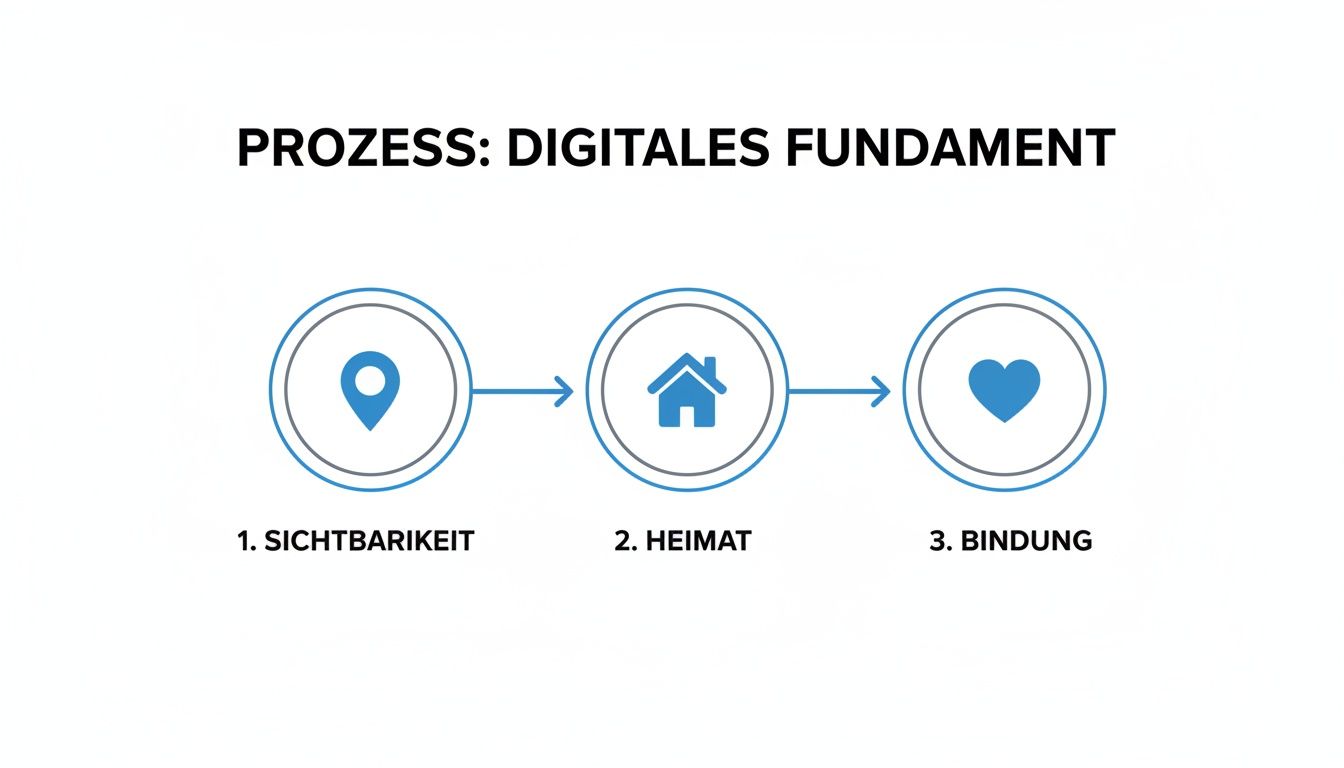
This process illustrates the interplay of the three pillars of a digital foundation: gaining visibility, directing customers to the digital “home” (your website) and building a bond there.
Create trust with pictures and contributions
A profile without pictures seems impersonal. People are visually oriented and want to see who they're dealing with. Authentic, high-quality photos are therefore essential.
Checklist for meaningful images:
- Exterior view: A photo of your entrance helps customers find you locally.
- interiors: Give an insight into your business and create an inviting atmosphere.
- The team: A friendly team photo creates a personal connection.
- At work: Show off your products in action or your team in action.
In addition to images, Google posts are a useful tool. They signal activity to Google and your customers. Use the feature to announce offers, news, or events. Each post is prominently visible for seven days and strengthens your local relevance. A short contribution per week can already make a difference and is a simple but effective component of Online marketing for small businesses.
A website that works for customers
Think of your website not just as a digital business card, but as your best salesperson who is available 24/7, answering questions and acquiring new customers. While your Google business profile is the guide, your website is the goal: your digital home over which you have full control.

This is where it is decided whether a visitor becomes a customer. To do this, your website must fulfill three central tasks: create trust, solve customer problems and motivate visitors to take clear action.
The foundation: trust and local connection
For local companies, the regional connection is — often as Local SEO called — an important factor. Search engines want to provide their users with relevant results from the immediate environment. Your website should therefore clearly signal which region you are an expert in.
This is achieved through targeted measures:
- Integrate place names: Your location doesn't just belong in the Impressum. Mention your city or district on the homepage, in service descriptions or blog articles. A painting company could write: “Your expert for façade painting in Musterstadt. ”
- An authentic “about us” page: Tell your story Introduce your team with real photos and explain what drives you. This creates a personal connection.
- Show real customer testimonials: Nothing is more convincing than satisfied customers. Include quotes or short success stories, ideally with a location. This serves as strong social proof.
These elements not only boost your reputation among potential customers, but also send clear signals to Google that you're relevant in your region.
A user-friendly technical basis
The best presentation is of little use if the technical basis is not right. There are two technical aspects in Online marketing for small businesses decisively.
First, the mobile optimization. The majority of your local customers can find you via a smartphone. If your website is cluttered on small screens, visitors will quickly disappear. Google considers mobile friendliness as an important ranking factor.
A slow website can cause potential customers to switch to the competition. Studies show that even a delay of just a few seconds significantly increases the bounce rate.
Second, the Loading times. A page that loads slowly frustrates users. Use free tools like Google PageSpeed Insights to check your site's performance. It is often too large images or unnecessary technical elements that slow down your site.
From visitor to customer: Clear calls to action
The goal of your website is to get visitors to take action. This works best with clear calls to action, so-called Calls to action (CTAs). A CTA is a guide that tells the user what the next step is.
Examples of effective CTAs for local companies:
- “Call now”: A clickable button with your phone number is very helpful for mobile users.
- “Book an appointment online”: A direct link to your calendar tool.
- “Request a quote”: A link to a simple contact form.
- “Plan a route”: A link that opens Google Maps with your address.
Place these CTAs prominently and logically, for example at the end of a service description. By making things as easy as possible for the customer, you turn passive interest into active action. If you would like to delve deeper into the topic, our article on Conversion rate optimizationhow you can further increase the effectiveness of your website
Build trust with social media and reviews
Trust and authenticity are critical to small business success. Customers aren't just looking for a product, they're also looking for a connection to your store. Social media and online reviews play an important role here: They are tools to build a community and actively shape your reputation.
It's not about being present on every platform. The key is finding the channels that suit your business and using them consistently.
Find the right social media channel for your company
Each social media platform has its own unique character. The rule is: Quality over quantity. Focus your energy on one or two channels instead of being half-hearted across all platforms.
A small guide:
- Facebook: A still relevant channel for local companies to reach a broad target group. Here you can announce events, share news, and connect with your neighborhood.
- Instagram: The ideal platform for visual industries. Catering, crafts, fashion or design can score points here with strong images and short videos.
- LinkedIn: The network for professional service providers such as consultants, lawyers or agencies. The focus here is on specialist topics and building up an expert status.
The decisive factor is the added value you offer. Instead of pure product advertising, you show insights behind the scenes, give useful tips or tell the stories of your satisfied customers. That creates closeness.
Reviews as an important sign of trust
Online reviews are the digital form of word of mouth. Before a customer chooses you, they're likely to read what others are saying about you. Actively managing your reputation is therefore a core component of Online marketing for small businesses.
Every review — whether positive or negative — is an opportunity. It's direct feedback that helps you get better and an opportunity to publicly show how much you value your customers.
Respond to any feedback Thank you for your praise and respond to criticism in a professional and solution-oriented manner. This signals to potential new customers that I'm being taken seriously here.
Kindly ask satisfied customers for a review. Often only this small impetus is missing. This process not only boosts your reputation, but also sends positive signals to search engines like Google.
If you expand your social media strategy, working with influencers could also be interesting. Here you can also find out about professional aspects such as Taxation of influencer incometo act in a legally secure manner.
Measure the success of your marketing efforts
Online marketing without analysis is like going on a blindfold ride. You may be on your way, but you don't know whether you'll reach your destination.
Many small business owners shy away from the topic of “analysis.” The good news: The most important data for well-founded decisions is often free of charge and easily accessible. It's about getting a sense of what works so you can invest your time and budget where it's most worthwhile.
The Google company profile as an analysis tool
Your easiest tool for measuring success is your Google business profile. Under “Performance data”, Google provides you with all important information in an easy-to-understand format.
Here you can see at a glance:
- searches: How many people have searched for your business and discovered your profile?
- Interactions: How often was the “Call” button clicked?
- Directions: How many potential customers have planned the route to you?
- Website clicks: How many visitors came to your website via your profile?
These figures are valuable. If calls and directions increase after uploading new images or publishing a post, it's a clear sign that your efforts are paying off.
What your website reveals about users
Your website also provides valuable insights. Find out from which pages most visitors use your contact form. This shows you which of your offers are the most convincing.
When you run a blog, you can quickly see which articles are read the most. This is a direct indication of which topics your target group is interested in. Produce more of what's popular. For a more detailed analysis, our article on Local rank tracking Instructions on how to specifically monitor your visibility in local search.
The following table gives you an overview of the most important key performance indicators (KPIs) that you should keep an eye on.
Key figures (KPIs) for your local marketing
This table shows key performance indicators for primary online marketing channels so you can easily measure the success of your efforts.
ChannelImportant Key Figure (KPI) What this KPI saysGoogle company profileCalls & DirectionsThe direct interest in making contact or visiting — the most important indicator for local businesses.Your own websiteLength of stay & contact requestsHow long visitors stay on your site and how often they actively seek contact. An indicator of relevance and persuasion.social mediaEngagement rate (likes, comments) How engaged your community is with your content. Shows whether your posts are relevant and engaging.email marketingOpen rate & click rateHow many recipients open your emails and click on the links they contain. Measure interest in your topics and offers.
With these meaningful figures, you can manage your marketing in a targeted manner and identify which activities attract new customers to your store.
Summary and your next steps
Successful online marketing for your local business doesn't have to be expensive or complicated. The key is to implement the right measures consistently and in a customer-oriented manner.
This guide has presented the key tools: Your Google company profile as a digital figurehead, your webpage as a trustworthy anchor point and authentic communication via valuations and social media as an engine for your customer relationships. These building blocks create a strong digital presence that continuously brings you new customers.
Don't wait for the perfect moment. The most important step is the next one.
Get started with your Google business profile today. It's the fastest, most cost-effective way to improve your visibility in local search and reach customers right at your doorstep.
Implement the first item on our checklist and lay the foundation for your digital growth.
A well-organized workplace is helpful to keep you on track in the long term. Inspirations about how you Set up your home office workplace productively can, can be found online.
Your journey to digital success starts now — step by step.
Would you like to prevail in local competition and achieve a top position on Google without worrying about the details yourself? SocialEdge is your specialized partner for effective Google Maps marketing. We help you get found by your customers.
Discover now how SocialEdge brings your local ranking to the top positions.