Why local SEO optimization is important for companies
A typical scenario: Someone in your city needs a handyman, is looking for a restaurant or wants to book a hairdressing appointment. The first step is usually a quick Google search with a smartphone. At that moment, it is decided whether your company will be perceived as an option or whether a competitor with a better online presence will win the order.
Organic visibility as a factor for trust
Paid ads can generate attention in the short term. However, user trust is often built up through organic, i.e. unpaid, search results. A high ranking signals relevance and trustworthiness to Google and searchers. This can have a positive effect on click-through rate and ultimately on sales. Without targeted optimization of the website and Google company profile, this potential remains unused.
Statistics illustrate this: In 2025, it is estimated that in Germany there will be over 99,000 searches per second Posted on Google. About 94% of all clicks organic results are accounted for, as users tend to trust them more. More SEO statistics can be found on aioseo.com.
An important aspect: For example 75% of users don't click on the second page of search results. Anyone who doesn't make it to the first page barely exists online for the majority of potential customers.
Mobile search as a decisive factor
Search behavior has changed significantly — away from desktop to smartphone. Searches such as “tax advisor near me” or “Café now open” are commonplace. Search engines therefore prefer companies whose online presence is optimized for mobile users. Fast loading times, highly visible contact information and easy navigation on mobile devices are important standards today.
Local SEO optimization is a tool to reach this target group that is ready to buy. It not only helps to be found, but also to be perceived as a relevant local option. For companies that want to expand their local reach, strategies for local online marketing an important basis for sustainable growth.
Analyzing SEO Performance: A Realistic Assessment
Every SEO strategy starts with an inventory. Before time and resources are invested, it is necessary to determine the current situation. An audit is a systematic analysis of the strengths and weaknesses of your own online presence.
This first step is critical. It transforms assumptions into data-based facts. This ensures that optimization measures are targeted and not based on assumptions.
The self-audit for local companies
No special tools are required for an initial overview. Put yourself in the shoes of a potential customer. Open Google and search for your core services related to your location, such as “Steuerberater Bühl” or “Hairdresser near me.”
Pay attention to the following:
- Does your company appear in the “Local Pack”? This is the area with the map and three highlighted local results.
- What position are you in? Are you in the top 3 or lower on the list?
- What is the status of your Google business profile? Does it look complete and up to date? Is all information accurate, are there high-quality photos and positive reviews?
This simple search gives a first impression of current visibility and shows whether customers can find you when they actively search for your offers.
A common misconception made by local entrepreneurs is the assumption that an appealing website alone provides visibility. Without targeted optimization for local search queries, the potential often remains unused.
Identify typical SEO vulnerabilities
The first check is followed by a detailed analysis of typical sources of error. A basis for local SEO is the consistency of master data, also as NAP data known (name, address, phone).
This is where details matter. Verify that the company name, address, and phone number are the same on your website, Google Business Profile, and all relevant online directories (e.g. Yellow Pages, 11880). Even small deviations such as “street” instead of “street” can confuse Google and have a negative impact on the ranking.
Another important point is the local connection to your website.
- Is your location mentioned in the homepage title or in headlines?
- Is there an easy-to-find contact page with the full address and an embedded Google Maps map?
- Do your texts appeal to people from your region?
The following checklist can help structure this process.
Checklist: Local SEO audit
This checklist is used to self-assess the most important local SEO factors.
Area checkpoint status (good/medium/bad)Google company profileProfile completed in full (opening hours, services, etc.)?Google company profileCurrent, high-resolution photos available?Google company profileNew, positive reviews regularly?On-page SEOLocation mentioned in page title and H1 headlines?On-page SEOContact page with NAP data and map available?NAP consistencyAre the name, address & telephone number the same everywhere?Local visibilityRanking in the Local Pack for 1-2 main keywords?
This analysis forms the basis for all further measures. If you want to delve deeper into the subject matter, you will find a professional Agency SEO audit guide further information. With these insights, you're well prepared to identify effective levers for your local visibility.
Optimize your Google company profile to acquire customers
The Google company profile (formerly Google My Business) functions as a digital shop window. It is often the first point of contact for local customers. It is one of the most effective free tools for local SEO optimization.
Careful maintenance determines whether a company appears in the “Local Pack” — the top results of local searches. Many entrepreneurs do not make full use of this potential and limit themselves to basic information. The key is to understand the profile as an active marketing and communication channel, not as a one-off task.
Categories and attributes as important SEO factors
The choice of main and secondary categories is a fundamental setting. Anyone who stays too general here signals to Google that they are less relevant to specific search queries.
A practical example: A restaurant with purely plant-based cuisine should not only use the main “restaurant” category. “Vegan restaurant” is more precise here. This increases the chance of appearing high up on searches such as “eat vegan in [your city].”
In addition, they should attributes be used. This additional information is often helpful for customers and important signals for Google. Do you offer free WiFi, barrier-free access or card payments? Every detail helps to make the profile more complete and useful.
Using content to build trust
A completed profile is the basis. A vivid Profile can attract customers. Tools such as Google Posts, the question-answer section, and reviews are suitable for this purpose.
- Use Google Posts: Think of the posts as a news channel for your company. Announce promotions, introduce new products, or share seasonal information. Every post is a signal to Google that your company is active.
- Proactively answer questions: The Q&A area is often neglected. Check which questions customers are asking and answer promptly and competently. A tip: Ask and answer common questions yourself. In this way, you can reduce uncertainties among potential customers.
Reviews are an active way to connect with customers. Respond to every review, whether positive or critical. A well-thought-out answer shows appreciation and can strengthen trust among profile visitors.
Figures prove the relevance: Already used in 2022 98% German consumers use the Internet to find local companies, and 87% They relied on Google for this. These digital contact points are crucial for business success.
Add visual elements and a clear description
Your company description should be concise. Get to the heart of what sets you apart. Integrate your most important keywords and location naturally, but avoid simply stringing keywords together.
Visual impressions are often decisive. High-quality, recent photos and videos of your store, products, or team can create a personal connection. This will set you apart from competitors whose profiles contain outdated or no images. A virtual tour, for example, can lower the inhibition for a first visit.
If you want to further optimize your profile, our post shows how to improve your Optimize Google My Business and be able to use all functions strategically.
Site optimization for local visibility
A well-maintained Google company profile is an important first step. To reach the full potential of SEO optimization However, to exploit, your website must send the same signals. Your profile sparks interest, your website provides the detailed information that convinces a searcher.
Google views your profile and website as a single unit. When both provide consistent information, this increases search engine trust and can result in better rankings in local search results.
Use local keywords strategically
Your goal is to clearly signal to Google which service you offer at which location. This is achieved by placing local keywords in relevant places on your website.
It is important to avoid so-called “keyword stuffing.” Excessive repetition of keywords looks unnatural and can have a negative impact. The local reference should be integrated organically into the texts.
- Page title (title tag): This is the most important element in search results. A clear structure such as “Tax Advice for Companies in Munich | Kanzlei Mustermann” makes sense.
- Main heading (H1): The H1 should concisely summarize the content of the page, e.g. “Your experienced tax advisor in Munich-Schwabing.”
- Subheadings (H2, H3): Use these to link individual services to the location, such as “payroll for Munich start-ups.”
- Body text: Mention your location, including districts or well-known places nearby, to underline your local roots.
Create custom pages for each location
If you run multiple branches, a general contact page isn't enough. In order to be visible for every location, a separate landing page should be created for each location.
Each of these pages should include unique, location-specific information:
- My NAP data: Name, address and telephone number of the respective branch.
- Unique description: Information about the local team and the special features of the location.
- Local customer testimonials: Reviews from customers from the relevant region.
- Directions & map: An embedded Google Maps map that points to the exact address.
A well-designed location page sends a strong signal to Google: “We're firmly established in this location.” This can make a difference in the competition for the top spots.
Consider technical SEO aspects
The best content is not effective if the technical basis of the website is not right. When searching locally, which is often carried out on the go, two factors are particularly important:
- Mobile usability: Your site must display well on mobile devices and be easy to use. Large font, easy-to-click buttons and simple navigation are crucial. About 70% of local searches take place on the move. A poor mobile experience often results in immediate abandonment of the site.
- Charging time (page speed): Online, users' patience is limited. If a page loads for more than three seconds, many users drop out. Keep your site slim, compress images and ensure a clean technical implementation.
Clean on-page optimization is the bridge between clicking on your Google profile and getting in touch. It confirms your local expertise and can turn a visitor into a customer.
Measure SEO success and adjust strategy
SEO is a continuous process of implementation, analysis, and adjustment. In order to evaluate the success of the measures, it is important to focus on the most relevant key figures.
Instead of being overwhelmed by a variety of metrics, you should focus on the direct results of your local SEO work. The Google company profile and Google Search Console provide the most important data free of charge. These tools serve as a cockpit for data-based decisions.
Relevant KPIs for local companies
Keep an eye on the following four metrics. They provide a clear picture of how users are interacting with your profile and whether your measures are working:
- Impressions in the Local Pack: How often is your company shown in the local map view? An increase is a first positive sign of increasing visibility.
- Clicks to the website: How many users clicked on your website from your profile? This value shows whether your appearance is convincing.
- Calls: How often was the call button used? Every call is a direct request.
- Route queries: How many users have requested directions to your location? A clear sign of buying interest.
Tip: Compare this data on a monthly or quarterly basis. A positive trend in these KPIs is a good indicator of the success of your SEO strategy. If the figures are stagnating, it is time to review and adjust the strategy.
Interpreting data and making targeted adjustments
For example, if your impressions are increasing but the number of clicks remains low, it could indicate that your profile picture, photos, or business description aren't appealing enough.
Or are the calls coming back even though visibility is good? Then you should check whether the telephone number and opening hours are correct and up to date. It is often such details that make the difference.
Professionalism in the SEO sector is growing in Germany, which is also reflected in budgets. Reputable SEO agencies rarely rate their monthly services in 2025 below 500 euros. Although 89% of marketing experts Seeing SEO as successful remains the budget for 38% The biggest challenge, as a study by seodeutschland.de shows.
Measuring serves as a basis for making well-founded decisions and using your budget in a targeted manner. Special tools such as a SEO ranking app can simplify this process and help you keep track of progress.
Summary and next steps for your local SEO
You have now received an overview of the key measures to improve your local visibility. The success is based on the interplay of four basic components: analysis, optimization of the Google company profile, optimization of the website and continuous measurement of success.
This cycle of analysis, implementation and control is the basis for long-term results. It makes it possible to make decisions based on data instead of guessing.
Don't think of SEO as a one-time project. It is a continuous process. Regular, small improvements are often more sustainable than large, rare efforts.
The graphic below illustrates this cycle for measuring the success of your SEO activities.
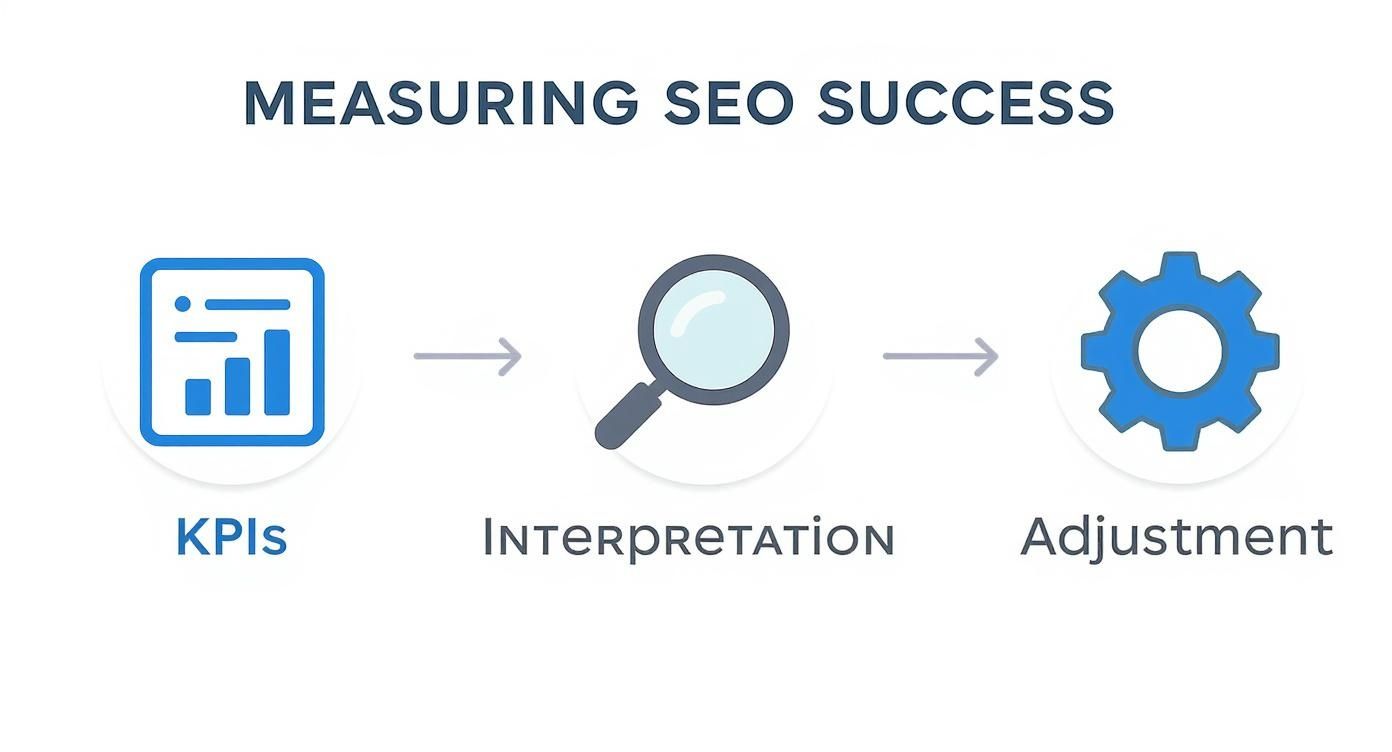
The graph shows how the definition of relevant key figures (KPIs) forms the basis for interpreting results. From this, targeted next steps for the strategy can be derived.
With the methods shown, you have the tools at hand to noticeably improve your visibility on site and achieve measurable results. Start now with the first step: an assessment of your current situation to be visible to the customers who are looking for you.
Looking to improve your local visibility? SocialEdge helps you to be more visible in local search results. Schedule yours now free potential analysis on https://www.socialedge.ai.