What local online marketing really means
Imagine that you have the best coffee shop in town, but no one in your neighborhood knows about it. Local online marketing acts as a digital town sign that shows potential customers the way to you. It bridges the gap between a Google search like “coffee shop near me” to an actual visit to your store.
The core of the strategy is focus. Instead of reaching the entire country with a watering can, all efforts are focused on being relevant to people within a clearly defined area. This turns an anonymous online search into a personal visit to your site.
The basic building blocks for local visibility in online marketing
Good local marketing is based on several pillars that are mutually supported. When these building blocks work together, you build trust with your target group and can increase your turnover.
- Google company profile: This is often the first digital touchpoint. A well-maintained profile shows potential customers what they need to know at first glance: opening hours, address, telephone number and customer reviews.
- Local SEO (search engine optimization): This is about optimizing your website for local searches. The aim is to achieve a high position in the search results for searches such as “hairdresser in Cologne” or “italian restaurant Hamburg.”
- Regional social media activities: Through platforms such as facebook or instagram You can build a local community. With targeted posts and ads, you can address people directly in your neighborhood.
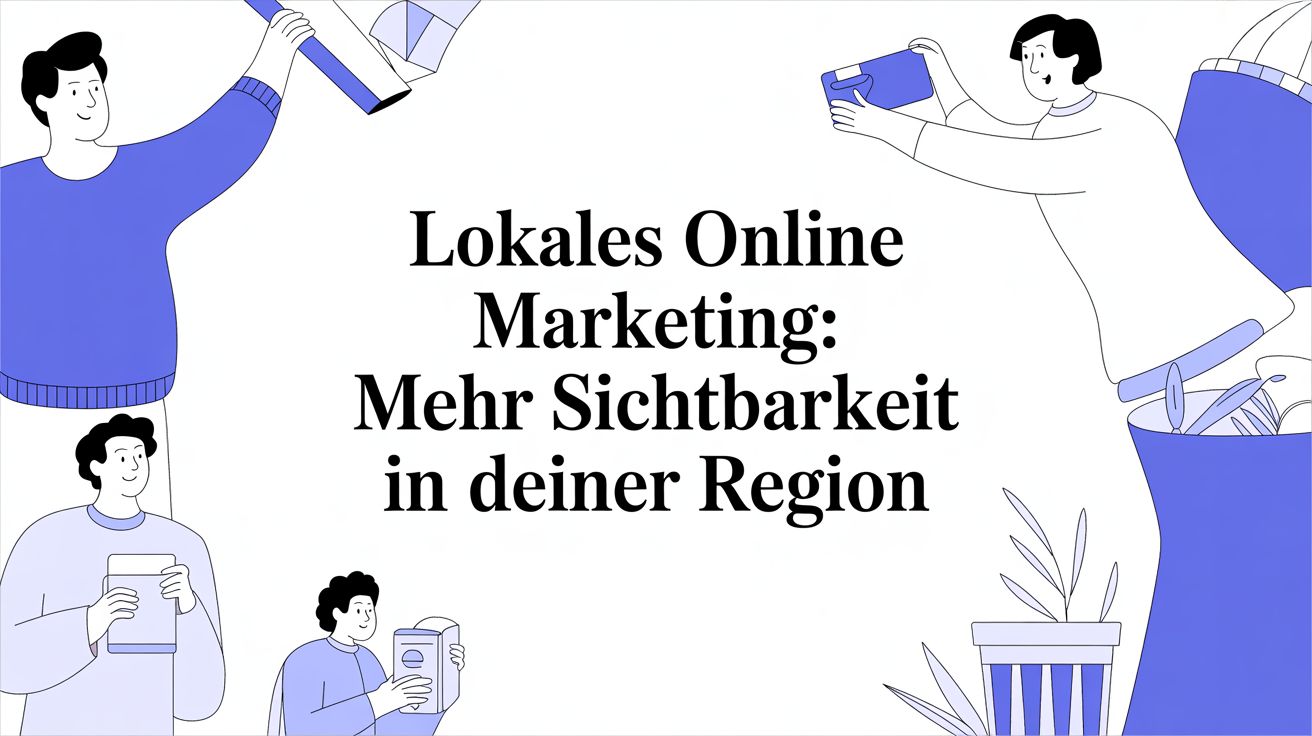
This infographic shows how the key elements of local online marketing work together to attract customers close to you.

The focus is on the local customer and is addressed via various channels such as Google, a search engine optimized website and social media.
Why local online marketing is essential today
Statistics show: 46% of all Google searches have a direct local connection. That's almost every second search. Ignoring these potential customers is hardly sustainable for local companies anymore. Most of these searches happen on the go on smartphones — by people who often want to make an immediate purchase decision.
The increasing number of “near me” searches is a clear signal. Customers today expect to find suitable results from their immediate environment. They want quick, easy solutions for their needs.
This is exactly where a great opportunity lies. Well-designed local online marketing can generate store visits, phone calls and long-term loyal customers from these search queries. It's not about reaching the whole world, it's about reaching the right people — exactly when they need you.
This is how your Google company profile becomes a customer magnet
that Google company profile is the first contact with your company for many potential customers and therefore a linchpin for your local online marketing. A well-maintained profile is more than a digital business card; it's one of your most powerful tools for attracting new customers.
You can compare it to your company's reception area. An incomplete or outdated profile looks like a locked door. An optimized profile, on the other hand, welcomes users, answers the most important questions at a glance and invites them to get in touch.

The foundation: correct master data for your local marketing
The basis for every strong profile is complete and accurate master data. That sounds trite, but mistakes often creep in here that can affect your visibility.
The basics are name, address, telephone number (in technical language also NAP data called) and opening hours. Not only does this information have to be accurate, it should be all The online platforms on which you are represented will be the same. Even a small deviation can confuse customers and Google, which can lead to a poorer ranking.
The right categories for precise allocation
Choosing the right business categories is an important lever for your local visibility. Google uses these categories to understand your offer and show you when searching for the right searches.
As the main category, choose the one that best describes your core business. Be as specific as possible. “Italian restaurant” is more meaningful than just “restaurant.” You can then cover other facets of your offering via secondary categories, such as “pizzeria”, “wine bar” or “delivery service”.
A precisely optimized Google company profile increases your chances of appearing in the so-called “Local Pack.” These are the three prominent local results directly below the Google map, which receive the majority of clicks.
A strategic selection of categories therefore helps you to be found in your area for a wider range of search queries.
More than just words: photos and videos in online marketing
Images give potential customers an authentic insight into your store even before they've even entered it.
Upload high-quality photos that show different perspectives:
- Exterior view: Help users find you easily.
- interiors: Convey the atmosphere of your premises.
- Products & services: Show what you're offering.
- The team: Give your company a personal face.
Visual content has a big impact. Data shows that companies with over 100 images on their Google profile 1065% more clicks received on their website as the average. This underlines the importance of images for visibility. You can read more about this in this article about Digital marketing statistics on seo.com Read up.
Interaction as the key to relevance
A static profile may lose relevance. Google rates activity positively because it signals that your business is up to date. Therefore, use the interactive functions to enter into dialogue with your customers.
Die Contribution function is suitable for sharing news, offers or events. These posts appear directly on your profile and keep it up to date.
You can also use the “Questions & Answers” feature proactively. Ask the most frequently asked questions (FAQs) yourself and answer them directly. In this way, you take away uncertainties from potential customers and position yourself as a helpful expert. Regular maintenance turns your profile from a purely informational site to a lively channel that can lead to more calls, website visits, and directions.
Local SEO: How to become the number one address in your neighborhood
The Google company profile is your digital shop window. Local search engine optimization (SEO) ensures that people pass by this shop window. It aims to position your website high in searches such as “best coffee in Cologne” or “bicycle repair Berlin Neukölln.” It's about being the most relevant answer to a local search query for Google.
The decisive difference to general SEO is the focus on the immediate environment. You're not competing with every coffee shop on the Internet, just with those in your city or neighborhood. With targeted, local measures, you can often achieve visible results more quickly.
Local keywords as a guide for your online marketing
An important step is to provide your website with the right local signals. Put yourself in the shoes of your customers: How would they search for you? Probably not just for “tax advisor”, but more for “tax advisor in Hamburg” or “payroll Altona.”
You should incorporate these combinations of service and location into your website texts. Here are important places for this:
- Home page: Make it clear where you are based and which area you serve.
- Contact page: Add your full address and possibly a route description.
- Service pages: Connect your offers directly to your location. So don't just write “Professional Teeth Cleaning,” but “Professional Teeth Cleaning in Munich-Schwabing.”
These local keywords help search engines understand which geographical searches your website is relevant to.
NAP consistency: Uniform company data as a sign of trust
An often underestimated but decisive aspect of success is the so-called NAP consistency. NAP stands for Name, Address, Phone — i.e. name, address and telephone number. These three core pieces of data should be the same on every platform that mentions your company.
Every correct entry on the web is a positive reference for Google. If the search engine finds exactly the same data at different locations, confidence in the accuracy of your company information grows. A deviation such as “street” instead of “street” can already impair this trust.
Check your data in key industry directories, on your social media profiles, and on your own website. Consistency creates trust — with Google and with your customers. A good starting point for finding deviations is a targeted Search for your company name on SocialEdge.
Technical optimization for local SEO
In addition to the content, the technical basis of your website must also be right. Two elements in particular are important for local searches:
- The page title (title tag): That is the clickable headline in Google search results. It should include your most important keyword and location, for example: “Friseursalon Haargenau | Ihr Friseur in Frankfurt Bornheim”.
- The meta description: The text below the title in search results. Although it is not a direct ranking factor, it is an important text that should encourage users to click. Here too, mention your location and a clear advantage.
Another crucial point: Your website must work well on smartphones. Most local searches take place on-the-go. A slow or confusing mobile site can cause potential customers to leave the site immediately.
Build trust through customer reviews in local marketing
Online reviews are the digital version of word of mouth. For many potential customers, they are a decisive factor when choosing a provider. Good management of your reviews is therefore a central part of every local companies.
The reviews in the Google profile are like personal recommendations that are visible around the clock. Every positive comment is a leap of faith that can attract new customers.

Proactively ask for feedback for more reviews
The best way to get a steady stream of new reviews is to actively and systematically ask for them. Don't wait for customers to write a review of their own accord. Incorporate the request for feedback into your processes, for example after a successful completion of a service.
There are a few best practices for this:
- In a personal conversation: A sentence like “We'd love to hear your feedback on Google” can already have an impact.
- By email or text message: After your purchase, send a quick message with a direct link to your review profile.
- QR codes in stores: A QR code on flyers, invoices or at the checkout can direct customers directly to the review page.
Make things as easy as possible for the customer. The fewer hurdles, the more likely you are to receive a review.
Respond professionally to every review
A crucial part of your online reputation is dealing with everyone type of feedback. Each review is a public stage where you can show how important your customers are to you.
A quick, personal response to positive feedback strengthens customer loyalty. A simple “thank you” signals appreciation.
A well-thought-out, solution-oriented response to a critical evaluation can even strengthen the trust of potential new customers. It signals transparency, professionalism and the will to take problems seriously.
A negative review is an opportunity for improvement. Respond objectively, apologize for any inconvenience and offer a concrete solution. Avoid public discussions and suggest resolving the conversation offline. This shows all readers that customer satisfaction is important to you.
Why reviews on multiple platforms are important for your online marketing
Customers obtain information at various points. It is therefore not enough just to look good on Google. A study shows that 62% of consumers Before making a purchase decision, check reviews on at least two to three different platforms. Portals such as Yelp or industry-specific pages may also be relevant. This underlines the importance of holistic reputation management. More SEO statistics on seranking.com offer deeper insights into this topic.
Local content: Build a community through targeted online marketing
Good content solves problems and builds a bridge to the people you want to reach. For local online marketing That means: Develop content that provides added value specifically for your neighborhood. It is about establishing yourself as a helpful part of the local community.
This approach can help turn anonymous website visitors into loyal customers. It's not just about selling products, it's about building a relationship. By answering the questions people in your neighborhood are asking, you can become the first point of contact.
Local topics create relevance for your marketing
The key to successful local content is to think beyond your own offering. What motivates your target group? Where can you help with your knowledge?
Here are a few ideas with a strong local connection:
- Blog articles about local events: Report on the upcoming city festival or the weekly market and give tips for destinations in the region.
- Collaborations with other local companies: Introduce another store from the neighborhood that complements your offering. For example, a café could write about the neighboring bookstore.
- Customer success stories: Tell the story of a customer from your neighborhood (with their consent) Nothing creates more trust than an authentic testimonial.
- Instructions with local reference: A hardware store could create a guide on the topic of “balcony planting for city apartments in [your district].”
Such content is not only rated positively by search engines, but is also gladly read and shared by people around you. You can find further suggestions on content strategy in our SocialEdge blog.
Social media as a direct mouthpiece in the neighborhood
Social media is a good way to build a local community and maintain contact with customers. Platforms such as instagram and facebook offer useful tools for this.
An engaged, active group of people close to you is often more important than a high number of followers. Interaction is crucial here.
The digital marketing market in Germany is experiencing strong growth and recently reached a value of 14.5 billion US dollars. By 2034, an increase to around 31.02 billion US dollars is forecast. This growth is largely driven by the use of smartphones and social media platforms — an opportunity for local companies. More details about The development of the German digital marketing market can be found at expertmarketresearch.com.
To build a local community on social media, you can use the following tactics:
- Use location tags: Mark your location with every post. This shows your content to users who are nearby or are searching for that location.
- Connect with local players: Work with well-known personalities or other companies from your city. Local bloggers or influencers can have a following that's relevant to you.
- Place targeted advertising: Take advantage of precise geographic targeting from Facebook and Instagram. You can display your ads within a radius of a few kilometers around your store and thus minimize wastage.
When you combine valuable content with a well-thought-out social media strategy, you can build a loyal customer base that will recommend your company to others.
Your checklist for successful local marketing
Here you can find the most important strategies from this guide summarized in an actionable checklist. Think of this as a roadmap to your local online marketing build or optimize.
The list is divided into four phases. It's a good idea to work through the points in order to create a solid foundation for your local visibility.
Phase 1: Laying the foundation for your online marketing
These first steps ensure that potential customers find you and get the right information.
- Complete your Google business profile: Fill out every field on your profile — from opening hours to services to recent photos.
- Reconcile NAP data: Check your name, address, and phone number (Name, Address, Phone) on your website, social media, and important business directories. Here is 100% consistency decisively.
Phase 2: Optimize your website for local SEO
Your website is your digital figurehead. Make sure it's optimized for local searches and gives visitors a good experience on any device.
- Research and incorporate local keywords: Find out how people in your city are searching for you (e.g. “Steuerberater Hamburg”). Of course, integrate these search terms into the texts on your website.
- Ensuring mobile-friendliness: Test your site on your phone. Is everything easy to read and easy to use? Most local searches take place on mobile devices.
Phase 3: Build trust and reputation in local marketing
Visibility is important, but trust is critical in local business. Your most powerful tool for this is online reviews.
A proactive and professional approach to customer feedback is a key pillar of your credibility. Every review is a chance to publicly demonstrate your customer service.
Make these two tasks a regular routine:
- Actively collect reviews: Ask satisfied customers specifically for a review, for example via email or with a QR code in store.
- Respond consistently to reviews: Thank you for positive feedback and respond to criticism in a professional and solution-oriented manner.
Phase 4: Actively expand visibility in online marketing
With a solid foundation, you can now start expanding your reach and connecting with local people.
- Publish your first local blog post: Write about a topic with a local connection, such as a district festival or a cooperation with another store.
- Start a local social media campaign: Use location tags and advertise an offer specifically to people within a small radius around your business.
This checklist is your handy guide to get started right away. If you're looking for help optimizing your Google profile and building your local visibility, take a look at SocialEdge packages. We can do many of these tasks for you.
Frequently asked questions (FAQ) about local online marketing
Here you can find answers to common questions that local entrepreneurs ask themselves about local online marketing.
How quickly can I see results from local SEO?
First small successes, such as more calls or directions via your Google business profile, can often occur after just a few weeks after you have optimized it.
Stable top rankings for competitive search terms (e.g. “Friseur Hamburg”) usually require a longer period of time. Calculate here three to six months consistent work to establish yourself at the top.
What does local online marketing cost?
Many effective basic measures do not cost money, but time. Filling out your Google business profile or asking for reviews are examples of such effort-based but effective activities.
Depending on the competition and region, further measures such as professional local SEO by an expert or targeted advertisements on Facebook and Instagram can cost in the range of a few hundred to several thousand euros per month.
Which online marketing channels are most important for my company?
The foundation for almost every local business is that Google company profile.
In addition, the choice of channels depends on your industry:
- Catering & retail: Visual platforms such as instagram are often very effective here to present the atmosphere, products or daily offers.
- Service providers (e.g. lawyers, craftsmen): The focus here is on trust and competence. A clean local SEO strategy And a good Evaluation profile are crucial.
Do I need an agency or can I do it myself?
You can implement many basics yourself, especially with good instructions. This saves the budget and you develop a better understanding of your own marketing.
An agency can be useful if you don't have the time or if you operate in a very competitive market. Experts can help to avoid typical mistakes and identify potential. When working together, make sure you stay in control of your data. You can find out more about how we handle this in our privacy policies.
Summary and next step
Local online marketing is a decisive factor in becoming visible in your region and attracting new customers. The most important pillars are an optimized Google company profile, targeted local SEO, active review management and relevant content for your community. By gradually implementing the measures presented here, you can create a solid basis and sustainably strengthen your local presence.
SocialEdge is your partner to be successful in local competition. We help you get into the top 3 local Google search without an advertising budget and turn your visibility into real revenue.