Why local search engine optimization makes the difference
Local search engine optimization, or local SEO for short, is much more than just a buzzword. It is the digital bridge that brings a searching customer directly to your shop online. While classic SEO aims to make a website visible worldwide, local SEO focuses specifically on a clearly defined region.
A simple example illustrates the difference:
- Anyone looking for “changing bicycle tires” in general will receive instructions and videos.
- But if you enter “bicycle repair shop in Berlin,” you will be shown specific companies in the area — complete with address, opening hours and customer reviews.
It is precisely this distinction that is important because search behavior has changed. Users today expect relevant results that are tailored to their current location.
The importance of the Google Local Pack
When someone starts a local search query, Google very often plays the so-called “Local Pack” off. This is this eye-catching box with a map, which usually appears directly below the search field and prominently presents three local companies. This area is still with shown in normal organic search results.
Landing in the Local Pack is like having a digital signpost right outside your front door. This allows you to capture the attention of customers who are ready to buy before they scroll on to the competition.
Figures prove this: Recent studies show that between 46 and 50 percent All searches on Google have a local connection. Around 36 percent of them show the Local Pack — a clear signal of how crucial this space is for your visibility.
An overview of the core elements of local search engine optimization
This table summarizes the most important pillars of local SEO and shows which aspects are decisive for your success.
Section descriptionImportance for local visibilityGoogle company profileYour central figurehead in Google search and on maps. Completion and maintenance are crucial here. Very highLocal keywordsSearch terms that have a clear geographical connection (e.g. “Steuerberater Hamburg” or “Restaurant near me”) .Very highNAP consistencyUniform information of name, address and telephone number (name, address, phone) across all online directories.online reviewsCustomer reviews on Google and other portals. Number, average rating and timeliness are decisive signals.HighLocal backlinksLinks from other regionally relevant websites (e.g. local news portals, industry associations) .Medium to highOn-page SEOOptimizing your website with local content, location-based keywords and structured data (Schema.org) .Means
In short: A well-maintained company profile, positive reviews and consistent data form the basis. Everything else builds on that and strengthens your local presence.
Who benefits from local search engine optimization
Every company that depends on customers from the immediate area benefits. The principles of local SEO are a cornerstone of success local online marketing and not a niche strategy for specific industries.
Here are a few examples:
- Brick-and-mortar stores: From small bookstores to fashion boutiques to electronics retailers.
- Service provider: Craftsmen, hairdressers, lawyers or cleaning companies working in a specific area.
- gastronomy: Restaurants, cafés, bars and snack bars.
- Health care: Doctors, dentists, physiotherapists and pharmacies.
At the end of the day, local search engine optimization is about closing the gap between digital search and real business. It's a direct way to turn people who are looking for a solution online into local customers.
What's important for local search results
Google plays by its own rules when it comes to local searches. The criteria used to evaluate local companies differ from those of the general, global search. To be visible here, you need to understand which signals count for the search engine.
Think of Google as a scrupulous librarian. His job is to find the right result for every search query — your company. The librarian doesn't just pay attention to the title. He checks the location, how often the offer was used and what others are saying about it. Your job is to provide him with all this information clearly and without contradiction.
The following graphic shows how the search gets finer from a general query to the decisive “local pack.”
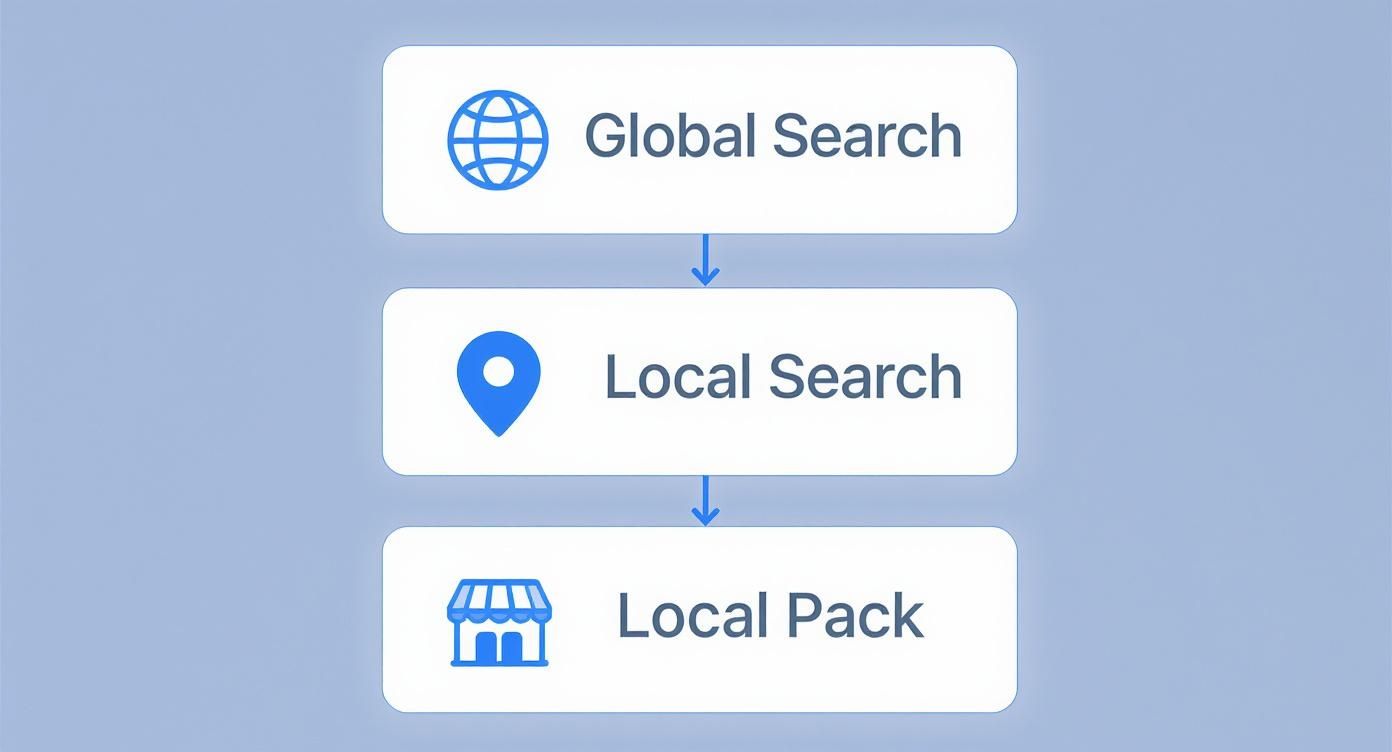
Right here, in the Local Pack, the customer decides where to go or who to call. And this is exactly where you want to be visible.
The Google company profile as a digital core
Yours Google Business Profile (formerly known as Google My Business) is the linchpin for your local success. Think of it as your digital business card that appears directly in Google search and Google Maps. A patchy profile is like an empty shop window.
Take the time to fill out each field carefully. This applies not only to the basics, but also to details such as “WiFi available” or “barrier-free entrance.” Every detail helps Google understand your offer better and show it to the right users at the right time.
The importance of the right categories
Choosing your business and ancillary categories is a strategic decision. As the main category, you should always choose the term that sums up your core business. A restaurant that specializes in Italian cuisine chooses “Italian Restaurant” as the main category.
- main category: The foundation — what you are at heart (e.g. “plumber”).
- Subcategories: The specialization — what else you offer (e.g. “heating installer”, “pipe cleaning”).
A clear categorization is a strong signal for Google and increases your chances of appearing in relevant searches.
Photos, opening times and news
Nothing is worse than outdated information. Incorrect opening hours, especially on public holidays, lead to frustrated customers and are a negative signal for Google. Timeliness creates trust.
A profile that is alive, i.e. regularly updated with current, good photos, radiates activity and professionalism. Studies show: Profiles with over 100 pictures get significantly more clicks and calls. Upload new photos regularly — of the store, of your products, or of your team at work.
Your profile is not a one-time project. It needs constant care. How do you your Improve Google Maps ranking can, depends largely on how consistently you maintain these elements.
NAP consistency as an anchor of trust
One of the most fundamental ranking factors is NAP consistency. The abbreviation stands for NAme, Adress, Phone (name, address, telephone number). These three core data must be absolutely identical on every platform on the Internet, from your website to business directories to social media profiles.
Think of the Internet as a city. Every mention of your company is a guide. If there is “Hauptstr. 10” on one sign and “Hauptstraße 10” on another, this causes confusion. Not only with your customers, but especially with Google. The search engine loses confidence that your information is correct and downgrades your relevance.
Even small deviations such as “GmbH” versus “GmbH” can influence the system. Review your online entries and correct any discrepancies. Correctly structured geodata is also a technical factor for a clean presentation in map services, for example through KML files for accurate location information.
These factors are the foundation of your local visibility. A well-maintained Google company profile and watertight NAP consistency create the trust you need with Google.
How local searches lead to customer visits
A good ranking in local search results is half the battle. The decisive step is to convert this online interest into actions — be it a visit to your shop, a phone call or a booking. Local searches are rarely just a passive search for information. There are usually clear purchase intentions behind this.
When someone googles “Italians nearby” on their smartphone, they don't just want to browse. The person is hungry and looking now after a solution. It is precisely this immediate urgency that makes local search valuable for your business.
The bridge between a mobile search and a real action is short. Statistics show that 80 percent All local searches result in a conversion. When searching from a mobile phone, it becomes even more specific: Almost half of the users who search for a local store on the go become active on the same day. 78 percent These mobile local searches result in an offline purchase.
Build trust before the customer arrives
Your Google business profile is your digital shop window. Here, a potential customer decides in seconds whether to give you a chance or to click on to the competitor. Human and authentic details are often decisive.
Quick answers to questions that are asked directly in the profile show that you are there for your customers. Real, high-quality photos of your store, team, and products at work create a connection. They provide insight and reduce uncertainty before the first visit.
A potential customer must feel as though they already know a bit about your business — even before they've set foot on your threshold. Positive reviews are the strongest sign of trust.
Positive reviews as a strong sales factor
Customer reviews are the modern form of word of mouth. A high number of positive reviews immediately creates trust and confirms the quality of your offer in the eyes of new customers. Reviews are often the last push that makes someone choose you.
Actively managing your reviews is therefore essential:
- Respond to every review: Thank you for positive feedback and respond to criticism in a professional and solution-oriented manner. This shows that the opinion of your customers is important to you.
- Encourage happy customers: Ask your regular customers for a review. A friendly message is often enough to get valuable feedback.
- Use content from reviews: You can use positive quotes for your website or Google Posts to confirm customer satisfaction.
In order for you to be able to collect reviews, your company must of course first be correctly listed on Google. A fully maintained profile is the basis. In our article, we'll show you step by step how to make your List your company on Google and thus lay the foundation for your visibility.
Specific examples of increased sales
Theory is good, but practice is better. The principles of local search engine optimization work across industries.
Example 1: The restaurant
A restaurant optimizes its Google profile with professional food photos, uploads the current menu and makes online table reservation possible with one click. It responds promptly to reviews and posts its lunch offers weekly. The result? More direct bookings via Google and noticeably better capacity utilization.
Example 2: The craft business
An electrician uploads before and after pictures of installations, precisely delimits his catchment area and highlights the “Call” button. Dozens of positive reviews from satisfied customers underline its reliability. The result? More qualified calls from people who want to place an order directly.
In both cases, the aim is not only to give the seeker an answer, but also to make the path to the desired action as easy as possible. Every optimized detail of your online presence helps you turn one click into a customer.
Mobile users and local backlinks: A strategy for on-the-go
The way your customers search for you today has changed. Reaching for a smartphone to quickly find a solution has become second nature for most people. This is your opportunity as a local company, because mobile search is the most direct link to new customers in your neighborhood.
The figures speak for themselves: Approximately 72.6 percent Internet users in Germany are only online with their smartphones. For the local search engine optimization It is becoming even more relevant: There are over 1.5 billion search queries worldwide with the addition “near me” every month. And in Germany? Search here almost 44 percent mobile users at least once a week according to local information. You can find out more about these SEO statistics here.
These figures make it clear that anyone who ignores mobile users is giving away a large portion of their potential revenue.
Mobile friendliness is a must
Imagine that a customer is on the go, urgently needs your service and finds you on Google. If he then comes across a website that loads slowly or is inoperable on the small screen, he is immediately gone. Mobile friendliness is a basic requirement today. Google also knows this and rewards mobile-optimized pages with better rankings.
But it's not just about your website. Remember your Google business profile — this is usually the first point of contact for mobile searchers. Everything has to fit here at a glance.
Someone who searches on a cell phone wants to trade. He doesn't want to read novels, but a quick solution. Clicking on your phone number must immediately start the call (click-to-call), and tapping on the address must open navigation in Google Maps.
Make sure that these exact features work smoothly in your profile. Any hurdle can drive potential customers to compete.
Local backlinks: Your city's digital recommendations
While optimizing your own profile is the basis, there is another lever that increases your local significance: local backlinks. A backlink is a link that links to yours from another website.
See every backlink as a recommendation. A link from a big news site is good. However, a link from the website of the city magazine, the local sports club or another store in the neighborhood can be more valuable for your local ranking. Such links send a clear signal to Google: This company is anchored and relevant in the local community.
How to get valuable local links
Building backlinks often sounds more complicated than it is. With creativity and the right approach, you can secure local recommendations.
Here are a few tried and tested ideas:
- Network locally: Work with other companies whose offerings complement yours. A wedding photographer can recommend the best florists in town and may also be linked in return.
- Demonstrate local commitment: Sponsor the local soccer team or support the city festival. Such actions often result in a mention with a link on the organizer's website.
- Talk to the local press: Are you celebrating a company anniversary or do you have an exciting story to tell? Give the local newspaper a tip. An online article is not only an advertisement, but also provides a backlink.
- Subscribe to relevant directories: In addition to major portals, there are often also specialized regional business directories. An entry there strengthens your NAP consistency and is another local signal. Which Business directories are important for your company, we have summarized it for you in a separate article.
Each of these measures strengthens your local authority. You're showing Google that you're a lively and valued part of the community.
Measure the success of local SEO and avoid typical mistakes
A good strategy for local search engine optimization It's important to have. But in the end, what counts is what it brings to your business. It is just as important to know the typical stumbling blocks.
Without monitoring your success, you are operating in fog. However, the success of local SEO can be made tangible with a few simple, meaningful indicators — the so-called Key Performance Indicators (KPIs).
It depends on these key figures
You don't have to get lost in a jungle of metrics. Focus on the numbers that reflect direct action from your potential customers.
These KPIs will tell you whether your efforts are bearing fruit:
- Calls directly from the profile: This number shows how many people have pressed the “Call” button on your Google business profile. A clear sign of buying interest.
- Requests for directions: This metric counts how many potential customers have actively sought their way to you. Every click here is a potential visit.
- Clicks to the website: Here you can see how many users jumped from your Google profile directly to your website.
- Visibility in the local pack: Keep an eye on how often your business appears in a “three-pack” of local search results for your most important keywords.
You can find this data in the statistics (the “Insights”) of your Google company profile. A regular look at them is enough to identify trends.
The most common mistakes and how to avoid them
Many local companies fall into the same traps over and over again. This costs them positions in search results. Most of these mistakes are easy to avoid with a little attention.
A classic thinking mistake is to regard the Google company profile as a unique thing. However, local SEO is not a sprint, but a marathon. A profile that is not maintained regularly loses importance.
The most typical pitfalls are summarized in a table, with tips on how to avoid or fix them.
The most common mistakes in local SEO and their solutions
This table shows typical pitfalls and provides actionable tips on how you can avoid or fix them.
Typical errorWhy it's a problemHow to fix itInconsistent NAP dataDiffering name, address, and telephone number (NAP) information creates confusion and undermines trust on Google, leading to poorer rankings. Set a central, correct version of your data. Then compare all online entries — from the website to business directories to social media.Wrong or too general categoriesAn inappropriate main category means that you won't show up in relevant searches made by your customers. Select the most specific main category that describes your core business (e.g. “Italian restaurant”). Use secondary categories for more offers.Ignored customer reviewsNot responding to reviews signals disinterest. Google prefers interaction. Respond to every review in a timely and professional manner. Thank you for your praise and offer a constructive solution in case of criticism.Missing or bad photosA profile without pictures seems impersonal. Bad, blurry photos are more likely to scare off customers. Regularly upload high-quality, authentic photos of your store, products, and team.
By avoiding these mistakes, you build a solid foundation for your local visibility. The combination of consistent optimization and a look at the figures makes the difference.
Your roadmap to better local visibility
You now know that a well-maintained Google company profile, uniform company data on the Internet and active management of your reviews are the three cornerstones of successful local search engine optimization are. Now it's time to implement it.
This section is your personal starter to noticeably and measurably increase your visibility on site.
Quick Wins: Quick results for the start
Let's start with the things that have the greatest leverage and can be implemented quickly. You can tackle these three “quick wins” immediately and often see the first positive results within just a few days or weeks.
Think of this as your instant checklist:
- Get your Google business profile up to 100%: Click through every point on your profile. Have all fields been filled out? From the main and secondary categories to your services and attributes such as “WiFi available” or “barrier-free entrance.”
- Upload 10 compelling photos: Show yourself! Upload up-to-date, authentic images of your store inside and out, of your team in action, and of your products. Profiles with good photos are proven to get more clicks and calls.
- Reply to your last five reviews: Show that you're there and listening. Respond to recent feedback Thank you for good reviews and respond to criticism professionally and helpfully.
These three simple yet effective actions send a strong signal to Google. They show that this company is active, relevant and cares. This is the basis on which further, long-term strategies for your local search engine optimization build up.
It's best to start today. Each check mark on this list is a step towards better positioning in your local market.
Local SEO FAQs
The same questions arise again and again when it comes to local search engine optimization. Here are the most important ones summarized and answered in a practical way.
How quickly can I see results from local SEO?
Initial positive effects, such as a better ranking in Google Maps or more calls from your profile, can often be felt within four to eight weeks Make it noticeable. This works especially if you implement the basics correctly — i.e. complete your Google company profile and ensure uniform contact details.
In order to be permanently visible in highly competitive search terms, you need staying power. Expect several months of continuous work here. Think of local SEO as a sustainable investment in your local visibility.
Do I need a website for local search engine optimization?
In short: Not necessarily, but it is highly recommended. At the heart of your local presence is your Google company profile. With a well-maintained profile alone, you can achieve a lot in Local Pack and Google Maps.
However, having your own website gives you more options. There, you can go deeper into detail, create special landing pages for districts or services, and send important SEO signals. This strengthens your authority in the long term and can improve your rankings.
What is the difference between “normal” and local SEO?
Think of it this way: In classic SEO, you're trying to be the best answer on the entire Internet for a specific topic. It is a global or nationwide competition.
At the local search engine optimization The playing field changes. This is about being relevant to a specific location. Factors such as the distance of the searcher to your store, local customer reviews or mentions in city portals play a decisive role. The goal is not to be the best solution in the world — but the best and next for the people in your neighborhood.
Summary and next steps
Local search engine optimization is not a one-time project, but an ongoing process. The key to success lies in a fully optimized Google company profile, consistent NAP data across all platforms, and the active management of customer reviews. Start with the “Quick Wins” presented here to get quick results, and stay tuned to ensure and expand your local visibility over the long term.
Do you want to finally be really visible in your region, but you don't have the time for the details? SocialEdge is your partner to be found locally. We'll get your Google business profile up to speed and ensure that you appear at the top of key searches. Start now and secure your competitive advantage.