What local SEO optimization means in practice
Local search engine optimization is a central marketing discipline for every company with a physical location — be it a café, a law firm or a craft business. If someone searches for “hairdresser in Berlin” or “Italian restaurant around the corner,” Google wants to show the best, most relevant and most trustworthy result. This is exactly where the local SEO optimization on.
Your job is to send Google crystal-clear signals that your store is the perfect answer to a local search query. This is achieved through a combination of a well-maintained Google company profile and a website that is also optimized for local searches.
The power of local search
Search behavior has changed dramatically. We pull out the smartphone and expect location-based results immediately. These “I want to now” moments make local searches so valuable, because a potential customer who searches on the go usually has a very specific purchase intention.
The figures speak for themselves: Approximately 14% of all keyword searches in Germany aim to find local information or companies. For service providers such as tradesmen, doctors or restaurants, this means that anyone who is not visible in the local search is virtually invisible online for a large proportion of their potential customers. More facts about this and more SEO statistics can be found on seranking.com.
A strong local presence is your digital business card that brings customers from the neighborhood straight to your door. It's about building trust online that you already enjoy offline.
Why the Google Local Pack is so crucial
At the heart of local search is the so-called “Local Pack”, often referred to as the “Local 3-Pack.” These are the three company listings that Google prominently displays directly below the map in search results. Placement here is like a shop window in the best location in town.
To get into this area, Google primarily assesses three factors:
- Relevance: Does your company profile really match the search query?
- Distance: How far is your store from the searcher's location?
- Prominence: How well-known and established is your company on the Internet? Reviews, mentions and links play a big role here.
A well-thought-out strategy for local SEO optimization is aimed precisely at strengthening these three pillars. It's a continuous process that ensures your visibility and sets you apart from local competition.
Preparation: The foundation for your local SEO success
Before we start optimizing, the basis must be right. A successful local SEO optimization Start not with activism, but with a clear strategy and careful preparatory work.
The process of turning a local search into a customer is simple: A search leads to visibility, and this visibility ideally leads to more sales.
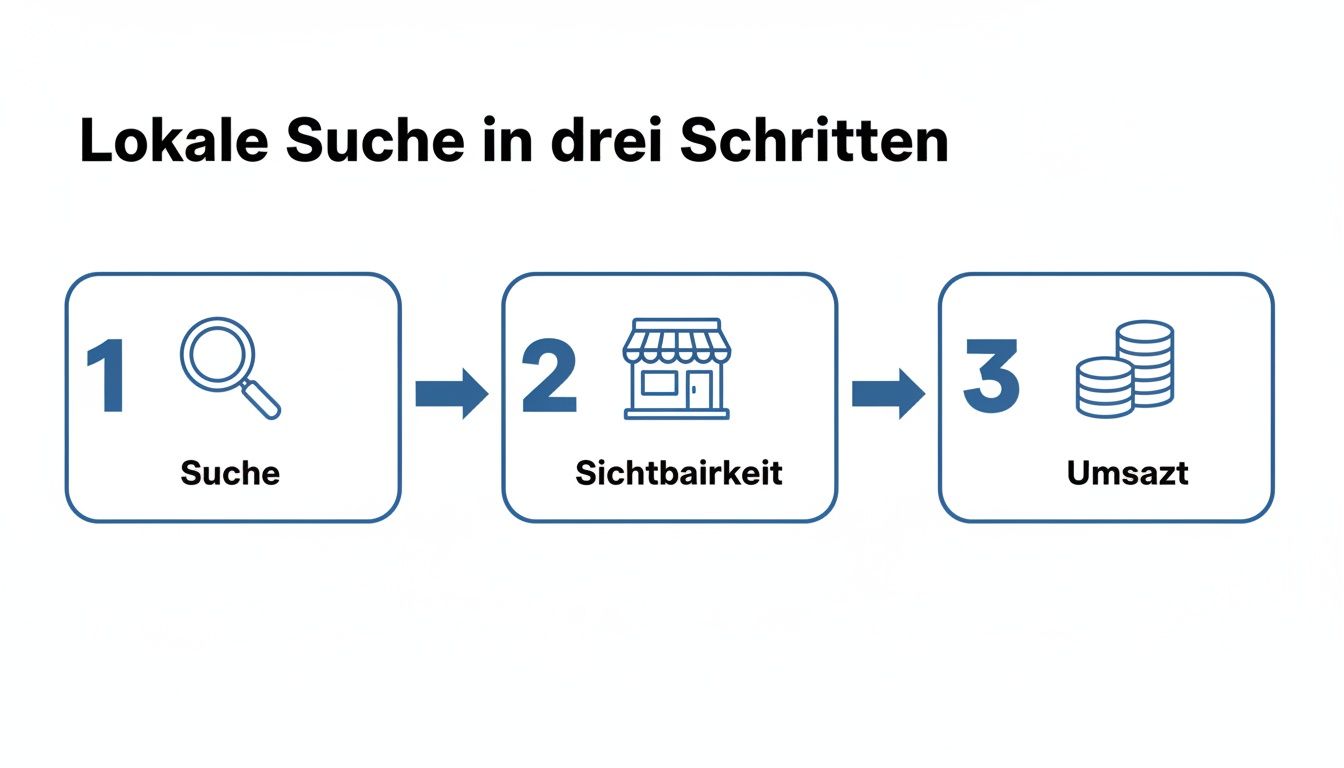
Without visibility in local search results, the path to the customer is blocked. Your entire strategy must therefore be aimed at building exactly that bridge.
Step 1: Analyze the competition
The first thing you need is an honest inventory. Find out who is dominating local search results in your industry and city. Put yourself in the shoes of your customers and search for your most important services combined with your location.
Take a close look at the top winners:
- Google company profile: How complete and maintained are their profiles? Are they actively using Google posts? How many reviews do they have and how good is the cut?
- Website analysis: Is the website focused on local searches? Do place names appear in titles, headlines, or texts?
- Assessment management: Where do your competitors collect reviews and how do they deal with them? Are they responding to feedback?
This analysis shows you where the competition is strong and provides you with valuable ideas for your own strategy.
Step 2: Ensure NAP Consistency
The abbreviation NAP covers the three most important data about your company: Name, address, phone number (name, address, telephone number). The absolute consistency of this data across all online platforms is one of the most fundamental ranking factors for local SEO.
Google compares the information from your business profile with data on your website, social networks, and online directories. Conflicting information — a different spelling of the company name here, an outdated telephone number there — damages your ranking and creates doubts about the credibility of your company.
Inconsistent NAP data not only confuses search engines but also potential customers. A clean, uniform database is not negotiable.
Before you move on, you need to make sure that your data is the same everywhere. The table below gives you an overview of the most important platforms that you should check out.
Key platforms for your NAP consistency
An overview of the most important online directories and platforms on which the consistency of your company data (name, address, telephone) should be checked.
Platform or directoryImportance for local SEO data to be verifiedGoogle company profileVery high name, address, telephone, website, opening hoursOwn website (imprint, contact) Very high name, address, telephone, emailYelpHochname, address, telephone, websiteApple MapsMiddle name, address, telephone industry-specific directionsMeans up to highAll contact details, often also services
Make sure that the data listed here exactly matches the information in your Google profile. A good overview of relevant Business listings and directories helps you identify the most important sources for your industry.
Step 3: Define clear goals
What exactly do you want to achieve with local SEO? Without clear goals, you cannot measure the success of your measures. Set goals that are specific, measurable, achievable, relevant and scheduled (SMART formula).
Specific examples of goals could include:
- Calls to the Google company profile within three months at 20% boost.
- Clicks on the route planner in the next quarter at 15% increase.
- The ranking for the most important keyword from position 8 in the Local Pack (Top 3) within six months.
Such goals give you a clear direction and serve as a compass for all further steps.
Step-by-step optimization: Local SEO measures
After preparation, it is time for practical implementation. The following steps show you how to make your business visible to local searches.
Optimize Google business profile
Your Google business profile is at the heart of your local SEO. For many potential customers, it is the first point of contact with your company. Think of it as your digital shop window — inviting, informative, and compelling.
A completely completed profile is just the basis. The trick is to use every function strategically to build trust. Put yourself in the shoes of your customers. Think about how it is finding a good dentist nearby from the customer's perspective. This change of perspective helps you deliver the information that is really being sought.
- categories: Choosing your categories is one of the most important ranking factors. Die primary category must describe your core business precisely (e.g. “Italian restaurant” instead of “restaurant”). Fill the secondary categories to cover all facets of your offering (e.g. “barber”, “hair extension”).
- Description, products & services: Your company description is the ideal place to naturally integrate relevant local keywords. You can also use the “Products” and “Services” sections. Create a separate entry for each important service, including a description and price.
- photos: Authentic photos create trust. Profiles with over 100 Images generate significantly more clicks and calls. Show outdoor and indoor photos, your team, photos at work, and product or result images. Authenticity beats perfection.
- Contributions and Q&A: The contribution function is your mouthpiece for the customer. Use them at least once a week for news or offers. The Questions & Answers (Q&A) section is also important. Proactively ask the most common customer questions yourself and provide the answers to alleviate uncertainties.
If you want to dive deeper into the subject matter, here is a detailed guide on how to your Optimize Google business profile.
On-page SEO for the local website
Your Google profile is the poster child, your website is the foundation. Both must play together perfectly. Anchor the local SEO optimization deep into your website so that it sends crystal-clear signals that you're the best local point of contact.

- Title tag & meta description: The page title is a strong signal for Google. Integrate your core services and location here (e.g. “Professional heating maintenance in Cologne”). The meta description determines the click in the search results.
- Headings (H1, H2): A clean structure helps readers and Google. The main heading (H1) should also include the combination of service and location (e.g. “painting work in Munich-Schwabing”).
- Structured data (schema markup): Structured data is snippets of code that help search engines understand your business information. That”LocalBusiness“Scheme is crucial to clearly identify name, address, telephone number, opening hours and reviews. This increases the chance of rich snippets in search results.
Build local content, reviews, and links
In local competition, trust is the hardest currency. Customer reviews and local backlinks are like digital word of mouth and underpin your credibility.
- Local content: Standard service descriptions are not enough. Create content that's regionally relevant. If you operate several locations, each branch needs its own, optimized page with photos, team, reviews and directions. Case studies or blog articles about local projects (e.g. “garden design in Stuttgart-Vaihingen”) create trust and are part of a good content marketing strategy.
- Manage reviews: Reviews influence the purchase decision of 93% of all consumers and are an important ranking factor. Actively ask satisfied customers for feedback, e.g. via email with a direct review link or via on-site QR code. Always respond publicly, quickly and professionally to all reviews — including negative ones. In exceptional cases, you can use a Have Google review deleted.
- Local backlinks: A backlink is a recommendation from another website. Links from locally known sites are a strong sign of trust for Google. Quality comes before quantity. Build links through local partnerships, sponsorship of associations or presence in relevant industry directories. An overview is provided by the list of Top 7 portals for craft businesses nearby.
Measuring success: KPIs for local SEO optimization
Without measurement, every optimization is just a shot in the blue. You can only prove your success and adjust your strategy if you have the right key figures (KPIs) in mind.
Which KPIs really matter
Focus on a handful of key metrics, which you can usually find directly in the free Google tools.
- Google Business Profile Insights: Here you can see the performance of your profile. Key metrics are searches, calls, Route planning and website clicks.
- Google Search Console: It provides insights into the organic performance of your website. Pay attention to local keyword rankings (e.g. “Steuerberater München”) and the Click-through rate (CTR).
A simple monthly report on KPI development is sufficient to identify trends and react to them.
Local rank tracking
The ranking position can vary significantly depending on the location of the searcher. You need to know how you stand in your city in particular. Specialized tools simulate searches from exact locations and show you whether you've made it into the Local Pack. Find out more in the guide to Local rank tracking.
Compact checklist for your local SEO optimization
This checklist summarizes all important steps and serves as your practical roadmap.
1. Preparation
- Analyze competitors in the local pack.
- Check NAP data (name, address, telephone) for consistency.
- Define measurable goals (e.g. +20% more calls in 3 months).
2. Google Business Profile
- Select appropriate primary and secondary categories.
- Fill out the description, services and products in detail.
- Upload new, authentic photos regularly.
- Publish Google posts weekly.
- Proactively fill and monitor the Q&A area.
3. Website & on-page SEO
- Integrate local keywords with title tags, meta descriptions, and headlines.
- Create detailed location pages for each branch
- Producing local content (blog articles, case studies)
- Implement schema markup (LocalBusiness).
4. Authority & Trust
- Establish a process for generating customer reviews.
- Respond promptly and professionally to all reviews.
- Build local backlinks through partnerships and sponsorships.
5. Performance measurement
- Monitor the most important KPIs (calls, route planning, rankings) on a monthly basis.
- Use a local rank tracking tool.
- Adjust the strategy based on the data.
Summary and next step
Local SEO optimization is a continuous process that starts with solid preparation and ranges from detailed maintenance of your Google business profile, local targeting of your website to building trust through reviews and links. Consistent measurement of results ensures that your efforts bear fruit.
You don't want to leave your local visibility to chance? SocialEdge is your specialized software for Google Maps marketing, which puts you in the top 3 local search without an advertising budget. We take care of the complete optimization and ensure sustainable results while you focus on your core business. Request your free potential analysis now.