Why local SEO is crucial for your business
It used to be the Yellow Pages, today it's the smartphone. Searches such as “hairdresser near me”, “Steuerberater Berlin” or “Heiznotdienst Hamburg” are part of our everyday life. This is exactly where the Local SEO optimization: It places your company high in the search results for these specific inquiries.
The prejudice that SEO is only for large corporations is outdated. Small and medium-sized companies in particular — from craft businesses to medical practices to local retailers — benefit the most from a well-thought-out local strategy. Your competition is not global brands, but the shop around the corner.
The direct connection between online search and your sales
The figures illustrate the relevance: Approximately 46 to 50 percent of all searches on Google have a clear local connection. More importantly: 78 percent These searches of mobile devices result in a retail purchase, often the same day.
This data demonstrates the direct, measurable connection between your digital presence and the real success of your business. If you want to dive deeper into the subject matter, you can find more facts in our detailed article about local online marketing.
Google recognized this change a long time ago. Local searches often display the “Local Pack” — a prominent box with three local companies and a map. One place in this trio is the digital equivalent of a premium shop on the best shopping street in the city.
This table summarizes the most important pillars of local search engine optimization and their direct benefits.
Area of optimizationMain goalsDirect benefits for your companyGoogle company profileIncrease visibility in the “Local Pack” and on Google MapsMore calls, directions and website clicks from local customersOn-page SEOShow relevance for local search queries on your own website Better rankings for “service + city” searches, higher conversion rateAssessment managementBuild trust and social reliability (social proof) Higher click rates in search results, stronger customer loyaltyLocal quotes (NAP)Ensuring consistent company data across the web Strengthens authority at Google, avoids customer confusion
Each of these areas helps send a strong signal to search engines: Your company is the best and most relevant answer to a user's local search query.
Local SEO is not an abstract marketing discipline. It is the most direct way to reach customers who are ready to buy from your immediate area.
How to overtake established competitors with Local SEO Optimization
This is a great opportunity for many local businesses. Perhaps a competitor has had a well-known name for decades but neglected their digital presence.
That is exactly your moment. With strategic local SEO optimization, you can digitally pass by these “top dogs”. You use the channels your customers use today and position yourself as the more modern, accessible and trustworthy choice. Clean local optimization is therefore a powerful lever for prevailing in direct competition.
The Google company profile as the core of local SEO optimization

Think of your Google business profile (formerly Google My Business) as your digital shop window. For many potential customers, it is the first point of contact with your business. An incomplete or outdated profile looks like a closed door during opening hours — it scares off and damages the first impression.
In the world of Local SEO optimization Maintaining this profile is the most effective and fastest lever you have. Google places this information prominently in search and on Google Maps, i.e. exactly where people with acute intent to buy are traveling.
The figures prove this: 76 percent The people who search for something local on their smartphones then visit a nearby store — often within 24 hours. Off 28 percent This search even directly becomes a purchase. Since demonstrably 42 percent If users click on the Google Map Pack for local searches, your company profile is the decisive gateway to these customers.
The foundation: correct categories and master data for your profile
It all starts with choosing the right categories. Google lets you set a main category and multiple secondary categories. Precision is required here.
A plumber should not simply choose “craftsman” but specify “plumber” as the main category. As secondary categories, “heating installer” or “pipe cleaning” are then available to cover the entire range of services. This exact attribution helps Google to turn you off with relevant queries.
Absolute consistency of your core data is just as important, often as NAP data denotes:
- Name (your company name)
- Address (your address)
- Phone (your phone number)
These three details must be exactly the same everywhere on the Internet. Even a small deviation such as “Hauptstr.” instead of “Hauptstraße” can be an interfering signal for Google that weakens your local authority.
More than just a name and address: fill your profile with added value
A good profile goes far beyond basic information. Use all fields that Google offers you to make your offer tangible.
A practical example: An Italian restaurant shouldn't be satisfied with the “restaurant” category. Under “Services,” it can enter “Delivery,” “Pick-up,” “Catering,” or “Private Parties.” Under the “Products” tab, the bestselling pizzas can be presented with appealing photos and prices.
Your company description offers on 750 characters the chance to convince. Instead of marketing phrases, you should explain what makes you special. A craft business could emphasize its specialization in renovating old buildings or highlight its 24-hour emergency service. Include your most important keywords here naturally, such as “Electrician emergency service in model city.”
Remember: Your Google business profile is not a one-time listing, but an active marketing tool that requires regular maintenance. Every update signals to Google that your business is active and relevant.
Interaction as a key to trust and ranking
The profiles that rank best are not just data sheets. They are living channels of communication. Google provides you with several tools for this purpose.
- Google posts: Use this feature as your mini blog. Post weekly offers, introduce a new employee, or share a relevant blog article from your website. These contributions are only visible for a limited time and therefore indicate that they are up to date.
- Questions & Answers (Q&A): Customers can ask questions here that anyone can answer. Don't wait for that. Be proactive, ask the most common questions (FAQs) yourself and answer them precisely. This keeps you in control of the information.
- Messaging feature: Activate the chat so that customers can write to you directly from the search. Important: If you use this feature, you must react quickly. Long response times are rated negatively by Google and may result in the feature being deactivated.
Maintaining your profile on an ongoing basis is crucial. For detailed step-by-step instructions to get the most out of each feature, check out our post, which explains how to use your Optimize Google My Business Can.
Anyone who consistently uses these interactive elements builds trust with potential customers and constantly sends Google positive signals. The result is better rankings, more visibility and ultimately more calls and orders.
How to optimize your website for local search
An optimized Google company profile is important, but it's only part of the strategy. Your website must also clearly signal that you are the right address for local inquiries.
We achieve this with targeted on-page optimizations. We ensure that Google not only whitewhere you are, but also understandswhat you offer to people around you. It's not rocket science, but solid craftsmanship that noticeably improves your local rankings.
The first step is to understand the search intent of your local customers. What terms do they enter on Google? Thorough keyword research, which analyses search volume, competition and the intent behind the search, is the basis for this.
Once you know your most important local search terms, place them strategically. It is not about indiscriminately pressing keywords into texts. The trick is to incorporate them so naturally that the text remains fluid and helpful for the reader.
- Page title: In short and to the point — “Dachdecker in Musterstadt” is more effective than just the company name.
- H1 heading: It must be immediately clear what this is about.
- Subheadings: They structure the text, improve readability and provide space for relevant terms.
- Body text: Sprinkle in keywords, of course. Keyword stuffing is counterproductive.
From practice: Natural keyword integration improves the reading experience for your visitors while sending positive signals to search engines. This results in a win-win situation.
An example: A roofer in Hamburg will generate significantly more local inquiries with the page title “Your experienced roofer in Hamburg | Mustermann GmbH” than with the title “Mustermann GmbH — Quality since 1980".
If you have multiple locations, each should have its own landing page. This is the only way to give each branch a fair chance of a top ranking in their respective catchment area.
Internal links are an often underestimated lever. A link from your homepage to the “Our branch in Berlin-Kreuzberg” subpage helps Google understand the structure of your website and the relevance of each location.
Research location-based keywords for your local SEO optimization
Tools like the Google Keyword Planner or Ubersuggest are useful for checking search volumes. However, you can often find the most valuable keywords by listening to your customers or analyzing local forums and social media groups. What questions are asked again and again?
Search specifically for Long-tail keywords. These include longer searches such as “cheap tire service in Munich-Giesing” or “vegan breakfast café in Cologne-Ehrenfeld.” Anyone who searches in this way usually has a very specific intention.
It is recommended to create a simple table: primary keywords (e.g. “Physiotherapy Berlin Mitte”) and secondary keywords (e.g. “manual therapy appointment”, “back pain practice”). This allows you to keep track of things when optimizing your pages.
You distribute this keyword list by topic on your pages — “services”, “locations” and suitable blog articles. This creates a clear structure for Google and helps your visitors quickly find what they're looking for.
Create location pages (landing pages) for multiple branches
If you operate multiple sites, dedicated location pages are essential. You prevent your branches from competing with each other on Google (keyword cannibalization) and create maximum relevance for every location.
Imagine a hair salon with branches in Berlin-Mitte and Charlottenburg. The site for Mitte requires its own opening hours, photos of the local team and perhaps special offers. In this way, the visitor feels directly addressed.
Don't forget to link to every single location page from your main page. This not only directs visitors, but also link authority to the right place.
A tip: Use dynamic content. Customer reviews that relate specifically to a branch create trust and provide fresh, locally relevant keywords.
Include an interactive map, preferably Google Maps with a marker for each location. This is a strong signal for Google and practical for your customers.
Integrate local business schema markup for local SEO optimization
Structured data, specifically the Local Business Schema Markup, help Google collect the most important information about your business in a structured way.
This piece of code in <head>-Google precisely shares the area of your website: company name, address, telephone number, and opening hours.
A simple example could look like this:
{” @context “:” https://schema.org","@type":"LocalBusiness","name":"Musterbetrieb GmbH”, "address”: {” @type “:"postalAddress”, "streetAddress” :"Hauptstraße 1", "addressLocality” :"sample city”, "postalCode”: “12345", "addressCountry”: “DE"}, "telephone” :"+49-123-456789", "openingHours” :"Mo-Fr 08:00-18:00 “}
Before you make the code live, check it with the Rich Results Test from Google. Inaccurate data is ignored by Google.
If everything fits, increase your chances of Rich Snippets in search results. This is additional information such as opening times or reviews directly below your search result. They increase the click rate and immediately create trust.
Checklist for the ideal local landing page
What makes a local landing page successful? Here's a checklist:
- Contact information immediately visible: Address, telephone number and e-mail belong in the area that you can see without scrolling.
- Integrate Google Maps: One click and your customers can start the route directly on their smartphone.
- Current opening times: Always keep the times up to date — in text and schema markup.
- Clear calls to action (CTAs): Buttons such as “Make an appointment now” must be eye-catching and easy to use on the go.
- Check charging time: A slow site, particularly mobile, is a conversion killer and bad for your ranking.
- Analyze user behavior: Use tools such as heat maps to see where users are clicking and where they are jumping off to specifically improve your site.
With these on-page measures, you are laying a solid foundation for your local visibility.
Build trust with reviews and local mentions

Positive online reviews are an important decision-making tool for potential customers and a clear relevance signal for search engines. Who is collecting real customer testimonials neglected, leaves potential unused.
At the same time, consistent mentions of your company online, so-called “citations”, ensure stronger local authority. Remember:
- The first impression counts: Reviews act like personal recommendations.
- Ranking factor: About 93% Users read reviews before choosing a product or service.
- Digital presence: Uniform entries in important directories strengthen your findability.
Develop a strategy for authentic customer reviews
Good reviews are the result of a proactive strategy. Actively ask for feedback, preferably right after a successful deal has been closed.
Make the process as easy as possible for the customer.
- Ask in person: A friendly email or text message after the purchase is effective.
- Make it easy: Create a direct link to your Google reviews page. A QR code in store is also a good method.
- Stay fair: Never offer benefits in exchange for a review. This is against the guidelines and undermines credibility.
Real, honest reviews will get you more in the long run than bought five-star reviews.
Respond professionally to every feedback
A quick, personal response to a positive review shows that you value your customers.
Dealing with critical feedback is at least as important. This is your chance to show that you take problems seriously.
- Please express your specific thanks: Instead of a generic “Thank you”, write: “Thank you, Ms. Müller, for your review! We are pleased that you enjoyed the fast delivery. ”
- Stand by mistakes: If anything went wrong, sincerely apologize. “We're sorry that the goods arrived damaged. That must not happen. ”
- Provide a solution: Show directly that you are fixing the problem. “We've already sent you a free replacement. ”
Confident communication, especially when faced with criticism, strengthens customer loyalty and improves your online image.
The importance of NAP consistency for local SEO
Your master data — NAme, Aaddress, Phone (NAP) — must be the same across the web. Any discrepancy can confuse Google and have a negative impact on your ranking.
- company name: Always write exactly the same, including legal form (GmbH, GbR).
- address: Street, house number, zip code and city must match 1:1 in every directory.
- telephone number: Decide on a format and stick to it consistently.
The most important online directories for the German market
Focus on the platforms that are relevant in Germany.
Directory relevanceQuick noteYellow sideTop 3 The industry books A classic with high authority. It's a must.YelpPopular with restaurants & cafesStrong in the catering sector, with many active users.meinestadt.deStrong for crafts & service providers Focused on the regional level, ideal for local services.
Check each entry for absolute consistency.
Detect and fix inconsistencies
Regular checks are essential.
- Keep a list (e.g. in Excel) of all your online entries.
- Go through the NAP data point by point and mark each variance.
- Correct the errors directly in the respective portal. Tools can automate this process.
Reviews and your ranking on Google Maps
A well-thought-out evaluation strategy is a key lever for improving your ranking on Google Maps.
Our detailed article shows you how to get to the top of the map results through targeted optimizations.
Learn more in our guide: How to improve your ranking on Google Maps
How to optimize for hyperlocal “near me” searches
People used to search for “Restaurant Berlin.” Today, everything revolves around the immediate area: “Café near me” or “workshop now open” have become the norm. This is a great opportunity for every local company.
Mobile devices have accelerated this change. Anyone who is on the go wants immediate results — a slow-loading page or confusing menus on the smartphone are exclusion criteria.
Technical basics for mobile users
A seamless mobile user experience is an important signal for Google.
- Mobile friendliness (responsive design): Content and functions adapt seamlessly to various display sizes.
- Page speed: Every additional second of charging time has a negative effect. The aim is to load times below 3 seconds. Compress images, remove unnecessary code, and use caching.
These basics are critical for Google to consider you for “near me” queries.
Create relevance with local content
Anyone who shows that they are part of the neighborhood gains sympathy — from customers and search engines.
A few ideas from practice:
- Blog posts about local events that support you
- Tips on special features in the district
- Portraits of partners or suppliers from the surrounding area
“Local content goes far beyond keywords and demonstrates a genuine connection to the community. ”
This not only creates more relevance in search results, but also creates trust among potential customers.
Images as underrated local SEO signals
Photos can send your address directly to Google.
- Speaking file names: stead
IMG_1234.jpgratherkonditorei-muenchen-sendlinger-tor-torte.jpg. - Geotags: Embed GPS coordinates using online tools so Google knows where your image was taken.
Such details strengthen your local visibility.
The growing importance of voice search
Voice assistants such as Siri, Alexa or Google Assistant change search behavior. Questions are asked in full sentences: “Where can I find a pharmacy that is now open near me? ”
Globally, over 1.5 billion searches performed with “near me.” In Germany, this figure is also rising sharply.
Therefore, use natural, dialogue-like formulations. A well-kept Questions & answerssection on your website or Google business profile is ideal for this.
If you want to delve deeper into the subject matter, our article offers valuable insights on how to optimize for “SEO near me”.
Your roadmap for successful local SEO optimization
If you want to be found locally, you need persistence. Better visibility is not a sprint, but a marathon that is worthwhile. Four key areas lay the foundation for your success.
Focus on these four pillars:
- A completely maintained Google company profile.
- A website that is targeted On-page optimization is aimed at local searches.
- Proactively managing your valuations.
- Absolute NAP consistency (name, address, telephone number) in all relevant online directories.
Start with what's most important: your Google business profile. Check that all services are registered, that the opening times are up to date and that the photos are inviting. This is often where the greatest untapped potential lies.
To understand the importance, it helps to consider the typical local search.
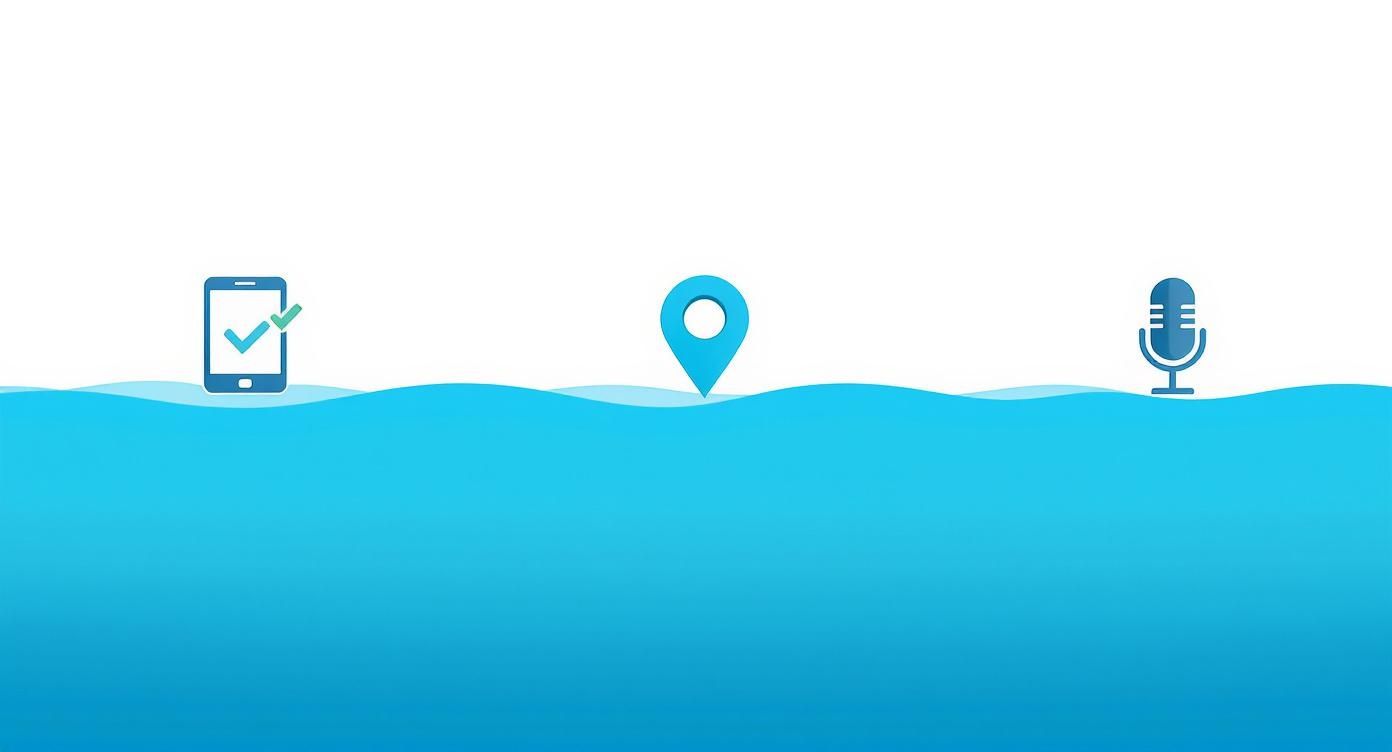
The graph makes it clear: A potential customer's search almost always starts on the go, is influenced by relevant local content and is increasingly controlled by voice search. Your marketing needs to start at exactly these points.
It's not about making everything perfect from the start, but about getting started. Every optimized entry, every new positive review and every locally relevant blog article is a building block for your success.
Common questions about local SEO optimization
When optimizing for local search, the same questions arise over and over again. Here you can find practical answers to the most common of them.
How long does it take for Local SEO Optimization to show results?
The first successes are often achieved faster than with supra-regional SEO. If you fill out your Google business profile cleanly and completely, you can often already within few weeks Record the first additional calls or clicks.
To achieve stable top rankings based on an optimized website and a solid foundation of reviews, you should realistically with three to six months calculate. This depends heavily on competition in your city and industry.
The important thing is: Stay tuned! Local SEO is an ongoing process. Anyone who regularly maintains their profile, continuously collects new reviews and keeps their website up to date will not only maintain their positions, but also constantly improve them.
My shop doesn't have a fixed address — what now?
This is a typical situation for service providers who travel to customers, such as mobile hairdressers or locksmiths. Google has a solution for that.
You can also create a company profile without a publicly visible address by creating a catchment define. Instead of a street, enter the cities, postal codes, or regions in which you operate. Your private address remains hidden and is only used by Google for one-time verification.
- Verification: Google usually sends a postcard with a code to the stored (private) address to make sure that your company exists.
- Practical tip: Since the physical address is omitted as a ranking factor, you should invest even more energy in local landing pages on your website. Create a separate subpage for each important city or district.
Is Local SEO Optimization free?
The most effective measures don't cost money, but your time. Creating and maintaining a Google business profile is free. Optimizing your website or asking for reviews also doesn't require a budget.
Costs can arise if you want to use support or speed up processes:
- Specialized tools: Tools for keyword research or the automatic update of company data in directories.
- External help: agencies or freelancers who do the optimization.
- Paid ads: Google Local Service Ads (LSA) or targeted local ad campaigns to increase organic visibility.
However, organic optimization remains the most sustainable foundation that ensures you long-term visibility at no cost per click.
Summary and next steps
A well-thought-out local search strategy is the most direct way to more visibility and new customers from your neighborhood. The basis for this is an optimized Google company profile, a locally oriented website, active review management and consistent company data on the web.
If you don't want to go down this path alone, we support from SocialEdge You as a specialized partner. We bring your company forward in the local search — sustainably and efficiently.