What is local SEO and why it's critical for your business
Imagine: Someone is looking on their smartphone on your street for a service that you offer. Do you or your competitor appear two blocks away in search results? This is where local SEO comes in. It's about optimizing your online visibility for search engines like Google so that it's clear who you are, what you offer and — most importantly — where to find you.
This is essential for every company with a physical location or a defined service area. Search behavior has changed: Users expect relevant, location-based results, particularly from mobile devices.
The power of local search in numbers
The connection between a local search and an actual purchase is short. Current data shows that 46% of all Google searches have a local connection. This has direct effects: Studies show that, for example 50% of userswho are looking for a local store on the go, visit or call it the same day. More details about these figures can be found in various SEO statistics on aioseo.com.
These figures illustrate: Local SEO is not an abstract marketing exercise, but a direct investment in acquiring new customers. Without good local visibility, you remain invisible to the majority of potential customers.
The cornerstones of local success
A successful local SEO strategy is based on the interplay of several core areas. Think of it as a sturdy foundation, with each stone supporting the other to ensure maximum visibility and trust with your customers.
The following infographic summarizes the three most important pillars that determine success in local SEO.
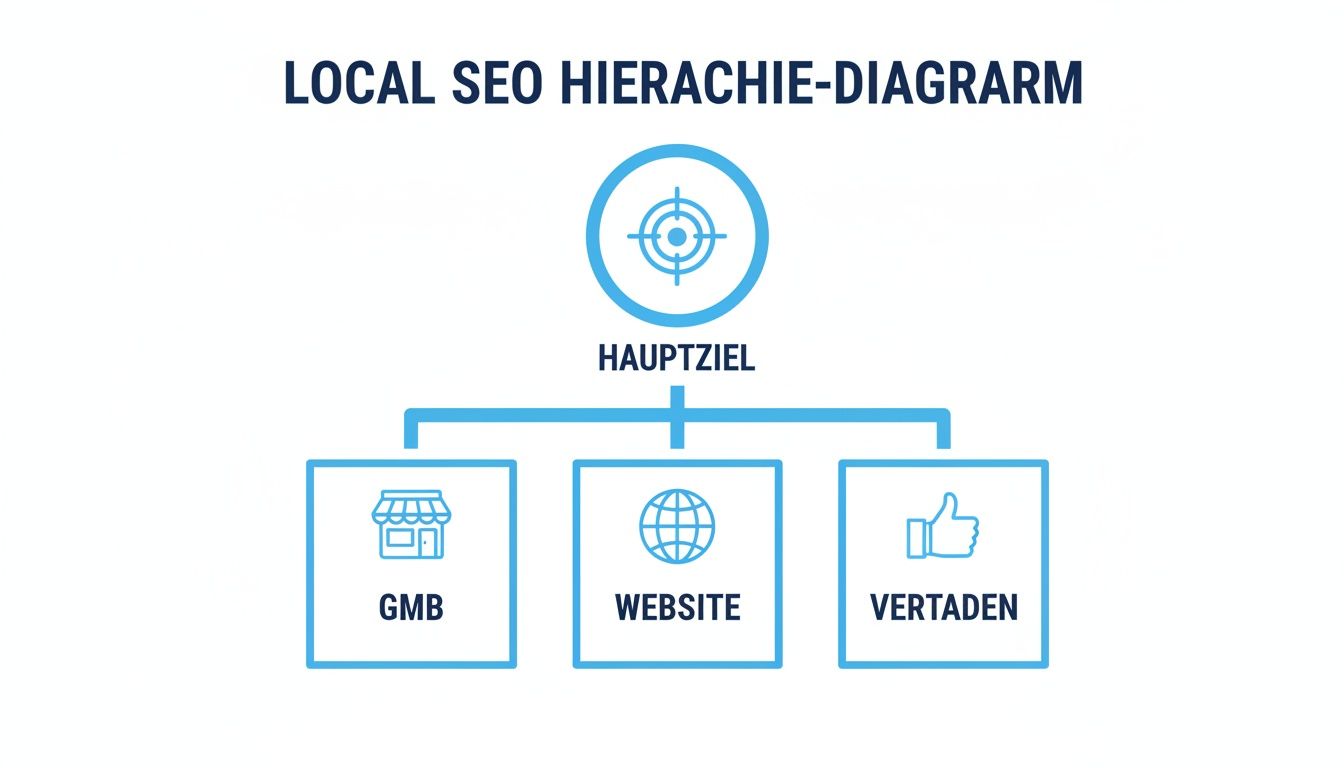
As the graphic shows, your Google company profile, your website and the trust you have built up online form the basis. Everything is aimed at attracting more customers from your immediate area.
The goal is to bridge the gap between digital search and your real business. How to help potential customers who are wondering How to find a good dentist near youto get a quick and convincing answer — namely you.
The most important pillars of local SEO at a glance
This table summarizes the core components of local SEO and shows their direct benefits for local companies.
Component descriptionBenefits for your companyGoogle company profileYour free company listing on Google, which appears in the Local Pack and on Google Maps. Increases visibility, provides important information (opening hours, address) and builds trust through reviews.Localized websiteYour website, which clearly communicates where you work (e.g. through location pages or local keywords). Attracts targeted visitors from your region and signals Google relevance for local searches.Reviews & ReputationCustomer reviews on Google and other portals, which serve as important social proof. Builds trust among potential customers and is a strong ranking factor for Google.NAP consistencyUniform spelling of name, address and telephone number (NAP) across all online directories. Strengthens credibility with search engines and prevents confusion among customers.Local backlinksLinks from other local websites (e.g. city portal, local industry association, partner). Signal to Google that they are firmly anchored and relevant in the local community.
Each of these pillars is valuable. Working together, they unleash their full potential and make your company visible locally.
In a nutshell: Local SEO is a business-critical necessity. It anchors your business in the local community and ensures that you are found exactly when the intent to buy is highest.
Although the goals are similar, there are key differences between general and local search engine optimization. You can find out more about this in our article about Difference between SEO and local SEO.
The website and Google company profile as a foundation
Your Google business profile (formerly Google My Business) is often the first point of contact for local customers. It acts like a digital shop window. A well-maintained profile attracts customers, while an incomplete or outdated profile is a deterrent. This listing is at the heart of your local SEO, as it sends Google clear signals about your offer, location, and relevance. The information from your profile is displayed directly in the Local Pack and on Google Maps.
Your website is the second crucial anchor. It serves as a central source of information and is the ultimate truth for Google about your company. This is where initial interest is transformed into a purchase decision. The aim is to establish your website as a local authority that signals to search engines: We are the first port of call for this service in this region.
Optimize your Google business profile
Before you use advanced tactics, the basis must be right. A well-maintained Google company profile is crucial for your visibility.
1. Choose the right categoryYour main category is the most important single piece of information for Google. Be as specific as you can. “Italian restaurant” is more meaningful than “restaurant.” Use secondary categories to cover other services such as “pizzeria” or “delivery service.”
2. Keep NAP data consistentNAP stands for Name, address, phone number (name, address, telephone number). These three pieces of data must be 100% identical on your website, Google business profile, and all other online directories. Google reviews this data to verify the trustworthiness of your company. Variations such as “street” instead of “street” can damage your ranking.
3. Fill your profile with lifeA lively profile is rewarded by Google. Actively use the features offered:
- Photos and videos: Show off your premises, your team, and your products.
- Posts (Google Posts): Inform about offers, news or events.
- Question and answer function (Q&A): Proactively answer customer questions to provide important information.
A well-maintained profile is the basis. Our guide shows you step by step how to create a Create a Google business profile.
Optimize the site for local searches
Your website must clearly signal to Google that you're relevant to a specific region.
1. Separate landing pages for each locationIf you run multiple branches, create a separate landing page for each location. These pages should include unique content, local contact details (NAP), and customer testimonials from the respective region.
2. Create technical foundationsUse structured data (schema markup) to provide search engines with the most important information about your company in a machine-readable format. The “localBusiness” scheme helps Google quickly understand your address, opening hours and business type and can improve your visibility through rich snippets. A mobile-friendly website with fast load times is also a must, as most local searches are made from mobile devices.
How content, links, and reviews work together
Visibility alone isn't enough. To prevail in local competition, you need to build trust. Three components are crucial for this: relevant local content, credible links and authentic customer feedback.
Create relevance with local content
Create content that addresses the specific questions and needs of your local audience. A gardener could write about the best plants for the regional climate. Such valuable blog posts Position yourself as an expert, attract local visitors and provide Google with geographical relevance signals. A well-thought-out content marketing strategy is a central component of successful local SEO.
Local links as a sign of trust
Backlinks from other local websites (e.g. city portal, partner company, local association) are digital recommendations. You show Google that your company is connected and recognized in the community. This process, also known as “citation building,” involves mentioning your company with consistent NAP data in relevant online directories. Each uniform entry in a Business directory Strengthens your local authority.
Reviews as a decisive factor of trust
Customer reviews are often the decisive factor for a purchase decision and are also a direct ranking factor for Google. Active evaluation management is therefore essential.
- Ask for feedback: Ask satisfied customers specifically for a review, e.g. by email or by sending a message on site.
- Respond to criticism: Always respond to negative feedback in a professional and solution-oriented manner. A constructive response can even strengthen the trust of potential customers.
The combination of helpful content, a strong network of local references and a transparent approach to reviews is the basis for sustainable trust and top rankings.
Measure local SEO success with relevant metrics
To evaluate the success of your local SEO measures, you need to track the right key figures (KPIs). It's not just about rankings, but about how improved visibility translates into specific business actions.
Key figures in the Google company profile
The statistics dashboard of your Google business profile provides valuable insights into direct customer interactions:
- Calls: How often was the call button clicked on your profile?
- Directions: How many users have planned the route to your location?
- Website clicks: How many users have switched from your profile to your website?
An increase in these metrics shows that your optimizations are working and are leading to more qualified inquiries.
Analyze website data with Google Analytics and Search Console
Google Analytics and Google Search Console help you understand what users are doing on your website.
- Google Search Console: Analyze which local search terms your site ranks for and what the click-through rate (CTR) is.
- Google Analytics: Set goals to measure important actions, such as submitting a contact form. This is how you connect traffic from local search directly to business results.
Tools to measure success
Specialized tools can help to simplify evaluation. One SEO app combines rankings, profile interactions, and website metrics in a clear dashboard. This saves time and helps you make data-based decisions and continuously improve your strategy.
Summary and next steps
Local SEO is a continuous process based on four pillars: an optimized Google company profile, a locally oriented website, building trust through links and reviews, and measuring success through relevant key figures.
Start with the basics: Check your Google business profile for completeness and accuracy. Even small but continuous improvements can make a big difference and get you to the top of local search results.
Do you want to make sure that your local SEO strategy bears fruit right from the start and brings your company forward in the long term? SocialEdge is your partner to get you to the top of local search results — without an expensive advertising budget. Find out how we can make you visible in your neighborhood.