Why AI makes the difference in local SEO
Imagine your competition spending hours manually searching for keywords while you identify relevant local searches in just a few minutes. This is where AI comes in. It is not about replacing human expertise, but about supporting it with powerful technology.
Visibility in the immediate vicinity is crucial, especially for local businesses such as cafés, craft businesses or law firms. This is where the AI SEO optimization and converts time-consuming routine tasks into quick, data-based actions. Instead of getting lost in large spreadsheets, you can focus on your core business and customers.
Efficiency as a decisive competitive advantage in AI SEO optimization
The biggest advantage of AI in SEO is the huge time savings. Analyses that used to take days are now completed by AI systems in minutes. You can invest this saved time directly in the quality of your services or in customer service.
This efficiency is measurable. A study shows that companies that rely on AI-based analysis tools implement their SEO audits on average 67% were able to shorten. The trend is clear: 62% German companies are already using AI for data analysis 42% for creating website texts.
AI is more than just an automation tool. It uncovers patterns and opportunities that are often overlooked manually. Imagine an AI analyzing hundreds of your customer reviews and filtering out the most frequently mentioned positive aspects. These insights are valuable for your marketing.
Precision and relevance for local target groups through AI
AI tools analyze large amounts of data to find hyper-relevant keywords for your location. They understand local jargon and identify search queries that signal a clear intent to buy.
What does that mean specifically for a café in Berlin-Kreuzberg? Instead of just optimizing for the general keyword “Café Berlin,” an AI suggests more specific terms that demonstrably convert better. The AI-based optimization of your content is only one aspect of this. Read our further article to learn more about how the basics of SEO for AI work and how to make your website fit for the future.
Direct comparison of local SEO with and without AI
This table shows how efficiency and results are changing due to the use of AI in local SEO compared to traditional methods.
ResponsibilityTraditional approachApproach with AI SEO optimizationLocal keyword researchManual research in tools, often time-consuming and focused on broad terms. Automatic identification of long-tail keywords with local purchase intent in minutes.content creationWriting all texts manually, often based on gut feeling. Preparation of drafts and outlines, analysis of the tonality of competitors.Analyzing reviewsTedious, manual reading through individual reviews for sentiment analysis. Quick extraction of recurring topics and sentiments from hundreds of reviews.Create GMB postingsManual ideation and formulation, often irregularly.Generation of relevant posting ideas based on seasonal trends and customer questions.Technical SEO analysisManual checking of hundreds of URLs for errors, very time-consuming. Automated audits that prioritize problems and often suggest solutions directly.
It's clear that AI doesn't do the work for you, but makes it more targeted and effective.
In summary, AI offers local companies three key benefits:
- Huge time savings: Routine tasks such as keyword research or drafting articles are accelerated.
- Well-founded decisions: Instead of relying on your gut feeling, you make decisions based on user data.
- Better customer contact: You can tailor your content more precisely to the needs and language of your local audience.
This guide shows you step-by-step how to take advantage of these benefits — with specific examples, immediately applicable prompts, and clear strategies for your business.
Local on-page optimization with AI support
Your website is your digital figurehead. But even the best presentation is of little use if potential customers can't find it online. This is exactly where the AI-powered SEO optimization to optimize your on-page factors so that local customers not only notice you, but also find their way to you.
By on-page SEO, we mean all measures that take place directly on your website: texts, meta data, images and internal links. AI tools act like an assistant here, helping you tackle these tasks faster and in a more data-based way. AI does the groundwork so you can focus on strategic fine-tuning and your technical expertise.
Find keywords with local relevance through AI analysis
The days of manual keyword research are gone. Modern AI tools such as ChatGPT, Gemini or specialized SEO tools can identify relevant search terms for your local business in just a few minutes. The key lies in the correct instruction, the so-called prompt.
Instead of searching broadly for “Physiotherapy Berlin,” you can specifically instruct the AI to find more specific long-tail keywords — i.e. search queries that reveal a clear intent.
A good prompt could look like this:
“I run a physiotherapy practice in Berlin-Mitte, specializing in sports injuries and manual therapy. Make a list of 15 long-tail keywords that potential patients from my neighborhood would Google if they're looking for urgent treatment. Also consider specific questions and issues. ”
The result could be keywords like:
manual therapy for knee pain Berlin MittePhysiotherapist for athletes near AlexanderplatzQuick appointment physiotherapy after cruciate ligament rupture BerlinWhich physiotherapist helps with back pain in 10117
Such specific search queries often have a lower search volume, but their conversion rate is usually significantly higher because they meet exactly the needs of a potential customer.
Formulate meta titles and descriptions using AI
Meta titles and descriptions are often the first point of contact with users in Google search results. You must both convince the search engine and make people curious. An AI can design various variants in a matter of seconds, which you can use as a starting point.
Let's stick with our physiotherapy practice, which is planning a new landing page.
A prompt for the meta data could be:
“Create 3 variants for an SEO-optimized meta title (max. 60 characters) and a meta description (max. 155 characters). Topic of the page: 'Manual therapy for sports injuries. ' The main keyword is 'manual therapy sports injury Berlin'. The practice is in Berlin-Mitte and advertises quick appointments. ”
The AI then provides suggestions that form a good basis. You can then refine them with your brand voice and expertise. This approach significantly speeds up the process without sacrificing quality. In our guide to Optimizing for local SEO Let's go into more detail about such strategies.
Improve website texts with AI as a writing assistant
The use of generative AI to create content is established in the German SEO environment. 42% companies in Germany are already using AI tools to write longer texts for their websites. This can be a useful strategy, as studies show that comprehensive articles of over 3,000 words can generate up to three times more traffic. You can find out more about this in the Current AI statistics on geoagentur.de.
Imagine you want to write a blog post about “The 5 most common mistakes after knee surgery.” AI can help you create a coherent structure, formulate initial drafts or explain complex medical relationships in an understandable way.
The key to success here lies in the right approach:
- Have an outline created: Ask the AI to suggest a logical structure for your article.
- Generate drafts: Have the AI write the first few paragraphs for each bullet point.
- Bring in human expertise: Review, correct, and add to the text. Add personal experiences, case studies from your practice, and your professional assessment.
AI provides the basic framework, but authenticity, personal touch and professional depth come from you. You remain the expert who ensures that the content is not only optimized for search engines, but above all accurate, helpful and trustworthy.
Optimize Google business profile with AI

Your Google business profile (formerly Google My Business) is often the first point of contact a potential customer has with you. It's more than just an online business listing — it's your digital business card right in Google search and on maps. A well-maintained profile decides whether someone calls, visits your website, or starts the directions.
The biggest challenge here is regularity. The profile constantly needs fresh, relevant content. This is exactly where AI can become a valuable tool. Instead of thinking about phrases or looking for ideas for the next post, use AI tools as your assistant.
Create the company description in just a few minutes
Your company description is your elevator pitch. They have 750 charactersto convince potential customers. This is where you need to get to the heart of what sets you apart and incorporate relevant keywords at the same time.
AI makes this process easier. Instead of staring at a blinking cursor, give the tool the facts and let you create a blueprint.
Prompt example for a local Italian restaurant:
“Write an inviting company description for the Google business profile of our restaurant 'La Trattoria da Franco. ' We are in Cologne-Ehrenfeld and are known for our homemade pasta based on family recipes and the relaxed atmosphere. Use a maximum of 750 characters. Important keywords include “Italian restaurant Cologne Ehrenfeld”, “homemade pasta” and “family-friendly.” Mention the fresh ingredients and our founder Franco. ”
The AI provides you with a solid basis, which you then add your personal touch. This way, the keywords are placed, contain the most important information and saved you time.
Create regular and relevant Google posts with AI
Anyone who regularly posts on their profile signals activity to Google and customers. Posts are suitable for current offers, events, new products or insights behind the scenes. The challenge is often finding ideas.
Think of AI as a source of ideas and texts. You can ask them to draw up an editorial plan or to formulate specific contributions.
Prompt example for a bookstore:
“I need 3 short Google posts (approx. 150 words each) for my bookstore in Hamburg.
- A post that promotes our 'Deal of the Week' (a specific crime story).
- An announcement for our author reading next Saturday.
- A post about our new reading corner, which is perfect for cold autumn days. ”
With such targeted instructions, you will receive finished text drafts in a short period of time. Add an image, publish, and you're done. This allows you to remain visible without much effort.
Important advice from practice: Always think of AI-generated content as a first draft. A check for facts, tonality and authenticity is essential. No AI can replace your personal handwriting and the voice of your brand.
An optimal profile goes beyond just posting. Comprehensive strategies, such as your Optimize Google My Business can, also include managing reviews and answering customer questions — AI can also help here.
Practical AI prompts for your Google business profile
This table provides you with ready-to-use prompts to create content for your Google business profile using AI tools. Customize the details for your business.
Task example prompt for AI toolProduct/service description“Write a short, convincing description (max. 1,000 characters) for our new “Bicycle Spring Check” service. Target group: Cyclists in [your city]. Keywords: 'bicycle inspection [your city] ', 'safe in spring'. Emphasize thorough testing of brakes, gears, and lights. ”Event announcement“Google Post for our annual summer party on [date]. Mention live music, grilled specialties, and children's entertainment. The post should arouse anticipation and end with a clear call to action (e.g. 'Add it to your calendar now! ') . ”Prepare FAQ answers“List the 5 most common questions that customers might have about [your profession, such as a hairdresser]. For each question, provide a short, clear and friendly answer for the Q&A section of our Google business profile. ”Respond to a negative review“A customer complained about long waiting times. Formulate a professional and empathetic response. Show understanding, apologize and offer a solution or compensation (such as a voucher for the next visit). Stay factual and customer-oriented. ”
These prompts are a good starting point. Experiment with it to see what works best for your business.
Answer customer questions (Q&A) precisely and quickly
The Q&A section in the profile is an often overlooked resource. Here you can proactively answer your customers' typical questions and thus remove hurdles. Questions such as “Are there parking spaces? ” or “Can I pay by card? “should never go unanswered.
When a complex question comes in, AI helps you formulate a structured and helpful answer.
- Be faster: They process inquiries quickly and don't keep potential customers waiting.
- Appear uniformly: AI helps maintain a professional and consistent tone of voice across all answers.
- Don't forget anything: An AI tool can remind you to shed light on all aspects of a question.
Gain valuable insights from customer reviews
Customer reviews are direct, unfiltered feedback. But who has the time to manually go through hundreds of comments to spot patterns? That's exactly what AI tools can do for you.
Ask an AI to analyze a large number of your reviews and filter out recurring positive and negative points.
An example prompt for your AI tool:
“Analyze the following 50 customer reviews for my café. Summarize the 3 most common positive comments and the 3 most common criticisms. List the results in brief. ”
The result is a data-based analysis that shows you what your customers appreciate and where there is potential for improvement. With these findings, you can make targeted adjustments.
Targeted increase visibility in Google Maps through AI
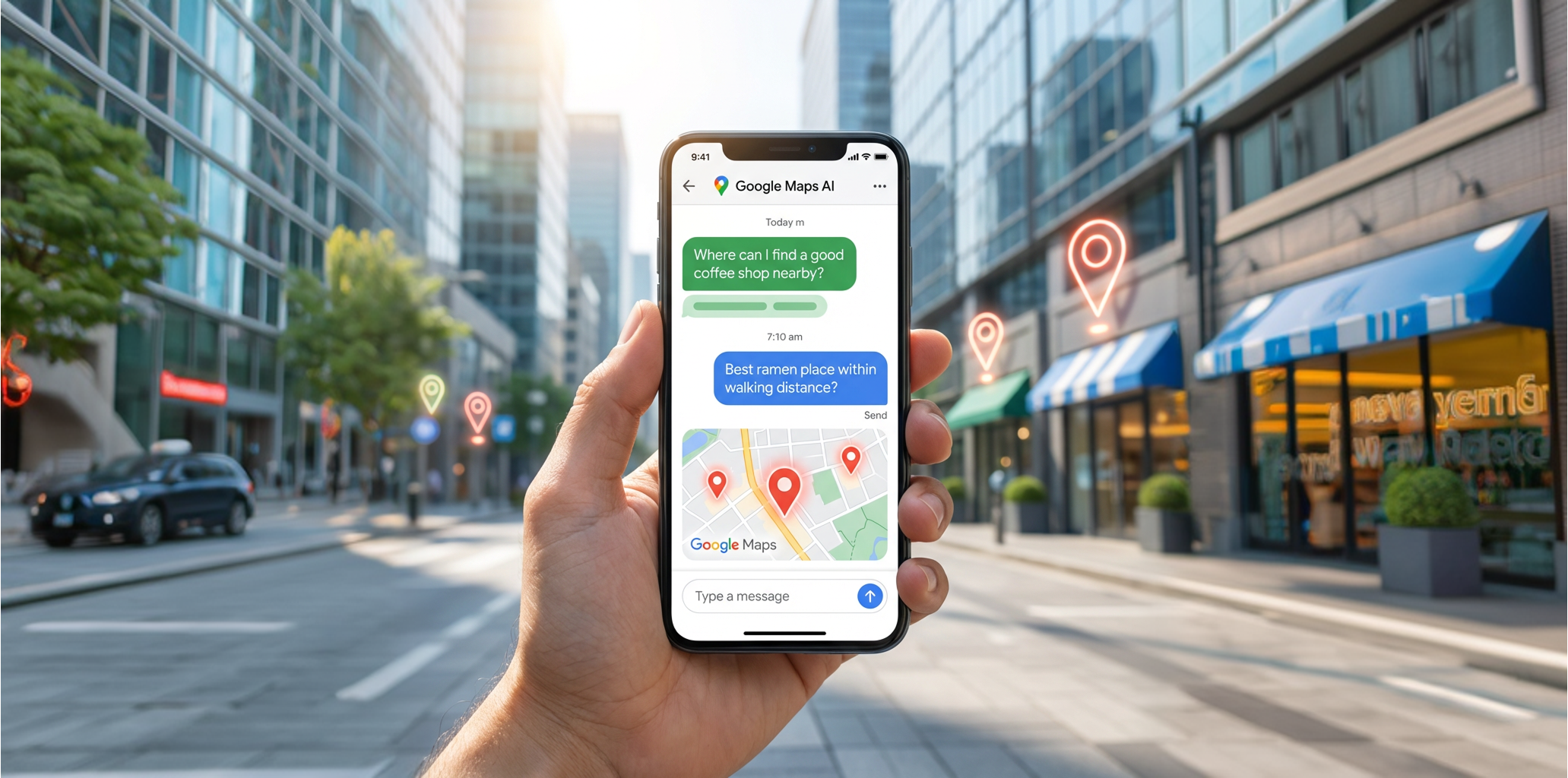
If you want to be found locally, there is no way around Google Maps. For many potential customers, the search starts right there. The key question is: Do you appear in the “Local Pack”? A top ranking is valuable and with AI-powered SEO more reachable.
This is about more than just entering the address. Google Maps is a search engine with its own algorithm. AI tools are a lever here to systematically optimize the decisive signals and strengthen your presence.
Ensuring consistent NAP data as a foundation
One of the most basic ranking factors for local searches is consistent NAP data (name, address, telephone number). Google must be sure that your company is genuine and based in the specified location. Any deviation can weaken your authority.
Detecting these inconsistencies manually is time-consuming. This is where AI tools come in:
- Audit of existing entries: Specialized software scans the web for mentions of your company and uncovers divergent NAP data.
- Automated corrections: Many of these tools can not only identify errors, but also suggest corrections or submit them automatically.
- Development of new citations: The AI suggests relevant, industry-specific portals where an entry makes sense.
A clean NAP profile is the basis for further improvements. More details on how to make your Improve Google Maps ranking, we have summarized them in our own guide.
Conduct and use competitive analysis with AI
Are you wondering why a competitor always ranks above you in Maps? An AI can help you analyze its strategy. Instead of manually comparing profiles, AI tools analyze your competitors' Google profiles based on data.
Here's how you get insights into working tactics:
- Keyword patterns in reviews: The AI searches through customer reviews and recognizes recurring key terms. If customers often write about “fast service,” you know where to focus.
- Analysis of image strategy: What type of photos is your competitor uploading? AI image recognition finds patterns and shows you which visual content is well received.
- Frequency and topics of Google posts: The analysis shows how often and on which topics your competition is posting. This is a source of ideas and an orientation for your own editorial plan.
You don't have to reinvent the wheel. With these insights, you can adapt successful tactics and implement them for your own company.
Increase local relevance with geotagged photos
Photos are an important ranking factor in Google Maps, especially when they have a clear local connection. Geotagged photos are images that are provided with geographical coordinates. They prove to Google that the photo was taken at a specific location — ideally right at your store.
The challenge is often to develop new photo ideas over and over again. AI can also help here.
A practical prompt for a local craft business:
“I run a painting business in [your city]. Give me a list of 10 creative photo ideas for Google Maps that show our work on site and signal local relevance. The pictures should look professional but authentic. Think of before-and-after scenarios, team photos on projects, and detailed photos of our work. ”
The AI provides you with a list of specific suggestions that you can implement. From a photo of the team in front of a well-known building in your city to a detailed shot — this is how you create visual evidence of your expertise. This not only strengthens your ranking, but also the trust of future customers.
Measure success and adjust AI SEO optimization
An SEO strategy is only as good as the results it delivers. Without measuring what works, you act in uncertainty. Google Search Console and Google Business Profile Insights provide valuable data. The trick is to interpret this data and translate it into concrete steps.
Integrating AI into your SEO processes is a continuous cycle of measuring, analyzing, and adapting. This is the only way to ensure that your work bears lasting fruit.
Which local KPIs are important for measuring success
Local SEO is about tangible actions that bring you more business. yours AI SEO optimization must aim to improve key performance indicators (KPIs).
Focus on the KPIs with the biggest leverage for your local business:
- Rankings for local keywords: Track your positions for search queries with clear geographical references, such as “Steuerberater Berlin Mitte.”
- Calls from your Google business profile: Every call is a potential customer who found you directly via Google search.
- Clicks on the directions: This signal shows a clear intent to visit your store.
- Website clicks from profile: How many users continue to click from your profile to your website?
- Analysis of search queries: What terms do users use to find your profile? This often creates new keyword opportunities.
You can find all this data in the insights of your Google business profile. Analyze the development of these figures on a monthly basis to identify trends and evaluate the impact of your measures.
Use data from the Search Console for AI SEO optimization
Die Google Search Console is your direct link to Google. It shows you how your website is doing in organic search, even on a local level.
Have a look at the Performance report Filter the data to see which pages and searches are getting the most clicks and impressions. Have you optimized a landing page with AI? Then you can see whether it is gaining visibility here.
A typical scenario: You see that a page is viewed often (high impressions) but barely receives any clicks. This is an indication that the page title and description are not yet convincing. A good use case for an AI tool to test more appealing variants and improve click-through rate (CTR).
Respond to new developments such as AI overviews
Google searches are constantly changing. Since May 2024, they have AI Overviews It is also part of search results in Germany. Google answers many queries directly with an AI-generated summary.
This means that just ranking on page one is no longer enough. The goal must be to be cited as a source in these prominent AI answers. A study shows that 52% The sources cited in AI Overviews come from the top 10 search results. Although click rates may change, there were 63% of the surveyed entrepreneurs that the AI overviews had a positive effect on their organic traffic or visibility. You can find out more about these developments in this Article about AI and SEO in transition on duesseldorf-wirtschaft.de.
To appear in these summaries, your content must meet three criteria:
- Accurate: Answer specific questions clearly and to the point.
- Well structured: Use clean headlines, lists, and short paragraphs.
- Trustworthy: Back up your statements with expertise and facts.
This is where the circle comes full circle AI SEO optimization. Use AI to analyze your existing texts and rephrase them so that they optimally answer the questions of your local target group. A prompt could read: “Summarize the following text so that it asks the question 'How much does a professional dental cleaning cost? 'answered directly and comprehensibly for a layman. ”
This data-based and flexible approach is the key to long-term success in local SEO.
This is how things continue for you now

With a well-thought-out AI SEO Strategy Not only do you save time, but you can also work more precisely and create authentic, local content more efficiently. The most important areas of action for more visibility are your on-page optimization, your Google company profile and Google Maps.
The cycle of measuring, analyzing and adapting presented here is the key to being successful in local SEO in the long term. Start with a small but effective step.
My tip for getting started: Use one of the prompts from this article to revise your business description on your Google Business Profile today. That's a small amount of effort with a potentially big impact — an ideal first step to improve your local visibility.
Practical questions: AI in local SEO
Here we answer some of the most common questions about using AI in local marketing.
Will AI soon take over my entire local SEO?
No, that is neither realistic nor the goal. Think of AI tools as capable assistants that do repetitive work for you — keyword research, text drafting, data analysis.
Strategy, quality control and, above all, your personal touch, expertise, and brand voice remain your job. The best results come when technology meets human experience.
Which tools are the best to start with?
You don't have to invest in expensive specialized software right away. For starters, all-rounders like ChatGPT, Google Gemini or Claude is well suited. With it, you can collect keyword ideas, design posts for your Google business profile, or outline the structure for a local landing page.
Combine this with data from the Google Search Console and the insights from your Google business profile. This gives you a strong, free basis for testing the impact of your measures.
Does Google punish AI-generated content?
No, not per se. Google ranks content based on its usefulness, correctness, and helpfulness for the reader, regardless of how it was created.
An unchecked text created at the push of a button will not achieve good rankings. However, if you use AI as a tool and refine the design with your expertise, real examples, and personal insights, the result can rank very well.
The added value for the user counts. As long as your content solves a problem and creates trust, it's secondary to Google whether an AI was involved in the writing process.
How quickly will I see initial successes with AI SEO?
It depends on your market and the state of your website. Minor adjustments, such as a revised description in the Google company profile, can often have an effect after just a few weeks (e.g. more calls).
More extensive on-page optimizations require more patience. Calculate here three to six monthsuntil changes are fully noticeable in the ranking. However, the biggest immediate win is saving time on your daily SEO tasks.
Summary and next steps
Die AI SEO optimization offers local companies the opportunity to increase their visibility in a more efficient and data-driven way. Instead of completing manual, time-consuming tasks, you can use AI tools for keyword research, content creation, and analysis. The key to success is seeing AI as an assistant and refining the generated content with your own expertise. Start with small, actionable steps, such as optimizing your Google business profile, and measure your success continuously.
Ready to increase your local visibility? SocialEdge is your partner for specialized Google Maps marketing. We help you move forward in your region so you can focus on your core business. Secure your exclusive place in your region now on socialedge.ai.