What does a good Google ranking really mean
A strong ranking on Google is much more than just a number in a report — it is often the first point of contact with your customers. When someone searches for what you offer, your position will determine whether you're even an option at all.
At the very top of organic search results Standing is like a technical recommendation from Google. This signals trust and competence. In contrast to paid ads, which you virtually rent, you really have to earn a top organic position. Google rewards those who best answer searchers' questions — with useful content, a clear structure and real added value.
Organic vs. paid Google placement: The difference
It is important to clearly separate these two paths to visibility, because the strategy behind them is fundamentally different:
- The organic placement: You can earn this position through targeted search engine optimization (SEO). It is the result of relevant content, a technically flawless website and a solid online reputation. Organic visibility is sustainable and is perceived by users as significantly more credible.
- Paid ads (SEA): These usually appear at the top or bottom and are clearly marked as “Advertisement” or “Sponsored.” Here you can buy visibility per click. This works as long as the budget flows — once it's gone, the ad also disappears.
SEO is therefore not a sprint, but a marathon. It's about understanding and serving your target group and their needs better than anyone else. This pays off in the long term and creates a stable foundation for your online success.
Why Google's ranking in Germany is crucial
The figures show how important a good ranking is. Google will remain in 2025 with a market share of around 91.98% the absolutely dominant search engine in Germany. And even more important: Organic searches are included 54.25% It is by far the most important source of traffic of all website visits. Anyone who is not visible here leaves the field to the competition. More about the Current search engine trends can be found at seranking.com.
This guide shows you step by step how you can systematically and sustainably improve your position on Google.
The most important factors for your Google ranking
In order to improve your Google ranking in a targeted manner, you first need to understand how Google works in the first place. It's best to think of the algorithm as an extremely competent librarian. He not only reads the title of a book, but also evaluates the entire content, checks the recommendations of other experts and even observes which books captivate visitors the longest.
Google itself is talking about over 200 ranking factors, but don't worry: you don't have to learn each one by heart. The trick is to know the levers with the greatest effect and to use them correctly. Basically, everything can be broken down into three core areas, which form the basis for a strong Google ranking.
The three pillars of your Google ranking
Each of these areas plays its own important role, and they are interdependent. A technically perfect website without good content will fail just as much as a page with brilliant texts that no one on the Internet mentions or links to.
- On-page SEO: That's everything you can control and optimize directly on your own website — your “own house,” so to speak. This includes in particular the quality of your content, technical cleanliness and ease of use.
- Off-page SEO: This includes any signals that come from outside your website and suggest its trustworthiness and authority. You could describe it as your “reputation in the city” — that is, what others say about you.
- User signals: Here, Google takes a close look at how visitors interact with your website. Do they stay long? Do they immediately click away in frustration? This is the direct “customer feedback” that Google evaluates.
The following infographic gives a good overview of the basic composition of Google search results.
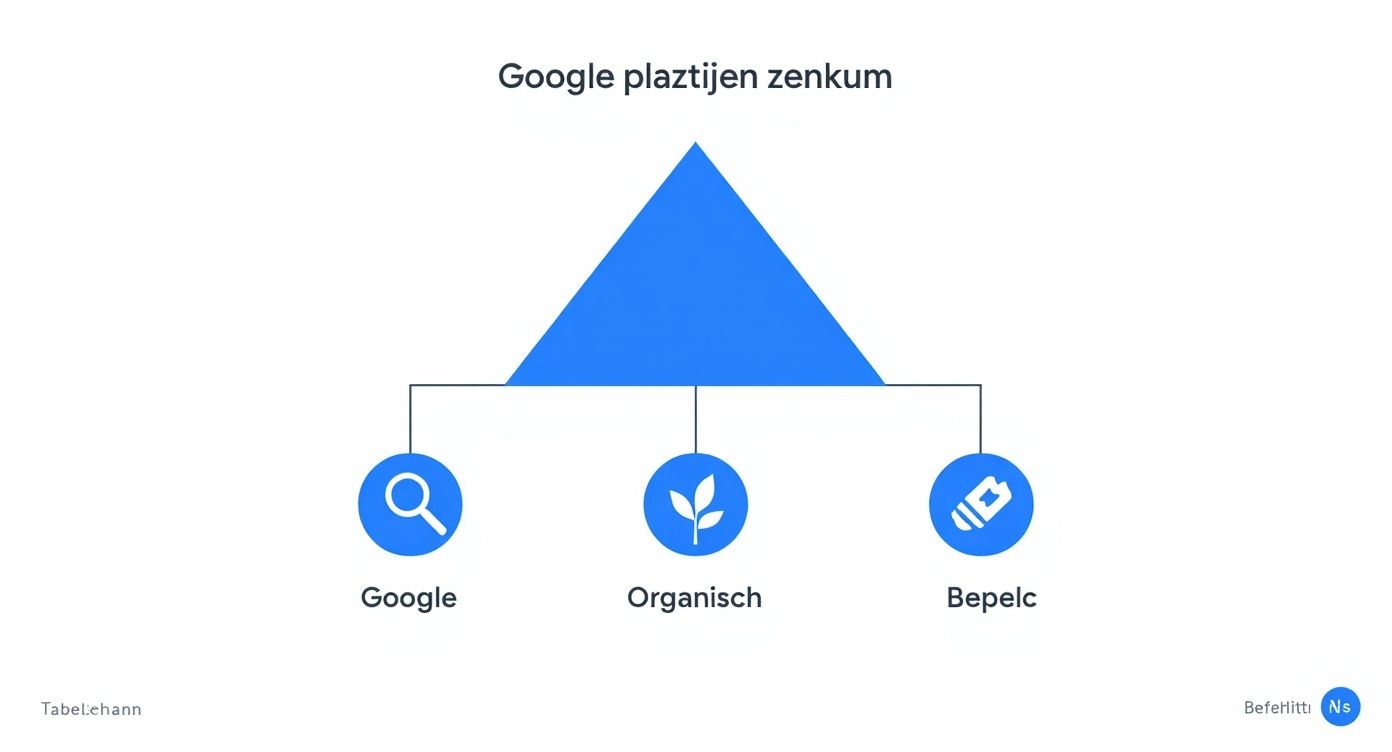
It's clear here that organic, i.e. unpaid, placement is a central pillar of your visibility. And the best part is that you can strengthen this pillar yourself through targeted optimization.
Overview of key Google ranking factors
To help you get started, we've summarized the most important factors in a table. This allows you to see at a glance what is important in the individual areas.
CategoryImportant ranking factorsShort descriptionOn-PageRelevant content, keywords, technical cleanliness, mobile-friendliness, loading speed, internal linkingAnything that happens directly on your website. Google checks whether your site answers the search query optimally and is technically flawless.Off-PageBacklinks (number & quality), mentions (brand mentions), local quotes (NAP) signals from other websites that prove your trustworthiness and authority. Considered digital word of mouth.User signalsClick-through rate (CTR), length of stay, bounce rateThe behavior of real users. It shows Google whether visitors were satisfied with your search result or not.
These three areas are closely linked. A technically fast page (on-page) with strong recommendations (off-page) leads to satisfied visitors (user signals), which in turn improves your rankings.
On-page factors for a better Google ranking
Your on-page optimization is the basis. Think of it like building a house: Before you buy fancy furniture (off-page) or throw the first party (user signals), the foundation must be solid, the walls must be standing and the rooms must be logically divided.
The most important things here are high-quality content, which the Search intent Hit a user exactly. When someone searches for “buy red running shoes,” they want to see a product overview and not a scientific treatise on the history of red color pigments. The technical health of your site is just as important: Fast loading times, a perfect display on a smartphone and a secure HTTPS connection are no longer a freestyle, but an absolute must.
Off-page factors as a sign of digital trust
Your reputation on the Internet is significantly influenced by so-called backlinks sculpted. A backlink is nothing more than a link that points to your page from another website. Think of it as a personal recommendation from one side to the other.
A single link from a renowned trade magazine weighs much more for Google than ten links from any unknown blog. The following applies very clearly here: Quality beats quantity.
But it's not just about links. Mentions of your brand (so-called brand mentions) or positive reviews on industry portals are also valuable off-page signals. All of this helps Google rank your website as a true authority in your area of expertise.
User signals as direct feedback for Google
Ultimately, Google always wants to deliver the best possible result to its users. That is exactly why the signals that real visitors leave on your site have become an extremely strong ranking factor. Google measures very precisely how people react to the search results they see.
Here are the three key metrics:
- Click-through rate (CTR): Of all the people who see your search results, how many actually click on them? A high CTR tells Google that your title and description are curious.
- Dwell time: How long do visitors stay on your site after they come from Google? A long stay is a clear sign that your content is exciting and relevant.
- Bounce rate: How many users leave your site immediately without taking any further action (such as clicking on another link)? A high bounce rate can be a warning sign that the site hasn't met expectations.
If users stay on your site for a long time and don't immediately return to Google search, this is the ultimate sign for the algorithm: “Hit! The searcher has found what he wanted. “It is precisely these positive user signals that often make the decisive difference in the end.
Optimize your local Google ranking

For every store with a shop or a fixed catchment area, there is a digital business card that is often more important than your own website: presence in Google's “Local Pack” and on Google Maps. When someone searches for “hairdresser near me” or “Italian restaurant Berlin,” it is precisely this local placement that determines new customers or empty tables.
A good ranking is no coincidence here. It is the result of a well-thought-out optimization of your Google company profile (formerly “Google My Business”). This profile is your digital figurehead and by far the strongest lever to show Google how relevant you are to your environment.
The foundation: NAP consistency
Before we dive into the finer details, the foundations must be right. And that foundation is called NAP: Name, address, phone number. In other words, name, address and telephone number. These three core data must be absolutely identical on your website, in your Google company profile and in all important online directories.
Even the smallest discrepancies such as “street” instead of “street” can confuse Google and undermine your authority. Think of it this way: You give a friend three slightly different addresses for the same party. Confusion would be inevitable. That's exactly what happens with Google when your data doesn't match 100%.
The right categories for your local Google ranking
Right after the master data, there is probably the most important step: choosing the right categories. Google lets you set a main category and multiple secondary categories. Your main category should describe your core business as precisely as possible.
- main category: Be specific! Instead of just “restaurant,” choose “Italian restaurant” if that's your specialty.
- Subcategories: Here you can supplement everything else you offer. So an Italian restaurant could add “pizzeria,” “delivery service,” or “venue.”
Through these categories, Google understands which searches you are relevant for, even if the search term doesn't exactly match. This is also how you can find someone who simply searches for “order pizza.”
Maintain images and current information
A profile without pictures is like a shop window without goods — it appears impersonal and not inviting. Professional photos of your business, team, and products or services are essential. They immediately create a first impression and build trust.
Up-to-date opening hours are just as important. There is hardly anything more frustrating for a potential customer than standing in front of a locked door even though Google shows that it's open. Therefore, maintain public holidays and special opening hours meticulously.
Manage reviews for better rankings
Customer reviews are an important signal. They are a strong indicator for other users and a relevant ranking factor for Google. Many positive reviews signal: “There is quality here, customers are satisfied here! ”
Active assessment management is crucial. Don't just respond to criticism, but also thank you for positive feedback. A professional and quick response shows that you care about your customers and strengthens loyalty.
Actively ask satisfied customers to leave a review. A simple link in a post-purchase email or a small local notice can help increase your number of reviews.
Stay up to date with Google posts
The contribution function in your company profile is often neglected. Use them to inform you about offers, news or upcoming events. These posts appear directly on your profile in search results and on maps.
Regular posts signal to Google that your company is active and up to date. This not only improves visibility, but also gives you the opportunity to communicate directly with potential customers and highlight special activities. To dive even deeper into the subject matter, we have collected further tips in a separate article on how to your Improve Google Maps ranking Can.
The importance of local Google ranking in figures
Optimizing your local profile is a key success factor. The click rate (CTR) will remain decisive in 2025, and it is particularly relevant in the local sector: 46% of all searches in Germany, they have a local connection. From all clicks that are made on these results, go 42% to the Google Maps package. Anyone who doesn't show up here is leaving a large part of the business to the competition. A complete and carefully maintained Google company profile is your direct link to a better Google ranking on site.
Create content for a top Google ranking

Once the local and technical base is in place, we get to the heart of every successful strategy for a better Google placement: first-class content. Think of your content as a bridge that connects a user's question to your answer. When that bridge is stable, trustworthy, and truly helpful, you'll be rewarded — by your visitors and by Google.
It is no longer a question of simply stuffing texts with keywords. The real lever lies in understanding what your potential customers really want to know. Your job is then to provide them with this information better, more comprehensible and more comprehensively than anyone else. Good content solves problems, creates trust and establishes you as a true expert in your niche.
Search intent as a compass for your content
Before you type even a single word, you must enter the Search intent Decipher behind a keyword. What exactly does a user expect when they type a specific term into Google search? Basically, most searches fall into three categories, each of which requires completely different content.
- Informational inquiries: The user is thirsty for knowledge. He asks “How do I properly trim a hedge? “or search for “symptoms of a cold.” Detailed guides, instructions or blog articles are the perfect answer here.
- Transactional inquiries: Here, the intent to buy is crystal clear. People are looking for “buy running shoes for men” or “cheap hairdresser Berlin.” The user now wants to see product pages, price comparisons or a direct booking option.
- Navigational queries: The user already knows their destination and uses Google as an abbreviation. For example, he types in “Facebook Login” or “SocialEdge” to go directly to the desired page.
If your content doesn't match the search intent, you have virtually no chance of a good Google ranking, no matter how brilliantly written the text is. A simple trick: Enter your desired keywords yourself on Google and take a look at the top results. Do you see advice articles, product listings, or local profiles? That's your guide.
Keyword research: Understanding the language of your customers
Keywords are nothing more than the language of your customers. Careful keyword research helps you identify exactly the terms and phrases that your target group uses on a daily basis. It's about developing a real sense of which questions are unanswered out there and which problems need to be resolved urgently.
Let's say you run an auto repair shop. Potential customers may not only be clumsily looking for “car repair shop,” but much more specifically for “oil change costs,” “what to do with check engine lights,” or “install cheap summer tires.” Each and every one of these searches is a golden opportunity to be visible at the right time with the right content.
A classic mistake is to only focus on keywords with huge search volumes. The more specific ones are often much smarter Long-tail keywords. Although they are searched for less often, they reveal a much higher intent to buy and are usually much easier to conquer.
Content with real added value for your Google ranking
Once you know your keywords and the intent behind them, the real work starts. The key to content that Google prefers is simple: Create content that people help. For every text you produce, ask yourself these three questions:
- Does this content completely solve the user's problem? Go in depth and don't omit any important aspects.
- Is the content easy to digest and well structured? Short paragraphs, clear subheadings, lists, and bold Key messages make every text more readable.
- Do I offer a unique perspective or useful additional information? Don't just copy what the competition is writing. Bring in your own experience, specific examples, or new data.
A well-structured article with meaningful images and maybe even an embedded video will almost always cut out a desert of pure text. This mix keeps readers' attention and at the same time signals high quality to Google. By the way, there are specialized tools to help with research and preparation; more about the possibilities of Find out SEO optimization software in our blog. By consistently providing useful and well-prepared information, you build up a thematic authority step by step — and this is the basis for a sustained good Google ranking.
The technical foundation for stable placement
Imagine yourself beautifully furnishing a shop, but the foundation of the building is cracked. It's exactly the same with your website: The best content and a flawless company profile are of little use if the technical basis is shaky. Technical SEO isn't rocket science — it's the foundation on which your Google placement Stands securely.
At its core, it's about making it as easy as possible for Google to “read” and understand (i.e. crawl and index) your pages. If your website is slow, annoying on mobile phones, or looks cluttered, it doesn't just frustrate your visitors. Google also notices this and punishes you with poorer rankings. Clean technology is therefore a direct investment in your visibility.
Mobile-first: The smartphone decides the Google ranking
Google used to look at the desktop version of a website and then decide on the ranking. Those days are finally over. Today, the principle applies “Mobile-First”: Google rated primer the mobile version of your website. That is only logical, because user behavior has completely changed.
round 60% of all searches These days come from smartphones and tablets. Whoever lands in first position here has an average click rate of 22.4% one — the places behind are significantly falling off. More You can find insights into current Google search statistics at affmaven.com. If your site isn't running smoothly on your mobile phone, give away the lion's share of your potential customers.
Core Web Vitals: Speed as a ranking factor
We all know how quickly patience runs out on the Internet. That's why Google has the Core Web Vitals made into important ranking factors. These key figures measure in a very specific way how quickly a page loads, how stable it behaves and how quickly it reacts to clicks or inputs.
A slow website is a conversion killer. Often, just one or two seconds too much load time is enough and a potential customer is gone — to the competition, which was faster. He hasn't even seen your offer.
Optimizing the loading time is therefore not just a technical gimmick for Google. It is a fundamental service for your visitors. A fast, seamless experience sends a strong signal of quality.
Other technical pillars for your Google ranking
In addition to mobile optimization and speed, there are a few other technical homework tasks that are crucial for a good Google ranking. They ensure security, a clear structure and comprehensibility.
- HTTPS encryption: A secure connection (the “https://” in the address line) is now the absolute standard. It protects your visitors' data and is a clear sign of trust for Google and a small but fine ranking factor.
- Logical URL structure: Speaking URLs such as
yourdomain.de/services/seo consultingare worth gold. They are immediately understandable — for people and search engines. Cryptic addresses such asyourdomain.de/ p?id=123On the other hand, they are a relic from the Stone Age of the Internet. - XML site map: Think of the site map as a map of your website that you give to Google. It lists all important pages and helps the Google crawler not miss anything and understand the structure of your website more quickly.
A solid technical foundation is not a one-off project, but must be reviewed regularly. To really look deep into the engine room of your website, a professional check is often the best way. In our article, we explain what a comprehensive SEO audit by an agency arrives.
Conclusion: The next steps towards a top ranking
The path to a better Google placement is a process that is based on clear principles. Your strategy requires a solid foundation based on three pillars:
- Technology & local: A technically flawless website and a well-maintained Google company profile are the basis.
- Content with added value: Create content that solves your audience's problems and questions better than the competition.
- Authority & Trust: Build authority through positive user signals and valuable backlinks (digital recommendations).
SEO is not a project that you check off once; it requires patience and constant fine-tuning. The key to success is staying consistent. It's better to focus on one area first, such as local optimization, before moving on to the next.
If you want to speed up this process and focus on the right strategy right from the start, professional support can make the difference. The know-how of a specialized agency helps you develop a sustainable and effective strategy for your visibility. You can find out more about what such a collaboration can look like in our article about the benefits of a SEO optimization by an agency. Don't hesitate to get help to achieve your goals faster.
Frequently asked questions about Google placement
The topic of Google ranking is full of details and naturally raises questions. To help you keep track of things, we have collected the answers to the most pressing questions here. These are not dry theories, but tried and tested information with which you can start something right away.
How long does it take to improve my Google ranking?
Honestly? SEO is a marathon, not a sprint. The idea of jumping to the top overnight is unrealistic. How fast it really works depends extremely on how strong the competition is in your niche and where your website currently stands, both technically and in terms of content.
Realistically speaking, if you work consistently, you can go after approximately three to six months see the first positive developments and jumps in the rankings. But it takes perseverance to truly establish yourself in the top positions on a permanent basis. SEO isn't a project that you complete once — it's a continuous process.
What is the difference between SEO and SEA?
Both terms are constantly buzzing through the marketing universe, but mean two completely different ways to become visible on Google.
- SEO (search engine optimization): This is about getting yourself a place in the organic, i.e. to earn unpaid search results. You can do this with first-class content, a technically clean website and a good online reputation. SEO is a long-term investment that brings sustainable results and is often seen as more credible by users.
- SEA (search engine advertising): These are the paid ads you see via Google Ads Switch. You buy yourself a prominent place, so to speak, and usually pay per click. This provides immediate visibility, but this is gone just as quickly as soon as you turn off the money supply.
Which free tools help with monitoring?
You don't have to spend a fortune to keep track of your progress. Google itself provides the most important tools free of charge, and they are more than enough to get you started.
The absolutely indispensable tool is the Google Search Console. You can see them as a direct link to Google. It tells you which search terms you are being found for, what position you are in on average and whether there are technical errors that are slowing you down.
For every local store, this is also Google company profile a must. The integrated statistics are a gold mine for local data. You can see exactly how often your profile has been viewed, how many people have requested directions or called you directly from the listing.
You feel that at your local Google placement Is there still room for improvement, but you simply don't have the time to take care of it? SocialEdge specializes in getting just such local businesses like yours to the top of Google search — and without expensive ads. We polish up your profile, maintain your good reputation and create sustainable visibility so that you can concentrate fully on your core business again.
Find out more now and secure your competitive advantage on socialedge.ai