Why an optimized Google business profile is crucial
In the past, people used to use business directories, but today almost everyone picks up their smartphones. Customer behavior has fundamentally changed. The first point of contact for finding a local provider is usually Google — regardless of whether it's a plumber, a café or a tax advisor.
Your Google company profile is more than just a digital address entry. It is your virtual shop window and often the first impression that potential customers get of you.
The bridge from online search to shop visits
A well-maintained profile creates a direct connection between a customer's digital search and their visit to you on site. At a glance, it provides him with exactly the information he needs to make a quick decision.
This direct connection is at the heart of successful local online marketingbecause it makes it as easy as possible for the customer to get to you.
Imagine: Someone searches for a “bicycle repair shop with e-bike service” and finds your profile. He sees:
- Positive reviewsthat signal competence.
- Latest photos your workshop.
- Exact opening times and the correct address.
- A visible “Call” button for direct contact.
There is a high probability that this customer will choose you, often without having visited your website.
Visibility even without your own website
A major advantage of the Google business profile is its independence. Even if you don't have your own website, you can build up considerable reach and attract new customers with an optimized profile. Your profile works like a free mini website right in Google search results.
Today, an optimized profile is an important basis for local visibility. It can decide whether a customer ends up with you or with a competitor.
The figures speak for themselves: A study shows that 84 percent German consumers search for local companies every day. Rund 75 percent Of these, use Google Search or Google Maps. In practice, companies with actively managed profiles have significantly more interactions, such as calls, website clicks and visits to the store.
Optimizing your Google company profile is a strategic tool that can generate customers and thus revenue from search queries.
Laying the foundations of Google My Business optimization
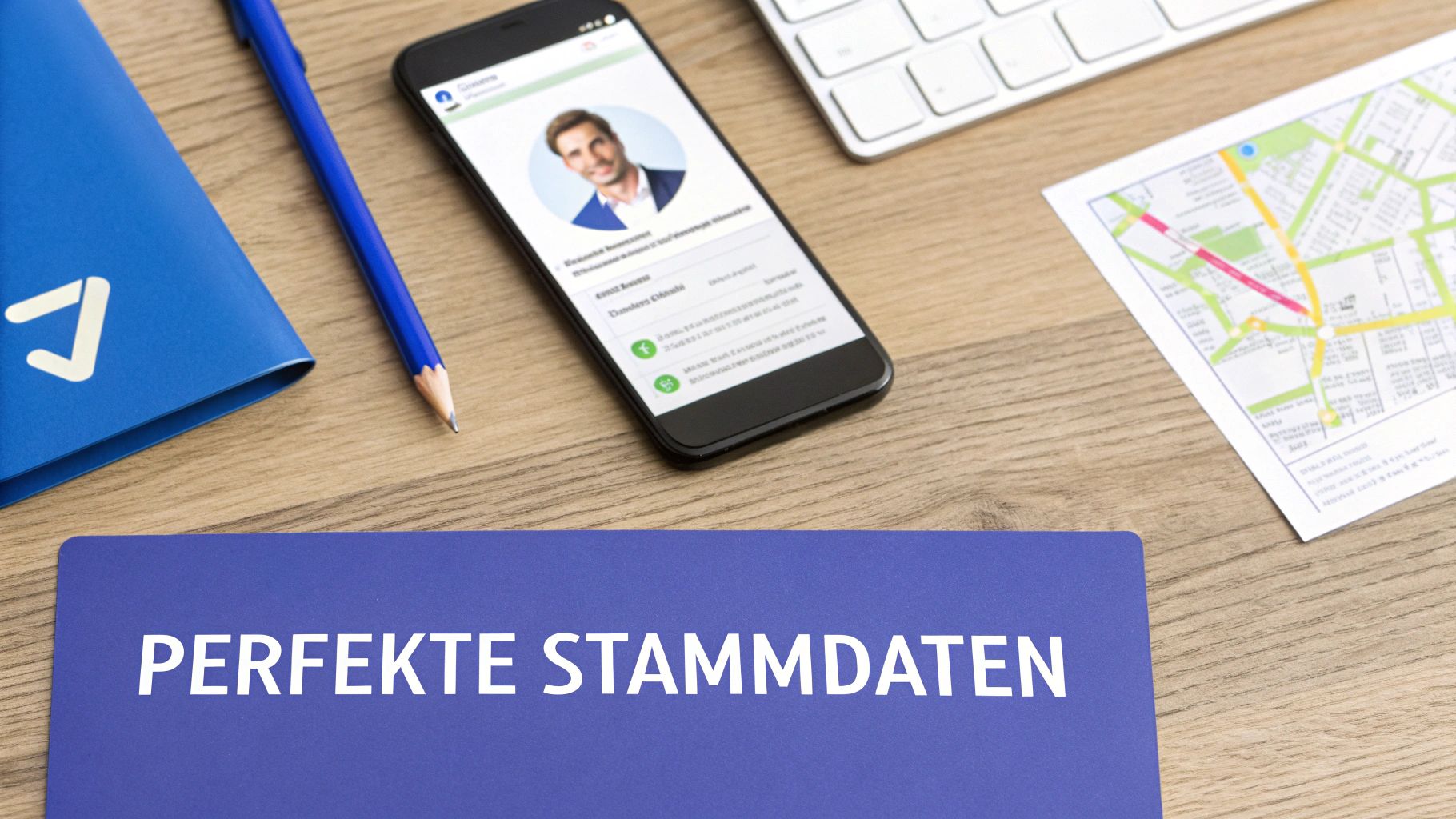
Before it comes to details, the foundation must be right. A strong local ranking on Google starts with clean and correct master data. When this information is accurate, complete, and consistent, you have a good basis for every additional Optimize your company profile created.
Think of your profile as the foundation of a house. If it has cracks, the whole building becomes unstable. Conflicting or outdated core information can confuse Google's algorithm and reduce trust in your company.
The rule of NAP consistency
What is decisive for your local visibility is the so-called NAP consistency. NAP stands for NAme, Adress, Phone — i.e. name, address and telephone number. These three data points should be the same on every online platform your company appears on.
It sounds simple, but mistakes often creep in here. Even small deviations can have a negative impact on your ranking.
- Company name: Is your company called “Müller GmbH”, “Müller GmbH & Co. KG” or “Bäckerei Müller”? Decide on an official spelling and use it consistently.
- address: Always use the same spelling. For Google, “Hauptstr. 123” is something different than “Hauptstraße 123.” Additions such as “backyard” must also be uniform.
- telephone number: Choose a fixed format, for example +49 (0) 123 456789 or 0123 456789, and stick with it.
Google's algorithm compares the data in your business profile with listings in other directories and on your website. The more often he finds identical information, the more trustworthy he regards your company. The result can be better visibility.
Checklist for essential master data in your company profile
This table summarizes the most important master data and shows why precise maintenance is important. Think of them as a basic checklist.
Data pointImportance for SEOpraxistTipnameUse very accurate spelling as in the commercial register or on the company sign. Don't include additional keywords.addressEnsure very uniform spelling (e.g. “Str.” vs. “Street”) on all platforms.phone numberVery highAlways use the same format, ideally with an international prefix.webpageVery highLink directly to the homepage or a relevant location page. Check the link regularly.categoriesExtremely highSelect the most specific main category. Use secondary categories for more offers.Opening hoursKeep HochAlways up to date, especially on public holidays. Wrong times can lead to dissatisfied customers.Service areaHigh (for service providers) Clearly define which cities or regions you serve if you don't have a fixed business address.
Maintaining this basic data is an ongoing process. Check these points regularly to always provide Google and your customers with the correct information.
Strategically choosing the right categories for your profile
According to NAP data, choosing your categories is an important lever for getting found for the right search queries. Google allows a main category and several secondary categories. This selection helps decide for which services or products you appear in the search results.
Die main category should get to the heart of your core business. Do you run a café where you also sell home-roasted coffee? Then “café” as a main category is probably more appropriate than “restaurant.”
With the Subcategories you can further expand your offer. An Italian restaurant could add secondary categories such as “pizzeria,” “delivery service,” or “restaurant with outdoor terrace.” It is not only found when searching for “restaurant”, but also specifically by users who are looking for pizza or an outdoor space.
In addition to your main category, you can have up to nine additional categories register. Companies with a precise category structure can increase their visibility in local search.
A look at the competition
If you're unsure which categories are the best, take a look at the profiles of your direct competitors who rank well on Google. Which main and secondary categories do they use? This can be a good clue to find relevant terms for your industry.
If you implement these principles correctly, this is an important first step towards your Improve Google Maps ranking and make sure the right customers find you.
Build trust with visual content and contributions
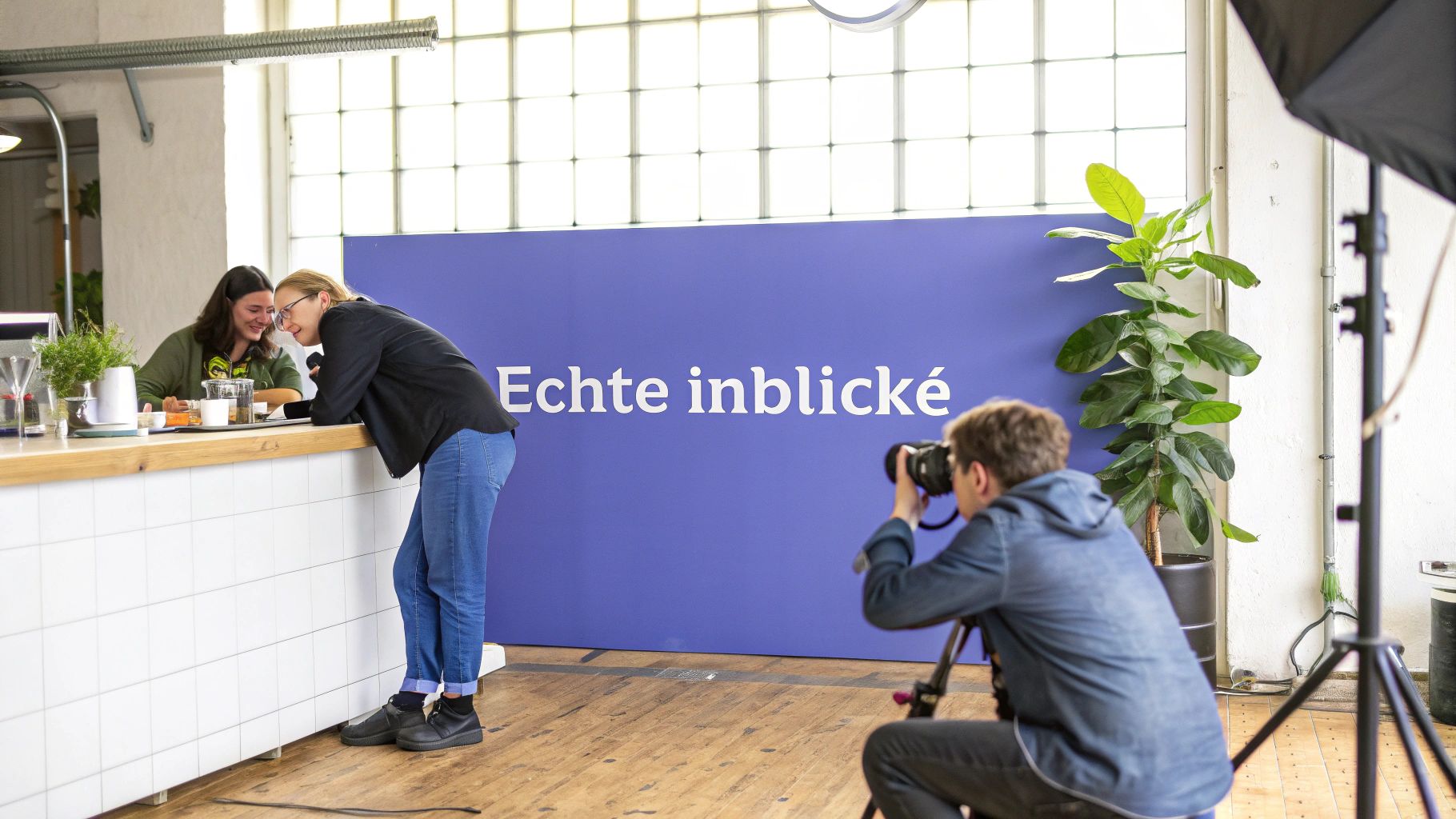
Your master data is correct and the categories match. Now it's a matter of giving personality to your profile. A profile with only text is informative but hardly arouses any emotions. Pictures and regular news are useful for building trust and giving potential customers insight before they enter your store.
People process images faster than text. A good photo can convey what makes your company special: the atmosphere, the quality of your work, or your team. Visual content is an important factor when it comes to optimizing your Google business profile.
Use authentic photos instead of stock photos
A common mistake is using generic stock photos. They often look professional but are interchangeable. Customers feel that. The key word is authenticity.
Your goal should be to tell a visual story. Show who you are and what you do to make your company appear approachable.
The most important photo types for your Google business profile
To create a compelling overall picture, you should upload a mix of different photo types. Each type serves a purpose and answers questions from potential customers.
- Logo and cover photo: This is the first visual impression. Your logo must be sharp and easy to recognize. The cover photo is your chance to score points straight away. Choose a high-quality image that represents your company — an inviting shot of your business, an image of your team, or a powerful product photo.
- Outdoor shots: Make it easy for people to find you. Upload images of the outside view — from different angles and at different times of day. This is how you recognize your business immediately.
- Interior photos: Provide insights. Show off the atmosphere and decor. A restaurant can show pictures of the dining room, a hairdresser the seats and a law firm the reception area.
- Team photos and pictures at work: Real images of you and your team at work create a personal connection and build trust. A craftsman can post pictures of a clean construction site, a café the barista in action.
Tip: Quality is crucial. The pictures don't have to come from professional photographers; a modern smartphone is often enough. But they must be sharp, well-lit and appealing.
Stay active and relevant with Google posts
In addition to the photos, the Google posts (Posts) a powerful tool to keep your profile alive. View it as a mini blog that appears directly on your company profile to share up-to-date information.
Regular, relevant posts signal to customers and Google that your company is active. A profile that is regularly updated with news appears more trustworthy than a static entry.
Ideas for effective Google posts
The options for contributions are varied. It is important that you offer added value. Here are a few tried and tested ideas:
- offers: Promote discount promotions or seasonal sales. For example: “This week: 20% on all coffee specialties! ”
- news: Provide information about new products, expanded services, or new employees. For example: “Just arrived: Our new collection of handmade leather bags. ”
- Eventi: Announce events, such as an open house or a workshop. For example: “We have a free wine tasting on Saturday. ”
- Glimpses behind the scenes: Show short videos or pictures of your team at work. It looks authentic.
Each post should have a clear goal, an appealing image and a clear Call to action (CTA) have — i.e. a call to action such as “Call now,” “Learn more,” or “Reserve.”
One post per week can be a good rhythm. This keeps your profile fresh without overwhelming you in everyday life. The combination of authentic photos and regular, useful posts can make the difference and turn your Google business profile into a channel that actively attracts new customers.
Using customer feedback as a powerful marketing tool
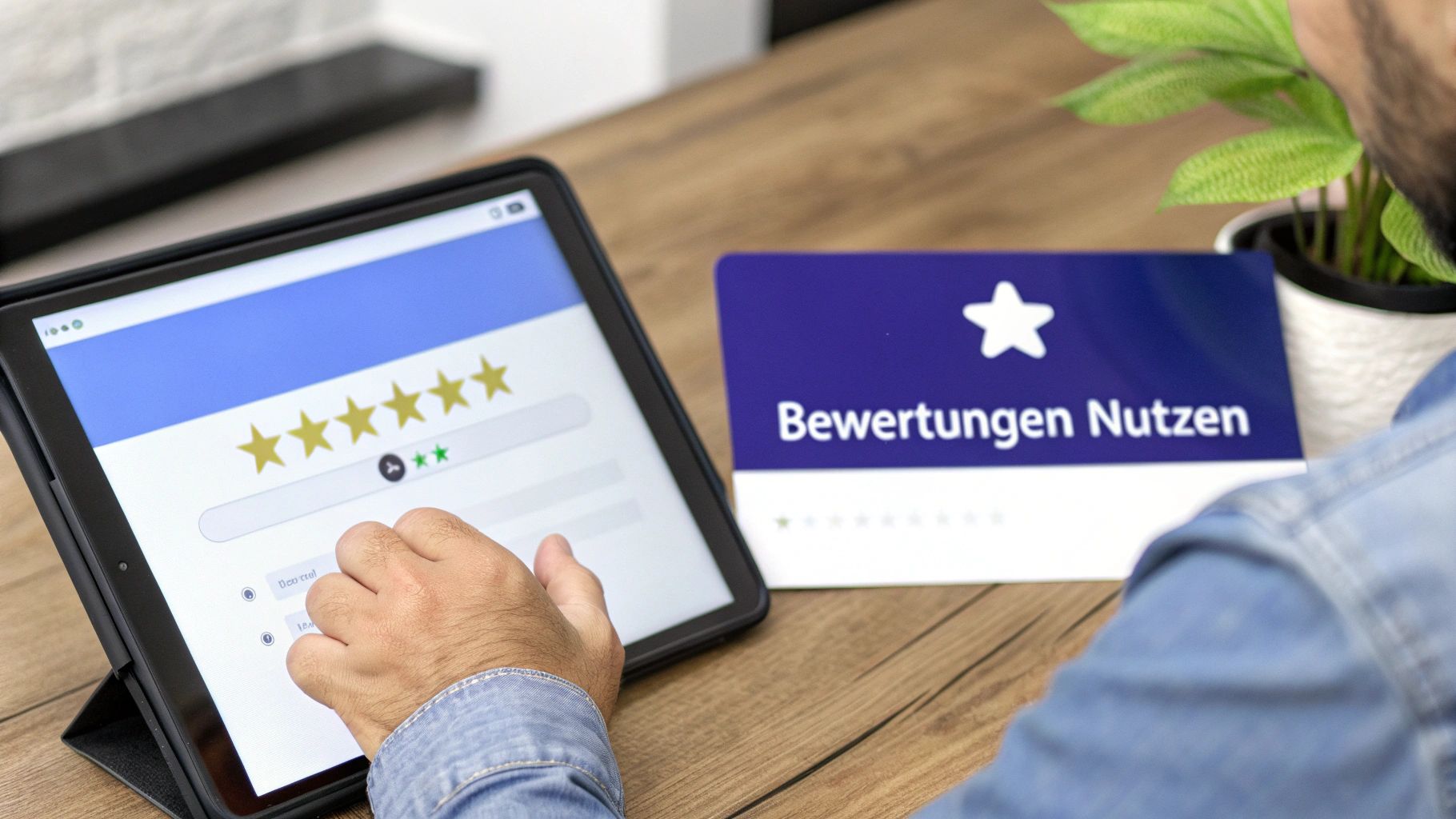
Your profile is set up, the data is correct and the pictures are appealing. Now comes the part that makes your Google company profile a lively meeting place: interacting with your customers.
Reviews and the “Questions & Answers” section are more than just feedback channels. Think of it like a public conversation. Potential customers read along and decide on the basis of this whether they can trust you.
When you actively manage these interactions, you show that there are real people behind your company who listen and care about their customers' concerns.
Actively ask for Google reviews
Many business owners are reluctant to ask their customers for a review. Most satisfied customers are happy to share their positive experiences — you just have to kindly remind them of them. The easiest way to get new reviews is to actively ask for them. This is a strong signal for Google and for new customers.
Please follow Google's guidelines. It's not allowed to pay for reviews or offer discounts. Make things as easy as possible for the customer. Set up a direct link to your review form and integrate it into your communication, for example in an email after a purchase or via a QR code in store.
Customer feedback is the so-called “social proof.” An authentic, good review is often more convincing than an advertising brochure.
The figures speak for themselves here. A study from 2023 has shown that over 80 percent Consumers in Germany read online reviews on Google before making a purchase decision. Profiles that regularly respond to reviews see an increase in user interactions of up to 25 percent. More about these exciting insights into the impact of Google reviews You can read it here.
Respond confidently to every review
Every review deserves an answer, both good and critical. This not only shows your appreciation to the author, but also to all other readers that the opinion of your customers is important to you.
How to respond to positive reviews:
A simple “thank you” is good, but it works better. Go into details, it looks more personal.
- Example of a restaurant: Instead of “Thank you for the good review,” try this: “Thanks for your great feedback! We are delighted that you enjoyed our homemade pasta so much. We hope to see you again soon! ”
How to deal with negative reviews:
A critical review is an opportunity. A professional, solution-oriented answer can even strengthen the trust of potential customers.
- Stay professional. An emotional or defensive response is not effective.
- Thank you for the feedback. That shows greatness.
- Apologize for the negative experience. Empathy is key.
- Move the conversation. Offer to resolve the matter offline, by phone or email.
A thoughtful response to criticism is good customer service and can neutralize a bad impression.
Proactively use the Questions & Answers feature
Did you know that anyone can ask questions on your profile? And anyone can answer them, too. That's why you shouldn't ignore the “Questions & Answers” section.
The best tactic: Take action yourself. Think about which questions you are frequently asked and answer them proactively in your profile. This is how you set up a kind of FAQ that removes the most important ambiguities.
- Your question asked: “Do you also offer vegan options? ”
- Your answer as owner: “Yes, we have a selection of vegan dishes on our menu. You are also welcome to ask our local team for the latest daily recommendations. ”
By actively maintaining this area, you retain control of the information, take away uncertainties from potential customers and show yourself as a competent point of contact. This is an often underrated but effective lever for Google business profile optimization.
Measure the success of your Google My Business optimization
A completed profile is a good start, but optimization is an ongoing process. To understand which measures are working, you need to measure success. That's what the Google Business Profile Insights. They show you how users interact with your profile.
If you interpret this data correctly, you can make targeted adjustments to your strategy. It is about making data-based decisions. Which photos lead to clicks? Which posts result in calls? You can find the answers in your profile analyses.
Understand the key metrics of your company profile
The insights provide a lot of information. Focus on the key metrics at the start to get a sense of how your profile is performing.
- searches: Here you can see which terms users use to find your profile. It is interesting to distinguish between direct searches (users who search for your company name) and Discovery searches (Users who search for a category, product, or service, such as “tax advisor near me”). A high percentage of discovery searches is a good sign because it means you're getting new customers.
- User interactions: This area shows what specific actions users are taking on your profile. This includes calls, website clicks, tidings And the Request directions. An increase in directions after uploading new photos can be an indicator that your visual content is having an impact.
An increase in directions by 15% After targeted photo optimization is not uncommon. This metric is a strong indicator that online efforts are leading to more potential walk-in customers.
From data to action: draw the right conclusions
The figures alone are of little use. The crucial step is to interpret them. For example, if you have expanded the description of your services to include specific keywords, you should check whether you now also appear for these terms in search queries.
Here is an overview of the most important key figures to help you derive targeted measures.
Key KPIs in the Google company profile
A breakdown of the key performance indicators for measuring success and what they say about your profile's performance.
Key figure (KPI) What it measuresOptimization leverDiscovery searchesVisibility among new customers looking for a category or service. Precise main and secondary categories, use of attributes, relevant Google posts.callsThe direct interest of potential customers in getting in touch. A prominent “call” button, clear and trustworthy profile information.directionsA user's intent to physically visit your store. Meaningful photos (exterior and interior views), correct address details, positive reviews.Photo viewsThe visual interest in your company. Compare the performance of your photos with that of the competition. High-quality, authentic images of products, teams and spaces. Add new photos regularly.
Robust data analysis is a fundamental part of every successful SEO Strategy — this applies to your local profile as well as to a website.
Further optimization options
Once the basics are right, you can go a step further.
Use the attributesto intercept specific searches. A restaurant can add attributes such as “vegan options” or “outdoor patio.” A service provider can score points with “Make an appointment online.” Each attribute is another chance to be found in a niche search.
Forget the areas too products and services not. Actively maintain them. Add new products with images and prices Describe your services in detail and use terms that your customers are looking for.
The key to sustainably successful optimization of your Google company profile is a simple cycle: measure, analyze, adapt. This ensures that your profile is actively working for you and delivers measurable results.
Google My Business optimization checklist
Optimizing a Google company profile isn't a one-off project. Think of it as a communication channel that needs to be maintained regularly. With this checklist, you have the most important points at hand to optimize your profile and remain visible in the long term.
Use these tasks as a guide. Each completed item can strengthen Google's and future customers' trust in your business.
The most important levers for your visibility
- Check the basics: Are name, address, and telephone number (NAP data) identical everywhere? Any difference can cause confusion.
- Maintain a visual presence: Fresh, authentic photos are important. Upload images of your store, team, or new products regularly.
- Stay in dialogue: Respond to every review in a timely manner. A “thank you” for positive feedback is just as important as a professional response to criticism.
- Stay up to date: One Google post per week can be a good goal. Share offers, news, or events
A well-maintained profile can be a decisive advantage in local competition. Google rewards activity with better visibility, and customers see that your store is active.
Anyone who stays on the ball here can build up a strong position in the local search. If you are looking for professional support, you can find SocialEdge specialized solutions for local marketing.
Common questions about optimizing your Google business profile
When optimizing the Google company profile, the same questions arise again and again in practice. The most important answers are summarized here.
How often should I publish new posts?
A good frequency is once a week. This shows Google and your customers that your profile is being actively maintained. Relevance is more important than quantity. An article about a current offer or an event provides more than just a fill in the gaps. An outdated post can make an unkempt impression.
What do I do if I have an unfair negative review?
Stay professional. A factual, public response is often the best response. Show understanding, even if you think the criticism is wrong, and offer to resolve the issue offline.
A confident response to criticism can have a positive effect on other potential customers. It shows that you take feedback seriously.
If a review clearly violates Google guidelines (e.g. spam, hate speech), you should report it. The chances of deletion are highest when there are obvious violations.
Is it now called Google My Business or Google Business Profile?
The official name is now “Google Business Profile.” It used to be called “Google My Business” (GMB). In everyday life, the terms are often used in a mixed way. The basic functions and meaning for local search have remained the same.
Does a missing website affect my Google ranking?
Having your own website is helpful, but not a mandatory requirement for a good local ranking. A well-optimized company profile can also be successful without a linked website. Functions such as calls or route planning work independently. A website is a valuable bonus that creates additional trust and can further support your ranking.
Summary and next step
A well-thought-out Google My Business optimization is a central component of local visibility. The process starts with correct master data (NAP), the right choice of categories and is brought to life through authentic photos and regular contributions. The active management of reviews and the “question & answer” area builds trust among potential customers. Finally, analyzing the insights helps to measure the success of your measures and to continuously improve the strategy. A well-maintained profile is not a one-time project, but a permanent process that pays off through more calls, visits and ultimately more turnover.
Looking to take your local marketing to the next level? We from SocialEdge help you get to the top of local search results in the long term. Discover our specialized solutions on https://www.socialedge.ai.