Why your Google business profile is crucial
Many local companies do not fully use their Google company profile (formerly “Google My Business”). This profile is often the first and most important point of contact between you and a potential customer. It's more than just a business listing — it's your poster child in Google Search and Google Maps.
Search behavior has changed. Instead of searching for a company name directly, users formulate their needs: “reliable plumber near me” or “best Italian restaurant with terrace.” In these searches, the quality of the profile determines who receives the assignment or the guest. If your profile doesn't appear here or is incomplete, you're virtually non-existent for these customers who are ready to buy.
First impressions count — especially digitally
A well-maintained and completed profile creates trust. Imagine you're looking for a new hairdresser and you find two entries:
- Profile A: Name and address only. No photos, no current opening times.
- Profile B: Professional pictures of the salon and the team, current opening hours, numerous positive reviews (to which the owner even answers) and a current offer.
The choice is easy. An optimized profile answers a customer's most important questions before they have to ask them: Have you opened? What exactly do you offer? And what do others say about you?
The figures prove this. Since its introduction in the year 2014 The importance for local companies in Germany has grown enormously. A recent study shows that 84 percent of German consumers Use Google or Google Maps every day to find local providers. Companies with a full Google Business Profile have an 70 percent higher probabilitythat customers visit them. The probability of buying increases by 50 percentif the profile is up to date and informative.
Additional insights: Who more about the general What Google My Business means for local businesses would like to find out, you can find further information here.
From simple entry to active customer acquisition
An optimized profile is an active marketing tool that specifically helps you:
- Better visibility: They are found for relevant searches in your area.
- Building trust: Through up-to-date information and authentic reviews.
- Encouraging interaction: Customers can call you directly, visit your website, or start the route to you.
The following screenshot from the Wikipedia company profile shows the key elements that a potential customer sees at first glance — from addresses to reviews and photos.
This view shows how important it is to carefully care for each individual area. Failures in this area can lead to valuable losses of opportunity for the competition.
Laying the foundation for your local visibility
Before we get into the details such as photos and posts, the basics of your Google business profile must be right. If the basic information is inaccurate, subsequent optimizations lose effect. It's about giving Google clear and consistent signals about who you are and what you're offering right from the start.
Accurate and consistent master data
The first and most important component is the so-called NAP consistency. The abbreviation stands for Name, Address, Phone — i.e. name, address and telephone number. These three core data must not only be correct in your profile, but must also be entered identically throughout the web.
Google compares your company profile information with that on your website, in business directories, and on your social media channels. Every match builds your credibility. Any discrepancies — “street” instead of “street” or an outdated telephone number — may result in a poorer rating of your local authority. Precision is crucial here.
The strategic choice of your business categories
Once the master data has been correctly stored, the next decisive step follows: choosing the right categories. Many entrepreneurs only choose the most obvious option and therefore do not exploit the full potential. Google allows you to define a main category and several additional categories.
Die main category describes your core business and has the biggest impact on your ranking in general search queries. An Italian restaurant should choose “Italian restaurant,” not just “restaurant.” Specificity is an advantage here.
Die additional categories make it possible to respond to specific services or offers that customers are also looking for.
- A restaurant that also delivers? Add “Delivery Service.”
- A café with fresh croissants? The “bakery” category could be relevant.
- A plumber who specializes in bathroom renovation? This should be added as a separate category.
These additional categories make you visible to a wider range of searches and can fill niches where your competition may not be present.
Put yourself in the shoes of your customers: What terms or services could they search for that go beyond your main business but that you still offer?
This strategy is an effective lever. The number of available Google Business Profile categories in Germany has grown steadily since 2020; 2025 Are German companies above 3,800 various categories available. Statistics show: Choosing the right main category can give you the chance to appear in the top 3 of local searches by up to 40 percent increase. Companies that regularly review their categories benefit from an average 25 percent higher click-through rate. A recent List of all Google business categories is a valuable resource here.
Using the example of a café, the following table shows how you can target different customer groups with the right mix of main and additional categories.
Comparison of main and additional categories
Category typeExample categoryTarget search queryReached customer groupmain categoryCafé"Café nearby” People looking for a classic spot for coffee & cake.additional categoryBreakfast restaurant “Breakfast [district]” Customers who are explicitly looking for a place for the first meal of the day.additional categoryCoworking space “Working in a cafe” Freelancers & students who need a space with WiFi & coffee.additional categoryIce cream parlour “Eat ice cream [city]” passers-by on a hot day or families with children.
The combination of categories makes the profile visible and versatile.
Analyze competitors and find niches
An effective tactic is to analyze the competition. Search for the top-ranked companies in your sector in your city and take a close look at their profiles. Which main and additional categories do they use?
You can often find valuable suggestions here or discover categories that you haven't thought of yourself yet. Perhaps you're serving a niche that a competitor has already successfully filled through a specific category — a gap that you can fill.
The combination of correct master data and a strategic category structure forms the basis for all further measures. Only when this basis is in place is it worthwhile to fill the profile with content and exploit the full potential in local online marketing to exploit.
Bring your profile to life
The base is in place. Correct master data and appropriate categories are the basis of your profile. Now it's time to fill this framework with content, give your company a face and make it tangible and trustworthy for potential customers. An incomplete or outdated profile can look unprofessional and lead interested parties to the competition.

Your visual business card: The importance of photos
People are visual beings. A good photo can often be the deciding factor in whether someone enters your shop or makes contact. The data from Google shows: Profiles with photos receive on average 42% more requests for directions and 35% more clicks to the website.
Use a thoughtful selection of images that tell a story — that of your business.
Every local company should have these types of images:
- The exterior view: A clear, well-lit photo of your entrance helps customers find you. Take the picture when the weather is good so that your sign or logo is clearly visible.
- The interiors: Provide insight into what customers can expect. This could be the guest room of your restaurant, the sales room of your shop or the waiting area of your practice.
- The team in action: Show the people behind the company. Photos of you and your employees at work create a personal bond and build trust. Authenticity is crucial here.
- Products & services in use: Make your offer tangible. A baker shows his cakes, a craftsman the renovated bathroom, a hairdresser the styled hairstyle.
Pay attention to the technical requirements. Google prefers JPG or PNG files with a resolution of at least 720x720 pixels. Make sure the images are sharp and represent your business in a positive way.
Google posts: Your direct line to customers
Many business owners ignore Google posts. This feature works like a bulletin board or mini blog directly on your profile. Here you can place current information, offers or news directly in the search results.
This sends important signals to Google and your customers: This company is active. Each post remains visible for six months and is a good way to stand out from the crowd.
Google posts are an effective but often underrated tool in the Google company profile. Anyone who regularly posts here shows activity, promotes interaction and can increase their click rate.
Use the various formats:
- offers: Promote a discount, seasonal special, or promotion A clear call-to-action (CTA) such as “secure an offer” redirects users.
- news: Tell about a new product, an award, or a new employee. A helpful tip from your industry can also be useful.
- events: Are you planning an open house, a workshop or an event? This is the right place to announce it.
A craft business could post an article about a completed project with before and after pictures. A restaurant can share its weekly menu and thus whet your appetite every day.
Show what you can do: products and services
For retailers and service providers in particular, the corresponding areas in the profile are valuable. Here you can present your entire portfolio in a detailed and structured way. Instead of just describing in general terms what you do, you can create specific offers, ideally with prices and descriptions.
How to make optimal use of these sections:
- Create categories: Keep things tidy. An electrician could divide his offer into “installation,” “repair,” and “smart home.”
- Create individual items: Describe each service and product precisely. Name a price or price range and add a meaningful description.
- Remember keywords: Integrate the terms that your customers are looking for in the descriptions, such as “installation of wallboxes for e-cars.”
- Add images: Each product and service can be enhanced with your own photo. This makes your offer more attractive.
Imagine a potential customer searching for “one-stop bathroom renovation.” He not only sees your company entry, but also a detailed service description with pictures and possibly a price indication. This transparency creates trust and pre-qualifies your inquiries. This turns your profile from a passive entry to an active marketing and sales channel.
Building trust — the art of professional evaluation management
Your master data is correct, the categories have been selected and your profile is filled with content. Now we're going to focus on the area that goes beyond pure visibility and creates trust: your customer reviews.
Reviews are a digital currency of trust in local marketing. They often influence a potential customer's decision to contact you. Professional management of your reviews is therefore one of your strongest marketing measures. It is about valuing feedback, dealing with criticism confidently and showing that customers are taken seriously.
Why every review deserves an answer
Every review, whether positive or negative, is an opportunity for dialogue. An unanswered review can signal disinterest. A well-thought-out answer, on the other hand, shows appreciation and professionalism. This is read not only by the reviewers themselves, but also by future interested parties.
Professionalism is particularly important when dealing with criticism. A quick, factual and solution-oriented response to a negative review can often neutralize or even positively reverse its effect. In doing so, you signal that you take problems seriously and take responsibility.
How to find the right words
Every answer should have a personal touch. However, a few basic principles help to strike the right tone.
For positive reviews (4-5 stars):
The point here is to say thank you and confirm the positive experience.
- Say thanks: Always start with a sincere thank you.
- Take up details: Refer to something specific from the review. Was the fast service commended? Mention it. This shows that you have read the review carefully.
- Intersperse keywords: Integral your service or location, of course. For example: “We are delighted that you were so satisfied with our bicycle repair in Hamburg-Eimsbüttel. ”
- Invite you to come back: End your answer with a friendly invitation to visit again.
For negative reviews (1—2 stars):
Peace and professionalism are required here. The goal is de-escalation and demonstrating problem-solving expertise.
- Avoid emotions: Never respond with emotion.
- Show responsibility: Start with an apology for the customer's negative experience. A sentence such as “We are sincerely sorry that your visit with us was not to your satisfaction” is a good start.
- Thanks for the feedback: Again, thank the customer for taking the time to respond.
- Move the conversation offline: Offer to resolve the issue in person. A request to be contacted by e-mail or telephone brings the discussion out of the public.
Don't go into details in your public response and avoid justifications. Clarify this directly. Your public response shows all potential customers how confidently you handle criticism.
How to proactively ask for reviews
The best reviews often come from satisfied, silent customers. Remind them to leave a review in a friendly way.
- The right time: Ask briefly about a positive experience — a successful project completion, a purchase or a word of praise in conversation.
- Follow-up via email: Send a friendly email a few days after your purchase. Thank you for your trust and ask for feedback. A direct link to your Google profile makes the process easier for the customer.
- Information on site: A small display at the cash register or a QR code on the invoice can be effective.
- In a personal conversation: A sentence like, “If you were happy, we'd really appreciate a review on Google,” is authentic and effective.
Don't underestimate the power of reviews. Companies with an average rating of 4 to 5 stars are from 87 percent who prefers customers. An increase of just one star can increase the turnover of a local store by up to 20 percent boost. In doing so, watch 78 percent German consumers regard Google as the most trustworthy platform for customer feedback. If you want to dive deeper into the figures, you'll find insightful Google review statistics.
Dealing with unfair criticism
Sometimes you get reviews that are unfair, fake, or violate Google policies (such as spam, hate speech, conflicts of interest). In such cases, you can report the review.
To do so, click on the three dots next to the review and select “Report a review.” Google is looking into the case. There is no guarantee of deletion, but if there are clear violations, the chances are good. Even if the rating persists, your professional, public response is the best way to set the context right for other readers.
Performance measurement and advanced tactics
Optimizing a Google business profile isn't a one-time process. To know which efforts are paying off, you need to measure results. This is the only way you can make well-founded decisions that increase your visibility.
Your most important tool for this is performance reports directly in your profile, which show how users are interacting with your company.
Keep an eye on key figures
Focus on the most meaningful key figures (KPIs).
The searches Tell them like Users find you. Here you mainly see your company name (direct searches), are primarily looking for people you already know. On the other hand, there are many general terms such as “Steuerberater Berlin Mitte” (Discovery searches), your optimization is working and you are actively gaining new customers.
The profile views Show how often your profile was viewed in Google search or on maps in total. An increasing number points to improved visibility.
Even more important are the interactions. Here you can see how many users have called, accessed directions, or visited your website. These figures are your direct return on investment.
Practical tip: Look at this data at least once a month. If you uploaded 20 new photos but the engagement rate remains the same, that may not have been the most effective measure. However, if the calls increase after a contribution about a special campaign, you know what is being received by your target group.
Understanding key KPIs in the Google company profile
An overview of the key performance indicators for measuring success and what they say about your profile's performance.
Key figure (KPI) What it meanOptimizing measure for poor valuesDiscovery searchesShare of users who found you through a category, product, or service (e.g. “Italian restaurant near me”). A high score is a strong sign of effective local SEO. Check primary and secondary categories. Fill out services and products in detail. Use keywords in posts and Q&A.Clicks on directionsNumber of users who have actively requested a route to your store. A direct indicator of visit intent. Check the address and card pin for accuracy. Opening times must be correct. Upload photos of the entrance area.callsNumber of clicks on the “Call” button directly from the profile. One of the most valuable interactions, which often results in direct orders. Telephone number must be correct and clearly visible. Use call-to-action in posts (e.g. “Call us for a free consultation!”)website clicksNumber of users who switched from your profile to your website. Important to generate traffic and provide more detailed information. Website link must be correct. Landing page should be mobile-friendly and contain the information promised in the profile.
These figures are more than statistics — they tell the story of how customers find and connect with you. Take advantage of these insights.
Advanced tactics for a decisive advantage
When the basics are right and you analyze your data, you can set yourself apart from the competition.
The often overlooked gold mine: The “Questions & Answers” section
The Q&A section is often neglected. The advantage: Not only customers can ask questions, but also you yourself. Proactively answer the most common customer questions before they're asked.
For example, a gym could post the question: “Do you also offer trial sessions? “and immediately provide the answer with all details and a registration link. This creates trust, saves your team time and positions you as a competent partner. At the same time, you can place relevant keywords here.
Show what makes you special: use attributes
Attributes are labels that describe your company in more detail and offer users a quick decision-making tool.
Depending on the sector, these may be different characteristics:
- Restaurant: “outdoor seating”, “barrier-free entrance”, “free WiFi”
- Craftsman: “Online appointment”, “managed by owner”
- Shop space: “Pick up in store”, “Contactless payment available”
Go through the list of available attributes in your profile and select all that apply. This improves your chances of appearing in filtered searches and provides customers with compelling arguments.
The following infographic shows another crucial process: actively managing your reviews. It's about creating a cycle of feedback, response, and improvement.
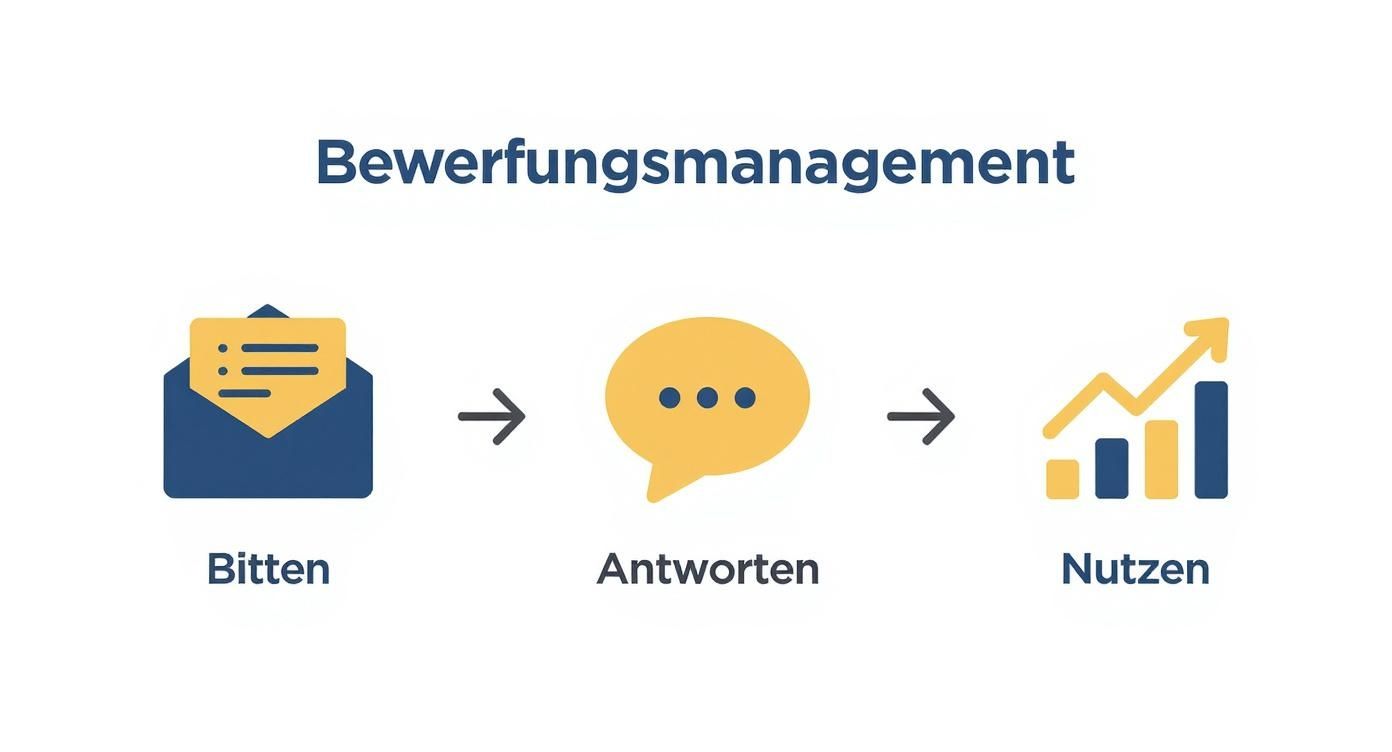
Here you can see how the targeted collection of reviews, professional answers and the analysis of feedback work together to build trust and constantly improve your offering.
Cleverly place local keywords
Include relevant local search terms in your Google profile — but carefully and not as a keyword list.
- In the company description: Formulate a concise sentence that links your main service to the location, e.g. “Your expert for modern bathroom renovation in Hamburg-Eimsbüttel.”
- In Google posts: Use a clear headline for an offer, such as “Professional tire change at a fixed price in Cologne-South.”
- In responses to reviews: Thank you for the positive feedback and mention the promised service: “Thank you so much! We are pleased that you were satisfied with the professional teeth cleaning in our practice. ”
This subtle integration signals to Google that it is highly relevant for local searches. Continuous analysis and adjustment of your strategy can be achieved by using specialized SEO optimization software support, as such tools help you find the right keywords and track their impact.
By combining regular monitoring with these tactics, your profile is transformed from a passive entry into a powerful tool for local customer acquisition.
Conclusion: What counts for you now
A Google business profile isn't a one-time affair. If you set it up once and then stop maintaining it, you leave potential unused. Instead, think of your profile as a dynamic part of your marketing that needs to be maintained continuously.
The building blocks for success are clear: It starts with a solid foundation of correct Master data (NAP) and a well-thought-out selection of main and secondary categories. Based on this, current photos and regular contributions make your business lively and accessible. Coupled with a professional approach to customer reviews, you build trust. A regular look at the key figures shows you what is working and where you need to readjust.
Each of these points contributes to your main goal: more visibility in local search, more trust with potential customers and, ultimately, more calls, more visitors, and more revenue.
Start treating your profile as your most important digital storefront today. If you want to go deeper into systematic analysis, a professional can Agency SEO audit guide provide valuable food for thought.
Your next step: Take ten minutes now. Check to see if your main category is the best one for your business. Then upload at least five new, authentic photos. It is often the small but consistent steps that make the biggest difference.
Practical questions: Quick answers for your Google profile
The same questions arise again and again about optimizing the Google company profile. Here are the most common ones summarized — with tried and tested answers.
How often do I really have to update my profile?
It depends on the type of information. Basic data such as changed opening hours or a new telephone number must straightaway be updated. The following routine has proven effective for everything else:
- Google posts: Try to post something new at least once a week.
- photos: Uploading new pictures once a quarter is a good rhythm. New photos should also be added on special occasions.
- reviews: An answer within 24 to 48 hours is ideal.
- Profile check: Set aside time once a month to review all data and analyze key performance indicators.
What do I do with negative or unfair reviews?
Don't react emotionally. An unprofessional answer can scare off potential new customers. Stay factual and solution-oriented.
If the criticism is justified, thank you for the feedback and offer a solution. This shows customer orientation. Offer to continue the conversation offline via email or phone.
If a review violates Google guidelines (such as spam), you can report it. To do so, click on the three dots next to the rating. However, there is no guarantee that Google will remove it.
Help, my company doesn't appear in the local search! What can I do?
If your profile remains invisible during local searches, it's usually due to a few basic factors. Review the checklist below:
Check out the basics first:
- Is your profile too 100% completely completed and verified?
- Does the address match your location exactly?
- Do you have the most suitable main category selected?
If these points are correct, check the subtleties: How far away is the searcher? How many and how good ratings do you have compared to the competition? Is your company data (NAP) consistent across the network? Work through the points from this guide and actively solicit new, positive reviews.
Summary and next step
Optimizing your Google business profile is a continuous process that has a direct impact on your local visibility and customer acquisition. Focus on accurate master data, strategic categories, high-quality visual content, and professional review management. Analyze your performance data regularly to adjust your strategy and stay ahead of the competition.
Do you want to make your profile a strong magnet for local customers? SocialEdge can help you to consistently appear in the top 3 on Google Maps without expensive ads.