How the local ranking works on Google Maps
To climb to the top of Google Maps, you need to know what rules Google plays by. The algorithm is clever and combines three main factors to give users the best result.
- Relevance: This is about how well your profile matches the search query. If someone searches for “vegan pizza,” Google will scan your profile, services, and even customer reviews for exactly those keywords. The better the hit, the higher the relevance.
- Distance: That is the most obvious factor. How far is your store from the searcher's location? There is little you can do about that, except to make sure that your address is accurate to the meter.
- Prominence: How well-known is your shop? Google measures this based on things like the number and quality of your online reviews, online mentions (so-called backlinks or quotes), and the overall strength of your website. A company with hundreds of positive reviews simply appears more trustworthy.
The following infographic sums up how Google weighs these three factors against each other.
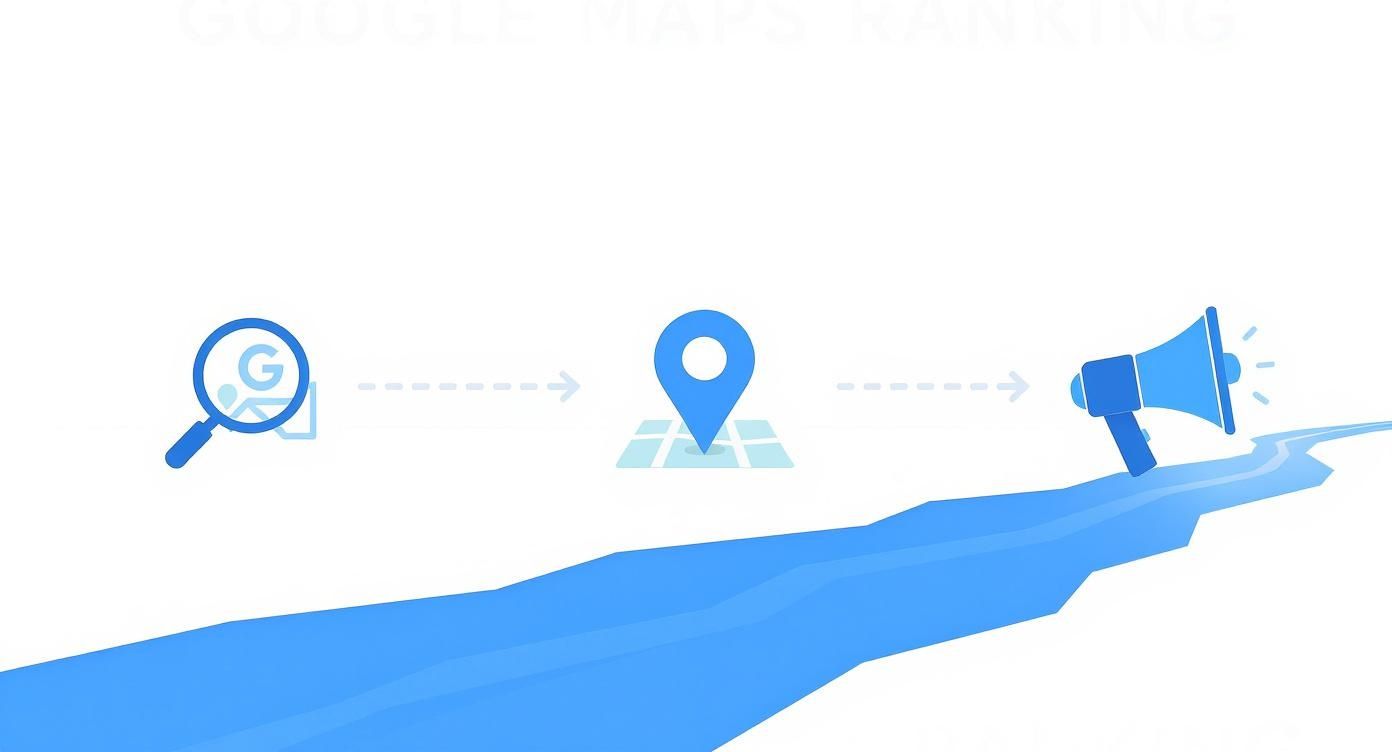
It's easy to see that a good strategy must focus on all three areas. This is the only way to secure a top position in the long term.
A top-optimized profile brings tangible results. Studies show that companies in the local pack on average 29% more clicks on their website and 21% more calls than those who only end up further down in the organic results.
A better ranking is therefore not just a cosmetic correction, but an investment that pays off through direct customer inquiries. In this guide, I'll take you step-by-step through optimizing each individual factor.
There are specialized platforms for anyone who wants to speed up this process and switch their local visibility to autopilot. You can find out more about such clever tools, for example, at SocialEdge, software that is specifically designed to help local businesses gain more presence on Google Maps.
Optimize Google Business Profiles for a better ranking
Think of your Google Business Profile (GBP) as your digital figurehead. If this profile is incomplete or out of date, it looks to potential customers like a shop with dusty windows and yellowed opening hours — they'd rather go straight to the competition. To in Google Maps ranking to really get up, a perfectly maintained profile is therefore not an option, but the absolute basis for everything that follows.
Every little detail that you enter here is a direct signal to the Google algorithm. It helps the search engine understand when exactly your company is the perfect answer to a local search query. Even the smallest gaps or inaccuracies can significantly reduce your visibility.
Select relevant categories and guide Google
Choosing the main category is by far the most important decision you make for your profile. It tells Google clearly what your core business is. The practical tip: Be as specific as possible.
A good example is a café that also offers homemade cakes. This is where the main category should “Cafe” be, not the much too general “restaurant.” This immediately signals a clear specialization and attracts the right clientele.
In addition to the main category, you can add up to nine other secondary categories. Use them to cover your entire range of offerings.
- For example, our café could complement “pastry shop”, “bakery” or even “breakfast restaurant”.
- A plumber with emergency service might choose “heating installer” as the main category and add “plumber” and “24-hour plumber” to be found for all relevant searches.
This precise classification is an enormous lever for your relevance and therefore a decisive factor for sustainably improving your Google Maps ranking.
Integrate keywords organically in the description
As soon as the categories are in place, it's time to search terms. Sensitivity is required here. The indiscriminate stringing of keywords together (keyword stuffing) is a no-go. Google recognizes such practices as spam and punishes them, which hurts your ranking.
Instead, integrate your most important keywords naturally into the company description and the listing of your services.
A really good profile is more than just a collection of data. It tells the story of your company and answers potential customers' most important questions before they're even asked.
The description gives you 750 charactersto convince. Here you can describe your unique selling point and core competencies. Instead of a boring “We are a hairdresser in Berlin,” write: “Your expert for modern haircuts, balayages and hair extensions in Berlin-Mitte. We work exclusively with sustainable products and provide you with individual advice. ”
Integrity as a ranking factor
An incomplete profile not only looks unprofessional, it is also a wasted ranking potential. Google rewards profiles that use all available fields, because they offer searchers the greatest added value.
Review the following points meticulously:
- services: Really list every single service with a short, clear description. A painting company should not only state “painting work” in general, but also list details such as “painting the façade”, “wallpapering” and “removing mold.”
- Attributes: These small but fine details help users find you specifically. Information such as “free WiFi”, “barrier-free entrance” or “online appointment” can make the decisive difference.
- Opening hours: Always keep them up to date — especially on public holidays or during company holidays. Nothing frustrates a potential customer more than being in front of a locked door even though Google says you've opened.
This detailed work signals to Google that your company is active, reputable and reliable — two strong indicators of prominence and trust.
Checklist for an optimized Google Business Profile
Use this checklist to ensure that your profile meets all important criteria for maximum visibility. This way, you won't overlook an important ranking factor.
ElementStatus (Yes/No) Practical TipPrecise main categorySelect the most specific category that describes your core business (e.g. “Italian restaurant” instead of just “restaurant”).Relevant secondary categoriesAdd any additional categories that accurately describe your offer (e.g. “pizzeria”, “delivery service”).Complete NAP dataCheck your name, address, and phone number for exact matches with your website and other directories.Keyword-optimized descriptionOf course, integrate your 2-3 most important keywords in the first 250 characters of the description.Current opening timesMaintain regular opening hours as well as special opening times for public holidays or company vacations.Detailed servicesList each individual service instead of just using general generic terms.Useful attributesMark all applicable attributes (e.g. “card payment”, “outdoor seating”, “women-led”).High-quality photosUpload at least 10-15 recent and professional photos showing interiors, exteriors, and products.
If you work through these points conscientiously, you create a rock-solid foundation. A seamlessly maintained profile is the first and most important step on the way to a better ranking in Google Maps. It strengthens your relevance for local searches and shows Google that your business is a prominent and trustworthy choice for users.
Keep NAP data consistent and build trust
Google's algorithm wants to provide its users with reliable and trustworthy local results. The hardest currency for this trust is consistency. If your company data is the same everywhere on the web, it sends a clear signal to Google: This business is genuine, active and professionally managed.
The focus is on the so-called NAP data: NAme, Aaddress and Phone (telephone number). These three pieces of information are your company's digital fingerprint. If they agree everywhere, your authority grows. If they diverge from each other, this creates doubt — and this can have a direct negative impact on your ranking.
Inconsistent NAP data as a ranking brake
Many entrepreneurs underestimate how meticulous the algorithm is here. It's not just a matter of blunders like an old telephone number. Sometimes even tiny deviations are enough to shake Google's trust and your efforts to Improve Google Maps ranking, to undermine.
Just imagine that your company appears online like this:
- Name: Once as “Müller GmbH”, then as “Bäckerei Müller GmbH” and elsewhere just as “Bäckerei Müller”.
- address: Your website says “Hauptstraße 1”, in one business directory “Hauptstr. 1” and in the next “Hauptstraße 1, 12345 Musterstadt”.
- telephone number: Sometimes with a country code, sometimes without, sometimes with a space after the area code, sometimes without.
None of this is a problem for a person. For an algorithm, however, these are contradictory signals. He cannot say with absolute certainty whether it is exactly the same company every time. This uncertainty is leading to a devaluation.
Maintaining this data is therefore not a detail for pedants, but a fundamental building block for stable online visibility.
A consistent digital footprint is not an end in itself. It is the basis for both search engines and potential customers to perceive your company as reliable and credible.
Systematically check your online presence
To eradicate these sources of error, you must first find out where and how your company is actually listed online. A manual search for your company name combined with your address or telephone number is a good starting point.
Start with the most important platforms:
- Your Google business profile: That is your reference. The NAP data stored here must be 100% correct and serve as a template for everything else.
- Your own website: Check the legal notice, the contact page and the footer. The information must match your Google profile exactly.
- Important industry directories: Platforms such as Yellow Pages, Das Örtliche, Yelp, or industry-specific portals are often the main source of inconsistent data.
- Social media profiles: The stored addresses and telephone numbers must also match here.
It is best to create a simple table in which you document all entries found. Note down the source (URL), the NAP data stored there and mark any deviation from your correct standard. This audit is the basis for the subsequent adjustment.
Don't underestimate this task. A study from 2025 shows: Companies whose NAP data is at least 90% of the relevant platforms are consistent, achieve on average 12% more visibility on Google Maps. If you want to dive deeper into the relationship between data consistency and local search, you'll find More insights about Google Maps trends on accio.com.
Resolve common sources of error
As you do your research, you're likely to encounter recurring errors. Most can be corrected with a little patience. You often have to log in to the respective portal and claim the entry (“claim”) in order to confirm ownership and edit the data.
Pay particular attention to these typical stumbling blocks:
- abbreviations: “Street” vs. “Str.”, “GmbH” vs. “limited liability company.” Decide on a variant and go through it consistently.
- Additions in the company name: Avoid advertising or descriptive additions. The name should exactly match the name entered in the commercial register.
- Phone number formatting: Choose a standard format, such as +49 (30) 1234567, and use it everywhere.
- Old addresses: After a move, outdated entries often remain on the Internet. These “ghost entries” are particularly harmful.
Systematically cleaning up your NAP data is an arduous task, but it has a direct impact on your ranking. Please also remember that the management of personal data, as required by contact requests, must always be in accordance with data protection regulations. A clear regulation on this can also be found in our privacy policy.
Use interaction and content for a better ranking
A perfectly optimized profile is a great basis, but the work doesn't stop there. To your To sustainably improve Google Maps ranking, you must constantly show the algorithm that your store is running, relevant, and valued by customers. Google loves active profiles — they signal a lively business to which customers are important.
A static profile that is created once and then never touched again loses relevance over time. Activity is in fact a huge part of the “celebrity” ranking factor. Through targeted interactions and fresh content, you build up this prominence piece by step and leave the competition behind.

Send current ranking signals with Google Posts
Think of Google Posts as free mini ads that pop up directly on your business profile and sometimes even in top search results (the “Local Pack”). They're a fantastic tool for promoting offers, news, or events while providing Google with fresh food. Every post is a positive signal and shows that there is something going on here!
It's really easy to use, but the effect is great. Just one post a week can make a huge difference and keep your profile alive.
- offers: Promote seasonal discounts or limited-time promotions. A classic: “This week 20% Discount on all summer tires! ”
- news: Tell your customers about new products, team growth, or awards. For example: “We welcome our new master hairdresser Sarah to the team! ”
- Eventi: Announce an open house, workshop, or special event.
Include a good picture, a clear call to action (e.g., “Call now,” “Learn more”), and a crisp text. And don't forget: Include your most important keywords naturally.
Manage customer reviews professionally
Reviews are pure gold for your local ranking. Not only that they make the purchase decision of 9 out of 10 consumers influence, they are also a direct signal for Google. Many positive reviews increase your prominence and build trust. But it's not just about the stars, it's also about how you handle them.
Actively managing reviews shows potential customers and Google's algorithm that you take feedback seriously and value customer satisfaction. A quick and professional response can turn even a critical evaluation into an opportunity.
Make it a rule to respond to every single review — good or bad. A response time of 24 to 48 hours is ideal.
Here's how you respond confidently to every feedback:
Rating typeTarget of your responseSample wordingPositive (5 stars)Show gratitude, increase praise and invite people to come back. “Thank you so much for your great review! We are delighted that you were satisfied with our service. We hope to see you again soon. ”Neutral (3 stars)Show understanding, ask for details and encourage direct contact. “Thanks for your feedback. It's a pity that we couldn't fully meet your expectations. We'd love you to contact us directly so we can do better next time. ”Negative (1-2 stars)Show empathy, apologize and offer a solution away from the public eye. Never enter into a public discussion! “Dear customer, we are very sorry that you had this experience. That is absolutely not up to our standard. Please contact us directly at [email/phone] so we can find a solution. ”
You can also actively ask satisfied customers to comment, for example with a small note on the invoice or a QR code in the shop.
Photos and videos as an important ranking factor
Pictures are often the first thing a potential customer sees of your company. You make your offer tangible and create an immediate connection. High-quality, up-to-date photos and videos are therefore much more than just decoration — they are a tangible ranking factor.
Profiles with lots of photos are proven to get more clicks on the directions and more calls. Logical, because Google prefers profiles that give searchers a real, comprehensive impression.
These pictures should definitely not be missing:
- Exterior view: Take multiple photos from different perspectives so you're easy to find.
- interiors: Show off the atmosphere, whether it's a waiting area, a guest room or a treatment room.
- Team photos: Introduce your employees This creates personality and trust.
- Products/services: Showcase your work or offer in action.
- 360 degree views: A virtual tour is a real eye-catcher and can significantly increase the time spent on your profile.
A real pro tip: Make sure that your smartphone camera has location services turned on when you take photos. pictures with Geotags (coordinates stored in the image data) are a strong signal for Google that underpins the local relevance of your company.
This continuous maintenance of your profile naturally takes time. But the effort pays off directly through better visibility and more customer inquiries. If you want to learn more about strategic content planning for local companies, visit SocialEdge blog related articles on this subject.
Website as a factor for a better Google Maps ranking
A perfectly optimized Google Business Profile is only half the battle. Many entrepreneurs underestimate how much their own website influences the ranking in local search. Google sees your website as a central anchor point to check how legitimate, relevant, and well-known your local company really is.
Think of it this way: When your Google profile and website speak the same language and confirm each other, that's a massive sign of trust for the algorithm. It is precisely this harmony that allows you to leave your competition behind on Google Maps. So don't see your website as a separate project, but as the foundation of your entire local online presence.
Embed local ranking signals on the website
For Google to recognize your local relevance, you need to provide clear and consistent information. It's about building your local identity directly into your website's DNA. These steps are usually technically uncomplicated, but they have a huge effect.
Three elements are absolutely crucial:
- NAP data visible everywhere: Your name, address and telephone number (in short: NAP) don't just belong hidden in the Impressum. Place this data clearly legible in the footer, i.e. at the end of each individual subpage. This is how you unmistakably signal to Google with every click: “We're at home here.”
- The interactive Google Map: Include an interactive Google Map on your contact or directions page. It is important that this card exact links to your verified Google Business listing This creates a direct, technical bridge between your website and your maps profile.
- Local keywords in the text: Integrate your location — i.e. the city or district — naturally into your texts. A painter from Berlin-Kreuzberg should also mention this on his performance page, instead of just writing about “Berlin” in general. This applies to page titles, headlines and normal running text.
One point that is often criminally neglected is mobile optimization. Most local searches happen on a smartphone while someone is out and about. A fast website that can be used perfectly on a mobile phone is therefore no longer a nice extra, but a tough requirement for a good ranking.
Location pages for companies with multiple branches
If you operate more than one location, a well-thought-out website structure is your key to success. A single contact page for all branches is a typical mistake that dilutes your local signals. The proven professional strategy: Create a separate, unique subpage for each individual location.
Each of these so-called “location pages” must be optimized for the respective city or district and contain the following components:
- Unique NAP data: The specific address and telephone number of the respective branch.
- Your own Google Map: A map that is exactly centered on that one location.
- Location-specific content: Introduce the local team, mention special offers or show customer testimonials from the immediate area.
- Local photos: Pictures that unmistakably show this one location — both inside and out.
This clear structure sends Google unique signals and makes it possible for each of your locations to appear at the top of local search results individually.
Local backlinks for more celebrities
A backlink is nothing more than a link from another website that points to yours. In local SEO, links from other local, relevant and trustworthy sources are pure gold. For Google, each of these links is like a personal recommendation from a neighbor and increases your local reputation — the so-called celebrity — enormously.
The rule here is very clear: class instead of quantity. A single link from the local city magazine can be more valuable than ten links from any industry directory.
This is how you get valuable local backlinks:
Link sourcePractical idea for implementationLocal news portalsOffer an interesting local story to a journalist. A company anniversary, a fundraising campaign or an expert tip on a seasonal topic often work well.Industry associations & chambersCheck whether your company is correctly registered and linked in the membership directory of your local Chamber of Commerce, Chamber of Crafts or your professional association.Local associations & eventsSupport the local sports club or city festival with a small sponsorship. In return, ask for a link to the sponsor or partner page.Regional partner companiesTalk to other local companies that also appeal to your customers but aren't competitors. For example, a wedding photographer can link to a florist and vice versa.
Building such relationships takes some time and commitment, but pays off in the long term through unimpeachable local authority.
Optimizing your website for local search is an ongoing process. Specialized tools can be of great help to keep track of things and ensure that no potential is left untapped. Have a look at the SocialEdge Pricingto see how a professional solution can help you systematically improve your local visibility.
Common questions about Google Maps ranking
When optimizing for local search, the same questions arise over and over again. Here I've put together the answers to the most common challenges entrepreneurs face when they Improve Google Maps ranking want. This allows you to quickly remove typical stumbling blocks.
How long does it take to see results?
That is the question that is asked most often. The truth is: It depends. How strong is the competition in your niche and in your location? How good or bad is your profile at the moment? And how consistently are you optimizing?
As a rule, however, most companies are already looking four to six weeks the first positive signals. This could be more calls via the profile or an increase in requests for directions. But playing at the top and staying there requires patience and continuous care over several months. SEO for Google Maps is definitely a marathon, not a sprint.
Do paid ads on Google Maps make sense?
Yes, paid ads that appear as “Sponsored” in search results can definitely be a useful addition. They give you immediate visibility in a prominent place, often even above the organic results.
However, it is important to understand: Have ads no direct influence to your organic ranking. This virtually buys you a place at the top — but only as long as you pay for it. As soon as you stop the campaign, visibility is gone. Solid organic optimization is and remains the more sustainable and cost-effective strategy in the long term.
How do you respond to negative or fake reviews?
Negative reviews are annoying, especially when they're unfair or even made up. The most important thing is how you react: Always answer — quickly, professionally and de-escalating.
- In case of justified criticism: Swallow the anger, apologize, and offer a solution. This shows other potential customers that you take feedback seriously and are service-oriented.
- For fake reviews: If a review obviously violates Google guidelines (spam, insults, false claims), you should report it for review immediately. Nevertheless, you should also answer publicly and objectively here. A sentence such as “Unfortunately we can't assign you to a customer, but would be pleased if you contact us directly” seems confident.
The best protection against the influence of individual bad reviews is to proactively ask satisfied customers for an honest opinion. This is how you build up a strong cushion of positive feedback.
How often should you create Google posts?
This is less about sheer quantity and more about regularity. Google Posts are a strong signal to the algorithm that your company is active and that you have something new.
For most local businesses, there has been a rhythm of one to two high-quality contributions per week proven. Take advantage of this opportunity to draw attention to current offers, news or seasonal promotions. It is much better to consistently publish one relevant article per week than four at once a month and then nothing again for weeks.
Is it enough just to optimize the Google Business Profile?
A resounding no. That is a fallacy that many succumb to. You can think of the Google Business Profile as the heart of local search, but Google also looks at signals from outside to assess your relevance and authority (the so-called “prominence”).
A website optimized for local search and consistent company data (NAP: name, address, telephone number) in important online directories are absolutely crucial. These external signals confirm to Google that the information in your profile is correct and create the trust that is necessary for a top ranking.
Summary and next step
A top position in Google Maps is not a coincidence, but the result of a well-thought-out and continuous strategy. From a seamless profile to active communication with customers to strong signals from your own website, everything is intertwined. If you want to speed up this process and gain a decisive competitive advantage in your region, a specialized solution is the next logical step.
SocialEdge helps local businesses like yours get to the top of Google Maps organically without an advertising budget. Find out how we can sustainably increase your visibility and arrange a non-binding initial consultation today at https://www.socialedge.ai.