Why local visibility on Google is crucial for your business
The digital world is huge, but the biggest opportunity for your business is often right on your doorstep. A simple website alone is no longer enough today. The real lever is being found by potential customers who right now actively search for your products or services.
Imagine a handyman in your city. Without a strong position in local search results, he relies on word of mouth or expensive, old-fashioned advertising. His competitor, on the other hand, who appears in the so-called “local pack” — i.e. the first three results on the map — in searches such as “Heizwartung Bühl”, is constantly receiving inquiries. That is often the subtle difference between a full order book and constant concern about the next customer.
The sustainable advantage of organic visibility
Paid ads can get you a place at the top. The catch: As soon as you stop making payments, you are invisible again. A strong, organic position in the local ranking, on the other hand, is sustainable. Once you build trust and authority with Google, you'll benefit from it in the long run.
A top 3 position in local results is not a coincidence, but the result of a well-thought-out strategy. It is like a digital guide that leads customers ready to buy directly to you.
To understand how important that is, just take a look at How customers search for a cleaning company near them. This thinking and search process can be transferred to almost any local industry.
The following graph impressively shows how dominant Google is and how relevant local searches are for companies.
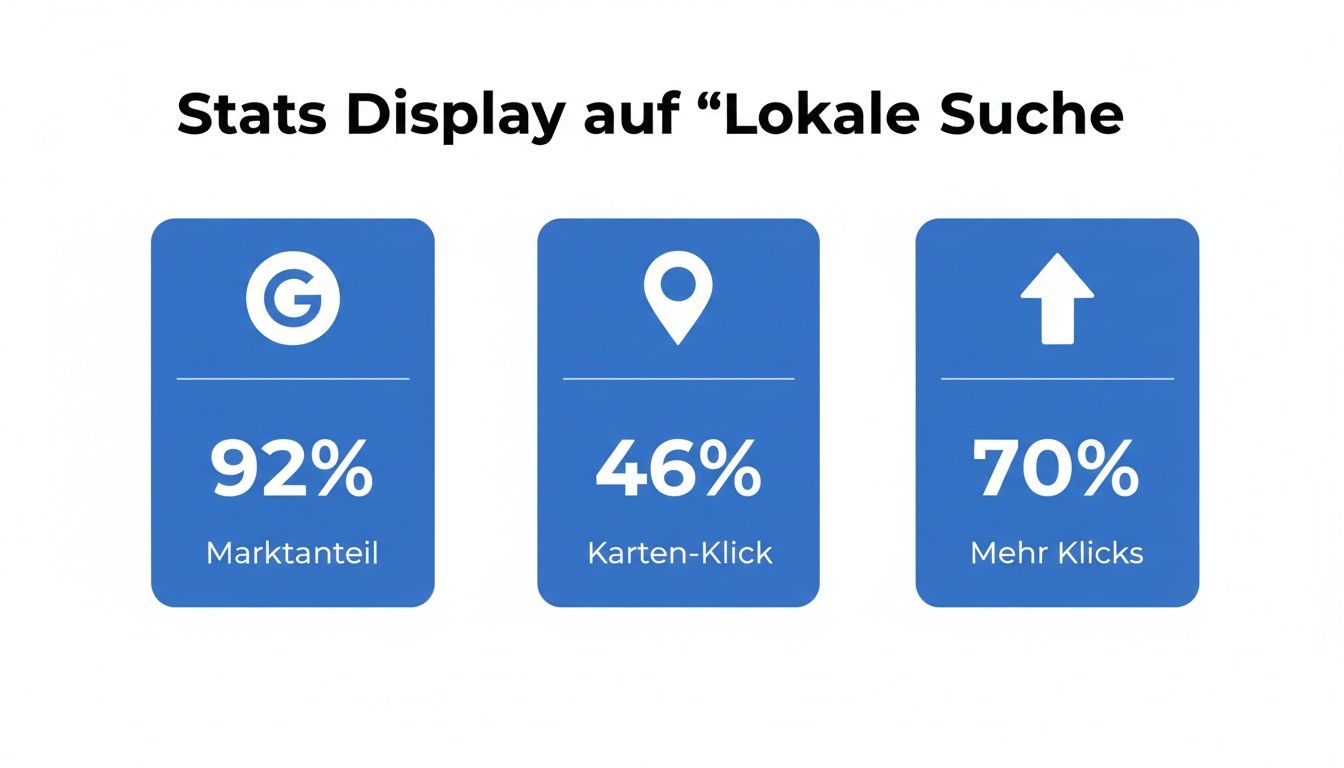
The figures speak for themselves: Almost all searches are carried out via Google, and for almost half of them, users click directly on an entry in Google Maps.
Figures that prove relevance
In Germany, Google has a market share of 91.98% a quasi-monopolistic position in online searches. That means that almost every potential customer wants to find you via this platform.
But the really exciting figures for you as a local company are these:
- End up with local searches such as “Friseur Bühl” 46% of users directly on Google Maps — and often choose one of the first results.
- Studies show that companies rely on the Top 3 positions receive up to 70% more clicks and calls as the competition in places five to ten.
Optimizing for local search is therefore not a nice extra, but a central business strategy. It is the most direct way to attract new customers and to beat the competition in your region. More about The basics of local SEO Find out in our guide.
This is how your Google company profile becomes a customer magnet
Many local entrepreneurs treat their Google company profile like a chore: fill it out once and then stop viewing it. However, this very idea is a mistake, because by doing so, you are leaving a lot of potential unused. A well-maintained profile is not a static business listing, but your dynamic tool to to be found better on Google. For many potential customers, it is the first point of contact with your business.
Think of it as a digital business card that appears directly in search results. It answers your customers' most important questions, often before they've even been to your website.
The right categories as a basis for your visibility on Google
It all starts with the choice of categories. They are the linchpin for which search queries Google even considers your company as a relevant solution. Die main category is the heavyweight and should get to the heart of your core business as precisely as possible.
A simple “restaurant” is okay, but “Italian restaurant” is much better when you serve pasta and pizza. A plumber should not be satisfied with “craftsman” but should precisely choose “plumber” or “heating installer.” That makes a big difference.
In addition, you should definitely use the Subcategories use. These also make you visible for more specific searches.
- The Italian restaurant could add secondary categories such as “pizzeria”, “delivery service” or “restaurant with outdoor terrace.”
- The installer could use “bathroom renovation” or “pipe cleaning” to specifically address customers who are looking for exactly this service.
With these details, you feed Google the right information and massively increase your chances of appearing on your customers' radar at just the right moment.
Strategically place keywords on your Google profile
Your profile offers various options for cleverly including important search terms. But that doesn't mean wild stringing together of keywords — that's more likely to scare off customers. It's about describing your offerings clearly and naturally.
A well-formulated descriptive text that mentions the most important services and location appeals to both the customer and the Google algorithm.
yours company description It's the perfect place for that. Here you have 750 characters space. Instead of flat phrases, you should provide concrete added value: “Your experienced specialist company for modern heating technology and bathroom renovation in Musterstadt. We offer emergency service, maintenance and advice.” That sounds competent and contains relevant search terms.
The areas are just as valuable Services and products. Be sure to fill them out in detail. Each individual service — such as “replacement of radiators” or “installation of a heat pump” — is a potential search term that can be used to find you. If you want to dive deeper into how such optimizations get users to take action, you can find practical tips in our article on Conversion rate optimization.
Foster interaction and trust through an active profile
A profile on which nothing has happened for months seems abandoned quickly. Google prefers active profiles because they signal up-to-date and reliable information. Regular activity is therefore a strong ranking signal.
High-quality photos They are worth their weight in gold. A professional image of your shop, your team at work, or your products creates a personal connection and trust. Upload new images regularly. An observation from practice: profiles with more than 100 photos attain significantly more interactions than average.
Regular contributions (Posts) are like small, free ads directly on your profile. Use them to draw attention to offers, news or events. Even if a post is only shown prominently for seven days, the sum of your activity counts for the algorithm over the long term.
An often underrated tool is the Question and answer function. Here, every user can ask questions publicly. Don't wait until someone asks — take action yourself:
- Ask yourself the most common questions and answer them immediately. For example: “Do you also offer 24-hour emergency service? ” or “Can you pay by card? ”.
- Keep an eye on new questions and answer quickly and in a friendly manner.
With this proactive communication, you not only remove uncertainties, but also place important information and keywords directly in your profile.
To make things easier for you, we have put together a checklist. This allows you to go through it point by point and make sure your profile is up to date.
Checklist: Optimize your Google company profile for better visibility
This table serves as a handy checklist to review the key optimization points for your Google business profile and ensure that no critical ranking factor is missed.
Optimization areaWhat to doWhy it's importantMaster data (NAP)Keep your name, address, telephone number accurate and consistent. Foundation for local search rankings. Google prefers consistency.categoriesSelect precise main category + all relevant secondary categories. Decisive to be played out in relevant searches at all.Opening hoursMaintain current regular hours and special opening times (holidays). Prevents customer frustration and negative reviews.company descriptionMeaningful text (max. 750 characters) with important keywords & location. Your “digital business card” for a first impression.Photos & videosRegularly upload high-quality images from outside, inside, team & products. Creates trust and demonstrably increases the interaction rate.Services/productsDetailed list with descriptions and prices (optional) .Makes your offer transparent and ranks for specific search queries.Contributions (posts)Post offers, news or events at least once a week. Signals Google activity and keeps customers up to date.Questions & answersProactively post and answer the most important FAQs yourself. Builds trust and places important information prominently.valuationsActively ask for new reviews and respond to each individual (even negative). One of the strongest ranking and trust factors of all.
Review these points regularly, at least once a quarter. This ensures that your profile is not just an entry, but a real customer magnet who is actively working for you.
Establish your website as a local anchor point for Google
Your Google business profile is the first handshake—it sparks curiosity. But your website is where you really impress and turn a visitor into a paying customer. That is exactly why your website must send Google crystal-clear signals: For which city, which region and which services are you the best choice?
Many local companies make the mistake of only filling their website with general information. But if you on Google be found more easily If you want, you have to turn it into an unmistakable local magnet. Every text, every headline, and even the technology behind the scenes should contribute to your local significance.
Optimize service pages with a local focus for Google
Your service pages are at the heart of your local SEO work. Here you must clearly show what you offer and above all where. A site that only describes “bathroom renovation” is in competition with thousands of providers across Germany. A site that focuses on “bathroom renovation in Bühl”, on the other hand, appeals to a very specific target group that is ready to buy.
The trick is to incorporate place names naturally and sensibly without overdoing it. Google has been looking through artificial “keyword stuffing” for a long time and, in the worst case, even punishes it.
Here are a few levers that really make a difference:
- The page title (title tag): That's the headline you see in Google search results. Formulate it concisely and meaningfully, for example: “Professional bathroom renovation in Bühl | Your local specialist company.”
- The meta description: The small text below the title in search results. See it as your mini ad: “Are you looking for a bathroom renovation expert in Bühl? We plan and build your dream bathroom. Get non-binding advice now! ”
- The headings (H1, H2): Give your texts a clear structure. The main heading (H1) should state the core topic and location, something like this: “Your specialist for bathroom renovation in Bühl and the surrounding area.”
- In the text itself: Mention your location or surrounding places whenever it's thematically appropriate. For example, describe projects that you have implemented in specific parts of the city, or mention your catchment area.
With this targeted optimization, you can help Google immediately understand the geographical context of your work. The result: They are played out for the really relevant local searches.
Use structured data to communicate with Google
Structured data, often also Schema markup They are called a small piece of code on your website that is invisible to visitors. But for Google, it's like a perfectly formatted business card. It translates your most important company information into a language that search engines understand without detours.
With Schema Markup, you serve Google the most important facts on a silver platter. The rewards are often so-called “rich snippets” — extended search results that immediately catch the eye and get more attention.
Imagine that your opening hours, star rating, or address appear directly below your search results. This not only increases the click rate, it also immediately creates trust. These types of schemes are particularly valuable for local businesses:
- Local Business: This is where you put all master data — name, address, telephone number, opening hours and exact coordinates.
- Review/aggregaterating: This is the code that makes your average star rating visible directly in search results.
- Service: Describes exactly which services you offer and in which area you work.
Setting it up requires a bit of technical skill, but it's worth the effort. You are thus signaling to Google on a deeper level how trustworthy and relevant your company is for the region.
Build local authority with the right content for Google
Anyone who wants to be considered the go-to expert in their region must also prove this with the content on their website. Show potential customers that you know the local conditions and have already worked successfully for their neighbors.
One effective way to do this is to create content that is directly relevant to the location.
- Local case studies: Describe a project that you have implemented in a well-known district or a neighboring community. Show before and after pictures, explain the specific challenges and how you solved them. This creates a strong connection and immediately builds trust.
- Blog posts on local topics: A painting company could write about the typical façade problems in the old town. A gardener about plants that thrive particularly well in regional climates.
Such content not only attracts highly interested visitors, but is also a good source for internal links and can your entire content marketing strategy fuel. In doing so, you prove to Google and your customers alike that you are not just any provider, you are The Local contact person.
How customer reviews influence your Google ranking
Online reviews are decisive in local competition. If you on Google be found more easily If you want, there is no way around clever reputation management. Positive customer feedback is much more than just a nice extra — for Google, they are a clear signal that your company is trustworthy and relevant. For potential customers, they are often the tipping on the scale, deciding whether to call you or would rather click on to the next provider.
However, the biggest problem for many entrepreneurs is not good service, but getting satisfied customers to make a review in the first place. Who would think of leaving feedback when everything went smoothly? That's exactly why you need to make things as easy and pleasant as possible for your customers.
How to get authentic reviews
The best time to ask for a review is right after a positive experience. The customer is happy, the good experience is still fresh in their head and the willingness to type a few nice words is highest.
Here are a few practical methods that work well:
- The personal note: Simply ask satisfied customers directly, for example at the end of a conversation or at the checkout. A loose sentence like “We would be very happy if you briefly rate us on Google” can make the difference.
- Follow-up via email or text message: Send a short, friendly message after the purchase or the order has been completed. Important: Include the direct link to your Google review profile so that the customer reaches their destination with one click.
- QR codes in stores: Place a QR code clearly visible on the counter, on flyers or directly on the invoice. A quick scan with the mobile phone and the customer lands on your review page.
But what you should avoid: promising incentives such as discounts for positive reviews. This not only violates Google guidelines, it also quickly looks implausible. Authenticity is crucial here.
The right way to deal with positive and negative feedback
Collecting reviews is only half the battle. How you react to it is at least as important. Every single answer is a public calling card for your customer service. Studies suggest that actively responding to feedback increases the trust of potential customers by up to Increase 30% Can.
An unanswered review — whether positive or negative — is a wasted opportunity. It signals disinterest, both to the author and to anyone else who reads your profile.
Therefore, react always promptly and personally to any feedback. A well-thought-out answer shows that you value your customers.
With positive reviews You should thank them in person. Address the reviewer by name and respond to a point from their review. It looks real and reinforces the good impression.
However, true mastery comes from dealing with negative feedback. A critical evaluation is not the end of the world, but your chance to prove professionalism.
- Stay calm and professional: Never respond out of emotion or in defense mode.
- Thank you for the feedback: Show that you take criticism seriously.
- Sincerely apologize: Even if it wasn't your fault — apologize for the customer's negative experience.
- Provide a solution: Ask the customer to contact you directly to resolve the issue in person. This is how you move the discussion from the public into a constructive conversation.
A confident response to a 1-star review can not only win back an unsatisfied customer. It also shows all future customers that you are there even if something goes wrong. Find out how to formulate the perfect answers in our detailed guide on the topic Reply to Google reviews.
Local signals to be found more easily on Google
If you want to be considered a local player on Google, you have to show more than just a top-optimized website. Think of it this way: Google is looking around your digital neighborhood. Does your company appear there at different, relevant locations, and always with the same, correct information? This creates trust and signals that this business is really a fixture here.
Two levers are particularly effective: local citations and local backlinks. The former form the solid foundation of your local presence. The latter are the turbo that can move you up in the ranking.
The foundation: Local citations for more trust with Google
Local citations are basically just mentions of your company in online directories. Each entry is a small vote of trust for Google. The be-all and end-all of this is the absolute consistency of your core data — even in technical language NAP data called:
- Name (your company name)
- Aaddress (street, zip code, city)
- Phone (your phone number)
And when I say consistent, I mean exactly identical. Even small things like “Hauptstr.” instead of “Hauptstraße” can cause Google to stumble and undermine your authority.
Inconsistent NAP data is like an unclear road sign for Google. They create confusion, raise doubts about the reliability of your information and can significantly lower your ranking.
But where do you start? Focus on the most important platforms first:
- The big players: Portals such as Yellow pages or The local are often the data source for countless smaller directories. If it is true here, it is often true in many other places as well.
- Business directories: As a craftsman, you stop MyHammer, as a doctor, there is a profile on Jameda Almost mandatory. Find out which portals are setting the tone in your niche.
- Local portals: Does your city have an official website with a business directory? Are there regional economic initiatives? Be present there too!
Take the time to review existing entries and correct any discrepancies, no matter how small. This may be a bit of a hassle, but it creates a rock-solid basis of trust with Google.
The ultimate discipline: Relevant local backlinks for your Google ranking
While citations are mandatory, backlinks are optional. A backlink is a link from another website to yours — and for Google, this is one of the strongest ranking factors of all. A link from a reputable website in your immediate area is like a personal recommendation from a valued neighbor. This strengthens your authority and therefore your opportunity to be found better on Google.
The only question is: How do you get these valuable links? The key is to connect locally — online and offline.
One of the most effective methods is Cooperation with other local companieswho are not in direct competition with you. A wedding photographer can wonderfully team up with a florist or an event location. You recommend each other on your own websites and, of course, set a link to the partner.
Another good option is that Sponsoring local events. Support the sports club around the corner, the annual city festival or a cultural project. Sponsors are almost always mentioned by name and link on the organizer's website. There is hardly any easier way to get such a high-quality, local backlink.
And last but not least: Show off your expertise! Do you offer local media or blogs guest posts on. A tax advisor could write an article for the regional business portal about new tax laws for small business owners. The author profile then links to his law firm as a matter of course. Such links not only show Google that you are locally based, but also that you have an idea of your subject.
How to measure and optimize your success on Google
Each optimization is only worth half as much if you don't measure what it has achieved in the end. Without tangible data, you are poking around in the fog. Um really to be found better on Google, you need to know exactly which of your efforts are bearing fruit and where there is still undiscovered potential. Only the analysis of the correct figures turns well-intentioned actions into an accurate strategy.
It's about separating the wheat from the chaff. Instead of getting lost in a flood of data, we focus on the key figures that really make the difference for your local business.
The most important key figures for your local SEO on Google
The most direct indicator of your local visibility is and remains your Google business profile. The performance data that Google provides to you directly here is a valuable source if you know what to look out for.
Three areas are particularly informative:
- How users search for you: Here, you must differentiate between direct searches (i.e. for your company name) and discovery searches (e.g. “Friseur Bühl”). A high or increasing proportion of discovery searches is a very good sign. It means that your SEO measures are taking effect and you are attracting real new customers that you didn't know before.
- Where customers see your business on Google: Are you more likely to appear in classic Google search or directly in Google Maps? This information tells you which platform your customers use to contact you most often.
- What users are doing: That is the most important point. This is where it gets specific. Count interactions such as Website clicks, calls, and route planner requests. An increase in these numbers is undeniable proof that your improved visibility is directly leading to more business inquiries.
Take a look at these figures regularly on a month-to-month basis. This allows you to quickly identify trends and see whether, for example, a series of new posts or uploading fresh photos had a measurable effect.
The Google Search Console as a tool for your website analysis
In addition to profile statistics, the free Google Search Console is a very powerful tool. It tells you which exact search terms people used to search for your webpage come. Here you can see in black and white for which local keywords (e.g. “Bühl bathroom renovation”) you are collecting impressions and clicks.
Place the search terms from the Search Console next to the keywords for which you have optimized your website texts. Do you see a big match? Perfect, then you've done everything right. Are you discovering terms that you didn't even expect? This is a template to make your content even more targeted.
This data gives you valuable information as to whether your work on the website is bearing fruit. Here you can also keep an eye on the development of your click-through rate (CTR) — an important indicator of how attractive your titles and descriptions are in search results. For a more in-depth guide to monitoring your rankings, I recommend reading our article on effective local rank tracking.
Continuous optimization for top positions on Google
Sometimes it is the small but consistently implemented things that make the biggest difference. If you've already laid the foundations, these measures can be the decisive boost to make up the last, hard-fought places:
- Get fresh reviews: A steady stream of new, positive reviews is one of the most powerful ranking factors of all. Actively ask satisfied customers to do so.
- Publish weekly Google posts: Use the contribution function consistently. This signals to Google that your company is active and relevant.
- Upload new, high-quality photos: Visual timeliness not only attracts customers, but is also rated positively by the algorithm.
- Maintain the question and answer area: Answer new questions as quickly as possible or proactively post the most important FAQs yourself. This shows competence and helps users.
These four points are often the key to climbing from page two to page one or moving from position four into the coveted top 3.
Summary: Your next steps to local visibility
We've gone through the journey from basics to advanced techniques for local visibility on Google. One thing should have become clear: In order to work at Google to be found more easily, a continuous process is required that pays off in the long term.
Your strategy should be based on three pillars that are mutually supportive:
- A completely optimized and active Google company profile.
- A fast, mobile-friendly Website with a clear local connection.
- A proactive Manage your online reviews.
These puzzle pieces interlock and send a strong signal to Google: Your store is a top address in your region — trustworthy, relevant and present.
The first step is often the hardest, but with a clear plan, it becomes feasible. Use the checklist from this article and go through your Google business profile point by point. You'll find that even small adjustments — the right categories or recent photos — can make quick improvements. The key is to start and move the biggest levers first.
Would you like to be at the forefront of local searches in the long term without having to worry about every detail yourself? SocialEdge specializes in delivering measurable results through exclusive support per sector and region. Arrange a free potential analysis and let us work together to ensure that your customers find you when it matters most. Find out more at https://www.socialedge.ai.