Why local optimization is crucial for your conversion rate
Imagine: A potential customer searches on their smartphone for “plumber near me” or “best coffee shop around the corner.” That first moment, often directly in Google Maps, determines whether it ends up with you or with the competition. Right here, even before anyone has visited your website, lies the biggest lever to win more inquiries and orders.
Your Google company profile (GUP) is more than just a digital entry. It is your most important local information platform. This is where the first impression is created, trust is built and this is where it is decided whether an interested party clicks on “Call”, “Plan a route” or “Visit the website.” Targeted optimization is therefore critical to success.
This simple but effective process is easy to visualize: from local search to the optimized profile to the customer's final action.
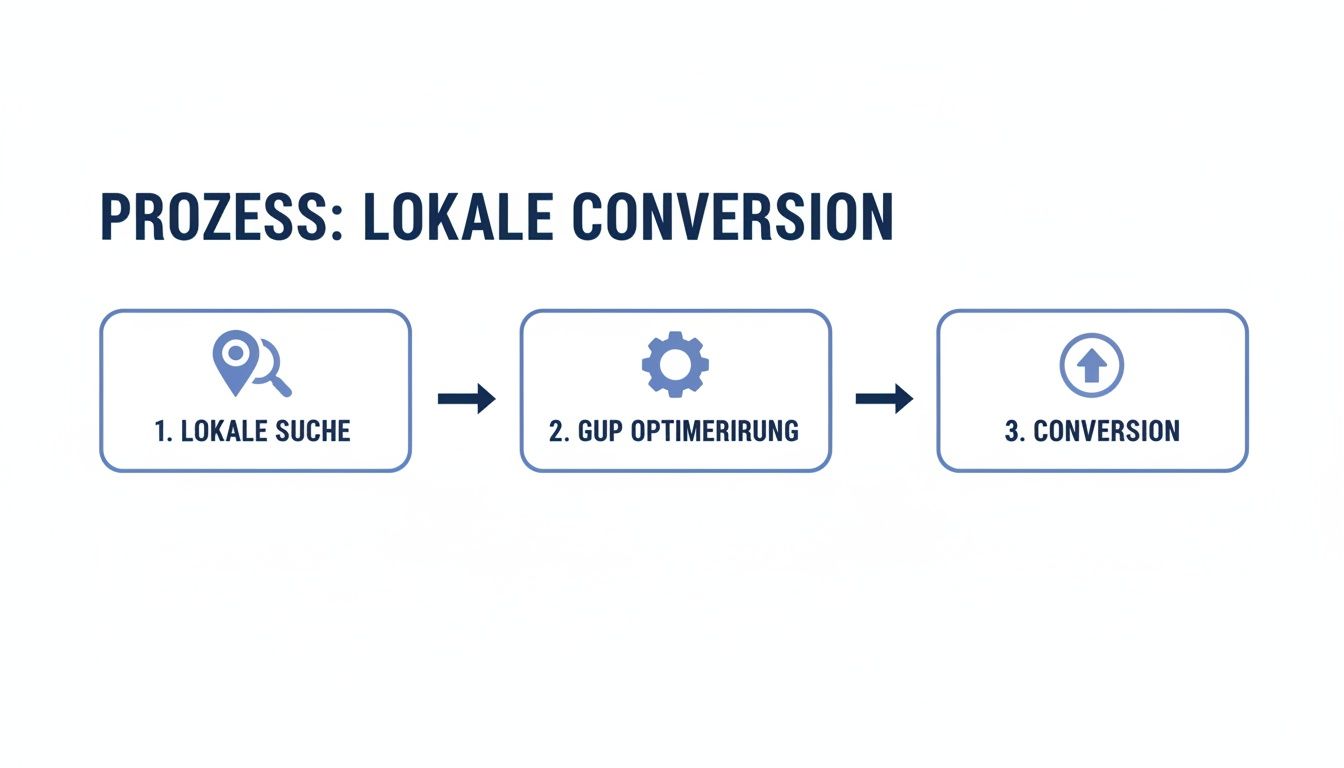
The diagram makes it clear: The company profile is the central link that turns a simple search into valuable customer interaction.
Direct contact with the customer
In Germany in particular, the influence of a well-maintained Google company profile is enormous. Studies show that 78% of consumers Use Google Maps to find local businesses and service providers. More importantly: 62% of these searchers contact the company directly via the profile. This direct contact option alone can increase the conversion rate by up to 35% boost. You can find out more about this in this insightful video analysis on YouTube.
This direct channel is valuable because it shortens the customer's journey to a minimum. Instead of having to click through a website first, he can call or book an appointment with a single tap.
It's about more than just clicks
Visibility is important, but at the end of the day, concrete, measurable actions count. Every element of your local online presence should contribute exactly to that.
An optimized Google profile that works hand in hand with a compelling landing page transforms passive searchers into active customers. The approach is to build trust at every single point of contact and to place clear calls to action.
In this guide, we focus on tried and tested measures. You will learn how to use targeted steps to generate not only more clicks, but above all more calls, bookings and visitors to your store. If you would like to delve even deeper into the subject matter, our article on Local SEO further valuable tips. We'll show you step by step how you can become the first choice in your region.
Overview: Leverage to increase the local conversion rate
The following table summarizes the most important areas of optimization and shows their direct impact on customer interaction and conversion.
Optimization areaSpecific measuresDirect effect on conversionGoogle company profileComplete and up-to-date information, high-quality photos, answers to questions and reviews. Increases trust and leads to more direct calls, route planning and website clicks.Local landing pageClear call-to-actions (CTAs), mobile-friendly design, fast load times. Reduces bounce rates and directs visitors specifically to a desired action (e.g. filling out a form).Trust signals (Trust)Positive customer reviews, consistent NAP data (name, address, telephone number) .Builds credibility and lowers the barrier to contact you.Call to action (CTA)Concise, action-oriented CTAs such as “Make an appointment now” or “Request a free quote.” Increases the click rate and convert passive visitors into active leads.
These four areas are the cornerstones of a successful local conversion strategy. If you start here, you will quickly see positive results.
Set up the Google company profile as a conversion engine
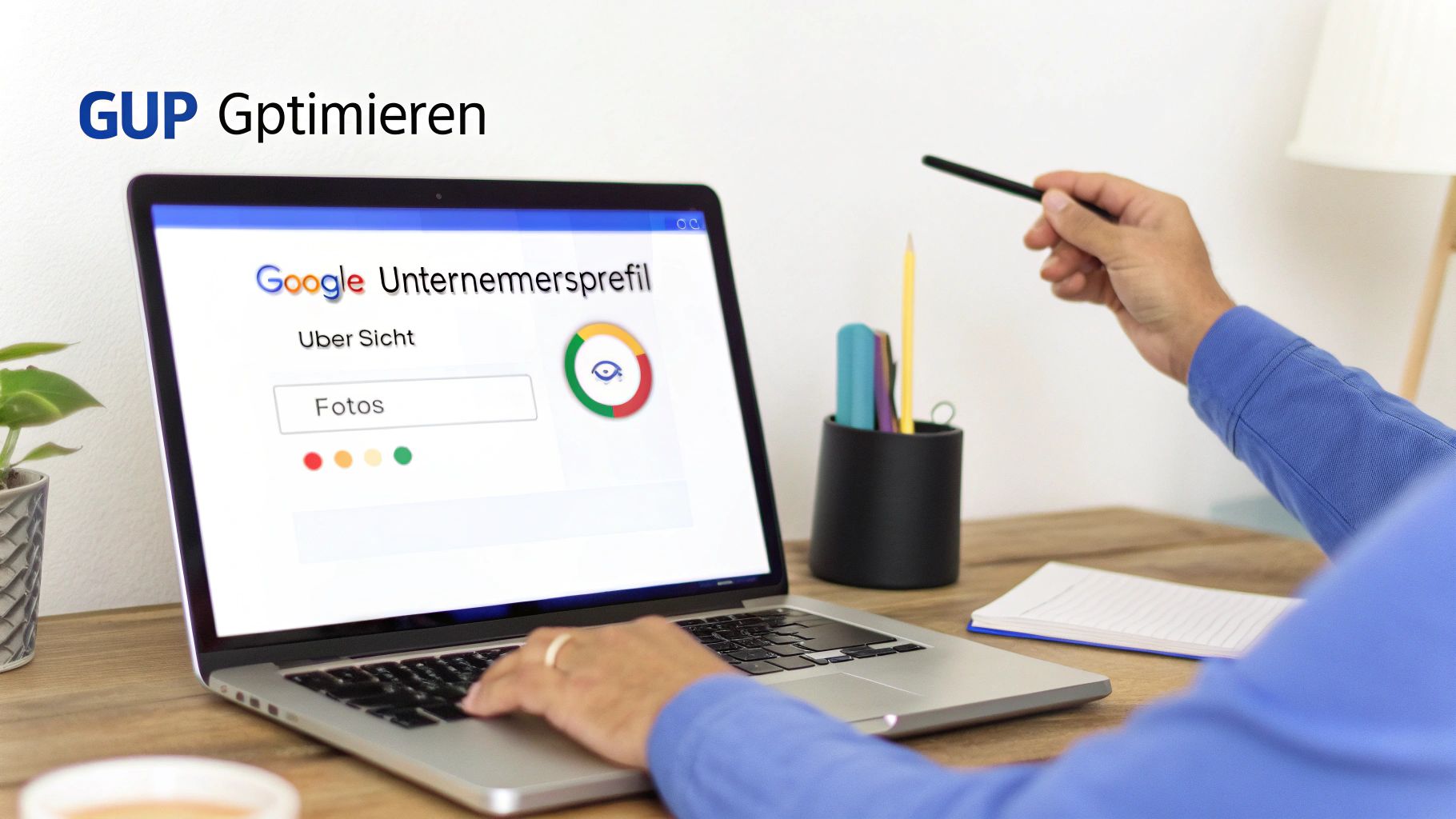
Many local entrepreneurs still see their Google company profile (GUP) as a kind of digital business directory — an entry that you create once and then forget. That's a mistake that can cost you customers day in and day out. Instead, think of your GUP as your most important local sales front — a dynamic channel that can actively attract new customers when properly maintained.
A completely completed profile is just the basis. The details turn a simple entry into a customer magnet. Every single element, from description to photos, must aim to build trust and get the user to take a clear action.
Choose the right categories and keywords for the conversion rate
It all starts with choosing the right categories, because they determine your visibility. Google distinguishes between a main and several secondary categories. Die main category It is crucial because it has the biggest influence on which search queries you are relevant for.
Be as specific as you can. A plumber should choose “plumber,” not generally “handyman.” You can then cover further services such as “heating installation” or “pipe cleaning” via the secondary categories.
Keywords must also be placed strategically. Your company description is the ideal place for that. Describe not only who you are, but above all what problems you solve for customers in your city. Terms such as “emergency service in [district]” or “certified specialist company” should naturally flow into the text. It's not about stringing keywords together, but about formulating helpful text that offers real added value. If you're starting from scratch, this guide explains step by step how to create a Create a Google business profile.
Describe services and products precisely
The “services” or “products” section is an often overlooked feature. Here you can list in detail what you offer — ideally directly with prices and short descriptions. This creates immediate transparency and answers the most important questions from your potential customers before they even pick up the phone.
For example, a hair salon could not only enter “haircut” here, but also break down the offer:
- Balayage dyeing technique: Including type advice and maintenance for brilliant results.
- Men's dry haircut: Quick and precise for the modern man.
- Festive updo: Individual advice for your perfect appearance.
Each listing, with a price and a short, meaningful description, helps Google understand the relevance of your offer. At the same time, you give customers exactly the information they need to make a quick decision.
Stay actively in conversation with Google posts
Think of Google posts as a mini blog right on your profile. They're the perfect tool to show that your business is active — both important signals for your ranking and conversion rate.
Here are a few ideas for posts that work:
- offers: A restaurant advertises its “lunch menu of the week” with a photo and a direct “reserve” button.
- news: A craft business posts pictures of a completed project and links to a detailed case study on its website.
- Eventi: A gym announces an “open house” and adds a clear “sign up” CTA.
The key to success is regularity and a clear call-to-action (CTA). A contribution without a call to action has little effect. Google provides you with buttons such as “Call,” “Learn more,” or “Order online” — always choose the one that best suits your destination.
Use photos and videos as visual persuasion tools
People buy from people. Visual content is the fastest way to build trust and highlight your expertise. A profile without pictures or just with a pixelated outdoor photo does not look inviting. High-quality, authentic photos, on the other hand, attract users to your store.
Regularly upload images that highlight various facets of your company:
- Your team at work: This creates personality and makes you approachable.
- Your premises: Give customers an honest insight into what to expect.
- Completed projects: Show off your results — that's powerful social proof.
- Products in detail: Showcase the quality of what you're selling
An installer who posts before and after pictures of a bathroom renovation is more convincing than someone who just writes about it. A café that shares pictures of freshly baked cake awakens emotions. It is precisely these visual stimuli that ultimately lead to more calls, directions and a higher conversion rate.
How to persuade with trust and authority
In local competition, there is often something that can't be outweighed in euros and cents: trust. Even before a potential customer calls you, they subconsciously ask themselves the question: “Can I trust this company? “Your ability to answer this question with a resounding “yes” is a powerful lever to your Increase conversion rate.
You have to build up trust in a targeted manner by being credible and competent. At the heart of this strategy is clever reputation management, and customer reviews are its most important currency.
Use reviews as a digital handshake
Reviews are the modern form of word of mouth. When potential customers read what others have experienced, they get an honest, unfiltered insight into your work. Many positive voices not only signal that you are doing a good job, but also that your business is in demand.
But how do you get this valuable feedback? Don't just wait and see. Make collecting reviews an integral part of your process.
- The right time: Ask for an evaluation as soon as an order is successfully completed or a customer is visibly satisfied. The positive impression is then still very fresh.
- Make it easy: Send a direct link to your Google review profile via email or text message. Each hurdle lowers the chance of a review.
- A personal request has an effect: Instead of an impersonal mass email, you should briefly refer to the assignment or conversation. This shows appreciation and motivation.
With this proactive approach, you systematically build up positive feedback that works for you around the clock.
The right way to deal with negative feedback
Negative reviews can happen. The decisive factor is not that They are coming but like They deal with it. An unanswered criticism can scare off potential customers. A confident, solution-oriented answer, on the other hand, can convince even skeptics.
Look at every negative review as an opportunity to prove your customer service.
Always remain professional and factual. Thank you for the feedback, apologize for the experience, and offer a concrete solution. This signals to all fellow readers that customers are taken seriously here.
A well-thought-out answer can not only limit the damage, but also strengthen trust in your company. In a separate guide, we will show you how to Reply to Google reviews and always hit the right note.
Further trust signals to increase conversion rates
In addition to reviews, there are other signals that underpin your credibility. You should place these clearly visible on your website and in your Google company profile.
Checklist for additional trust anchors:
- Show qualifications: Do you have certificates, a master craftsman's certificate or awards? A “TÜV-certified” seal or membership in the Chamber of Crafts are valuable.
- Local connection: Membership in the local trade association shows that you are anchored in the region.
- Use press reports: Did the local paper report on you? Link to the article or show a screenshot
- Unified NAP data: Make sure that your company name, address, and telephone number (NAme, Adress, Phone) are identical everywhere. Conflicting information may appear unprofessional.
Each of these points is a further building block for your foundation of trust. If you use these signals consciously, you build a strong bridge to your customers and pave the way for more inquiries.
Design a local landing page that converts
Clicking on your Google business profile is the first important step. But the real work is just beginning now. The potential customer has landed on your landing page, and this is where it is decided whether a click becomes a request.
This page is the critical point at which interest must become action. So what makes a local landing page strong? It's a mix of clear structure, the right information at the right time, and an unmistakable focus on the next step.
First impression: The headline
A visitor who arrives at your site wants to know in seconds: “Am I in the right place? “A strong, locally focused headline is your direct answer. It must immediately confirm to the user that you are solving exactly the problem they were looking for.
A meaningless headline such as “Welcome” is wasted potential. You'd better get straight to the point.
Examples of local headlines that work:
- Instead of: “Our sanitation services” -> Better: “Your specialist for plumbing & heating in Hamburg-Eimsbüttel”
- Instead of: “Professional haircuts” -> Better: “Your hairdresser for balayage & modern cuts in Cologne-Ehrenfeld”
This targeted approach immediately creates relevance. The visitor feels understood and is more willing to look around.
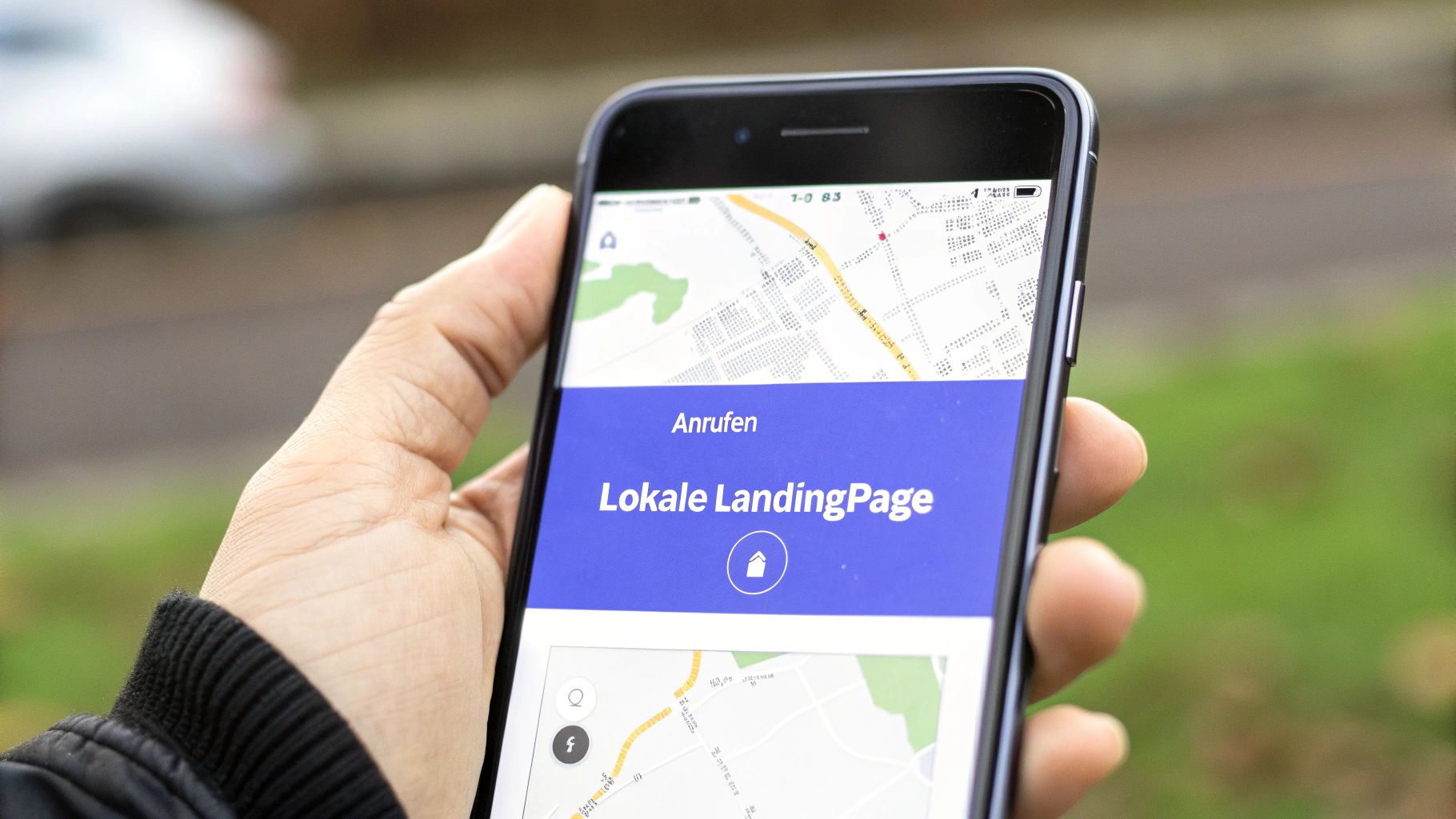
Make contact options immediately visible
Local searches are often characterized by a certain urgency. A pipe burst cannot wait, and the search for a restaurant is usually spontaneous. Your landing page must reflect this urgency by making contact options easily accessible.
The most important elements belong “above the fold” — i.e. in the area that is immediately visible without scrolling. These include in particular:
- Click-to-call button: A prominent button with the inscription “Call now”, which starts the telephone app directly on the mobile phone.
- Address and opening times: Clear, clear information, preferably linked directly to Google Maps.
A landing page for a local store shouldn't be a maze. The quickest way to get in touch must always be the most obvious. Every second that a user has to search for a phone number increases the risk that they will give up.
Formulate compelling call-to-actions
The call-to-action (CTA) is at the heart of your site. It is a clear call to action that tells the visitor what to do next. A weak CTA creates confusion, a strong CTA leads to a conversion. The approach is to find a clear, active and benefit-oriented language.
A brief comparison makes the difference clear:
Weak CTA (passive & unclear) Strong CTA (active & specific) Learn moreRequest a free quote nowSend my table for this eveningContactSchedule a binding consultation
The better CTAs promise a clear result and take away the user's uncertainty. He knows exactly what happens when he clicks. In order to make the message surrounding the CTA even more powerful, it can be worthwhile to learn the basics of a solid Familiarize content marketing strategy.
Mobile friendliness and charging time as important factors
Most local searches take place on smartphones. If your landing page takes a long time on your mobile phone or the font is barely legible, you lose potential customers. A page that isn't optimized for mobile devices increases your bounce rate and negates the effort to increase conversions.
What is part of mobile optimization?
- Responsive design: The page must automatically adapt to any screen size.
- Large, easy-to-click buttons: No tiny links that you barely hit with your finger.
- Short charging times: Optimize images and reduce unnecessary code. Just a few seconds of delay will cost you visitors.
Your landing page must work just as intuitively on a smartphone as on a large monitor. This is a prerequisite for having a chance in local competition.
Measure success to further increase the conversion rate
An optimization strategy is only good if you can also measure its success. Without reliable data, it is not possible to assess which measures are really the Boost conversion rate and which were only well-intentioned. It is about replacing assumptions with findings and creating a process that is based on facts.
For local businesses, the first and most important source of data is your Google business profile. The “insights” there show you how users interact with your entry. This is the basis for any further analysis.
Understanding the key metrics in the Google business profile
Your Google business profile dashboard provides lots of information. Focus on the metrics that signal a clear purchase or contact intent — i.e. the ones that can lead directly to a conversion.
Checklist of relevant GUP indicators:
- Calls: One of the strongest indicators. Everyone who clicks on the call button has a specific request.
- Website clicks: This number shows how many people are taking the next step and want to find out more on your landing page.
- Directions: For every store with walk-in customers, this is a clear buying signal. Clicking on route planning means: “I'm on my way to you! ”
- searches: Take a look at what keywords people are using to find you. Perhaps you will discover terms here that you have not yet focused on yourself?
This data tells you a story about the behavior of your potential customers. Observe developments over time to identify trends. When calls increase after you've posted a new offer, you know you've done something right.
Monitor landing page performance with web analytics tools
While the Google company profile represents the first point of contact, tools such as Google Analytics or Matomo tell you what happens afterwards. Here you can define specific conversion goals to quantify the success of your landing page.
A classic goal, for example, is to send a contact form. Set this up as a “goal” or “event” in your analytics tool, and you'll see how many of Google's visitors actually become a lead. On this basis, you can then calculate a meaningful conversion rate for your site.
The key point is to combine data from both worlds — the insights from the Google company profile and the analyses of your website. This is the only way to get a complete picture of the entire customer journey, from the initial local search to the final contact.
Draw the right conclusions from data
Collecting data is the easier part. The trick lies in interpreting them correctly and asking the right questions. Comprehensive strategies, such as your Optimize conversion rates and achieve measurable results, are an aid to better classify your own results.
Let's take an example: Show your GUP insights 150 clicks on the “Call” button, but your phone only rang a few times. What could be the reason for that?
- Is the stored telephone number correct and free of typing errors?
- Are you always available during the specified business hours?
- Do callers end up on hold?
Or another scenario: You get a lot of clicks on your website, but hardly anyone fills out the contact form. The reasons can be manifold: maybe the charging time is too long, the design on the mobile phone is confusing, or the form is too complicated.
With this analytical approach, you establish a cycle of continuous improvement. They measure, analyze, hypothesize, implement a change, and start all over again. That is the engine for sustainable growth. If you want to dive even deeper into measuring your local visibility, our guide on the topic will help you Local rank tracking continue.
What you should do now
For local companies, the formula is simple: More visibility and trust on Google directly leads to more inquiries and customers. Today, the customer journey usually starts directly in Google search results or on Google Maps.
Here are the three key adjustments you need to make:
- Your Google business profile: Think of it as your digital business card. It's often the first impression potential customers get of you.
- Actively manage your reviews: Real customer testimonials build the trust someone needs to call you.
- A landing page that converts: When someone clicks over to your page, the page must look perfect on their mobile phone and clearly tell the visitor what the next step is.
These three elements make up a team. Only when they work together will anonymous search queries become paying customers.
This is not a one-time project, but an ongoing process. Keep an eye on interactions on your Google profile, see what visitors are doing on your landing page, and adjust your strategy over and over again.
Your specific action plan
It's best to start today. Focus on one of the three areas — ideally the one where you expect the greatest potential. Work through the checklists and tips from this guide point by point. Every small improvement is a step towards a better conversion rate.
And if you don't have the time or want to rely on professional expertise, we're there. Take a look at how we do with our specialized services for local companies can help increase your presence and conversion rate.
Practical questions: Increasing the conversion rate
Finally, we will answer a few questions that we encounter again and again in everyday life. Many local entrepreneurs have similar hurdles in their heads when they start to improve their conversion rate in a targeted manner. Here are the answers, short and to the point.
How quickly do I notice something about the GUP optimization?
It's often faster than you think. Minor adjustments, such as corrected opening hours or new photos, can almost immediately result in more calls or clicks. We often see the first positive signs in practice within a few weeks.
But the pace also depends on the competition. In a highly competitive market, such as as a dentist in a big city, it takes longer to stand out. If, on the other hand, you start with a neglected profile, the first jumps are usually bigger and more quickly visible. Patience and consistent care are crucial.
Realistically speaking, you should plan around one to three months for stable and measurable improvements. This is the period in which Google has recorded all changes and incorporated user responses into the evaluation of your profile.
Do I really have to respond to every single review?
A resounding yes! This is one of the most effective dual-action levers. When you respond to positive feedback, you show appreciation to the customer and at the same time encourage others to leave a positive review as well.
Responding to criticism is even more important. A professional, solution-oriented response to a negative review shows allwho read that you take feedback seriously and care. How to turn a public complaint into proof of your customer service. Both together build trust.
What is more important to increase the conversion rate: Google profile or website?
The question comes up often, but it is like the question about the chicken and the egg. You can see it this way: Your Google company profile is your digital shop window, your website is the shop behind it. One only works half as well without the other.
- Your Google profile is the first point of contact in most cases. It captures attention, provides the most important information and brings the user to the first action.
- your website is the place where the actual persuasion work is done and the conversion is completed. Here are the details and the option to take action via a form or a booking tool.
The key to success lies in seamlessly dovetailing the two. The goal is a smooth journey for the customer — from the first click on Google Maps to sending the contact form. This is the only way to Increase conversion rate sustainably.
Summary and next step
In order to increase the conversion rate as a local company, a strategic focus on three core areas is essential: a fully optimized Google company profile, an active management of customer reviews to build trust, and a mobile-friendly landing page with clear calls to action. These elements work together and transform local searches into measurable customer actions such as calls, route planning, and inquiries. The key lies in a continuous process of measurement, analysis and adjustment to attract more customers in the long term.
Do you want to systematically increase your local visibility and conversion rate without wasting valuable time? SocialEdge specializes in getting local businesses to the top of search results. Find out now how we can make your company the first choice in your region.