What is the added value of SEO optimization software?
Many entrepreneurs invest in their website but wonder why they're not visible on Google. The problem is usually not a lack of effort, but a lack of strategic direction. Without reliable data, you optimize into the blue and rely on general “best practices” that may not be right for your own business.
This is where good SEO software comes in. It provides the facts that are necessary for well-founded decisions. Instead of guessing which keywords potential customers are using or why the competitor is ranking better, it provides concrete answers.
The real value of these tools lies in turning raw data into strategic clarity. They not only show what happens, but also help to understand why It happens and like You should react to that.
These software solutions bundle relevant information in one place and make it understandable. This allows the performance of the website to be continuously monitored in order to react quickly to changes in the market or in Google algorithms. For companies that want to grow online and be visible in the long term, these tools are an essential part of the strategy.
From presumption to data-driven strategy with SEO software
With such software, targeted measures based on analyses can be taken. This is a decisive advantage, particularly in local competition. Instead of investing budgets in broad campaigns, focus on the levers with the biggest impact. To understand the basics of an effective strategy, you can find out more about the topic here local online marketing.
In summary, SEO optimization software helps:
- Using resources efficiently: Budget and time are concentrated on the measures that promise the greatest success.
- Identifying competitive advantages: Analyze what makes your competition successful and uncover untapped opportunities for your own business.
- Making success measurable: Track well-defined metrics (KPIs) to demonstrate the return on investment (ROI) of your SEO efforts.
Understanding the core functions of SEO software
Modern SEO software is more than just a tool for tracking keyword positions. You can think of it as a cockpit that helps you look at your own website from the perspective of a search engine. Instead of relying on assumptions, you get tangible data for strategic decisions in order to systematically rise in search results.
The benefit of these tools is that they simplify and automate complex tasks. They transform confusing amounts of data into understandable recommendations for action. This saves time that can be invested in developing the business.
The following infographic clarifies this point: away from guessing, towards facts that make a strategy possible.
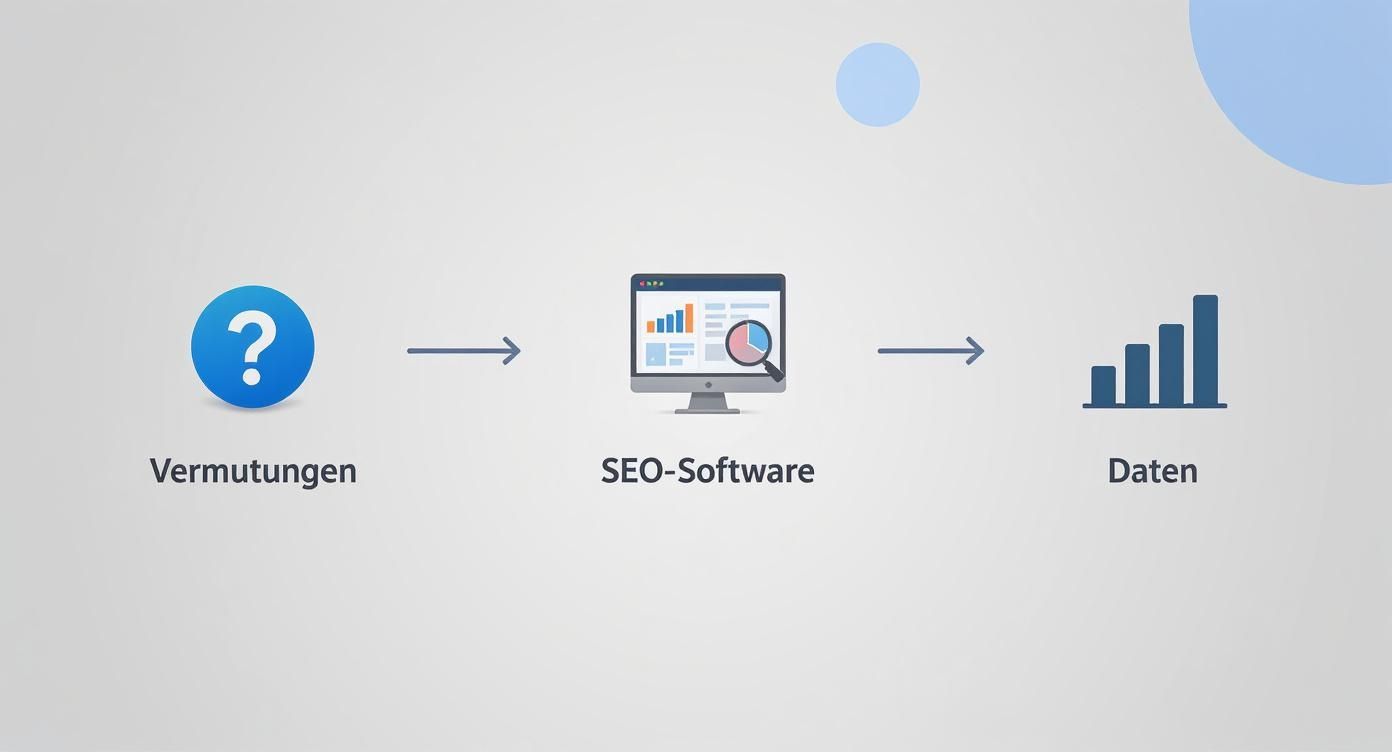
The infographic shows how the software bridges the gap between vague assumptions and solid data. This is the only way to create a functioning strategy. The core functions can be broken down into four key areas that are interlinked.
1. Keyword analysis and competitive analysis as a basis
Keyword analysis is the basis of every SEO strategy. It works like market research: You find out which terms and questions your potential customers enter on Google. Good software not only provides ideas, but also data such as monthly search volume, the Keyword difficulty (how hard it is to rank for it) and the estimated click price (CPC).
It gets interesting when you analyze your competitors. You can see exactly which keywords the competition is being found for, how much traffic they generate, and which content attracts the most visitors. Such insights help you find undiscovered niches and precisely align your own content strategy.
2. On-page optimization and content optimization
This is about the quality of your own content. The software analyses your pages and provides specific suggestions for improvements.
- Uncover content gaps: The tool shows you which topics your competitors cover that are still missing from your website.
- Improve texts in a targeted manner: You will receive suggestions as to which thematically appropriate terms (semantic keywords) you should incorporate into your texts in order to strengthen the relevance of your main keyword.
- Structure and readability: You'll receive feedback on the use of headlines (H1, H2, etc.), the length of the text, and the comprehensibility of your content.
Good content not only answers a search query, but also anticipates the next questions from the user. The software helps by analyzing the top-ranked sites and showing their success factors.
3. Technical SEO audit for troubleshooting
A technical audit is like an audit of the website infrastructure. It uncovers invisible issues that can affect your ranking, even if your texts are excellent. One SEO optimization software crawls your website like a search engine bot and checks it for hundreds of potential technical errors.
Typical test points are:
- Charging speed: Where are there bottlenecks and what is slowing down your site?
- Mobile-friendliness: Is your website well presented and easy to use on a smartphone?
- Indexing status: Are there pages that Google can't find because they are blocked by a “noindex” tag, for example?
- Broken links: The software detects all internal and external links that lead nowhere (404 error).
4. Backlink analysis and local SEO as ranking factors
Backlinks — links from other websites to yours — are an important ranking factor for Google. The software helps you to overview your own link profile and analyze that of your competitors. This allows you to identify harmful links and at the same time discover new ways to build valuable links.
There is another important aspect for local companies. Many tools offer special features to monitor and optimize the Google business profile. They help to keep company data (name, address, telephone number) consistent on the Internet and to manage customer reviews. If you want to dive deeper into this topic, our guide provides information on Google My Business optimization.
Special tools vs. all-in-one platforms: Make the right choice
When looking for the right SEO software, you are faced with the decision: Should it be an all-in-one platform that combines everything under one roof, or should it be several specialized individual tools? The answer depends on your goals, budget, and team capabilities.
The question can be answered with an analogy: Do you need a Swiss Army knife or a precise scalpel? Both are useful but are designed for different tasks.
The Swiss Army Knife: all-in-one suites
All-in-one platforms are the generalists among SEO tools. They offer an integrated approach and generally cover all important areas — from keyword analysis to technical audits to backlink monitoring.
The benefits:
- Centralized data: All important key figures come together in one place, which simplifies analysis and reporting.
- Unified user interface: All your team has to do is familiarise themselves with one system, which reduces training costs.
- Often more cost-effective: A comprehensive suite can be cheaper than buying many individual licenses for specialized tools.
A strong SEO software industry has developed in German-speaking countries. SISTRIX For example, it is one of the most used tools. Auch Xovi Has been since 2009 on the market and has established itself as one of the leading integrated SEO suites. PageRangers, founded 2014, attaches particular importance to data protection and operates its infrastructure in Germany and the EU. A good overview of The best SEO tools can be found at seo-kueche.de.
The scalpel: specialized tools
Specialized tools are the experts. They focus on a single task but often complete it with a level of depth and precision that an all-in-one solution rarely achieves. Examples include tools for technical SEO, complex link building, or optimization for local search.
A specialized tool goes deep where an all-in-one platform remains on the surface. It provides more detailed data and more advanced features for a specific purpose.
The advantage of specialists is particularly evident in the area of local SEO. While an all-in-one suite displays basic data about the Google company profile, a dedicated solution such as SocialEdge can specifically analyze the ranking in Google Maps, manage reviews and monitor local competitors in detail. If you have your Improve Google Maps ranking If you want, such focused tools are often the better choice.
How to make the right choice for your business
In the end, the decision comes down to your priorities. A small company or a marketing generalist who needs a quick overview often benefits from the simplicity of an all-in-one solution.
On the other hand, a specialized agency or an in-house team with clear areas of focus — for example in e-commerce with complex technical requirements — usually performs better with a combination of a basic suite and selected special tools. Think about which features are really important for your success indispensable are, and make your choice based on that.
How to choose the right SEO software for a team
Opting for new SEO software is more than a technical update — it's a strategic investment in your company's online visibility. To make the right choice, you shouldn't just compare features. The question is more important: Does the tool fit our everyday work and our team?

A decisive factor is the usability. The best software is useless if it is so complicated that no one in the team uses it. Ask yourself: Is the interface intuitive? Can colleagues without deep SEO knowledge quickly find what they need without having to study a manual?
Check data quality and reliability
Another critical issue is the quality of the data. Your strategic decisions are only as good as the figures on which they are based. The accuracy of search volume, ranking positions, or competitive analysis data may vary from provider to provider.
Good SEO software depends on up-to-date and reliable data. Clarify where the data comes from and how often it is updated. This is the only way to build your strategy on a solid foundation.
Even the scalability is often underestimated. Your business is growing, and your software should be able to keep up. Check whether the tool can be flexibly adapted — for example by adding more projects, keywords, or users — without significantly increasing costs.
Specific requirements for the German market
If your company operates in German-speaking countries, there are additional criteria. These are often decisive for smooth and legally secure use.
Important criteria for the DE market:
- German-language support: In case of problems, quick and competent help in your own language is important.
- GDPR compliance: Make sure that the software complies with European data protection guidelines. A server location within the EU is a clear plus here.
- Focus on local data: The tool must be able to provide precise data for the German market, particularly for local search queries and the analysis of regional competitors.
Checklist for choosing the right software
In order to keep track of the large number of providers, a checklist helps with an objective comparison. Don't start with the tools, start with yourself: What exactly do we need? A guide, like a SEO audit agency can assist with such a needs analysis, provides food for thought.
A tip: Take advantage of free trial periods. Only in practical testing can you get a feel for the operation and the data quality. Involve your team, because in the end, everyone has to work with the new solution. Make your decision not only on the basis of features, but on the added value for your company.
The role of AI in modern SEO software
Artificial intelligence (AI) is more than just a buzzword. In modern SEO software, it is a decisive motor in the background. Think of AI not as a substitute for human expertise, but as a tireless assistant that takes on data-intensive tasks and provides insights that would otherwise remain hidden. She is the analyst who recognizes patterns in huge amounts of data that are invisible to the human eye.
This development is not surprising given the growth of the SEO sector. The global market for SEO services is expected in the year 2025 upon 146.96 billion US dollars grow. A survey shows that 62.1% that marketing experts use more tools today than they did two years ago — AI is a key driver of this. By using AI analysis tools, the time for SEO audits has already been reduced by an average 67% be shortened. If you want to dive deeper into the figures, you'll find more SEO industry statistics on aioseo.com.
How AI is changing keyword analysis
Classic keyword research can take a lot of time. AI‑supported features in a SEO optimization software make this process not only more automated, but also more precise.
One example of this is the automatic creation of Keyword clusters. Instead of manually sorting hundreds of search terms according to user intent, AI analyses the semantic relationships. It groups search queries that are closely related to each other by topic and thus provides a template for creating comprehensive pillar pages and appropriate supporting content, thus building topic authority.
AI helps to think beyond individual keywords and open up entire subject areas instead. It understands the intent behind a search and thus provides the blueprint for a content strategy that comprehensively answers users' questions.
Predictive SEO and technical audits with AI support
Modern AI algorithms can also generate forecasts. Based on historical ranking data, seasonal fluctuations, and competitor activity, good SEO software can predict potential ranking changes. This allows you to act proactively instead of just reacting to losses that have already occurred.
The benefits are particularly obvious during technical audits. Where manual testing reaches its limits, AI uncovers complex problems faster and more precisely:
- Detect abnormalities: The AI notices unusual patterns in Google's crawling behavior, which often indicate hidden technical errors.
- Prioritize tasks: Instead of a long list of errors, AI assesses the urgency of each issue based on its potential impact on rankings.
Ultimately, AI increases the efficiency and depth of SEO work. It does routine work and provides data-driven insights so you can focus on strategy.
Your next step: Make data-driven SEO decisions
With SEO optimization software, you can take your strategy to a new level. Instead of relying on assumptions, you work with data and in-depth knowledge. They transform data chaos into clear recommendations for action. The key is finding the solution that fits your goals, budget, and team capabilities.
Ask yourself at the beginning: Where is the most time lost in our current processes? Where is the biggest, untapped potential in our SEO? The answers to these questions show which features are essential for you.
A data-driven approach is not a one-off project, but an ongoing cycle. The right software becomes an important ally that helps you react quickly to market changes and grow sustainably.
A practical tip: Take advantage of the free trial phases that almost every provider offers. This is the only way to get a real feel for the tool — how is it used, do you find your way around the user interface and convince yourself of the data that the tool provides?
If you're ready to base your SEO on a solid data foundation, a non-binding consultation can help you find the right software for your company and increase your visibility.
SEO optimization software frequently asked questions
Finally, a few frequently asked questions about choosing and using SEO software.
How much does good SEO software cost?
The price range is wide and depends on demand. Simple tools to get started are often already available for 100€ per month. This can usually be used to monitor keywords and carry out basic website checks.
For professional applications, such as those required by agencies or larger companies, the costs are higher. Comprehensive all-in-one platforms can cost several hundred or over a thousand euros a month. The price depends on the range of functions, the amount of data and the number of users.
Is a free SEO tool enough?
Free tools, especially the Google Search Console, are the basis. They provide valuable data directly from Google, such as clicks, impressions, and technical indexing issues.
However, these tools have limits. Strategic analyses — for example on competition, backlink options or technical optimization — require a paid tool. These programs access their own databases and allow you to look beyond your own website.
Think of it this way: Free tools show you what's growing in your own garden. Paid software provides a map of the entire region and shows where the most fertile soils are that you have not yet worked on.
How quickly can I see results when I use software?
You have to differentiate between two things. The software itself delivers instant results in the form of data, analyses and recommendations for action. As soon as a project is set up, you can find mistakes and develop a plan.
However, actual results in Google rankings take time. SEO is a marathon. Depending on the state of the website and the strength of competition, the first positive signals may be visible after a few weeks. For stable, sustainable improvements in the rankings, you should realistically use three to six months calculate. Patience and consistent implementation are crucial.
Summary and next steps
Choosing the right SEO optimization software is a strategic step to transform online marketing from a guessing game into a data-driven process. It enables the analysis of keywords, competitors, technical aspects and backlinks in order to use resources efficiently and make success measurable. Whether an all-in-one platform or specialized tools are the better choice depends on individual goals, budget, and team capacities. It is important to choose a user-friendly solution with reliable data that fits specific requirements, such as the German market.
Ready to optimize your local visibility with tangible data? SocialEdge is specialized software that is designed to get companies ahead in local search results, such as Google Maps.