1. Optimize Google Business Profiles (GBP)
Optimizing your Google Business Profile is the most fundamental of all local SEO strategies. Your GBP is often the first point of contact for customers when making local searches. An incomplete profile is like a closed store during opening hours — it costs you potential customers directly.

Why this strategy works
Google uses GBP data to assess the relevance, remoteness, and awareness of your business. A fully optimized profile signals that your company is active, trustworthy, and relevant to users' needs. This directly leads to a better ranking.
Implementation costs and typical errors
- Expense: Low for basic equipment, funds for ongoing maintenance (photos, contributions, Q&A).
- completeness: Fill each Field off — from opening hours to services to attributes such as “WLAN available”.
- categories: Select the most specific main category (e.g. “Italian restaurant” instead of “restaurant”) and add relevant secondary categories.
- activity: Upload new photos weekly and use the “Posts” feature for offers or news.
2. Conduct local keyword research
Targeted local keyword research is the strategic foundation. It's about identifying the search terms that potential customers in your area are using. Successful local SEO strategies focus on the combination of service and geographical reference.

Why this strategy works
For local search queries, Google prioritizes results with maximum relevance to user location. By targeting your content to specific local keywords, you signal to the search engine which region and which queries your company provides the best answer for.
Implementation costs and typical errors
- Expense: Means. Requires initial analysis and regular review.
- Use patterns: Combine your service with geographical information such as “[service] + [city]” (e.g. Tax Consultant Cologne) or “[service] + [district]” (Hairdresser Berlin Mitte).
- Understanding search intent: Analyze whether users are looking for information, need directions, or want to take action directly.
- Integrate long-tail keywords: Also focus on more specific phrases such as”Notary appointment for buying real estate in Munich Schwabing“, which have a higher probability of conversion.
3. Establish local links and citations
Consistent online mentions, so-called citations, are a strong signal of local relevance. A citation is any online mention of your company name, address, and telephone number (NAP). Entries in business directories and local portals confirm to Google the legitimacy of your company.
Why this strategy works
Google verifies a company's credibility using data from across the web. When your NAP data is the same across many trusted platforms, Google's confidence in the accuracy of your information grows. This is a direct ranking factor.
Implementation costs and typical errors
- Expense: Medium to high, as maintaining entries manually can be time-consuming.
- NAP consistency: Make sure your company name, address, and phone number exactly identical are written.
- Quality over quantity: Focus on important industry directories (such as Jameda for doctors) and local city portals.
- Local partnerships: Build relationships with other local businesses to get backlinks through sponsorships or referrals.
4. Establish evaluation management
Online reviews are the digital form of word of mouth and one of the strongest ranking factors within local SEO strategies. Google favors companies with a high number of positive, recent reviews.
Why this strategy works
Reviews signal relevance, trustworthiness, and authority to Google. Algorithms analyze not only the stars, but also the frequency and content of the reviews. A proactive approach shows Google and users that you take customer feedback seriously.
Implementation costs and typical errors
- Expense: Means. Requires an established process and continuous monitoring.
- Establish process: Systematically ask customers for a review, such as via email or in-store QR code.
- Respond to every review: Respond consistently to all reviews, both positive and negative.
- Use negative reviews as an opportunity: Stay factual, apologize, and offer a solution.
5. Develop a local content strategy
Creating locally relevant content is effective local SEO strategyto demonstrate expertise and authority in your region. A blog that answers local questions or reports on regional events positions your company as a point of contact.
Why this strategy works
Google prioritizes content that provides users with the most value. A real estate agent who creates detailed district guides, or a craft business that writes about local construction challenges, creates exactly this added value and attracts qualified traffic.
Implementation costs and typical errors
- Expense: High, as regularly creating high-quality content requires time and expertise.
- Find topics related to local issues: Use the “Users also ask” box in Google search results to identify relevant questions.
- Establish regularity: Plan at least two to four relevant blog posts per month.
- Apply on-page SEO: Integrate the place name and local keywords into titles, headlines, and text, of course.
6. Clarify Google Maps categories
Choosing the right categories for your GBP is an often overlooked one local SEO strategy. Google uses these categories as a primary indicator to understand what your business offers and which searches it's relevant to.
Why this strategy works
Your main category defines your core business and has the biggest impact on your ranking. Secondary categories cover additional services. Google matches these categories directly with the user's search intent. A specific category is preferred for related searches.
Implementation costs and typical errors
- Expense: Low. A unique, careful setup is usually sufficient.
- Select a specific main category: Be as precise as possible (e.g. “pizzeria” instead of “restaurant”).
- Complement relevant secondary categories: Add 3-5 relevant secondary categories to cover your entire offering.
- Use service attributes: Highlight specific features such as “barrier-free access” or “online appointment booking.”
7. Use photo and video content
Visual content is effective local SEO strategy. High-quality, up-to-date photos and videos act as strong engagement signals for Google, increase click-through rate and convey authenticity.
Why this strategy works
A rich collection of current images and videos shows Google that your company is active and transparent. For users, visual content is a leap of faith: they see the quality of your work or the atmosphere of your store before they visit you.
Implementation costs and typical errors
- Expense: Means. Requires regular creation and uploading of high-quality images.
- Create basic equipment: To start, upload at least 10-15 high-resolution photos (exterior view, interiors, team, products).
- Regularity is key: Add at least one new photo or short video every week.
- Optimize files: Name image files with relevant keywords (e.g.
friseur-muenchen-balayage.jpg).
8. Ensure mobile optimization
The majority of local searches take place on mobile devices. A website optimized for mobile devices is therefore a mandatory basis for all local SEO strategies. Since Google's “mobile-first indexing,” the mobile version of your site has been the primary basis for ranking.
Why this strategy works
Google prioritizes websites with an excellent mobile user experience (UX). Quick loading times and easy navigation are direct ranking factors. A website that makes contact details or booking functions immediately accessible converts visitors into customers more effectively.
Implementation costs and typical errors
- Expense: High, as technical optimizations (load time, UX design) often require developer resources.
- Optimize charging time: Use Google PageSpeed Insights and compress images consistently.
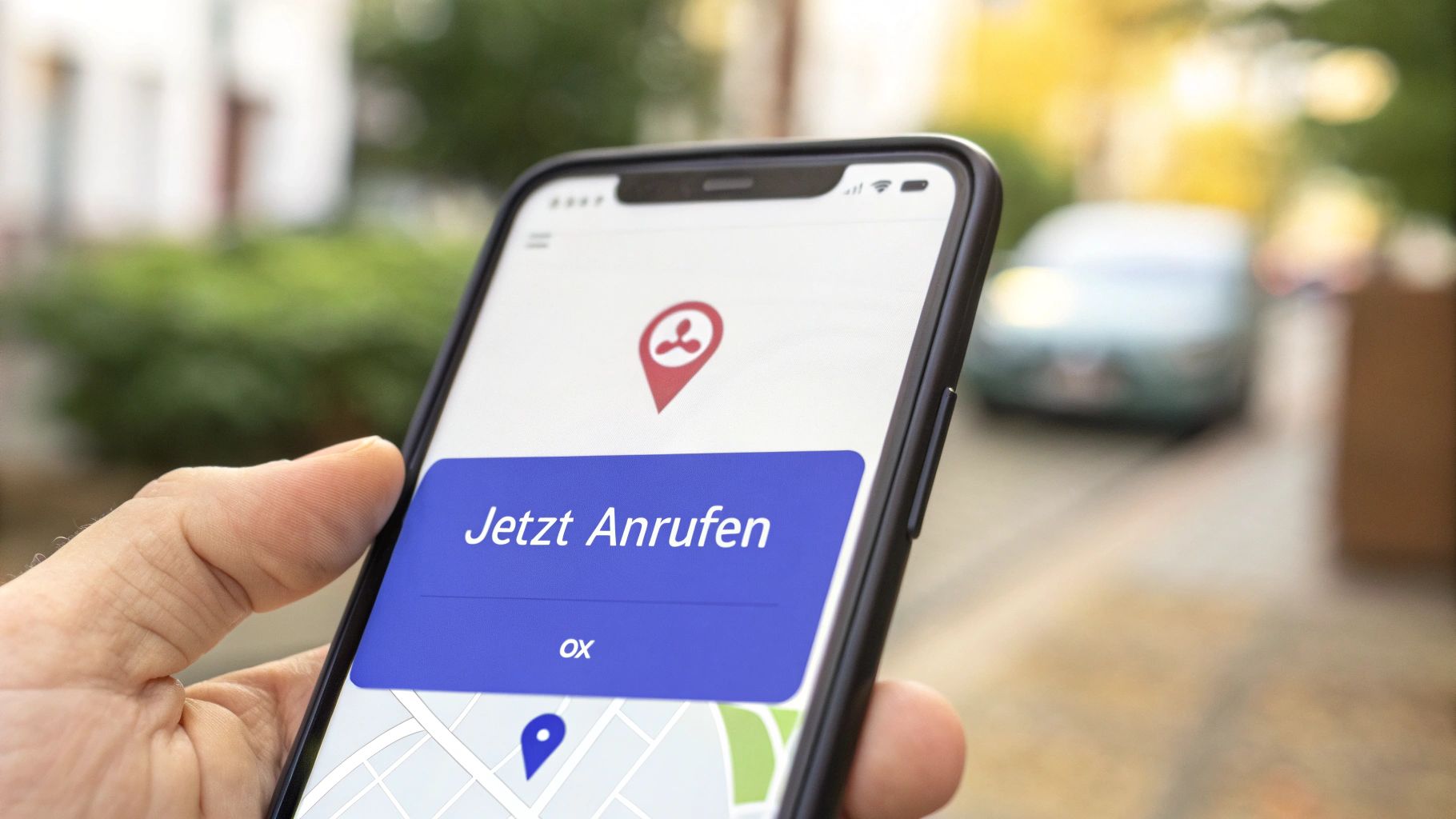
- Design for the thumb: Place important interactive elements, such as call buttons, in an easy-to-reach area of the screen.
- Simplify calls to action: Reduce form fields to a minimum and place buttons such as “Call now” prominently.
9. Follow a local backlink strategy
A targeted local backlink strategy focuses on the local relevance and authority of the referring pages. A link from the local IHK website or a well-known local blog is a strong signal that your company is a trustworthy part of the community.
Why this strategy works
Google rates links as recommendations. A link from a relevant, local source strengthens the “visibility” (prominence) of your company, one of the three central ranking factors in the Local Pack.
Implementation costs and typical errors
- Expense: Up. Building relationships and actively seeking links takes time and commitment.
- Use local partnerships: Sponsor local associations or events to get a link.
- Industry associations: Join organizations such as the Chamber of Industry and Commerce to get an entry in the membership directory.
- Reach out to local press: Inform local media about special events, such as a new opening.
10. Actively use Google Posts
The “Posts” (Google Posts) feature in your GBP is a powerful tool within local SEO strategies. They allow you to publish current content, such as offers or events, directly in your GBP listing.
Why this strategy works
Regular posts generate activity signals directly within the Google ecosystem. Every click and interaction shows Google that your business is of interest to users. This can positively influence your ranking and increases the conversion rate through clear calls to action.
Implementation costs and typical errors
- Expense: Low. One post per week can be created quickly.
- Regularity is key: Publish at least one post per week
- Use visual appeal: Only use high-quality images or short videos.
- Integrate clear calls to action (CTAs): Use the CTA buttons provided by Google, such as “Call” or “Book Now.”
Strategic recommendations for sustainable local success
Getting to the top of local search results is not a one-time project, but a continuous process. Start with the actions that have the most impact and require the least resources.
Summary and next steps:
- Create a foundation: Fully optimize your Google Business Profile This is the most important and effective individual measure.
- Ensuring consistency: Check and correct your NAP data (name, address, telephone) in all important online directories.
- Build trust: Implement a process to actively and regularly collect and respond to customer reviews.
Local SEO is a marathon, not a sprint. Continuous maintenance and adjustment are crucial to keep the competition at bay in the long term. The time and effort you put into this today local SEO strategies invest, pay off in the long term through new customer inquiries, shop visits and phone calls.
If you don't want to manage this process alone, but are looking for a specialized partner who takes on the complexity for you, SocialEdge the solution. We analyse your potential, set the most important levers in motion and provide you with a decisive competitive advantage through our exclusive sector protection per postal code. Start now and turn your local visibility into measurable success with SocialEdge.