How AI is changing local search
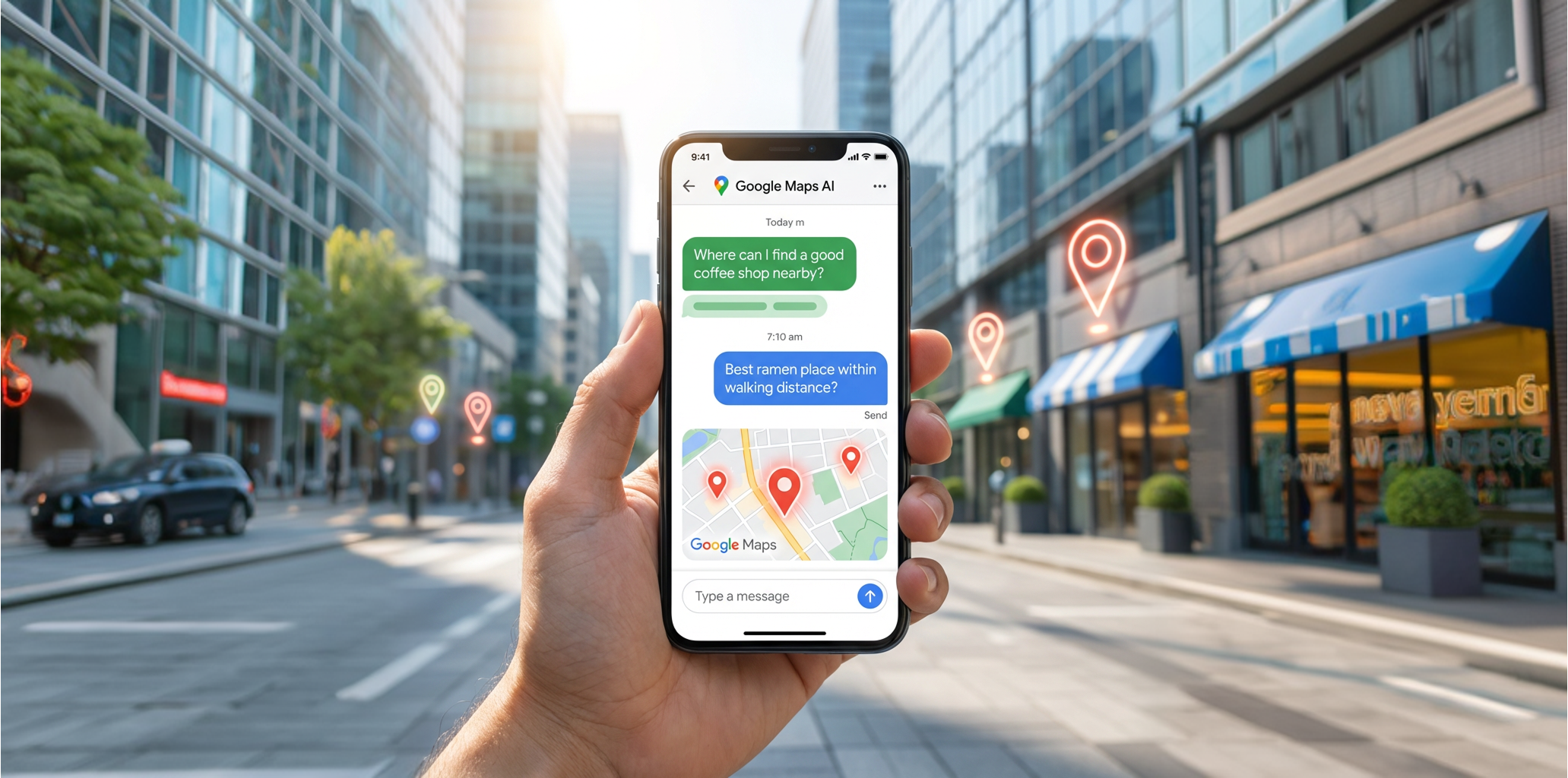
The days when customers rummaged through industry directories are gone. Today, users expect immediate, tailored recommendations on their smartphones — whether it's a restaurant for the evening or a plumber in case of an emergency.
This is exactly where AI comes in. Large language models such as ChatGPT, Gemini or Claude are increasingly acting as personal assistants and are changing how we find and get recommended local companies. A simple keyword search is often no longer enough.
Instead, these systems evaluate a complex network of local signals:
- Feedback culture: How up to date are the reviews? And, more importantly, how quickly and personally does the company respond to this?
- Real insights: Are there authentic photos of the shop, the products or the team that give a real impression?
- Willingness to dialogue: Are questions answered quickly and competently in the Google company profile?
- Consistent data: Are name, address, and telephone number (NAP) consistent across all online platforms?
From keyword to conversation: How AI recommends local businesses
Traditional local SEO continues to evolve. Keywords remain important, but contextual, conversational search queries are gaining in importance. An AI understands the purpose behind a question such as “Where can I find a child-friendly café with a sun terrace in Bühl? “often better than a traditional search engine.
When users ask AI systems such as ChatGPT, Claude, or Gemini, these models search publicly available online information. They analyse the entirety of a company's digital presence in order to make a recommendation. A company is no longer just found, but actively recommended because its entire digital presence radiates trust and relevance.
A company that impresses with a well-maintained Google company profile, positive and recent reviews, and consistent data is more likely to be recommended by an AI.
Figures confirm this trend: Although organic traffic in Germany is still 46.98 percent of all traffic, it has recently fallen slightly. This underlines the need to rethink your own local SEO strategy. A strong ranking on the Google company profile can promote conversions — often without additional advertising spending. A look at how AI is used in other areas, such as AI in nursing, redefining everyday working life, shows the enormous potential.
This change is an opportunity. Anyone who now learns to optimize their local signals for AI systems can secure a competitive advantage. In our further article, we'll show you how you Combining SEO and AI and adjust your strategy.
Build the foundation for your local AI visibility
Before we take advantage of the opportunities offered by AI, we need to lay the foundations. When searching locally, this foundation is yours Google company profile. It is at the heart of your local digital presence.
AI systems, whether in Google Search or Gemini, need clear, consistent, and trustworthy information to consider your store for a local search query. Any discrepancy, such as an outdated telephone number or incorrect opening hours, can weaken the trust of the algorithm.
The three pillars of your local foundation for AI SEO
At the top of the checklist is the consistency of your NAP data (name, address, telephone number). These three details must be the same on your website, in your Google profile, and in all other online directories. Even a small deviation such as “street” instead of “street” can be interpreted as a negative signal by algorithms.
Next up are the Business categories. It lets you tell the AI what you're doing.
- Your main category: Select the category that best describes your core business. If you run a pizzeria, the main category is “pizzeria,” not just “restaurant.”
- Additional categories: Use this to specify your offer. For example, the pizzeria could add “Italian restaurant”, “delivery service” or “restaurant with outdoor terrace.” In this way, you create more points of contact for search queries.
The third pillar is meaningful and optimised company description. This isn't about just filing a list of services. Describe what makes you unique, using terms that your customers would search for, such as “traditional Neapolitan pizza in Bühl” or “certified master plumbing and heating company.”
A carefully maintained Google company profile is the basic requirement for AI-powered search systems to recognize you as a trustworthy local authority.
More than just text: visual signals and data consistency
High-quality, authentic photos and videos are important ranking factors. They not only give potential customers insight, but also provide AI with valuable context. Show pictures of your space, your team at work, or your products. The AI analyses these images and thus better understands whether your business is relevant to the search query. Detailed tips on how to set up your profile correctly can be found in our guide on the topic Create a Google business profile.
A look at the figures shows the relevance: In Germany, almost nine out of ten search queries are carried out via Google. When you consider that over 54 percent of all web traffic in the DACH region comes from organic search, it becomes clear what is at stake. The “Whitespark Local Search Ranking Factors Report” shows that website content (24%) and reviews (16%) are leading, but right after that comes the optimization of the Google company profile (12%) as a fundamental lever.
This basic work is the basis for everything else. Only when this foundation is complete and maintained can you use the potential of AI for your local growth.
A smart content strategy for your company profile
A Google company profile is more than just a digital business card. When it's not being actively used, you're giving away valuable potential. Activity is an important relevance signal for Google. Regular, useful content shows both the search engine and your potential customers that your business is active.
This is exactly where AI tools such as ChatGPT, Gemini or Claude. You can turn this process from a mandatory task into a strategic advantage.
Instead of posting untargeted, these tools help you develop a well-thought-out content strategy that's tailored to your local audience. You can systematically find topics that interest your customers.
The following infographic summarizes the three pillars that form the foundation for your local visibility and any content strategy.
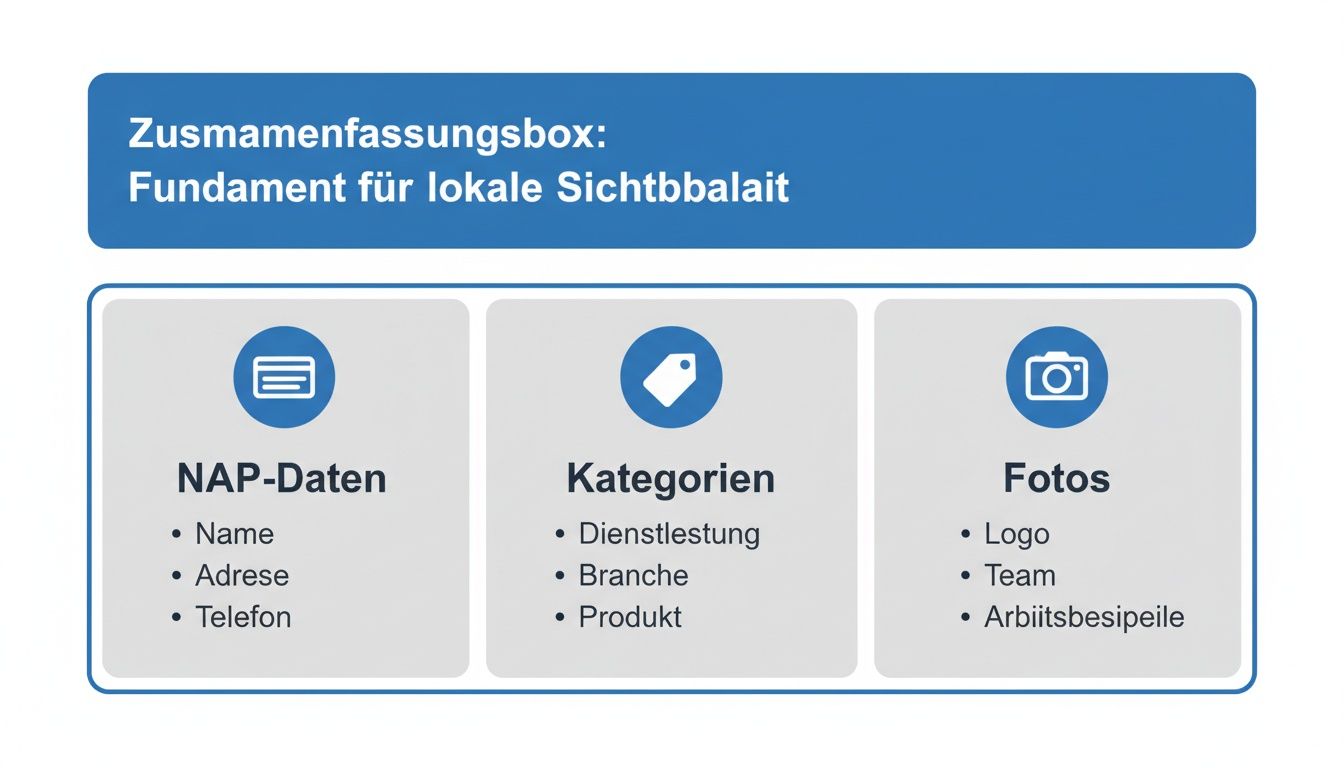
Only when these basics are right — i.e. consistent NAP data, the right categories, and authentic photos — can your content be fully effective.
An editorial plan with AI: The example of a local gym
Let's imagine a small gym in Bühl that wants to be more visible in local searches. A common hurdle is the regular production of fresh and relevant content. AI can act as a source of ideas here.
A well-formulated prompt is crucial:
“Create an editorial plan for 4 Google posts for a local gym in Bühl. The target group is professionals between 30 and 50 who are looking for a balance to everyday office life. The topics should address typical questions from this target group and use local keywords such as 'Fitness Bühl' or 'back training. ' Give me a headline, a short description, and a clear call-to-action for each post. ”
The result is not a dry list, but an actionable strategy:
- Post 1: Event — “Open house: Try out our new back training in Bühl! ”
- Post 2: Offer — “Exclusively for professionals: 10% discount on your first 10-card. ”
- Article 3: Info — “3 simple exercises for neck pain at a desk. ”
- Post 4: News — “We have new opening hours in the morning — ideal before work! ”
Each of these posts appeals to the target group and integrates important local search terms. This type of AI SEO optimization ensures that your posts not only exist but are also found.
This table compares common AI models in terms of their suitability for creating local SEO content to help you choose the right tool.
Comparing AI tools for content creation
AI tool strengths for local SEOpossible weaknessIdeal forChatGPT (GPT-4)Very creative, strong in creating editorial plans and diverse text formats. Requires precise prompts to avoid generic answers. Brainstorm content ideas, create social media posts, and answer customer questions.Google GeminiWell integrated into the Google ecosystem, often understands the search context and local nuances well. Sometimes less creative than GPT-4 when it comes to pure text drafts.Keyword research, creation of FAQ sections and optimization of company descriptions.claudeKnown for natural-sounding language and the ability to maintain a consistent tone of voice. Can reach its limits on very specific, niche local topics. Create longer, informative posts and formulate authentic customer responses.
Each tool has its own characteristics. It's a good idea to try out which model provides the best results for your specific needs. Ultimately, it's about speeding up the process without sacrificing quality.
Use the “Questions & Answers” section strategically
The “questions & answers” section in your profile is an often unused resource for local SEO. The advantage is that you can proactively ask your customers' most frequent questions yourself and answer them directly. This gives you control over the information and is a good place to place important keywords.
Let AI do the groundwork. A prompt could look like this:
“List the 10 most common questions customers have about a gym. Think of topics such as contract periods, trial training, course offerings and trainer qualifications. ”
With the list generated in this way, you can strategically fill your profile. Answer questions such as “Do you offer flexible memberships without a long contract period? ” or “Are there special courses for beginners? ”. This not only creates trust, but also provides Google with valuable, structured data about your offering.
From AI design to authentic contribution
A crucial point: See the texts created by AI as drafts, not as a finished product. Human fine-tuning is essential.
AI provides the structure and ideas, but the authenticity and personal touch come from you. Adjust the tone of voice to match your brand, add a personal anecdote, and check that every piece of information about 100% is correct.
This mix of machine efficiency and human expertise makes a content strategy successful. You achieve greater impact with less time and continuously signal to Google that your company is active, relevant and a good answer to local searches. If you want to dive deeper into copywriting with language models, our article provides about ChatGPT for SEO further insights and practical tips.
Reputation management with AI support
Reviews are the currency of trust in local search. They are often the first, unfiltered impression that potential customers get of you — and therefore an important lever for AI SEO optimization. If you actively and professionally manage your reviews, this not only signals relevance to Google, but also strengthens the bond with your customers.
However, the reality is usually different: In the hustle and bustle of everyday life, there is often no time to react quickly and individually to each individual assessment. AI can be a valuable aid here, not only speeding up your reputation management, but also improving the quality of your reputation management.
Personalized answers in less time
The biggest challenge when responding to reviews is not sounding like a robot. Pre-written answers seem impersonal. AI models such as ChatGPT or Claude can help you create bespoke designs.
A proven workflow looks like this:
- Give context: Copy the customer's original review into the AI
- Add information: Give the AI key points about your company and the desired tone of voice (e.g. “friendly & professional, owner-managed restaurant in Bühl”).
- Generate draft: Ask the AI to formulate a personalized and authentic answer based on this information.
A simple prompt for this could look like this:
“Write a friendly and personal response to this 5-star review for our Italian restaurant. The customer praises the 'homemade pasta' and the 'attentive service. ' Be specific, say thanks and invite him to try our new seasonal dishes next time. ”
The result is an answer that responds to customer feedback and provides added value — in a fraction of the time you would need manually.
Dealing professionally with criticism
Quick and confident action is particularly important when it comes to negative reviews. An unanswered 1-star review may scare off potential new customers. AI helps you to remain objective even in emotional situations and to find a solution-oriented answer.
A practical example:
Before (without AI):
- Rating (1 star): “Long wait, the food was cold. Never again! ”
- Response (stressed & defensive): “We had a lot to do that evening. The food always leaves our kitchen hot. ”
After (with AI support):
- Prompt: “Formulate a professional and empathetic response to this negative review. Apologize for the experience without being defensive and offer a solution, such as contacting us directly so we can make up for it. ”
- AI-powered answer: “Thank you so much for your honest feedback. We are sincerely sorry that your visit to us did not meet your expectations. A long wait and cold food are absolutely not our standard. We would be delighted if you would give us a second chance. Please contact us briefly by e-mail so that we can find a personal solution for you. ”
The difference is obvious. The second answer turns a negative experience into an opportunity to win back the customer and shows others that you take criticism seriously. If you want to dive deeper into the topic: In our article, you will find more tips on how to best Answer Google reviews correctly Can.
Identify patterns from hundreds of reviews
The strength of AI in reputation management lies not only in reacting, but also in analyzing. Companies with many reviews have a wealth of data that they often do not use.
AI tools can search hundreds or thousands of text reviews in a short period of time and uncover recurring patterns. You act like an analyst who gives you insights into your own business.
Imagine being able to get answers to questions like these at the click of a button:
- Which three services are most often praised by customers?
- Are there recurring criticisms, for example about the parking situation or specific products?
- Which employees are mentioned by name for excellent service?
- Are negative comments about waiting time piling up on certain days of the week?
These insights are valuable for optimising your business. You can improve processes in a targeted manner, train employees and tailor your offer better to the needs of your customers. This data-based optimization not only strengthens your customer loyalty, but also sends positive signals to Google and other AI systems.
Optimize visual content with AI

Images are often the first point of contact that a potential customer has with your store. A strong photo can be decisive. However, pictures are more than just decoration — they are an important factor in AI-powered SEO optimization.
Search engines like Google use AI not only to display images, but also to understand their content. This technology, known as image recognition (computer vision), analyses what's in your photos and matches that information with users' searches.
How Google “reads” your images
Imagine uploading a photo showing the sunny terrace of your café in Bühl. Google's AI recognizes just that: a patio, chairs, tables, maybe even a coffee cup. If someone searches for “Café mit Sonnenterrasse in Bühl,” the relevance of your profile increases because your pictures visually confirm this request. The AI therefore reads your photos almost like text and draws ranking signals from them.
For you, this means that your images must not only look good, but also be strategically selected. Show the aspects of your business that your customers are looking for.
- A dentist? Present pictures of a modern, barrier-free practice.
- A handyman? Show before and after pictures of a project.
- A restaurant? Attract with shots of the most popular dishes or the ambiance.
These visual documents strengthen the textual information in your profile and create a coherent overall picture, which is rated positively by algorithms.
AI as your personal image optimizer
AI can help you not only with the selection of motifs, but also with the technical preparation for search engines. A major hurdle is often the correct tagging and enriching the images with metadata. What is time-consuming manually becomes easier with AI.
Modern AI tools analyze your photos and automatically suggest appropriate, SEO-relevant descriptions and tags. Instead of just uploading a file called “Foto1.jpg,” the AI helps you to formulate meaningful file names and alt texts.
An image named as “moderne-kueche-eiche-massivholz-schreinerei-buehl.jpg” sends a stronger signal to Google than a generic file. AI can automate this process and ensure that no potential is wasted.
Another crucial point is the Geotags. These are coordinates contained in the image data that reveal the recording location — this is a strong signal for local SEO.
Geotagging and metadata management made easy
AI-based tools can automate or simplify this process. When you ensure that your photos include the correct geodata of your location, you're providing Google with proof of your local presence. This strengthens the connection between your company and the local area and can improve your visibility in regional searches.
The difference between manual and AI-based image optimization is clear here:
TaskManual optimizationAI-supported optimizationfilenamesOften generic (e.g. IMG_1234.jpg) Automatic creation of relevant, keyword-rich namesalt textsTime-consuming and often forgottenSuggestions based on image content save timetaggingUsually limited to a few, obvious termsGenerates detailed, thematically appropriate tags (e.g. “parasol”, “wooden table”)geotaggingRequires specialized software and manual inputCan be added or verified automatically
The strategic selection and technical optimization of your images is a key lever for your success. With AI support, you can turn your images into strong allies in the competition for the top positions in local search. If you're wondering which mobile apps can help you do that, you'll find useful information in our overview of the best SEO apps for on the go.
Frequently asked questions about AI in local SEO
Here we answer some of the most common questions about AI and local SEO.
How do AI chatbots like ChatGPT decide which local company to recommend?
AI chatbots such as ChatGPT, Gemini or Claude search publicly available online information to find an answer. For local companies, this means that the AI pays attention to the same signals that are also relevant for classic Google searches. A recommendation is the result of the entire digital presence.
Send a strong signal with a well-maintained Google company profile, many current and positive reviews, and regular contributions. The AI bundles this information and suggests your company when a suitable request such as “Find a reliable plumber in Bühl” is made.
Can an AI differentiate between a good and a bad service provider?
Yes, but she does it her way. An AI assesses quality based on digital traces. In their opinion, a “good” service provider is a company that has many detailed, positive reviews and reacts quickly to customer feedback. Fresh, professional photos and an active online presence are also positive signals.
A “bad” service provider is more likely to collect negative comments, have outdated information online or an inactive profile. The AI assesses the quality and quantity of data and customer testimonials that it finds about you online.
Can the AI do all of my local SEO work?
No AI is a powerful tool, but it doesn't replace a well-thought-out strategy or human expertise. She is an assistant but not an autopilot.
Think of AI as a co-pilot: It does tasks such as designing posts, analyzing customer reviews, or finding ideas for new content. Strategic direction, understanding of your local market and a personal touch in communication remain human tasks.
AI-powered SEO works best when human strategy and machine efficiency work together.
Is it allowed to use AI for Google posts or responses to reviews?
Yes Many companies are already using AI support to create content. The quality of the result is decisive. What counts for Google is that the content is useful, relevant, and honest.
Machine-generated spam is quickly detected. Every text created by an AI should be reviewed, refined and adapted to the tone of your brand by a human. An authentic, individual response to customer feedback is particularly important when responding to reviews. In addition to these specific questions, you will also find general frequently asked questions about the services offered by Nova360.
Summary and Your Next Step
Die AI SEO optimization offers local companies new opportunities to improve their visibility. The key lies in a solid foundation — a fully maintained Google company profile with consistent data (NAP), the right categories, and high-quality images. Building on this, AI can serve as a tool to create relevant content, improve reputation management through quick and personal answers, and optimize visual elements. AI systems such as ChatGPT or Gemini recommend companies based on the strength of these digital signals. Authenticity and human control remain crucial to building trust with customers and search engines.
Start optimizing your local presence for AI-powered search now. The first step is an analysis of your current status in order to derive targeted measures.